
Closing Costs in Washington DC: 2026 Buyer Guide to Taxes, Fees and Savings
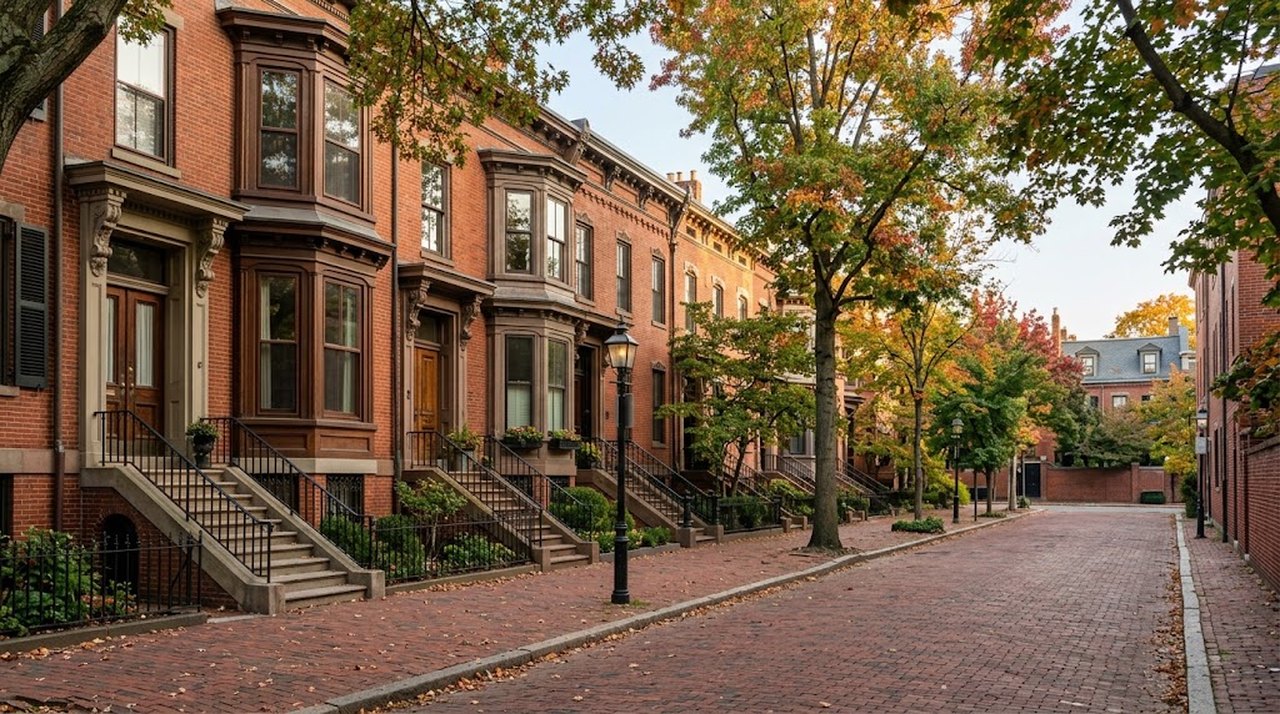
In DC, one line dominates a buyer’s closing costs: the recordation tax. First-time buyers may pay half.
Short answer: the largest DC-specific closing cost for a buyer is the deed recordation tax: 1.1 percent of the price on homes under $400,000 and 1.45 percent of the entire price at $400,000 or more. On a $650,000 home that is $9,425. Eligible first-time DC buyers pay 0.725 percent instead ($4,712.50) on homes up to $794,000, and a lower-income program can remove the tax entirely. Lender, title and prepaid costs come on top and vary by loan, so use your Loan Estimate for the full figure.
By Ken Byrne, NMLS #187129 · ALCOVA Mortgage LLC, NMLS #40508 · Updated October 2026
Closing costs in the District follow rules you will not find in Virginia or Maryland: a recordation tax with a cliff at $400,000, a reduced rate for first-time buyers with limits that changed on October 1, 2026, and separate rates for co-ops. This guide sets out what the District charges, what your lender and title company charge, and the programs that lower the bill, with each figure tied to a named source. For numbers on a specific home, talk to the Ken Byrne Team at JB Financing.
What closing costs include in DC
The Consumer Financial Protection Bureau describes closing costs as the fees paid to complete the transaction, such as appraisal fees, title insurance, government taxes and prepaid expenses like property taxes, homeowners insurance and interest. There is no official percentage for DC. The total depends on the price, the loan and the date you close.
| Group | Examples | Who sets it |
|---|---|---|
| District taxes and recording fees | Recordation tax, recording fees | DC law; the same with every lender |
| Lender charges | Origination or points, appraisal, credit report | Your lender; compare Loan Estimates |
| Title and settlement | Title search, lender’s and owner’s title insurance, settlement fee | Title company; you may choose your own |
| Prepaid items and escrow | Homeowners insurance, daily interest to month end, property tax reserves | Your loan terms and closing date |
| Loan program fees | FHA upfront premium, VA funding fee | Federal program rules |
CFPB, What fees or charges are paid when closing on a mortgage (reviewed September 11, 2024); DC Department of Insurance, Securities and Banking.
Your lender must send a Loan Estimate within three business days of your application and a Closing Disclosure at least three business days before closing. How to read the first one is in our guide to the Loan Estimate.
DC recordation tax and transfer tax
DC charges two taxes of the same size when a home sells. By custom the buyer pays the recordation tax and the seller pays the transfer tax, and the sales contract sets the split. The law puts the transfer tax on the seller and makes both parties liable for the recordation tax.
| Sale price | Recordation tax (buyer, by custom) | Transfer tax (seller) |
|---|---|---|
| Under $400,000 | 1.1% of the price | 1.1% of the price |
| $400,000 or more | 1.45% of the entire price | 1.45% of the entire price |
D.C. Code 42-1103 and 47-903; DC Office of Tax and Revenue, Recorder of Deeds FAQs.
The higher rate is not marginal. At $399,999 the recordation tax is $4,399.99; at $400,000 it is $5,800. One more dollar of price adds about $1,400 for the buyer and the same for the seller, which is worth knowing when you negotiate near that line.
| Purchase price | Standard recordation tax | First-time buyer rate (0.725%) | Saving |
|---|---|---|---|
| $500,000 | $7,250 | $3,625 | $3,625 |
| $650,000 | $9,425 | $4,712.50 | $4,712.50 |
| $750,000 | $10,875 | $5,437.50 | $5,437.50 |
| $1,000,000 | $14,500 | Not eligible: above the $794,000 ceiling | None |
Calculated from the rates above. Houses and condominium units; co-ops are taxed differently.
How this compares across the river is in our guide to closing costs in Virginia.
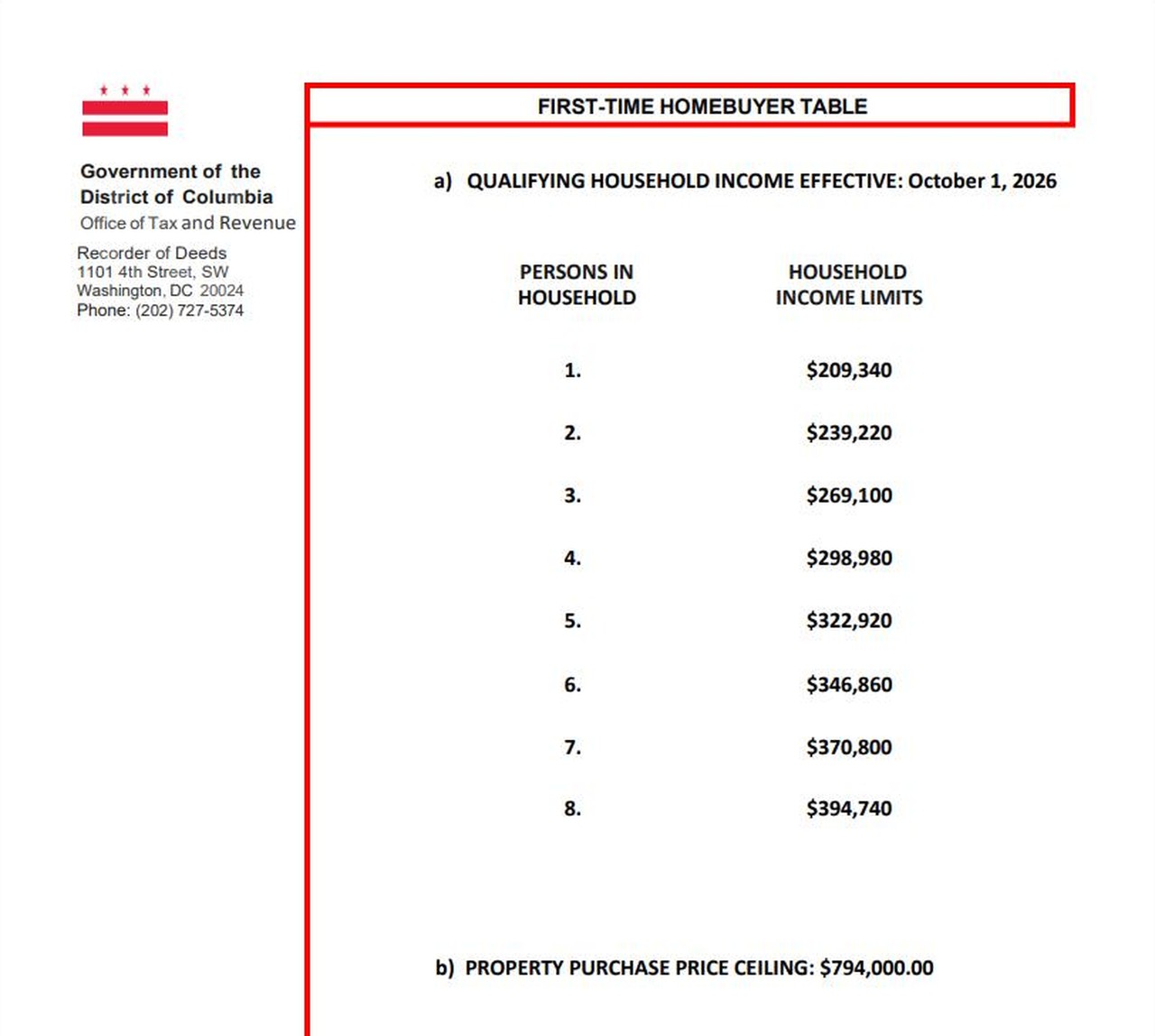
Form ROD 11, revised October 2026, lists the price ceiling and income limits for the first-time buyer rate. Source: DC Office of Tax and Revenue.
DC first-time homebuyer recordation tax: the 0.725 percent rate
Eligible first-time District homebuyers pay a recordation tax of 0.725 percent on a house or condo instead of 1.1 or 1.45 percent. The price ceiling and income limits are adjusted every October 1.
| Requirement | Rule for deeds recorded from October 1, 2026 |
|---|---|
| Purchase price | $794,000 or less (it was $777,000 the year before) |
| First-time buyer | You have never owned a DC home that qualified for the homestead deduction. This is not the three-year test other programs use |
| Residency and use | You are a District resident and the home will be your principal residence, qualifying for the homestead deduction |
| Household income | Within the limits below |
| How to claim | File Form ROD 11 when the deed is recorded. The reduced rate cannot be applied for after recording |
| Household size | Income limit | Household size | Income limit |
|---|---|---|---|
| 1 | $209,340 | 5 | $322,920 |
| 2 | $239,220 | 6 | $346,860 |
| 3 | $269,100 | 7 | $370,800 |
| 4 | $298,980 | 8 | $394,740 |
DC Office of Tax and Revenue, Form ROD 11 (Rev. 10/2026); D.C. Code 42-1101 and 42-1103(e). The form requires the Closing Disclosure, a homestead deduction application and federal tax returns for the household.
The whole benefit goes to the buyer; the seller’s transfer tax does not change. Your settlement company normally files the form with the deed, so tell them early that you intend to claim it. Other first-time buyer help in the region is in our first-time homebuyer guide.
DC Tax Abatement Program for lower-income buyers
The Lower Income Homeownership Exemption Program goes further. A qualifying household pays no recordation tax, receives a credit from the seller equal to the transfer tax that would have been due, and has its property tax abated for up to five years while it lives in the home.
| Requirement | Limit for fiscal year 2027 (from October 1, 2026) |
|---|---|
| Purchase price | $591,200 or less |
| Income, 1 person | $89,760 |
| Income, 2 people | $102,540 |
| Income, 3 people | $115,380 |
| Income, 4 people | $128,160 |
| Use | Owner-occupied principal residence |
D.C. Code 47-3502 and 47-3503; DC Office of Tax and Revenue, Form ROD 9 (Rev. 10/2026). Higher income limits apply in economic development zones. Larger households have higher limits.
On a $500,000 purchase that is $7,250 of recordation tax not paid plus a $7,250 credit, before the property tax abatement. Apply on Form FP-420, filed with the Recorder of Deeds; Form ROD 9 lists the limits and documents. The property tax abatement starts the October 1 after your deed is recorded.

Get a Mortgage Estimate for Free
See your monthly payment and estimated cash to close on a DC home.
✓Free, no obligation✓Licensed in VA, MD, DC and WV✓Loan officer Ken Byrne, NMLS #187129
Is there a tax on the mortgage itself?
Usually not on a home purchase. DC exempts a purchase money deed of trust that is recorded with the deed, and it exempts security instruments on residential property with five or fewer units when the owner signs the required affidavit. Maryland also exempts a purchase money deed of trust. Virginia does not: it taxes the deed of trust at 25 cents per $100 of the loan amount, plus a local tax where one is levied. See our guide to closing costs in Maryland.
| Recording fee | Amount |
|---|---|
| Deed | $30, including the $5 surcharge |
| Deed of trust | $150 to $155; OTR’s pages differ on whether the $5 surcharge is included |
| Late recording, more than 30 days after signing | $250 per deed |
D.C. Code 42-1102(5) and (21); DC Office of Tax and Revenue, General Recording Requirements and Fees, and Tax Notice 2024-01.
Buying a co-op
A co-op sale is taxed as a transfer of an economic interest, at different rates: 2.2 percent under $400,000 and 2.9 percent at $400,000 or more, reduced to 1.825 and 2.175 percent for eligible first-time buyers. There is no separate transfer tax on a co-op sale, so this one tax takes the place of both. On a $500,000 unit it totals $14,500, or $10,875 at the first-time rate. The law makes buyer and seller jointly liable and the contract sets who pays what, so ask your settlement company how it is split and calculated for your building.
D.C. Code 42-1102.02; Form ROD 11 (Rev. 10/2026).
Property tax and prepaid items
DC taxes residential property at $0.85 per $100 of assessed value. For an owner-occupied home, the homestead deduction takes $91,950 off the assessed value for tax year 2026, a saving of $781.58 a year; the amount for the tax year that began October 1, 2026 had not been posted when we checked. Bills are due March 31 and September 15.
| Assessed value | Yearly tax with the homestead deduction | Without it |
|---|---|---|
| $500,000 | $3,468 | $4,250 |
| $650,000 | $4,743 | $5,525 |
| $750,000 | $5,593 | $6,375 |
| $1,000,000 | $7,718 | $8,500 |
DC Office of Tax and Revenue, real property tax rates and relief pages. Assumes the assessed value equals the price; assessments often differ. For homes with one or two units, assessed value above $2.558 million is taxed at $1.00 per $100.
At closing you prepay some costs: the first year of homeowners insurance, interest from your closing date to the end of the month, and reserves for your escrow account. On a $520,000 loan at 7.28 percent (Freddie Mac’s 30-year average on October 1, 2026, used as an illustration, not a quote), interest runs about $104 a day, so closing 15 days before month end means about $1,556. The seller and buyer also settle property taxes for the days each owned the home. Reserves are explained in our escrow account guide.
Title insurance and settlement in DC
| Point | What DC rules say |
|---|---|
| Rates | Title insurers must file their rates and forms with the Department of Insurance, Securities and Banking and have them approved |
| Two policies | A lender’s policy protects only the lender; an owner’s policy protects you |
| Payment | A one-time charge at closing |
| Your choice | You have the right to select your title company and are not required to use the one your agent recommends |
| Funds | The settlement agent must record and disburse within one business day of settlement |
DC Department of Insurance, Securities and Banking, Title Insurance and the Settlement Process; D.C. Code 31-5031.17 and 42-2405.
Filed rates differ from one underwriter to another, and settlement fees differ from one company to another, so compare both. Ask for a written quote; your Loan Estimate lists these services under the costs you can shop for.
Get Pre-Approved Today
Get pre-approved and receive a Loan Estimate that itemizes your DC closing costs.
✓Free, no obligation✓Licensed in VA, MD, DC and WV✓Loan officer Ken Byrne, NMLS #187129
Costs that depend on your loan
| Loan type | Upfront program charge | Most the seller may contribute |
|---|---|---|
| Conventional, more than 90% loan-to-value | None | 3% of the lower of the price or appraised value |
| Conventional, 75.01% to 90% | None | 6% |
| Conventional, 75% or less | None | 9% |
| FHA | Upfront mortgage insurance premium of 1.75% of the loan; $10,977 on a $650,000 home with 3.5% down | 6% |
| VA | Funding fee of 2.15% for first use with no down payment, unless exempt; $13,975 on $650,000 | Closing costs, plus concessions up to 4% of value |
Fannie Mae Selling Guide B3-4.1-02; HUD Mortgagee Letter 2023-05 and Handbook 4000.1; VA.gov. Seller contributions can cover closing costs and prepaid items, not the down payment. FHA and VA charges can be financed.
Who is exempt from the VA charge, and how to lower it, is in our VA funding fee guide.
DC programs that help with closing costs
| Program | What it offers | Who it is for |
|---|---|---|
| Home Purchase Assistance Program (HPAP) | Up to $202,000 in gap financing plus an additional $4,000 for closing costs | First-time buyers within income limits, buying a primary home in DC |
| DC Open Doors | A first mortgage with an optional down payment assistance loan at 0% and no monthly payments, repaid when you sell, refinance, move out or reach 30 years | First-time and repeat buyers within the agency’s income limit; minimum credit score 640; through a participating lender |
| Employer-Assisted Housing Program and DC4ME | EAHP: down payment and closing cost assistance from DHCD, subject to funding. DC4ME: a reduced-rate first mortgage from the DC Housing Finance Agency with optional down payment assistance | Eligible District government employees |
DC Department of Housing and Community Development; DC Housing Finance Agency. HPAP is first come, first served and subject to funding. DHCD’s page had not been updated for the fiscal year that began October 1, 2026 when we checked, so confirm availability with DHCD before you rely on it.
These programs have their own lender lists and rules, so confirm that your lender participates before you rely on one. More on buying in the District is on our Washington, DC home loans page.
DC-specific steps that can affect closing
| Item | What to know |
|---|---|
| Tenant-occupied homes | Single-family homes are generally exempt from the Tenant Opportunity to Purchase Act, but the owner must still give a tenant written notice of an offer. A 2025 law added exemptions for some two-to-four unit buildings |
| Condo resale certificate | The seller must deliver it within 10 business days of the contract, and you may cancel within 3 business days of receiving it |
| Seller disclosure | The seller must give a property disclosure statement before or when you sign the contract |
| Water and sewer | Unpaid charges can become a lien once DC Water files a certificate of delinquency; the title company submits the ownership change to DC Water |
D.C. Code 42-3404.09, 42-1904.11, 42-1302 and 34-2407.02; D.C. Law 26-80; DC Water. Ask your title company or attorney how these apply to your contract.
What homes cost in DC right now
| Measure | Figure | Source and date |
|---|---|---|
| Typical home value | $570,135, about 1% lower than a year earlier | Zillow Home Value Index, August 31, 2026 |
| Median sale price | $684,297 | Redfin, three months ending August 2026 |
| Conforming loan limit, one unit | $1,249,125 | Federal Housing Finance Agency, 2026 |
The two price measures differ because one estimates the value of a typical home and the other reports closed sales.
LodeStar’s analysis of 2025 purchase quotes, reported by HousingWire in June 2026, ranked DC the most expensive market in the country in dollar terms for title, settlement, recording and transfer charges, even after a 21.1 percent drop from the year before. LodeStar points to transfer taxes as the main driver in high-cost jurisdictions, which is why the first-time buyer rate and the abatement program are worth checking.
Frequently asked questions
How much are closing costs in DC?
There is no official percentage. The fixed part is the recordation tax: 1.1 percent under $400,000 and 1.45 percent at $400,000 or more, so $9,425 on a $650,000 home. Lender, title and prepaid costs are added and appear on your Loan Estimate.
What is the DC recordation tax?
A tax on recording the deed: 1.1 percent of the price for homes under $400,000 and 1.45 percent of the entire price at $400,000 or more. By custom the buyer pays it.
What is the DC transfer tax and who pays it?
It is charged at the same rates as the recordation tax, and DC law places it on the seller.
What is the first-time homebuyer recordation tax rate in DC?
0.725 percent, for buyers who have never owned a DC home with the homestead deduction, on homes priced at $794,000 or less, with household income within limits that start at $209,340 for one person.
What is the DC Tax Abatement Program?
A program for lower-income buyers of homes priced at $591,200 or less. It removes the recordation tax, credits the seller’s transfer tax to the buyer and abates property tax for up to five years.
Does DC charge recordation tax on the mortgage?
Not on a typical home purchase. A purchase money deed of trust recorded with the deed is exempt, as are security instruments on residential property with five or fewer units when the owner signs the required affidavit.
Can the seller pay my closing costs in DC?
Yes, if the seller agrees, within loan limits: 3, 6 or 9 percent of the price on a conventional loan depending on your down payment, and 6 percent on FHA. VA allows the seller to pay closing costs plus concessions up to 4 percent.
How much does HPAP give for closing costs?
DHCD lists up to $4,000 in closing cost assistance, on top of up to $202,000 in gap financing, for eligible first-time buyers. Funding is limited, so confirm availability with DHCD.
What is the property tax rate in DC?
$0.85 per $100 of assessed value for residential property. Owner-occupants can subtract the homestead deduction of $91,950 for tax year 2026.
Next stepStart Your Pre-Approval
Start online, and Ken Byrne’s team will walk through your DC closing costs line by line.
✓Free, no obligation✓Licensed in VA, MD, DC and WV✓Loan officer Ken Byrne, NMLS #187129
This article is general information, not financial or legal advice and not a commitment to lend or an offer of credit. Loan limits, program rules, premium schedules and rates change, and individual eligibility depends on a full review of your credit, income, assets and the property. Every figure here is an illustration, not a quote, built from published sources and a weekly survey average rather than underwriting decisions. Insurance and mortgage insurance amounts are planning estimates. Confirm anything you plan to act on with a licensed mortgage professional. DC tax rates, forms and program terms were checked against District sources on October 5, 2026. Program funding and limits change. This is not tax or legal advice.
Categories
Recent Posts







GET MORE INFORMATION

Broker Associate