
Mortgage Loan Documents Checklist 2026: What Lenders Ask For and Why

In our experience, many underwriting delays are not about credit or income but about a document that is missing, out of date or does not explain itself.
Short answer: for most buyers the core mortgage loan documents are a photo ID, your most recent paystub, your last one or two years of W-2s, two full months of statements for every account you will use for the down payment and closing costs, and a signed IRS Form 4506-C. Self-employed borrowers add tax returns, gift funds need a gift letter, and VA buyers need a Certificate of Eligibility. The part most checklists leave out is that each document has a rule behind it: paystubs must be recent, purchase statements must cover a full 60 days, and every credit document goes stale four months after it is dated.
By Ken Byrne, NMLS #187129 · ALCOVA Mortgage LLC, NMLS #40508 · Updated September 2026
A mortgage checklist is only useful if you know why each item is on it. Lenders are not collecting paperwork for its own sake: each document answers a specific underwriting question, and each one has an age limit or a coverage rule set by the agency that will buy or insure the loan. Get the rule right and the document goes through the first time. Get it wrong and you are asked for it again, usually at the worst moment. This guide lists what you will be asked for, by type of borrower, and the rule behind each item, with the rules drawn from the Fannie Mae Selling Guide unless another source is named. If you would rather have someone check your pile before you apply, JB Financing, the Ken Byrne Team at ALCOVA Mortgage will do it.
The mortgage loan documents checklist at a glance
Start here. Everyone needs the first block; the rest depends on how you earn and where your down payment comes from.
| Document | Who needs it | The rule behind it |
|---|---|---|
| Identity documents, usually a government issued photo ID | Every borrower | The lender must collect your name, date of birth, address and an identification number |
| Social Security number | Every borrower | Needed to pull credit; one of the six items that make a loan application |
| Most recent paystub | Salaried and hourly borrowers | Dated no earlier than 30 days before the application, showing year to date earnings |
| W-2 forms | Salaried and hourly borrowers | The most recent one or two years, depending on the income type |
| Bank and investment statements | Anyone using the funds to close | The most recent full two months for a purchase |
| Signed IRS Form 4506-C | Almost every borrower | Lets the lender pull your tax transcripts from the IRS |
| Personal and business tax returns | Self-employed borrowers | Usually two years, sometimes one |
| Gift letter | Anyone using gift funds | Donor details, the amount and a statement that no repayment is expected |
| Certificate of Eligibility | VA borrowers | Proof of VA entitlement, based on service documents |
| Explanation of any large deposit | Purchase borrowers whose statements show one | Required when a single deposit exceeds half your monthly income and the funds are needed |
Fannie Mae Selling Guide sections B3-3.2-01, B3-4.2-01, B3-4.2-02, B3-4.3-04, B3-3.5-01 and B3-3.1-02; 31 CFR 1020.220 on identity; 12 CFR 1026.2(a)(3) on what makes an application; va.gov on the Certificate of Eligibility.
Every credit document has a shelf life. The Selling Guide states that credit documents "must be no more than four months old on the note date." A statement or paystub that was fine when you applied can expire before closing if the purchase drags on, and the lender will ask for a newer one.
When your application officially starts
Under the federal rule that governs mortgage disclosures, an application exists as soon as the lender has six pieces of information, whether or not you have handed over a single document.
| The six items | Why it matters |
|---|---|
| Your name | Identifies the borrower |
| Your income | Starts the ability to repay review |
| Your Social Security number, to obtain a credit report | Lets the lender pull credit |
| The property address | Ties the application to a specific home |
| An estimate of the property’s value | Sets the loan to value |
| The loan amount you are asking for | Sizes the loan |
12 CFR 1026.2(a)(3)(ii), Regulation Z.
Once those six are in, the lender’s clock starts and it must send you a Loan Estimate. The documents in the rest of this checklist come after that, to verify what you have said. What to look for when the Loan Estimate arrives is set out in our guide on how to read a Loan Estimate.
That is also why a quick pre-approval conversation and a full document package are two different stages. You can start with the six items and gather the rest while you shop; our pre-approval guide walks through that order.

“Send me a list of what you have, not the documents themselves yet. I will tell you what is missing, what is likely to be out of date by closing, and what to leave out.”
Arslan Jamil, Broker Associate
Loans originated by Ken Byrne, NMLS ID# 187129 · ALCOVA Mortgage LLC, NMLS ID# 40508. Equal Housing Lender.
Income documents for salaried and hourly borrowers
If you are paid on a W-2, the income package is short, but the dates matter more than most people expect.
| Document | Exact requirement |
|---|---|
| Most recent paystub | Dated no earlier than 30 days before the initial loan application date, and it must include all year to date earnings |
| W-2 forms | Covering the most recent one or two year period, depending on the documentation requirements for that type of income |
| IRS Form 4506-C | Signed at or before closing, so the lender can obtain tax transcripts; exceptions apply when automated underwriting validates the income or transcripts are already in hand |
Fannie Mae Selling Guide B3-3.2-01 on paystubs and W-2s; B3-3.1-02 on tax return and transcript documentation.
The 4506-C is the form people are most often surprised to sign. It does not give the lender your full return; it authorizes a request for a transcript through the IRS Income Verification Express Service, so the income on your application can be checked against what the IRS has on file.
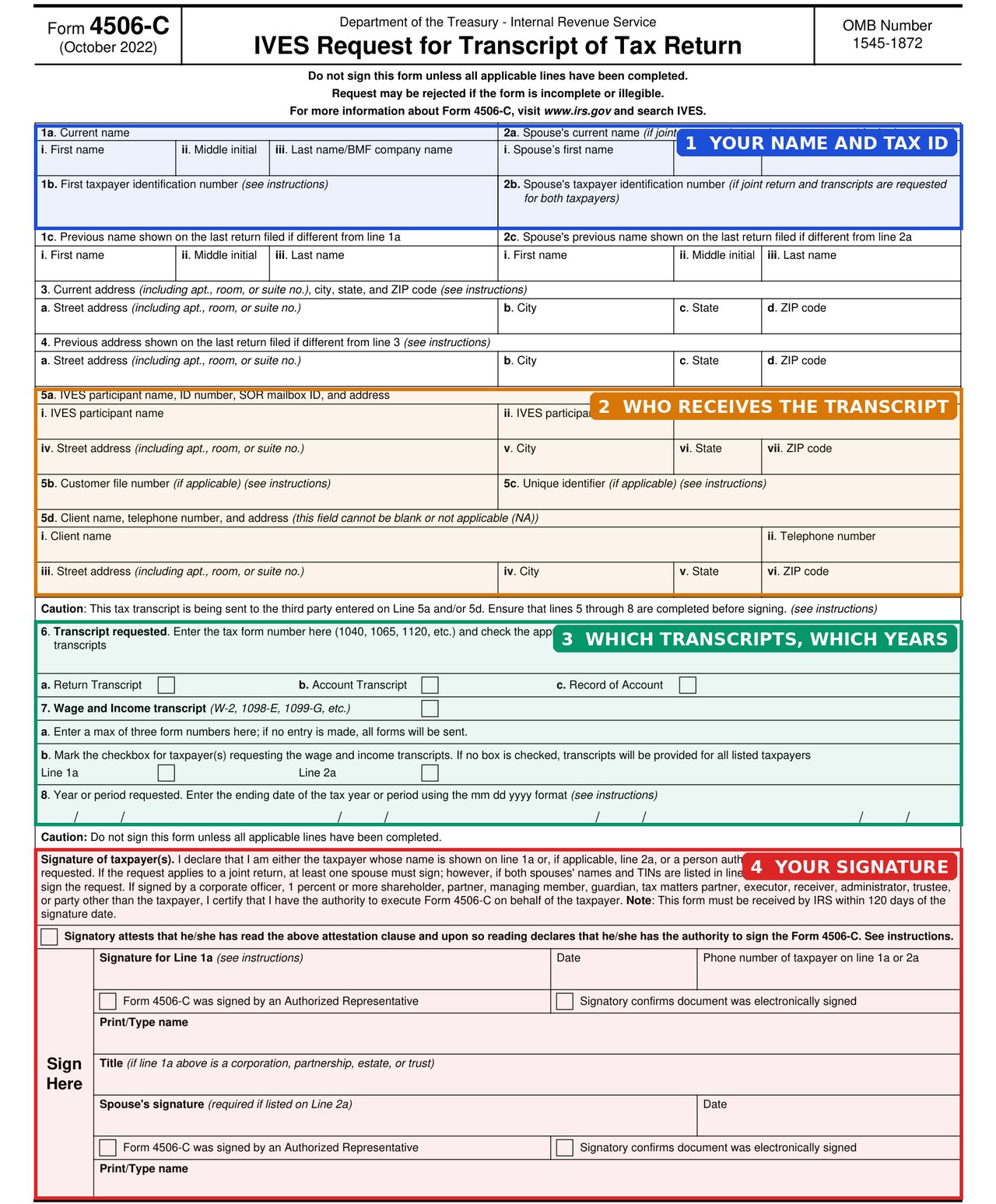
IRS Form 4506-C, October 2022 revision, with its four parts marked: 1, your name and taxpayer ID; 2, the IVES participant and client who receive the transcript; 3, which transcripts and tax years; 4, your signature. The form states it must reach the IRS within 120 days of the signature date. Source: Internal Revenue Service.
Bonus, overtime and commission income can often be counted, and the W-2 requirement is one or two years depending on the income type. How that income is weighed against your debts is covered in our guide to the debt to income ratio.
Self-employed borrowers
Self-employed income is documented with tax returns rather than paystubs, and the question is whether you need one year or two.
| Situation | Returns usually required |
|---|---|
| Standard case | Two years of signed personal returns, and business returns where applicable |
| Business in existence for five years, and you have owned 25 percent or more of it for the past five years consecutively | One year of personal and business returns can be enough |
Fannie Mae Selling Guide B3-3.5-01.
The lender also has to turn those returns into a monthly income figure. Fannie Mae requires a cash flow analysis, commonly on its Form 1084 or an equivalent, which starts from taxable income and adds back certain non cash items. That is why a year with heavy write offs can reduce the mortgage you qualify for. The full picture, including bank statement loans for borrowers whose returns understate their income, is in our self-employed mortgage guide.
Bank statements, assets and large deposits
Asset statements do two jobs: they show that the money for the down payment, closing costs and any required reserves exists, and they show where it came from.
| Rule | What it means in practice |
|---|---|
| Purchase: most recent full two months of statements | Sixty days of activity for each account you will use; lenders typically ask for every page |
| Refinance: most recent month | One statement per account is the standard |
| Automated underwriting may ask for less | When Desktop Underwriter findings specify the documentation, following them satisfies the requirement |
| Large deposit: a single deposit over 50 percent of total monthly qualifying income | On a purchase, it must be sourced if the funds are needed to close or for reserves |
Fannie Mae Selling Guide B3-4.2-01 on verification of deposits and assets, and B3-4.2-02 on depository accounts.
The large deposit rule catches more buyers than any other. Suppose your total monthly qualifying income is $8,000. Any single deposit over $4,000 on a statement you are using for the purchase is a large deposit, and if you need that money to close, you will be asked to show where it came from: a transfer statement from another account, a bill of sale, a bonus paystub, or a gift letter. Transfers between your own accounts are the easiest to document, as long as you provide statements for both.
Stop moving money around before you apply. Every transfer, cash deposit and new account shows up on the statements the lender reads. The simplest file is the one where the down payment has been sitting in one account for the full sixty days. How much you actually need to have saved is set out in our guide to minimum down payments.
Worried about a deposit on your statements?
Arslan Jamil, Broker Associate
Send me the amount and where it came from before you apply. Most large deposits are easy to document if you gather the paper trail now rather than after underwriting asks for it.
Loans originated by Ken Byrne, NMLS ID# 187129 · ALCOVA Mortgage LLC, NMLS ID# 40508. Equal Housing Lender.
Gift funds and the gift letter
Gift money from family is common and fully allowed, but it has to be documented properly or the lender cannot count it.
| The gift letter must include | Who can give the gift |
|---|---|
| The donor’s name, address and telephone number | A relative by blood, marriage, adoption or legal guardianship |
| The donor’s relationship to you | A domestic partner or fiancé |
| The dollar amount of the gift | A former relative |
| A statement that no repayment is expected | Someone with a long standing familial or mentorship type relationship with you |
Fannie Mae Selling Guide B3-4.3-04 on personal gifts. The donor cannot be an interested party to the transaction, such as the seller or the real estate agent.
The lender will also want to see the money move: evidence of the transfer from the donor to you or to the closing agent. Ask your donor to send the funds by a traceable method rather than cash, and keep the confirmation.
VA borrowers and identity documents
VA loans add one document to the standard list: the Certificate of Eligibility, which shows the lender your VA entitlement. What you need to get it depends on your status.
| Status | What VA asks for |
|---|---|
| Veteran | A copy of your discharge or separation papers, DD Form 214 |
| Active duty | A statement of service signed by your commander, adjutant or personnel officer, showing your full name, Social Security number, date of birth, entry date, any lost time and the name of your command |
va.gov, How to request a VA home loan Certificate of Eligibility.
Your lender may be able to request the certificate for you, so you may not need to do it yourself. Eligibility rules by service type are covered in our guide to VA loan eligibility.
Identity documents apply to everyone. Federal customer identification rules require a lender to collect at least your name, date of birth, address and an identification number, which for a U.S. person is a taxpayer identification number. A current government issued photo ID with a name that matches your other documents avoids most identity questions.
Keeping your file clean until closing
The documents you hand over at application are a snapshot. Underwriting will usually check that nothing important has changed before the loan closes, and the four month shelf life means some documents will need refreshing on a longer purchase.
| Do | Avoid |
|---|---|
| Keep paying every account on time | Opening new credit cards or loans |
| Send updated statements and paystubs as soon as they arrive | Large unexplained cash deposits |
| Tell your loan officer early about a job change or bonus | Moving the down payment between accounts |
| Keep copies of everything you send | Co-signing for anyone else |
New credit is a common reason for a re-underwrite, because it can move both your credit score and your debt to income ratio. How much a score change can matter is set out in our guide to the credit score needed to buy a house.
Frequently asked questions
What documents do I need for a mortgage?
Most borrowers need a photo ID, the most recent paystub, one or two years of W-2s, two full months of statements for every account used to close, and a signed IRS Form 4506-C. Self-employed borrowers add tax returns, gift funds need a gift letter, and VA borrowers need a Certificate of Eligibility.
How recent do my paystubs need to be?
Under the Fannie Mae Selling Guide, the most recent paystub must be dated no earlier than 30 days before the initial loan application date and must show year to date earnings.
How many months of bank statements does a lender need?
For a purchase, the most recent full two months, or 60 days, for each account. For a refinance, the most recent month. Automated underwriting findings can sometimes specify less.
What counts as a large deposit on a mortgage application?
A single deposit that exceeds 50 percent of your total monthly qualifying income. On a purchase, you must document where it came from if you need those funds to close or for reserves.
How long are mortgage documents good for?
Credit documents must be no more than four months old on the note date, under the Fannie Mae Selling Guide. If your closing is delayed, expect to send newer statements and paystubs.
Do self-employed borrowers need two years of tax returns?
Usually. One year of personal and business returns can be enough if the business has existed for five years and you have owned 25 percent or more of it for the past five years in a row.
What is IRS Form 4506-C and why do I have to sign it?
It is the IVES Request for Transcript of Tax Return. It lets the lender obtain a transcript of your tax return from the IRS to confirm the income on your application.
What needs to be in a gift letter for a mortgage?
The donor’s name, address, telephone number and relationship to you, the amount of the gift, and a statement that no repayment is expected. The donor cannot be the seller, the agent or anyone else with an interest in the sale.
When does my mortgage application officially start?
As soon as the lender has six pieces of information: your name, income, Social Security number, the property address, an estimate of its value and the loan amount you want. The lender must then send a Loan Estimate.
What do I need for a VA loan Certificate of Eligibility?
Veterans need a copy of their DD Form 214. Active duty service members need a statement of service signed by their commander, adjutant or personnel officer.
“Tell me how you are paid, where your down payment is coming from and when you want to buy. I will send back a checklist built for your file, with the dates each document needs to cover.”
Arslan Jamil, Broker Associate
Loans originated by Ken Byrne, NMLS ID# 187129 · ALCOVA Mortgage LLC, NMLS ID# 40508. Equal Housing Lender.
This article is general information, not financial or legal advice and not a commitment to lend or an offer of credit. Loan limits, program rules, premium schedules and rates change, and individual eligibility depends on a full review of your credit, income, assets and the property. Every figure here is an illustration, not a quote, built from published sources and a weekly survey average rather than underwriting decisions. Insurance and mortgage insurance amounts are planning estimates. Confirm anything you plan to act on with a licensed mortgage professional. Documentation rules are summarized from the Fannie Mae Selling Guide, federal regulations and va.gov as published in 2026. FHA, VA, jumbo and other programs, and individual lenders, can require more or different documents. This is general information, not a commitment to lend.
Categories
Recent Posts










GET MORE INFORMATION

Broker Associate