
When Should You Refinance Your Mortgage in 2026? A Complete Guide for DMV Homeowners
When Should You Refinance Your Mortgage in 2026? A Complete Guide for DMV Homeowners
By Ken Byrne, NMLS #187129 · ALCOVA Mortgage LLC, NMLS #40508 · Updated May 2026
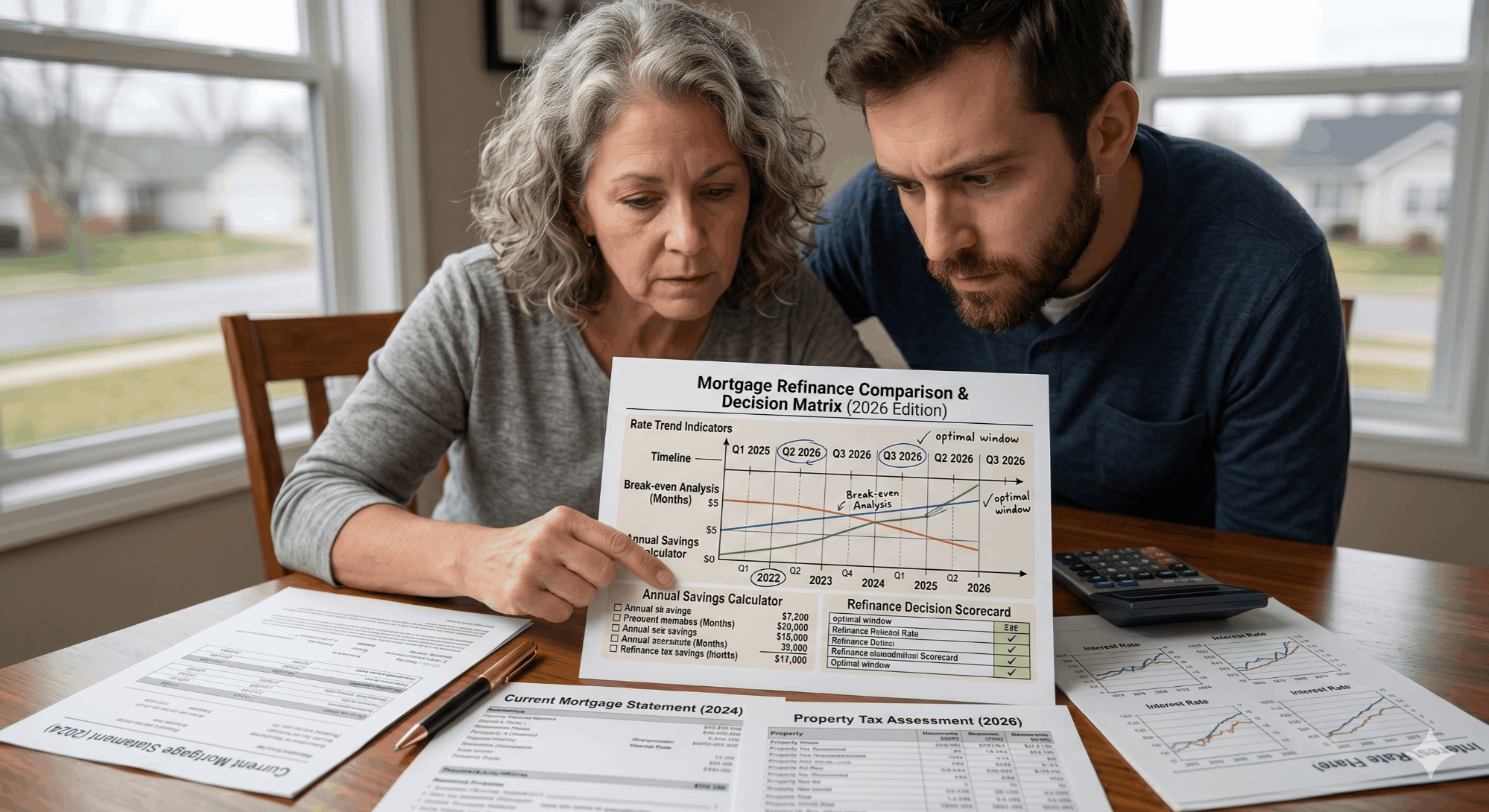
Quick Answer: Refinancing your mortgage in 2026 generally makes sense when you can lower your rate by at least 0.50%–0.75%, when you plan to stay in your home past your break-even point (typically 24–36 months), or when you need to tap home equity, remove PMI, or shorten your loan term. The decision is personal, not universal — run the numbers on your specific loan before assuming the math works.
Key Takeaways
- The 0.50% rule isn't a rule. What matters is your break-even point — how long it takes monthly savings to repay your closing costs.
- Two main types: rate-and-term refinance (change rate, term, or both) and cash-out refinance (tap equity).
- Closing costs in the DMV typically run 2%–5% of the loan amount, including Virginia recordation tax, Maryland recordation/transfer tax, or DC recordation tax.
- PMI removal alone can justify a refinance if you've crossed the 20% equity threshold and your current loan doesn't allow automatic removal.
- Don't refinance just because rates dropped slightly. If you plan to sell in the next 2 years, the math rarely works.
- 2026 conforming loan limit in the DC metro: $1,249,125 — refinances above this become jumbo loans with different underwriting.
Table of Contents
- Why Homeowners Refinance
- Rate-and-Term Refinance Explained
- Cash-Out Refinance Explained
- The Break-Even Calculation
- The 2026 Refinance Market in the DMV
- Signs Refinancing Makes Sense Right Now
- Signs You Should Wait
- Refinance Closing Costs in Virginia, Maryland & DC
- Step-by-Step Refinance Process
- Common Refinancing Mistakes
- Refinance, or Sell and Buy Up?
- Making the Right Move for Your Situation
- Frequently Asked Questions
- Glossary
If you bought a home in Northern Virginia, Maryland, or DC between 2022 and 2024, there's a real chance you're carrying a mortgage rate in the high 6s or even 7s. And every time rates dip — even a quarter point — the same question resurfaces: is now the time to refinance?
The honest answer is: it depends on more than the rate. A refinance is a financial transaction with real closing costs, and unless the savings outpace those costs before you sell or move, you've essentially paid for a transaction that didn't earn its keep. This guide walks through how to make that decision the right way for your specific loan, your equity position, and your plans for the next few years.
We'll cover both rate-and-term and cash-out refinances, walk through the break-even math, look at what's actually happening in the DMV market in 2026, and flag the situations where waiting is the smarter call.
Why Homeowners Refinance
People refinance for very different reasons, and the right strategy depends on which goal you're optimizing for. Here are the six most common reasons DMV homeowners refinance:
- Lower the monthly payment by reducing the interest rate.
- Pay off the loan faster by shortening the term (e.g., 30-year to 15-year).
- Tap home equity through a cash-out refinance for renovations, debt consolidation, or major purchases.
- Remove private mortgage insurance (PMI) once equity exceeds 20%.
- Switch from an adjustable-rate mortgage (ARM) to a fixed rate for payment stability.
- Remove or add a borrower from the loan — common after divorce or marriage.
Each of these has a different break-even calculation. Lowering your rate by 0.50% saves a different amount than removing $200/month of PMI, and pulling cash out adds a layer of cost-vs.-benefit analysis that pure rate refis don't have.
Rate-and-Term Refinance Explained
A rate-and-term refinance replaces your existing loan with a new one that has a different interest rate, a different term, or both. You don't pull cash out — the new loan balance equals (roughly) your existing balance plus closing costs if you choose to roll them in.
The three common rate-and-term scenarios
| Strategy | What Changes | Best For |
|---|---|---|
| Lower rate, same term | Rate drops, term stays 30 years | Reducing monthly payment |
| Same rate, shorter term | Move from 30-year to 15- or 20-year | Paying off mortgage faster |
| Lower rate, shorter term | Both change at once | Maximum long-term interest savings |
A rate-and-term refinance is usually the cleanest decision because the math is simple: compare new monthly payment to old, divide closing costs by monthly savings, and you have your break-even in months.
Free · No Commitment
See What Your Refinance Could Look Like
Get a personalized refinance quote in minutes. We'll run your current loan, current equity, and current credit through real numbers — not estimates.
Ken Byrne NMLS #187129 · ALCOVA Mortgage LLC NMLS #40508
Cash-Out Refinance Explained
A cash-out refinance replaces your existing loan with a larger loan, and the difference is paid to you in cash at closing. Most conventional cash-out refinances allow you to borrow up to 80% of your home's appraised value (sometimes 85% for VA-backed cash-out loans).
Here's a simple example. Say your home appraises at $750,000 and your current mortgage balance is $400,000. Your equity is $350,000. A conventional cash-out refi at 80% loan-to-value would let you borrow up to $600,000 — leaving roughly $200,000 in available cash (minus closing costs) while paying off the existing $400,000 loan.
Cash-out refi vs. HELOC vs. home equity loan
| Feature | Cash-Out Refi | HELOC | Home Equity Loan |
|---|---|---|---|
| Loan Structure | Replaces existing mortgage | Second mortgage, revolving | Second mortgage, lump sum |
| Rate Type | Typically fixed | Typically variable | Typically fixed |
| Closing Costs | 2%–5% of new loan | Often low or none | Lower than full refi |
| Best When | Need large lump sum + want to reset loan | Ongoing access to funds | Predictable one-time expense |
A cash-out refi makes the most sense when you can also lock in a meaningfully better rate on your full loan balance. If your existing rate is already low, replacing it with a higher rate just to access equity often costs more long-term than a HELOC or home equity loan layered on top.
The Break-Even Calculation
The single most important number in any refinance decision is your break-even point — the number of months it takes for monthly savings to cover the closing costs of the new loan.
The formula
Break-Even (months) = Total Closing Costs ÷ Monthly Savings
Worked example
Let's say you have a $500,000 mortgage at 7.25% with a current monthly principal-and-interest payment of approximately $3,411. You're considering refinancing to 6.25%, which would drop your monthly P&I to about $3,079 — a monthly savings of roughly $332. Closing costs come to $9,500.
Break-even: $9,500 ÷ $332 = roughly 29 months.
If you plan to stay in your home longer than 29 months, the refi earns its keep. If you plan to sell in 18 months for a job move, the math doesn't work — you'd pay $9,500 to save only about $5,976 in payments before selling.
Typical break-even ranges by scenario
These are illustrative ranges only — your actual break-even depends on your loan size, closing costs, and exact rate spread. The general rule: the bigger the rate drop, the faster the payback.
Run the Numbers
Estimate Your New Monthly Payment
Use our mortgage calculator to model different refinance rates and terms against your current loan in Virginia, Maryland, or DC.
The 2026 Refinance Market in the DMV
Two factors define the 2026 refinance landscape: where rates sit relative to your existing loan, and how much equity has built up in DMV homes since 2020.
Rates change daily and we don't quote specifics here — your loan officer can pull current pricing during a quote. What's worth knowing is the structural picture: most homeowners who bought between mid-2022 and late-2024 are sitting on rates noticeably higher than today's market, while anyone who refinanced or bought during the 2020–2021 sub-3% window is almost certainly not a refinance candidate.
On the equity side, DMV home values have continued to appreciate — particularly in Loudoun, Fairfax, and Arlington — meaning many homeowners now have far more equity than they realize. That changes two things: it can eliminate PMI from your loan, and it opens the door to cash-out refinances at favorable loan-to-value ratios.
For 2026, the conforming loan limit in the DC metro area is $1,249,125 for a single-family home, with the FHA loan limit at $1,149,825. Refinances above the conforming limit become jumbo loans, which carry different underwriting rules and sometimes different rates.
Signs Refinancing Makes Sense Right Now
You're a strong candidate to refinance in 2026 if several of the following are true:
- You can lower your rate by at least 0.50%–0.75% on your current balance.
- You plan to stay in the home at least 3–5 more years.
- Your credit score has improved meaningfully since you got the original loan.
- You've crossed 20% equity and want to eliminate PMI.
- You currently have an ARM about to adjust and want fixed-rate certainty.
- You want to shorten your loan term while keeping the payment manageable.
- You need a lump sum of cash for renovations, debt consolidation, or a major expense, and can do it without significantly raising your rate.
- You want to remove a co-borrower after a life event like divorce.
Signs You Should Wait
Refinancing is rarely urgent. Wait if any of these apply:
- You're planning to sell in the next 12–24 months — closing costs likely won't be recovered.
- Your rate is already in the 3s or low 4s — locked in during 2020–2021, that loan is gold.
- The rate improvement is less than 0.25% — break-even is probably 5+ years.
- You're about to apply for other major credit (auto loan, business line) — multiple inquiries hurt scoring.
- Your income or employment recently changed in a way that could complicate underwriting.
- You'd be resetting a 30-year clock just to slightly reduce payment, when you've already paid down 5+ years.
That last point deserves emphasis. Refinancing a loan you've been paying for 7 years into a fresh 30-year term means you'll be paying that mortgage 37 years from original origination — that's a hidden cost of "lower monthly payment" thinking.
Refinance Closing Costs in Virginia, Maryland & DC
Refinance closing costs in the DMV typically run 2%–5% of the loan amount, depending on the state, lender, and whether you're doing a rate-and-term or cash-out refi. Here's a breakdown of common cost categories:
| Cost Category | Typical Range | Notes |
|---|---|---|
| Loan origination | 0%–1% of loan | Lender fee |
| Appraisal | $500–$800 | Required on most refis |
| Title insurance (lender's) | $500–$1,500+ | Scales with loan size |
| Settlement / closing fee | $400–$1,000 | Title company / attorney |
| VA recordation tax | $0.25 per $100 (refi, on new $) | Lower than purchase rate |
| MD recordation/transfer | Varies by county | Rate-and-term refis often partly exempt |
| DC recordation tax | 1.1%–1.45% of new loan | Can be substantial on cash-out |
| Credit report / processing | $50–$300 | Various small fees |
| Prepaid escrow / interest | Varies | Taxes, insurance, partial month interest |
Virginia gives refinances a notable break on recordation tax — the state recordation tax on a refinance applies only to any new money borrowed beyond the existing principal balance, which keeps rate-and-term refis significantly cheaper than purchases. Maryland counties follow similar logic with partial exemptions. DC is the most expensive of the three jurisdictions for cash-out refinances because recordation tax applies to the full new loan amount.
Step-by-Step Refinance Process
From initial inquiry to closing, a typical refinance in 2026 takes about 30–45 days. Here's what happens:
Free · No Commitment
Ready to Explore Your Refinance Options?
Get a personalized rate quote and break-even analysis based on your actual loan. We'll show you whether the numbers work — and if they don't, we'll tell you that too.
Ken Byrne NMLS #187129 · ALCOVA Mortgage LLC NMLS #40508
Common Refinancing Mistakes
A refinance is a financial product, not a deal — and like any product, it has wrong reasons to buy. Here are the mistakes we see most often:
- Focusing on rate alone. A great rate with high closing costs can have a worse break-even than a slightly higher rate with lower costs.
- Ignoring loan term reset. Refinancing year 7 of a 30-year into a new 30-year resets the clock and often costs more in lifetime interest, even with a lower rate.
- Rolling all closing costs into the loan blindly. Convenient, but you pay interest on those costs for the loan's life. Sometimes worth it, sometimes not.
- Using cash-out to fund depreciating purchases. Pulling equity to finance a car or vacation is rarely a sound long-term decision.
- Not shopping more than one lender. Rates and fees vary. Federal regulators recommend comparing at least three Loan Estimates.
- Refinancing right before selling. If you're listing within a year, you'll almost certainly lose money on closing costs.
- Making big purchases during underwriting. Buying a car or opening new credit during the refi process can derail approval.
Refinance, or Sell and Buy Up?
For some DMV homeowners, the right question isn't "should I refinance?" but rather "should I sell and move into a different home altogether?" If you're refinancing because the house no longer fits — too small, wrong neighborhood, wrong school district, wrong commute — a refi only locks you deeper into the wrong property.
In that case, a sell-and-buy strategy may make more sense, especially if your existing home has built substantial equity that can fund a meaningful down payment on the next one. The trade-off is closing costs on both sides — but for the right life stage, that's often a better long-term move than paying to refinance a home you'll list in 24 months anyway.
Selling Instead of Refinancing?
List with a Full-Service 1.5% Commission
If you're considering selling your DMV home instead of refinancing, our affiliated real estate team offers full-service listing for a 1.5% commission — keeping more equity in your pocket for your next move.
Making the Right Move for Your Situation
Whether or not to refinance in 2026 isn't a market question — it's a personal one. The market sets rates; you bring everything else: your existing loan terms, your equity, your credit, your timeline, and your goals. The right answer requires running real numbers against your actual situation.
If you're carrying a rate from 2022–2024 and current rates are 0.50% or more below where you are, it's worth a conversation. If you've crossed 20% equity and are still paying PMI, it's worth a conversation. If you have an ARM about to adjust, it's worth a conversation. And if you've been paying off your loan for many years already, it's worth thinking carefully before resetting the clock.
The conversation itself doesn't commit you to anything. A good loan officer will tell you when refinancing makes sense — and when it doesn't.
Free · No Commitment
Talk Through Your Refinance With a Real Local Expert
Ken Byrne and the JB Financing team work with DMV homeowners every day. Get an honest look at whether refinancing makes sense for your specific loan.
Ken Byrne NMLS #187129 · ALCOVA Mortgage LLC NMLS #40508
Frequently Asked Questions
When is the right time to refinance my mortgage in 2026?
The right time is when (1) you can lower your rate by at least 0.50%–0.75%, (2) you plan to stay in the home long enough to recover closing costs (typically 24–36 months), and (3) your credit and income profile supports good loan pricing. Refinancing is also worth considering even without a rate drop if you need to remove PMI, switch from an ARM to a fixed loan, or tap equity for a major expense.
What credit score do I need to refinance a mortgage in Virginia, Maryland, or DC?
Most conventional refinances require a minimum credit score of 620, though 740+ unlocks the best pricing. FHA refinances can go as low as 580 with most lenders. VA streamline refinances (IRRRL) have flexible credit requirements since they're backed by the VA. Higher scores reduce both your rate and your mortgage insurance costs (where applicable).
How much equity do I need to refinance?
For a conventional rate-and-term refinance, you typically need at least 3%–5% equity (97% loan-to-value). For a cash-out refinance, most conventional loans cap you at 80% LTV — meaning you need at least 20% equity remaining after the new loan. VA cash-out refinances can go up to 90%, and FHA cash-out is capped at 80% LTV.
How much does it cost to refinance a mortgage in the DMV?
Expect 2%–5% of the loan amount in total closing costs. On a $500,000 loan, that's typically $10,000–$25,000. Virginia offers favorable recordation tax treatment for refinances (tax applies only to new money borrowed), Maryland counties have partial exemptions, and DC charges recordation tax on the full new loan amount, making DC cash-out refinances the most expensive of the three.
How long does a refinance take in 2026?
A typical refinance in 2026 closes in 30–45 days from application. Streamlined refinance programs (FHA Streamline, VA IRRRL) can sometimes close faster because they don't require a full appraisal or income re-verification. Cash-out refinances often take a bit longer due to additional underwriting requirements.
What is the conforming loan limit for refinances in the DC metro in 2026?
For 2026, the conforming loan limit for a single-family home in the DC metro high-cost area is $1,249,125. The FHA loan limit in the same area is $1,149,825. Refinances above these limits become jumbo loans, which have separate underwriting and pricing.
Can I refinance with no closing costs?
"No-closing-cost" refinances exist, but the costs aren't truly eliminated — they're either rolled into the loan balance or paid for with a slightly higher interest rate (lender credit). This can be a good fit if you want to preserve cash or if you're not certain how long you'll stay in the home, but it's important to compare total cost over your expected ownership horizon.
Should I refinance to a 15-year mortgage?
A 15-year refinance dramatically reduces total interest paid over the life of the loan and builds equity faster, but the monthly payment is significantly higher than a 30-year. The strategy works well for borrowers with stable, comfortable cash flow who want to be mortgage-free sooner. It's a poor fit if the higher payment would strain your monthly budget or limit your ability to save for retirement or emergencies.
Can I refinance an FHA loan into a conventional loan to remove mortgage insurance?
Yes — and this is a common strategy. FHA loans charge mortgage insurance for the life of the loan in most cases, even after you reach 20% equity. Refinancing into a conventional loan once you have at least 20% equity eliminates that ongoing cost. The savings often justify the refi closing costs even without a meaningful rate change.
How do I find a good mortgage lender for a refinance in Northern Virginia?
Look for licensed lenders with local DMV experience, transparent Loan Estimates, responsive communication, and verifiable NMLS credentials. Compare at least two or three Loan Estimates side-by-side — federal regulation standardizes these forms, so they're directly comparable. Ken Byrne (NMLS #187129) at ALCOVA Mortgage LLC (NMLS #40508) is a Branch Partner serving Virginia, Maryland, DC, and West Virginia, and JB Financing offers free no-obligation refinance quotes.
Will refinancing hurt my credit score?
There's a small, temporary impact — the hard credit inquiry typically drops your score by a few points, and opening a new account briefly lowers the average age of your credit. Most borrowers see their score recover within a few months as the new loan establishes a positive payment history. Multiple mortgage inquiries within a 45-day window are treated as a single inquiry for scoring purposes, so it's safe to compare lenders.
What's the difference between a refinance and a HELOC?
A refinance replaces your existing mortgage with a new one. A HELOC (home equity line of credit) is a separate, second loan layered on top of your existing mortgage that gives you a revolving credit line secured by your home. If your existing first mortgage has a great rate, a HELOC may be the smarter way to access equity without disturbing it. If your existing rate is high and you want to consolidate, a cash-out refinance may make more sense.
Glossary
Break-Even Point: The number of months it takes for the monthly savings from a refinance to repay the closing costs of the new loan.
Cash-Out Refinance: A refinance where the new loan is larger than the existing loan, with the difference paid to the borrower as cash at closing.
Closing Disclosure (CD): The federal form delivered at least 3 business days before closing showing the final terms, payment, and closing costs of the loan.
Loan Estimate (LE): The standardized federal form lenders provide within 3 business days of application showing projected rate, payment, and closing costs.
Loan-to-Value (LTV): The ratio of the loan amount to the property's appraised value. An LTV of 80% means the loan is 80% of the home's value (20% equity).
Private Mortgage Insurance (PMI): Insurance required on most conventional loans with less than 20% equity. Can typically be removed once the loan reaches 78%–80% LTV.
Rate-and-Term Refinance: A refinance that changes the interest rate, the loan term, or both, but doesn't include taking cash out.
Right of Rescission: The 3-business-day federal period after closing on a refinance of a primary residence during which the borrower may cancel the transaction.
Disclaimer: This article is for informational purposes only and does not constitute financial or legal advice. Mortgage programs, rates, and eligibility requirements are subject to change. Rate and cost figures referenced in examples are illustrative only and do not represent current pricing. Contact a licensed mortgage professional for guidance specific to your situation. Ken Byrne, NMLS #187129 · ALCOVA Mortgage LLC, NMLS #40508 · Licensed in VA, MD, DC, WV.
Categories
Recent Posts








GET MORE INFORMATION

Broker Associate