
Pre-Qualification vs Pre-Approval: What DMV Home Buyers Need to Know in 2026

A pre-approval letter tells a seller a lender has checked your finances. A pre-qualification usually has not.
Short answer: a pre-qualification is usually a quick estimate based on what you tell a lender. A pre-approval is usually based on verified income, assets and credit. Neither one is a guaranteed loan offer. Lenders use the two words differently, so ask what was actually checked.
By Ken Byrne, NMLS #187129 · ALCOVA Mortgage LLC, NMLS #40508 · Updated October 2026
This guide explains what each letter means, how each one affects your credit, what documents you need and how long a letter lasts. It is written for buyers in Virginia, Maryland, Washington DC and West Virginia.
To start a pre-approval with a local loan officer, talk to Ken Byrne at JB Financing.
What is the difference between pre-qualification and pre-approval?
The main difference is verification. A pre-qualification is often based on information you report. A pre-approval is often based on documents the lender has reviewed.
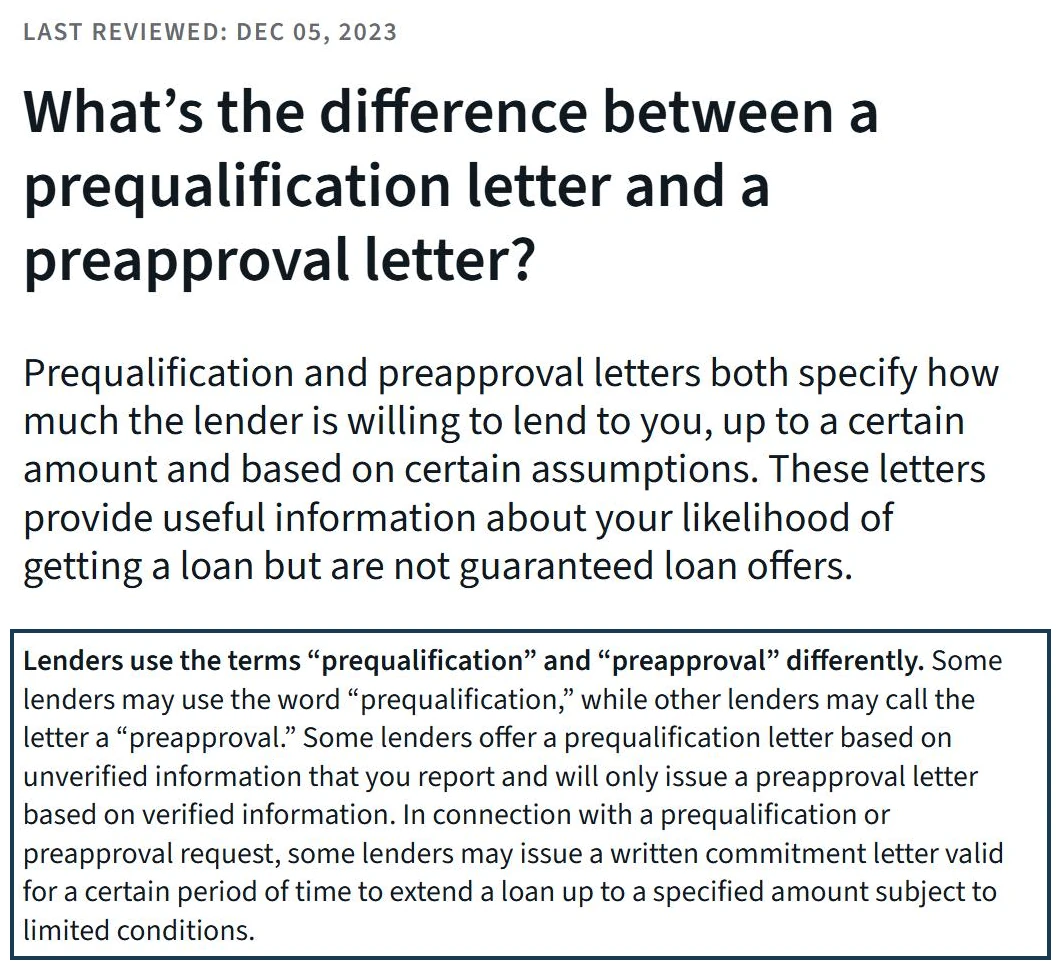
The CFPB says lenders use the two terms differently. Last reviewed December 5, 2023. Source: Consumer Financial Protection Bureau.
| Pre-qualification | Pre-approval | |
|---|---|---|
| Based on | Usually information you report | Usually verified income, assets and credit |
| Credit check | Lenders may check credit | Lenders typically check credit |
| Documents | Few or none | Pay stubs, W-2s or tax returns, bank statements |
| Weight with a seller | Less, since nothing has been verified | More, because the lender has reviewed your file |
| Guaranteed loan? | No | No |
Source: CFPB, What’s the difference between a prequalification letter and a preapproval letter?; CFPB, Get a preapproval letter, December 12, 2024. Documents row: ALCOVA Mortgage pre-approval checklist and Fannie Mae Selling Guide. Seller row is general guidance.
The CFPB’s advice is not to worry about the label. Ask the lender what it verified.
What is a mortgage pre-qualification?
It is an early estimate of how much you may be able to borrow. ALCOVA Mortgage describes it as an informal estimate based on self-reported information.
A pre-qualification is useful when you are months away from buying. It gives you a starting price range.
It is weak in an offer, because nothing has been checked yet.
To see what price fits your budget first, read about how your debt-to-income ratio affects approval.
What is a mortgage pre-approval?
It is a lender’s written statement that it is tentatively willing to lend you up to a set amount, after reviewing your finances.
Federal rules for reporting mortgage data give a precise definition of a true pre-approval program.
| A true pre-approval program, under Regulation C | What it means for you |
|---|---|
| A comprehensive analysis of your creditworthiness | Income and assets are verified, not just stated |
| A written commitment | You get a letter you can show a seller |
| Valid for a set period | The letter has an expiration date |
| Up to a specified amount | It names your maximum loan |
| Only certain conditions | Finding a suitable home, no material change in your finances, and limited items such as an acceptable title insurance binder |
Source: 12 CFR 1003.2(b)(2) and its official interpretation. A program labeled pre-approval that does not meet these terms is not one under the rule.
Not every lender letter meets this standard. Ask whether an underwriter or an automated underwriting system reviewed your file.
Does pre-qualification or pre-approval affect your credit score?
A pre-approval usually does, a little. The CFPB says lenders typically check your credit before issuing a pre-approval letter, and may do so for a pre-qualification too.
Each mortgage credit check typically has a small negative effect. FICO says one additional inquiry takes less than five points off most people’s FICO Scores.
Shopping several lenders does not multiply the damage. The CFPB says multiple mortgage credit checks within a 45-day window are recorded as a single inquiry.
| Scoring rule | Shopping window |
|---|---|
| CFPB guidance on mortgage credit checks | 45 days |
| Newer FICO Score versions | 45 days |
| Older FICO Score versions | 14 days |
| VantageScore | 14-day rolling window |
Sources: CFPB, What happens when a mortgage lender checks my credit?, last reviewed August 28, 2026; myFICO credit education; VantageScore, December 8, 2023.
If you want to stay inside the shortest window these models use, keep your mortgage credit checks within 14 days.
There is also a new limit on “trigger leads,” the unsolicited offers that can follow a mortgage credit check. The Homebuyers Privacy Protection Act took effect in March 2026. It limits when credit bureaus can pass your information to other companies for prescreened offers after a mortgage credit check, with some exceptions.
Source: Public Law 119-36, signed September 5, 2025, effective 180 days later.
If your score needs work first, see our 90-day credit plan.
What documents do you need for a mortgage pre-approval?
Most lenders ask for proof of income, assets and identity. The common Fannie Mae standards look like this.
| Document | Typical requirement |
|---|---|
| Pay stub | Your most recent one, dated within 30 days of the application, with year-to-date earnings |
| W-2 forms | The most recent one or two years, depending on the income type |
| Bank statements | The most recent two full months for a purchase |
| Employment and address history | At least two years on the loan application |
| Self-employed income | Usually two years of signed tax returns |
| Government-issued ID | Listed on ALCOVA Mortgage’s pre-approval checklist |
Sources: Fannie Mae Selling Guide B3-3.1-02, B3-4.2-01 and B3-3.2-01; Uniform Residential Loan Application (Form 1003).
Your automated underwriting findings can change what is needed.
For the full list, use our mortgage documents checklist.
How long is a pre-approval letter good for?
Usually a few months. The CFPB says letters typically expire in 30 to 60 days. ALCOVA Mortgage says most letters last 60 to 90 days, and its own approvals typically last 90 days.
The hard limit is the age of your documents. For a Fannie Mae loan, your credit report and income and asset documents must be no more than four months old on the day you sign the note.
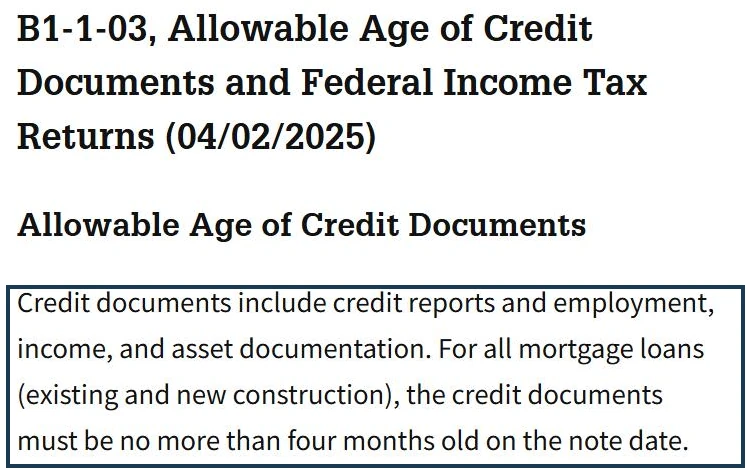
Fannie Mae Selling Guide B1-1-03, dated April 2, 2025. Source: Fannie Mae.
| Loan type | How old documents can be |
|---|---|
| Conventional (Fannie Mae) | No more than four months on the note date |
| FHA | No more than 120 days at disbursement |
| USDA guaranteed | Credit report no more than 120 days old at closing |
Sources: Fannie Mae B1-1-03; HUD Mortgagee Letter 2022-11; USDA HB-1-3555, chapter 10.
If your letter expires, the lender updates your documents and credit. ALCOVA says renewal is usually quicker than the first application.
How long does it take to get pre-approved?
ALCOVA Mortgage says most pre-approvals are completed within one to three business days. ALCOVA says starting the application takes minutes.
Files with self-employment, bonus or rental income can take longer, because there is more to verify.
For the steps after that, see how long mortgage approval takes.
Can you be denied after pre-approval?
Yes. The CFPB says pre-approval letters are not guaranteed loan offers.
An automated approval comes with conditions, and each one must be satisfied before the loan is final.
| Common reason a pre-approved loan falls through | What to do |
|---|---|
| A new debt, such as a car loan or new credit card | Avoid new credit until closing |
| A job change or drop in income | Tell your loan officer before you make the change |
| Large deposits you cannot document | Keep records of where the money came from |
| The appraisal comes in low | Plan for a gap or renegotiate |
| Documents expire before closing | Send updated pay stubs and statements quickly |
Based on Fannie Mae Selling Guide B3-2-01 and B3-2-05 (approval conditions) and 12 CFR 1003.2(b)(2) (no material change). The examples are general.
The CFPB says a lender that turns you down for a prequalification or preapproval letter must give you an adverse action notice.
Here is what happens next once you are approved: the homebuying process after pre-approval.
What credit score do you need to get pre-approved?
It depends on the loan program and the lender. Some official minimums changed recently.
| Loan type | Credit score rule |
|---|---|
| FHA | 580 or higher for 3.5% down; 500 to 579 needs 10% down |
| Conventional, Fannie Mae with Desktop Underwriter | No set minimum since November 16, 2025; the system weighs the whole file |
| Conventional, manually underwritten | 620 for fixed rate, 640 for adjustable |
| Conventional, Freddie Mac | Minimum 620 unless the Guide says otherwise |
| VA | No VA minimum; the lender may set one |
| USDA | The automated system decides; no fixed score in the handbook |
Sources: HUD Mortgagee Letter 10-29; Fannie Mae SEL-2025-09 and B3-5.1-01; Freddie Mac; VA quick reference toolkit; USDA HB-1-3555, chapter 10.
Lenders can set their own minimums above these. Ask what applies to your loan.
Debt-to-income also matters. Fannie Mae allows up to 50 percent through Desktop Underwriter, and 36 to 45 percent on manually underwritten loans.
More detail is in our guide to the credit score needed to buy a house.
Do you need a pre-approval letter to make an offer in Virginia, Maryland or DC?
A letter helps. The CFPB says it helps you make an offer because it gives the seller confidence you can get financing.
The letter is not the same as a loan commitment. In Northern Virginia, the standard conventional financing contingency form refers to a written loan commitment from the lender. The number of days is negotiated in each contract.
Source: Northern Virginia Association of REALTORS conventional financing contingency (K1359, v01/26) and NVAR standard forms changes, June 3, 2026; CFPB.
NVAR also added an interest rate definition to its financing contingencies on July 1, 2026. Confirm the rate with your lender before you write it into an offer.
Rates change often. See mortgage rates in Fairfax County.
Should you get pre-approved with more than one lender?
You can. The CFPB says getting pre-approved does not commit you to that lender.
A letter alone will not show you the best deal. Once you have chosen a home, request official Loan Estimates from several lenders and compare them.
A lender must give you a Loan Estimate within three business days after you provide six pieces of information: your name, income, Social Security number, the property address, an estimate of its value and the loan amount.
Until you receive the Loan Estimate and say you want to proceed, a lender can charge only a credit report fee. It cannot require bank statements or a purchase contract first.
Source: CFPB, What information do I have to provide to receive a Loan Estimate?; 12 CFR 1026.2(a)(3) and 1026.19(e).
Learn what to compare in how to read your Loan Estimate.
What is the ALCOVA CAN-DO Pre-Approval?
It is ALCOVA Mortgage’s pre-approval program for conforming conventional loans. ALCOVA calls it a guaranteed pre-approval, backed by a full review of your credit, income and assets.
ALCOVA says it will pay both the buyer and seller $5,000.00 should the loan not be approved after a valid CAN-DO Pre-Approval has been issued.
The payment applies only if every condition is met and ALCOVA does not issue final approval by the offer expiration date because of an oversight on its part.
| Condition ALCOVA lists | Plain meaning |
|---|---|
| No material change in your finances or credit | Do not take on new debt or change jobs |
| The contract allows a conventional loan | The offer must match the loan type |
| Closing on or before the offer expiration date | The contract date has to fit the offer |
| The appraisal supports the price, or a waiver applies | Value must check out |
| Satisfactory title | No title problems |
| Documents returned on time | Delays caused by others can void the offer |
Sources: ALCOVA Mortgage CAN-DO page and ALCOVA pre-approval guide, read October 8, 2026. ALCOVA notes that a written loan commitment has not been issued at that stage, and that “payment may constitute income and all taxes are the responsibility of the recipient.”
Ask whether CAN-DO fits your loan before you write an offer. For the full process, read our step-by-step pre-approval guide.

Get a Mortgage Estimate for Free
Start your pre-approval and know your price range before you write an offer.
✓Free, no obligation✓Licensed in VA, MD, DC and WV✓Loan officer Ken Byrne, NMLS #187129
Frequently asked questions
Is pre-approval better than pre-qualification?
For making an offer, yes. A pre-approval is usually based on verified documents, so it carries more weight with a seller.
Does pre-qualification hurt your credit?
It may not, but the CFPB says lenders may check credit for either letter. Ask whether the check is a soft or hard inquiry.
How many points does a pre-approval take off your score?
FICO says one additional inquiry takes less than five points off most people’s scores. Mortgage checks within the shopping window count as one.
How long is a mortgage pre-approval good for?
The CFPB says 30 to 60 days is typical. ALCOVA says most letters last 60 to 90 days. Fannie Mae documents must be no more than four months old on the day you sign the note.
Can I make an offer with only a pre-qualification?
You can, but it is weaker. A seller may ask for proof that a lender has checked your income and assets.
What is the difference between pre-approval and final approval?
Final approval comes after you have a contract, an appraisal and title work, and every condition is cleared. Pre-approval comes before you find a home.
Can my pre-approval amount change?
Yes. A new debt, a change in income, a different rate or a low appraisal can lower it.
Is a pre-approval letter a loan commitment?
No. The CFPB says it is not a guaranteed loan offer. A written loan commitment comes later in the process.
Should I get pre-approved before looking at homes?
Yes, in most cases. The CFPB notes that getting pre-approved early can reveal credit problems in time to fix them.
This article is general information, not financial or legal advice and not a commitment to lend or an offer of credit. Program rules and lender terms change, and your eligibility depends on a full review of your credit, income, assets and the property. Confirm anything you plan to act on with a licensed mortgage professional. Rules and program terms were read on October 8, 2026.
Categories
Recent Posts







GET MORE INFORMATION

Broker Associate