
How Much House Can I Afford on a $100K Salary in Northern Virginia?
How Much House Can I Afford on a $100K Salary in Northern Virginia?
Earning $100,000 a year in Northern Virginia puts you above the national median household income — but in one of the country's most expensive housing markets, it may not feel like it. With the median home price in the region hovering around $675,000 as of January 2026 and mortgage rates near 6%, the question of what you can actually afford on a six-figure salary is more relevant than ever.
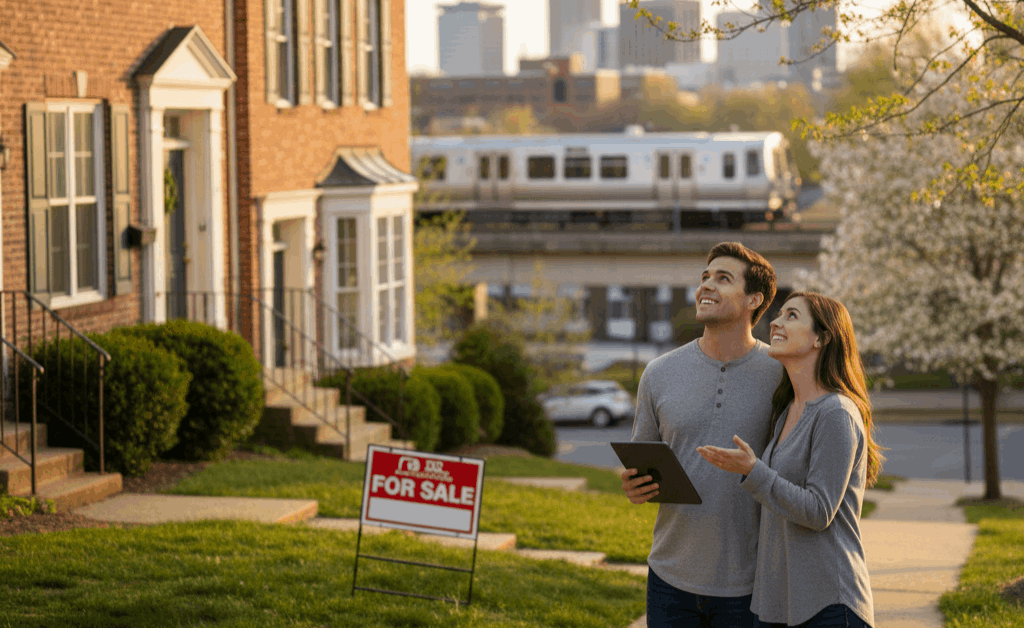
The good news? A $100K income can absolutely unlock homeownership in Northern Virginia — you just need to target the right areas, choose the right loan program, and understand how lenders evaluate your buying power. This guide breaks it all down with real numbers, county-by-county comparisons, and strategies to maximize every dollar.
On a $100,000 salary with today's mortgage rates near 6%, you can typically afford a home priced between $350,000 and $425,000 using conventional guidelines (28% front-end DTI ratio). With low-to-no down payment programs like VA or FHA loans, and Virginia's down payment assistance grants, your maximum purchase price could stretch to $450,000–$475,000 depending on your debts, credit score, and county property taxes. In Northern Virginia, that price range is most competitive in Prince William County, outer Loudoun County, and parts of Stafford County.
- A $100K salary supports roughly $2,333/month in housing costs (28% DTI), translating to a home price of approximately $350K–$425K with today's rates
- Property taxes vary dramatically across NoVA — from 0.87% in Loudoun County to 1.11% in Fairfax County — directly affecting your buying power by $15,000–$25,000
- Prince William County (median ~$550K) and outer Loudoun offer the strongest value for $100K earners, with townhomes starting in the mid-$400s
- Virginia Housing (VHDA) grants provide 2–2.5% of the purchase price in free down payment money that never needs to be repaid
- VA-eligible buyers near Fort Belvoir, Quantico, or the Pentagon can purchase with $0 down and no PMI, adding roughly $20,000+ to their effective budget
- Your actual debt-to-income ratio matters more than income alone — $400/month in car payments and student loans can reduce your buying power by $60,000+
- The 2026 DC metro conforming loan limit is $806,500, so conventional financing covers homes well above the $100K-salary price range
- The Math: What $100K Really Buys You in 2026
- How Lenders Calculate Your Affordability
- County-by-County Affordability Breakdown
- Real Monthly Payment Scenarios
- Best Loan Programs for $100K Earners
- Down Payment Assistance Programs in Virginia
- 7 Strategies to Stretch Your Budget Further
- Hidden Costs That Affect What You Can Afford
- Common Mistakes $100K Buyers Make in NoVA
- Frequently Asked Questions
- Glossary of Key Terms
- Your Next Steps
The Math: What $100K Really Buys You in 2026
Before looking at specific homes, let's start with the numbers that matter. Lenders use your gross monthly income (before taxes) to determine how much home you can afford. On a $100,000 annual salary, your gross monthly income is $8,333.
The standard guideline most lenders follow is the 28/36 rule: your total housing payment (principal, interest, taxes, and insurance — often called PITI) shouldn't exceed 28% of your gross monthly income, and your total debt payments shouldn't exceed 36%. Some loan programs allow higher ratios, but let's start conservative.
That $2,333 per month has to cover everything — not just your mortgage payment. It includes principal, interest, property taxes, homeowner's insurance, and if applicable, private mortgage insurance (PMI) or HOA dues. In Northern Virginia, where property taxes range from 0.87% to over 1.1% and HOA fees commonly run $100–$400/month for condos and townhomes, these costs eat into your buying power significantly.
Estimated Maximum Home Prices at $100K Income
| Scenario | Down Payment | Rate | Est. Max Price | Monthly PITI |
|---|---|---|---|---|
| Conservative (28% DTI, no other debt) | 5% ($20K) | 6.0% | $395,000 | ~$2,320 |
| Moderate (28% DTI, $300/mo other debt) | 5% ($17.5K) | 6.0% | $350,000 | ~$2,080 |
| FHA Loan (31% DTI front-end) | 3.5% | 5.75% | $400,000 | ~$2,570 |
| VA Loan (no down, no PMI) | $0 | 5.5% | $440,000 | ~$2,330 |
| Aggressive (43% DTI, clean credit) | 3% | 6.0% | $460,000 | ~$2,900 |
Estimates assume 2026 average rates, Fairfax County tax rate, $1,400/year homeowner's insurance, and no HOA. Your actual numbers may vary based on credit score, debt profile, and specific location. Use our Affordability Calculator for a personalized estimate.
See Exactly What You Can Afford
Plug your income, debts, and preferred county into our interactive calculator for a personalized home price estimate with real Northern Virginia tax rates.
Use the Affordability Calculator →How Lenders Calculate Your Affordability
Income alone doesn't determine what you can buy. Lenders focus primarily on two ratios that together paint a picture of your financial health: the front-end DTI (housing costs as a percentage of gross income) and the back-end DTI (all monthly debts as a percentage of gross income).
Front-End vs. Back-End DTI Explained
Your front-end ratio includes only housing costs: mortgage principal and interest, property taxes, homeowner's insurance, PMI, and HOA fees. Your back-end ratio adds all other recurring monthly debts — car payments, student loans, credit card minimums, and personal loans.
Here's why this matters so much for $100K earners: if you have $500 per month in non-housing debts, your maximum home price can drop by $70,000 or more compared to someone with zero other debts on the same salary.
| Monthly Non-Housing Debts | Impact on Max Home Price | Effective Buying Power |
|---|---|---|
| $0/mo (no car, no student loans) | Maximum range | $395,000–$440,000 |
| $200/mo (one car payment) | –$25,000 to –$30,000 | $365,000–$410,000 |
| $400/mo (car + student loans) | –$55,000 to –$65,000 | $335,000–$380,000 |
| $600/mo (car + student loans + credit cards) | –$80,000 to –$95,000 | $300,000–$350,000 |
| $800/mo (heavy debt load) | –$110,000 to –$125,000 | $270,000–$320,000 |
If you're carrying $400/month in car payments and student loans, paying off even one smaller loan before applying could increase your approved purchase price by $25,000–$40,000. Speak with a loan officer about which debts to target first — the answer isn't always the highest balance. Get a free pre-approval to see your exact numbers.
County-by-County Affordability Breakdown
Northern Virginia isn't one market — it's at least five distinct markets stacked on top of each other. The county you choose directly affects your property tax burden, available home inventory in your price range, and overall quality of life. Here's how a $100K salary plays out across each jurisdiction.
| County/City | Median Price (2026) | Property Tax Rate | Annual Tax on $400K Home | $100K Feasibility |
|---|---|---|---|---|
| Fairfax County | ~$700,000 | 1.11% | $4,440 | ⚠️ Condos only |
| Arlington County | ~$750,000 | 1.013% | $4,052 | ⚠️ Studios/1BR condos |
| Alexandria City | ~$650,000 | 1.09% | $4,360 | ⚠️ Condos only |
| Loudoun County | ~$700,000 | 0.87% | $3,480 | 🟡 Outer areas possible |
| Prince William County | ~$550,000 | 1.037% | $4,148 | ✅ Strong option |
| Stafford County | ~$475,000 | 1.01% | $4,040 | ✅ Best value |
| Washington, D.C. | ~$650,000 | 0.85% | $3,400 | 🟡 Condos in select areas |
Where Your $100K Goes Furthest
Prince William County is the clear winner for $100K earners looking for space and value. Townhomes in communities like Gainesville, Woodbridge, and Dale City regularly list in the $400,000–$500,000 range, with some entry-level options dipping into the high $300s. The county's proximity to VRE commuter rail stations makes it practical for DC commuters, and its median price sits roughly $150,000 below Fairfax County.
Stafford County offers even lower price points, with a median around $475,000 and single-family homes available under $400,000. However, commute times to DC can stretch to 60–90 minutes without VRE access. If you work at Marine Corps Base Quantico, Stafford is an ideal choice both for price and proximity.
Loudoun County's outer areas — particularly beyond Leesburg toward Round Hill and Purcellville — offer pockets of affordability with lower property taxes (0.87%) that partially offset the home price. Leesburg itself is trending higher, but the western edge of the county remains accessible.
Real Monthly Payment Scenarios
Abstract percentages and loan limits are useful, but what does a mortgage actually cost you each month? Below are five realistic scenarios for a buyer earning $100K in Northern Virginia, each showing the full PITI breakdown.
Scenario 1: $375,000 Townhome in Prince William County
| Component | Conventional (5% Down) | FHA (3.5% Down) | VA ($0 Down) |
|---|---|---|---|
| Purchase Price | $375,000 | $375,000 | $375,000 |
| Down Payment | $18,750 | $13,125 | $0 |
| Loan Amount | $356,250 | $361,875 | $375,000 |
| Interest Rate (est.) | 6.0% | 5.75% | 5.5% |
| Principal & Interest | $2,136 | $2,113 | $2,129 |
| Property Tax (1.037%) | $324 | $324 | $324 |
| Homeowner's Insurance | $117 | $117 | $117 |
| PMI / MIP | $148 | $253 | $0 |
| HOA (est.) | $150 | $150 | $150 |
| Total Monthly Payment | $2,875 | $2,957 | $2,720 |
| % of Gross Income | 34.5% | 35.5% | 32.6% |
Scenario 2: $425,000 Condo in Fairfax County
| Component | Conventional (5% Down) | VA ($0 Down) |
|---|---|---|
| Purchase Price | $425,000 | $425,000 |
| Down Payment | $21,250 | $0 |
| Loan Amount | $403,750 | $425,000 |
| Interest Rate (est.) | 6.0% | 5.5% |
| Principal & Interest | $2,421 | $2,413 |
| Property Tax (1.11%) | $393 | $393 |
| Homeowner's Insurance | $125 | $125 |
| PMI | $168 | $0 |
| HOA/Condo Fee | $350 | $350 |
| Total Monthly Payment | $3,457 | $3,281 |
| % of Gross Income | 41.5% | 39.4% |
In Northern Virginia, condo fees commonly run $300–$600/month and can push your DTI well above comfortable levels. A $425K condo with a $350 HOA fee costs you the same monthly payment as a $490K townhome with no HOA. Always factor in HOA before falling in love with a condo listing.
Get Your Personalized Pre-Approval
See your exact purchase price, rate, and monthly payment based on your real income, debts, and credit score — not estimates. Pre-approval takes about 15 minutes and doesn't affect your credit score.
Get Pre-Approved Now →Or call Arslan Jamil directly: (571) 242-0301
Best Loan Programs for $100K Earners in Northern Virginia
The loan program you choose can shift your buying power by $30,000–$70,000. Here's how the main options compare for someone earning $100K.
| Loan Type | Min. Down | PMI/MIP | Max DTI | Best For |
|---|---|---|---|---|
| Conventional | 3–5% | Yes (until 20% equity) | 45–50% | Good credit (680+), saving for down payment |
| VA Loan | 0% | No PMI ever | Up to 60% | Veterans, active military near Pentagon/Belvoir/Quantico |
| FHA | 3.5% | Yes (life of loan) | Up to 57% | Lower credit scores (580+), higher DTI tolerance |
| USDA | 0% | Low guarantee fee | 41% | Rural-eligible areas of outer Loudoun, Fauquier, Clarke |
| Virginia Housing (VHDA) | 0–3% | Reduced or none | 45% | First-time buyers, pairs with DPA grant |
Why VA Loans Dominate in the DMV
If you're a veteran or active-duty service member stationed at the Pentagon, Fort Belvoir, Joint Base Myer-Henderson Hall, Marine Corps Base Quantico, or Joint Base Andrews, the VA loan is the most powerful tool in your arsenal. Zero down payment and zero PMI on the same $375,000 townhome saves you roughly $18,750 upfront and $148/month compared to a conventional loan — that's over $70,000 in savings over a 30-year term.
Northern Virginia is one of the most military-dense metropolitan areas in the country, and the Ken Byrne Team at ALCOVA Mortgage has funded over $1.5 billion in loans, with deep experience guiding military families through the VA loan process in this market.
- $0 down payment required
- No monthly PMI — ever
- Typically lower interest rates than conventional
- More flexible DTI allowances (up to 60%)
- No prepayment penalties
- Limit of $806,500 in DC metro area (2026)
- VA funding fee (2.15% first use, can be financed)
- Must be primary residence
- Property must meet VA minimum property requirements
- Requires Certificate of Eligibility (COE)
- Some sellers perceive VA offers as weaker (myth)
- Disabled veterans may be exempt from funding fee
FHA Loans: The Bridge for Lower Credit Scores
If your credit score is between 580 and 679, an FHA loan may be your most accessible path. FHA allows just 3.5% down and is more forgiving of credit blemishes. The trade-off is mortgage insurance premiums (MIP) that remain for the life of the loan, adding approximately $200–$300/month on a $375K purchase. Many buyers use FHA initially, then refinance to a conventional loan once they've built 20% equity.
Down Payment Assistance Programs in Virginia
One of the biggest obstacles for $100K earners isn't the monthly payment — it's the upfront cash. A 5% down payment on a $400,000 home is $20,000, plus closing costs of $10,000–$15,000. That's $30,000+ before you get the keys. Virginia's down payment assistance programs can significantly reduce that barrier.
| Program | Assistance Amount | Type | Repayment | Key Requirement |
|---|---|---|---|---|
| VHDA DPA Grant | 2–2.5% of purchase price | True grant | Never repaid | First-time buyer, VHDA loan |
| VHDA Plus Second Mortgage | 3–5% of purchase price | Second mortgage | 30-year fixed, low rate | 680+ credit, VHDA first mortgage |
| Virginia DHCD HOMEownership | Up to 10% of sale price | Forgivable loan | Forgiven after 5–15 years | Below 80% AMI |
| VHDA Mortgage Credit Certificate | Up to $2,000/year tax credit | Tax credit | Ongoing annual benefit | First-time buyer, income limits |
| VHDA SPARC | 1% rate reduction | Rate allocation | No repayment | Targeted communities |
| Alexandria Flexible Homeownership | Up to $50,000 | Shared equity loan | Repaid at sale | Below 80% AMI, live/work in Alexandria |
On a $400,000 home, a 2.5% VHDA DPA Grant gives you $10,000 toward your down payment — money you never have to pay back. Combined with an FHA loan requiring 3.5% down ($14,000), the grant covers more than 70% of your required down payment, reducing your out-of-pocket to just $4,000 plus closing costs. The Ken Byrne Team at ALCOVA Mortgage is an approved VHDA lender and can package these programs together seamlessly. Call (571) 242-0301 to learn more.
7 Strategies to Stretch Your Budget Further
If the gap between what you can afford and what Northern Virginia costs feels overwhelming, these strategies can bridge it — each one adding real dollars to your purchasing power.
1. Eliminate or Reduce Monthly Debts Before Applying
This is the single most impactful move. Paying off a $350/month car loan before applying doesn't just free up cash flow — it can increase your approved loan amount by $45,000–$55,000. If you can't eliminate debts, focus on reducing credit card minimums by paying down balances.
2. Consider a Townhome Instead of a Single-Family Home
In Northern Virginia's $400K range, your choices are generally condos or townhomes. Townhomes typically have lower HOA fees ($50–$150/month vs. $300–$600 for condos), give you more space, and tend to appreciate faster. In Prince William County, well-maintained townhomes in the $380K–$450K range offer 3 bedrooms, 2–3 bathrooms, and often include a garage. Explore available options through The Jamil Brothers' MLS search.
3. Look at Outer Suburbs Along VRE Lines
The Virginia Railway Express (VRE) connects communities like Woodbridge, Manassas, and even Fredericksburg to DC. Homes along VRE corridors can cost $100,000–$200,000 less than equivalent properties in Fairfax or Arlington while providing reasonable commute access.
4. Stack Multiple Assistance Programs
Virginia allows you to combine programs in many cases. For example, you could pair a VHDA first mortgage with the DPA grant (2.5%) and a Mortgage Credit Certificate ($2,000/year tax credit). That combination reduces both your upfront costs and your ongoing tax burden.
5. Use a VA Loan If You're Eligible
This bears repeating: the VA loan's $0 down payment and no PMI add an estimated $20,000–$30,000 to your effective buying power compared to conventional financing. If you're a veteran or active-duty member and you're not using your VA benefit, you're leaving significant money on the table.
6. Negotiate Seller Concessions for Closing Costs
In 2026's more balanced Northern Virginia market — where homes are sitting an average of 42 days before sale — buyers have more negotiating leverage than they've had in years. Asking for 2–3% in seller-paid closing costs is increasingly common and can save you $8,000–$12,000 in upfront cash.
7. Save on the Sale Side Too
If you're currently a homeowner looking to sell before buying, the commission you pay on your sale matters. The Jamil Brothers Realty Group offers a full-service listing at just 1.5% commission — compared to the traditional 2.5–3% — saving you $7,500 or more on a $500,000 sale. That's real cash you can redirect toward your next down payment. This isn't a discount service — it includes professional photography, staging consultation, MLS listing, and full agent support.
Thinking About Selling Before Buying?
Find out what your current home is worth and how much you'd save with a 1.5% listing commission. Every dollar saved goes directly toward your next purchase.
Get a Free Home Valuation →Hidden Costs That Affect What You Can Afford
The sticker price is just the beginning. Northern Virginia has several costs that catch first-time buyers off guard and can push an "affordable" home out of reach if you're not prepared.
- Closing costs: Typically 2–5% of the purchase price ($8,000–$20,000 on a $400K home). Includes origination fees, appraisal, title insurance, recording fees, and prepaid escrows
- HOA / Condo fees: $50–$150/month for townhome HOAs, $300–$600/month for condos. Always confirm what's covered (some include water, exterior maintenance, or even utilities)
- Home inspection: $400–$600 for a standard inspection. Radon testing, termite inspection, and sewer scope add $100–$300 each
- Homeowner's insurance: $1,200–$2,000/year in Northern Virginia. Flood insurance adds $500–$2,500/year if applicable
- Maintenance reserves: Budget 1% of home value per year ($4,000 on a $400K home) for routine maintenance and repairs
- Virginia-specific costs: Grantor tax (state transfer tax) of $1.00 per $500 of sale price, plus local "regional congestion relief" fee of $0.15 per $100 in NoVA counties
- Mello-Roos / Special tax districts: Some newer Prince William and Loudoun developments have community development authority (CDA) taxes of $1,000–$3,000/year
- Commuting costs: Metro fare from outer stations to DC averages $200–$350/month. VRE passes run $200–$400/month. Factor this as part of your "real" housing cost
| Cost Category | Low Estimate | High Estimate | When It's Due |
|---|---|---|---|
| Down Payment (5%) | $17,500 | $21,250 | At closing |
| Closing Costs (3%) | $10,500 | $12,750 | At closing |
| Home Inspection | $400 | $900 | Under contract |
| Moving Costs | $1,500 | $5,000 | Move-in day |
| Immediate Repairs/Furnishing | $2,000 | $8,000 | First 30 days |
| 3-Month Emergency Fund | $6,000 | $9,000 | Before purchase |
| Total Cash Needed | $37,900 | $56,900 |
Common Mistakes $100K Buyers Make in Northern Virginia
The median home price in these counties is $700K–$750K — nearly double what a $100K salary can comfortably afford. Many buyers waste months searching in areas where the math simply doesn't work. Instead, start with Prince William County, Stafford, or outer Loudoun where your budget aligns with the market.
A $400K condo with a $450/month HOA costs you the equivalent of a $465K home with no HOA. Lenders count HOA dues in your DTI, which directly reduces your loan approval amount. Always compare total monthly costs, not just the listing price.
In Northern Virginia's competitive market, sellers rarely accept offers without a pre-approval letter. More importantly, pre-approval reveals your actual budget — which may differ significantly from online calculator estimates. A 15-minute pre-approval conversation with the Ken Byrne Team can save you months of looking at homes you can't qualify for.
Just because a lender approves you for $420K doesn't mean you should spend $420K. A 45% DTI ratio leaves very little margin for unexpected expenses, savings, or lifestyle. Most financial advisors suggest keeping your total housing payment under 30–33% of gross income for long-term financial health.
Many $100K earners assume they "make too much" for assistance programs. In reality, VHDA income limits in high-cost Northern Virginia counties extend well above $100K for many programs. The DPA grant alone could save you $8,000–$10,000 in upfront costs. Always ask your loan officer about available programs before assuming you don't qualify.
Ready to See Your Real Numbers?
Stop guessing and start planning. A pre-approval with the Ken Byrne Team takes about 15 minutes, costs nothing, and gives you exact numbers for your budget, monthly payment, and available assistance programs.
Start Your Pre-Approval →Or call us: (571) 242-0301
Frequently Asked Questions
Glossary of Key Terms
- DTI (Debt-to-Income Ratio)
- The percentage of your gross monthly income that goes toward debt payments. "Front-end DTI" includes only housing costs; "back-end DTI" includes all debts. Most lenders prefer a back-end DTI under 43%, though some programs allow up to 50–57%.
- PITI (Principal, Interest, Taxes, Insurance)
- The four components of a standard monthly mortgage payment. Lenders evaluate your total PITI against your income to determine affordability. In Northern Virginia, taxes and insurance can add $400–$600/month beyond principal and interest.
- PMI (Private Mortgage Insurance)
- Insurance required by conventional lenders when you put less than 20% down. Typically costs 0.3–1.5% of the loan amount annually, added to your monthly payment. PMI is automatically removed once you reach 20% equity. VA loans never require PMI.
- Conforming Loan Limit
- The maximum loan amount that Fannie Mae and Freddie Mac will purchase. For 2026 in the DC metro area, this limit is $806,500. Loans above this amount require jumbo financing with different qualification standards.
- Pre-Approval
- A lender's written commitment to lend you a specific amount based on verified income, credit, and assets. Stronger than pre-qualification, which is based only on self-reported data. In competitive markets, sellers typically require a pre-approval letter with offers.
- VHDA (Virginia Housing Development Authority)
- Virginia's state housing finance agency, now known as Virginia Housing. Offers below-market-rate mortgages, down payment assistance grants, and mortgage credit certificates specifically for Virginia residents. An approved VHDA lender is required to access these programs.
- MIP (Mortgage Insurance Premium)
- FHA's version of PMI. Includes an upfront premium (1.75% of the loan, financed into the balance) and an annual premium (0.55–0.85% of the loan balance, paid monthly). Unlike conventional PMI, FHA MIP remains for the life of the loan unless you refinance.
- VA Funding Fee
- A one-time fee charged on VA loans to help sustain the program. First-time VA borrowers with no down payment pay 2.15% of the loan amount. The fee can be financed into the loan. Veterans receiving VA disability compensation are exempt from the funding fee.
Your Next Steps
Buying a home on $100K in Northern Virginia is absolutely achievable — it just requires targeting the right areas, choosing the right loan program, and working with a team that understands the local market. Here's a practical action plan to get started:
Let's Find Your Number
The Ken Byrne Team at ALCOVA Mortgage has helped over 4,000 families across Virginia, DC, Maryland, and West Virginia find the right loan for their budget. With $1.5B+ in funded loans and 30+ years of experience, we'll make sure you know exactly what you can afford — and help you get there.
Get Pre-Approved → Use the CalculatorCall Arslan Jamil: (571) 242-0301 | Email: ajamil@alcova.com
Disclaimer: All mortgage calculations, rates, and home prices referenced in this article are estimates based on market conditions as of February 2026 and are subject to change. This content is for informational purposes only and does not constitute a loan commitment or guarantee of terms. Actual rates, payments, and eligibility depend on individual financial circumstances, credit history, and property details. Please consult with a licensed loan officer for personalized advice. ALCOVA Mortgage LLC, NMLS #40508. Equal Housing Lender.
Categories
Recent Posts







GET MORE INFORMATION

Broker Associate