
How Much House Can I Afford on a $150K Salary in the DC Area?
HOME AFFORDABILITY GUIDE
How Much House Can I Afford on a $150K Salary in the DC Area?
Published February 28, 2026 · Last Updated February 28, 2026 · 12 min read
A $150,000 household income puts you well above the national median — but in the Washington, DC metro area, where median home prices hover around $585,000 and some counties routinely cross the $700,000 mark, that salary doesn't stretch as far as you might think. The good news? With mortgage rates dipping below 6% in February 2026 for the first time in over three years, your buying power has improved meaningfully compared to 2024 and 2025.

This guide breaks down exactly how much house you can realistically afford on a $150K income across Northern Virginia, DC, Maryland, and the West Virginia Eastern Panhandle — complete with county-by-county scenarios, down payment strategies, and the specific programs that can stretch your dollar further.
On a $150,000 salary with current DC-area mortgage rates near 6%, you can typically afford a home priced between $550,000 and $750,000 depending on your down payment, existing debts, and which county you're buying in. With 10% down and minimal debts, most lenders will approve you for roughly $650,000–$700,000 in the DC metro's high-cost market.
- A $150K salary supports roughly $550K–$750K in home price depending on down payment and debts
- The DC metro's 2026 conforming loan limit of $806,500 means you won't need a jumbo loan in most scenarios
- Monthly housing costs at $650K range from $4,200–$4,800 depending on county property taxes
- Virginia, DC, and Maryland all offer down payment assistance programs — some with up to $202,000 in gap financing
- Buying in Prince William County or the WV Eastern Panhandle can stretch your budget by $100K–$200K vs. Arlington
- Current mortgage rates near 5.9%–6.0% give you roughly $40,000 more buying power than rates in early 2025
- The 28/36 rule suggests your max monthly housing payment should be $3,500–$4,500 on this income
- The Math: How Lenders Calculate Your Buying Power
- Three Buying Scenarios on $150K
- County-by-County Affordability Breakdown
- What Your Monthly Payment Actually Looks Like
- Down Payment Assistance Programs in the DMV
- Strategies to Stretch Your Budget Further
- 5 Mistakes $150K Earners Make When Buying in DC
- Your Home Buying Timeline
- Frequently Asked Questions
- Glossary of Key Terms
How Lenders Calculate Your Buying Power on $150K
Your income is only part of the equation. Mortgage lenders use two key ratios to determine how much they'll lend you, and understanding these formulas is the first step to setting a realistic budget in the DC metro.
The Debt-to-Income (DTI) Ratios That Matter
Lenders evaluate your debt-to-income ratio by comparing your monthly debt payments to your gross monthly income. On a $150K salary, your gross monthly income is $12,500. Two DTI thresholds come into play:
| DTI Ratio | What It Measures | Typical Max | Your Max at $150K |
|---|---|---|---|
| Front-End (Housing) | Housing costs ÷ gross income | 28%–31% | $3,500–$3,875/mo |
| Back-End (Total) | All debts ÷ gross income | 43%–50% | $5,375–$6,250/mo |
The back-end ratio is typically the binding constraint. If you carry $800/month in car payments and student loans, your maximum housing payment drops from $5,375 to $4,575 under a 43% DTI threshold. Conversely, if you're debt-free, some loan programs will approve you up to a 50% DTI, pushing your max housing payment to $6,250/month — though that level of spending may not be financially comfortable.
How Existing Debt Changes the Picture
These ranges assume a 30-year fixed mortgage near 6%, 10% down, and Fairfax County property tax rates. Your actual approval amount will vary based on credit score, loan program, and the specific lender's guidelines.
Not sure where you stand? Try our free affordability calculator to get a personalized estimate based on your income, debts, and target county in the DC area.
Three Buying Scenarios on a $150K Salary
Let's run the numbers across three realistic scenarios that DC-area buyers at this income level commonly face. All calculations use a 30-year fixed rate of 6.0%, which is close to the current average as of February 2026.
| Scenario | Conservative | Moderate | Aggressive |
|---|---|---|---|
| Home Price | $550,000 | $650,000 | $750,000 |
| Down Payment | 5% ($27,500) | 10% ($65,000) | 20% ($150,000) |
| Loan Amount | $522,500 | $585,000 | $600,000 |
| Monthly P&I | $3,132 | $3,507 | $3,597 |
| Property Tax* | $509 | $601 | $694 |
| Insurance | $138 | $163 | $188 |
| PMI | ~$195 | ~$175 | $0 |
| Total Monthly | $3,974 | $4,446 | $4,479 |
| Housing DTI | 31.8% | 35.6% | 35.8% |
| Comfort Level | ✓ Comfortable | ✓ Manageable | ⚠ Tight if debts exist |
*Property taxes based on Fairfax County rate of ~1.11%. Rates vary significantly by county. Estimates as of February 2026, subject to change.
Notice something interesting: the moderate and aggressive scenarios produce nearly identical monthly payments despite a $100,000 difference in home price. That's the power of a larger down payment — the $150K buyer at 20% down eliminates PMI entirely and borrows less, keeping the payment competitive even on a pricier home.
Find Out Your Exact Buying Power
Get pre-approved in as little as 15 minutes and shop with confidence across the DC metro area.
Get Pre-Approved Now →Ken Byrne Team at ALCOVA Mortgage | NMLS #40508
County-by-County Affordability Breakdown
One of the biggest advantages of buying in the DC metro is the range of markets within commuting distance. The same $150K salary buys very different homes depending on which side of the Potomac — or Blue Ridge — you land on.
| County / Area | Median Price (2026) | Property Tax Rate | Monthly Payment* | Affordability |
|---|---|---|---|---|
| Fairfax County, VA | ~$700,000 | 1.11% | $4,800 | Stretch |
| Arlington, VA | ~$700,000 | 1.013% | $4,720 | Stretch |
| Loudoun County, VA | ~$700,000 | 0.87% | $4,640 | Moderate |
| Prince William County, VA | ~$550,000 | 1.037% | $3,850 | Comfortable |
| Stafford County, VA | ~$500,000 | 1.01% | $3,520 | Very Comfortable |
| Washington, DC | ~$620,000 | 0.85% | $4,110 | Moderate |
| Montgomery Co., MD | ~$580,000 | 0.93% | $3,940 | Comfortable |
| Prince George's Co., MD | ~$430,000 | 0.96% | $3,050 | Very Comfortable |
| Jefferson Co., WV | ~$350,000 | 0.58% | $2,290 | Excellent |
*Estimated monthly payments assume 10% down, 30-year fixed at 6.0%, applicable county property taxes, homeowners insurance, and PMI where applicable. Figures are estimates as of February 2026 and subject to change based on market conditions.
The contrast is dramatic. In Jefferson County, WV, your monthly payment on a median-priced home could be less than half what you'd pay in Fairfax County — and you'd still be within commuting distance of DC via the MARC train or a reasonable drive on I-81 and Route 9.
How Far $150K Goes Across the DMV
Estimated comfortable purchasing ranges with 10% down and moderate existing debt. Ranges reflect homes you can afford without exceeding a 38% total DTI.
What Your Monthly Payment Actually Looks Like
Let's demystify what goes into that monthly mortgage payment. On a $650,000 home in Fairfax County with 10% down, here's the full breakdown:
| Cost Component | Monthly Amount | % of Payment | Annual Total |
|---|---|---|---|
| Principal & Interest | $3,507 | 78.8% | $42,084 |
| Property Tax (Fairfax 1.11%) | $601 | 13.5% | $7,215 |
| Homeowners Insurance | $163 | 3.7% | $1,950 |
| PMI (until 20% equity) | $175 | 3.9% | $2,100 |
| Total PITI + PMI | $4,446 | 100% | $53,349 |
The Hidden Costs Beyond Your Mortgage
Your mortgage payment isn't the only housing expense you'll carry. Budget an additional $300–$600/month for costs that don't appear in your PITI calculation:
- HOA dues — $100–$400/mo (common in condos and townhome communities throughout NoVA)
- Home maintenance reserve — budget 1% of home value annually ($540/mo on a $650K home)
- Utilities — $200–$350/mo for a typical single-family home in the DMV
- Lawn care / snow removal — $50–$150/mo depending on property size
- Home warranty — $40–$80/mo (optional but recommended for older homes)
When you factor in these costs, a truly comfortable all-in housing budget on $150K is closer to $5,000–$5,200/month — which still falls within the widely recommended 40% of gross income threshold for total housing costs.
Down Payment Assistance Programs That Stretch Your Dollar
One of the best-kept secrets in DC-area real estate is the array of down payment assistance programs available to buyers at the $150K income level. While some programs have income caps that may exclude $150K earners, several options remain available — especially in DC and Maryland.
| Program | State | Benefit | $150K Eligible? | Key Details |
|---|---|---|---|---|
| DC Open Doors | DC | 3.5% of purchase price | ✓ Yes | 0% interest, forgivable after 5 years |
| DC HPAP | DC | Up to $202,000 | ✗ Income limits apply | Gap financing + $4,000 closing costs |
| DC4ME | DC | Up to $10,000 | ✓ Gov employees | For first responders and educators |
| VHDA Grant | VA | 2–2.5% of loan | ⚠ Check limits | Income limits vary by county and household size |
| VHDA Plus Second Mortgage | VA | 3–5% of purchase | ⚠ Check limits | Second mortgage with deferred payments |
| VA Mortgage Credit Certificate | VA | $2,000/yr tax credit | ✓ Yes | 20% of mortgage interest, annually |
| MD MMP DPA | MD | 5% deferred | ⚠ Check limits | No payments until sale, refi, or payoff |
| MD SmartBuy 2.0 | MD | $40,000 student loan payoff | ✓ Yes | Pays off student debt at closing |
| WVHDF | WV | Up to $12,000 | ✓ Yes | Available with multiple loan types |
Eligibility requirements and benefit amounts are estimates as of February 2026 and may change. Income limits vary by household size and county. Consult a licensed loan officer for current program details.
Maryland's SmartBuy 2.0 program can pay off up to $40,000 in student loan debt at closing. For a $150K earner carrying student loans, this can effectively boost your buying power by $60,000–$80,000 by reducing your DTI and eliminating a major monthly payment.
Which DPA Programs Do You Qualify For?
Our team specializes in maximizing down payment assistance for DMV buyers. Call to discuss your specific situation.
Call (571) 242-0301 →Ken Byrne Team at ALCOVA Mortgage | Serving VA, DC, MD, WV
Strategies to Stretch Your Budget Further
If the county-by-county numbers show that your target neighborhood is just out of reach, these proven strategies can close the gap without overextending yourself.
1. Buy Down Your Mortgage Rate
Paying discount points at closing — typically 1% of the loan amount per 0.25% rate reduction — can significantly lower your monthly payment. On a $585,000 loan, buying one point ($5,850) could drop your rate from 6.0% to 5.75%, saving you roughly $95/month or $34,200 over the life of the loan.
2. Consider a Townhome or Condo
- $100K–$200K less than detached homes in same area
- Lower maintenance burden
- Often in walkable, transit-accessible locations
- Can build equity and trade up in 3–5 years
- Monthly HOA fees add $150–$400/mo
- Slower appreciation in some condo markets
- Less privacy and outdoor space
- HOA rules may limit renovations
3. Expand Your Geographic Search
With remote and hybrid work now standard in the DC area, many $150K earners are finding that moving one county out unlocks dramatically better value. A $550,000 home in Prince William County often offers more space and a larger lot than a $700,000 townhome in Fairfax — while keeping you within a manageable commute. Explore current listings across the DMV to compare what's available at different price points.
4. Use a VA Loan If You're Eligible
For active-duty military, veterans, and eligible surviving spouses, VA loans are a game-changer. They offer 0% down, no PMI, and competitive rates — and with multiple military installations in the DC area (Pentagon, Fort Belvoir, Quantico, Joint Base Andrews), a significant share of local buyers qualify. On a $650,000 purchase, skipping the down payment and PMI saves you roughly $65,000 upfront and $175/month ongoing.
5. Negotiate Seller Concessions
In the current market environment, where DC-area inventory has increased roughly 18% year-over-year, buyers have more negotiating power than they've had in years. Ask the seller to cover 2–3% of closing costs, which on a $650,000 home saves you $13,000–$19,500 in cash you'd otherwise need at settlement.
6. Combine Buying and Selling Strategically
If you're selling a current home while buying, The Jamil Brothers' 1.5% listing commission can save you thousands compared to the traditional 2.5–3% rate. On a $550,000 sale, that's roughly $5,500–$8,250 in savings you can redirect toward your down payment on the new home.
5 Costly Mistakes $150K Earners Make When Buying in DC
Just because a lender approves you for $750,000 doesn't mean you should spend $750,000. Lenders don't account for your retirement contributions, childcare costs, travel budget, or emergency fund. A good rule of thumb: target 80–90% of your maximum approval to maintain financial flexibility.
A $650,000 home in Loudoun County (0.87% tax rate) costs $1,560/year less in property taxes than the same-priced home in Fairfax County (1.11%). That's $130/month — enough to shift your effective buying power by roughly $20,000.
In the competitive DC market, sellers routinely reject offers from buyers without pre-approval letters. Getting pre-approved before you start touring homes ensures you know your exact budget and can submit offers that sellers take seriously.
Many $150K earners assume they earn too much for down payment assistance, but programs like DC Open Doors, Virginia's Mortgage Credit Certificate, and Maryland's SmartBuy have income limits that accommodate higher earners in expensive markets. You could be leaving thousands on the table.
According to Freddie Mac research, borrowers who compare rates from multiple lenders may save $600–$1,200 annually. Even a 0.125% rate difference on a $585,000 loan amounts to $22,000 over 30 years.
Thinking About Selling Before You Buy?
The Jamil Brothers' 1.5% listing commission saves you thousands — money you can put toward your next home's down payment.
Calculate Your Net Proceeds →Full-service listing at 1.5% vs. the traditional 2.5–3%
Your Home Buying Timeline on $150K
Ready to move forward? Here's a practical timeline that most DC-area buyers at this income level follow from first step to closing day.
Frequently Asked Questions
Yes, $150,000 is a solid income for home buying in the DC metro — though it won't buy you a mansion in Arlington. This salary typically supports a purchase price between $550,000 and $750,000 depending on your down payment, existing debts, and the specific county. You'll find the most options in Prince William County, Montgomery County, or the WV Eastern Panhandle, while closer-in areas like Fairfax and Arlington may require a larger down payment to stay comfortable.
The minimum down payment depends on your loan type. Conventional loans require as little as 3–5% ($19,500–$32,500), FHA loans require 3.5% ($22,750), and VA loans require 0% if you're eligible. A 10% down payment ($65,000) is a common target for $150K earners, as it lowers your monthly PMI cost while keeping the upfront commitment manageable. A 20% down payment ($130,000) eliminates PMI entirely.
Most conventional lenders require a minimum credit score of 620, but you'll get significantly better rates with a score of 740 or above. On a $585,000 loan, the difference between a 680 and 760 credit score can mean 0.25–0.50% in interest rate, translating to $90–$180/month in savings. FHA loans accept scores as low as 580 with 3.5% down.
The answer depends on your priorities. Virginia offers no state tax on groceries, generally strong schools, and lower property tax rates in some counties (Loudoun at 0.87%). DC has unique DPA programs like HPAP and Open Doors plus no need for a car if you live near Metro. Maryland's SmartBuy program is unbeatable if you carry student loan debt. Each state also has different income tax structures — Virginia tops out at 5.75%, DC goes to 10.75% on higher incomes, and Maryland ranges from 2% to 5.75% plus county surcharges.
It's possible but may require flexibility. The median home price in Arlington is approximately $700,000 in 2026, which pushes the upper limit of what a $150K salary comfortably supports. You may need a larger down payment (15–20%), minimal existing debt, and willingness to consider condos or smaller townhomes. Many $150K earners in Arlington start with a condo and build equity before upgrading.
The 2026 conforming loan limit for the DC metro high-cost area is $806,500 for a single-unit property, as established by the Federal Housing Finance Agency (FHFA). This applies to most Northern Virginia counties, Washington DC, and nearby Maryland counties. On a $150K salary, you'll almost certainly stay within this limit, meaning you won't need a jumbo loan with its typically higher rates and stricter requirements.
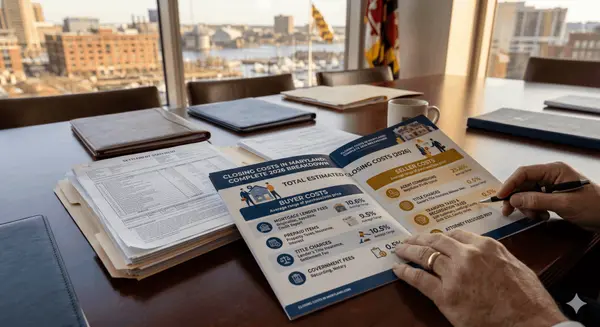
Closing costs in the DC area typically range from 2–5% of the purchase price. On a $650,000 home, expect to pay $13,000–$32,500 in addition to your down payment. Virginia closing costs tend to be on the lower end (2–3%), while DC and Maryland may run higher due to transfer and recordation taxes. Your loan officer will provide a detailed Loan Estimate early in the process so there are no surprises.
With 30-year rates averaging near 5.9–6.0% in February 2026 — the lowest in over three years — today's market offers improved affordability compared to 2024 and 2025. While rates may continue trending lower, there's no guarantee, and waiting means potentially competing with more buyers who are attracted by the same lower rates. The common advice holds: buy when you can afford to and your life circumstances are ready, then refinance if rates drop further.
Generally yes — lenders look at combined household income for joint applications. Two borrowers each earning $75K present the same $150K gross income to a lender. However, both borrowers' debts and credit scores are also evaluated. If one partner carries significant debt or has a lower credit score, it could reduce your combined buying power or result in a higher interest rate. In some cases, applying with only the higher-earning, better-credit partner can produce a better loan offer.
Start with the 28/36 rule: your housing payment shouldn't exceed 28% of gross monthly income ($3,500 on $150K), and total debts shouldn't exceed 36% ($4,500). For a quick estimate, use our affordability calculator which factors in DC-area property tax rates, current mortgage rates, and down payment assistance programs. For a definitive answer, get pre-approved — it's free and takes about 15 minutes.
Financial experts typically recommend keeping your mortgage payment (PITI) at or below 28% of your gross monthly income, which on $150K translates to about $3,500/month. However, in high-cost markets like the DC area, many lenders and financial planners accept up to 33–36% for borrowers with strong credit, solid emergency funds, and manageable overall debt. The most important factor is your total financial picture, not a single ratio.
FHA loans can work, especially if your credit score is below 700 or you have limited savings. The FHA loan limit in the DC metro area is $806,500 — the same as the conforming limit — so you have plenty of room. The main downside is that FHA loans require both upfront and annual mortgage insurance premiums (MIP), which cannot be cancelled the way conventional PMI can. For borrowers with good credit (720+), a conventional loan with 5–10% down is typically the better value.
Glossary of Key Terms
Next Steps: Turn These Numbers Into Your New Address
A $150K salary gives you meaningful buying power in the DC metro — enough to find a quality home in most parts of the region, especially with the improved mortgage rates we're seeing in 2026. The key is working with a team that understands the local market, knows the county-specific programs that can stretch your budget, and can guide you through the process from pre-approval to closing.
The Ken Byrne Team at ALCOVA Mortgage has helped over 4,000 families navigate home financing across Virginia, DC, Maryland, and West Virginia, with over $1.5 billion in funded loans and 30+ years of combined experience. Whether you're a first-time buyer exploring down payment assistance or a move-up buyer looking to maximize your purchasing power, we're here to help.
Ready to Find Out Exactly How Much House You Can Afford?
Get pre-approved today — it takes about 15 minutes and won't affect your credit score.
Start Your Pre-Approval →Or call (571) 242-0301 to speak with the Ken Byrne Team directly
Categories
Recent Posts





GET MORE INFORMATION

Broker Associate