
Cash-Out Refinance vs HELOC vs Home Equity Loan: Which Is Better in 2026?

Borrowing against your home comes down to one question first: is your current mortgage rate worth keeping?
Short answer: a cash-out refinance replaces your whole mortgage with a larger one at today’s rate. A HELOC or home equity loan is a second loan that leaves your first mortgage alone. If your current rate is well below the Freddie Mac 30-year average of 7.28 percent (October 1, 2026), a second loan often costs less in interest and can cost less each month, as in Example 1 below, because only the new money is borrowed at the higher rate. If your current rate is near or above today’s, or you want one fixed payment, a cash-out refinance deserves a close look.
By Ken Byrne, NMLS #187129 · ALCOVA Mortgage LLC, NMLS #40508 · Updated October 2026
Homeowners in Virginia, Maryland and DC have three main ways to borrow against their equity: a cash-out refinance, a home equity line of credit (HELOC) and a home equity loan. This guide compares them on rate, payment, closing costs, taxes and risk, using official rules and dated rate figures, with the recordation tax each one triggers in the DMV. To see cash-out refinance numbers for your own home, ask for a JB Financing mortgage review.
Cash-out refinance vs HELOC vs home equity loan at a glance
| Cash-out refinance | HELOC | Home equity loan | |
|---|---|---|---|
| What it is | A new, larger first mortgage that pays off the old one | A revolving line of credit, usually a second mortgage | A lump-sum second mortgage |
| Your current mortgage | Replaced, along with its rate | Stays in place | Stays in place |
| Interest rate | Fixed or variable | Typically variable | Usually fixed |
| How you get the money | One lump sum at closing | Borrow, repay and borrow again during the draw period | One lump sum |
| Monthly payments | One mortgage payment | A second payment that changes with the balance and the rate | A second, equal payment |
| Main drawback, per the CFPB | Closing costs are generally higher; your rate may be higher than your current mortgage | The repayment amount varies | You need a new loan if you need more money |
| Is your home at risk if you cannot pay? | Yes | Yes | Yes |
Consumer Financial Protection Bureau, What you should know about home equity lines of credit (booklet, updated August 2022) and Ask CFPB pages (reviewed August 28, 2026).
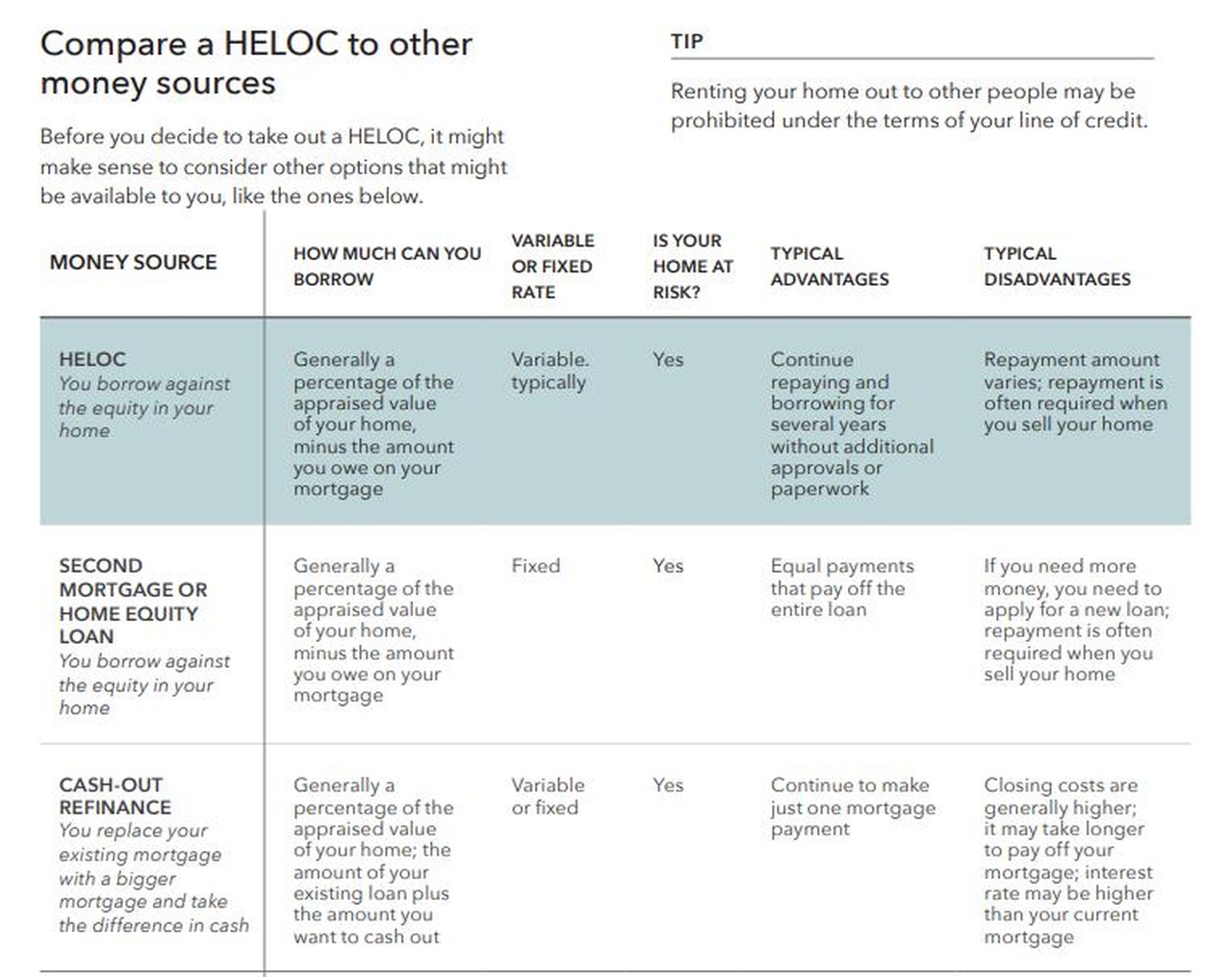
The federal consumer agency’s own comparison of the three options. Source: Consumer Financial Protection Bureau, What you should know about home equity lines of credit.
How a cash-out refinance works
You take a new first mortgage for more than you owe, pay off the old loan and receive the difference at closing. The amount is capped as a share of the home’s appraised value.
| Loan type | Maximum loan-to-value on a cash-out refinance |
|---|---|
| Conventional, one-unit primary home | 80% |
| Conventional, 2-to-4 unit primary home, second home or one-unit investment property | 75% |
| Conventional, 2-to-4 unit investment property | 70% |
| FHA | 80% of the adjusted value |
| VA | Up to 100% of the reasonable value under VA’s rule; lenders may set lower limits |
Fannie Mae Eligibility Matrix (August 5, 2026); Freddie Mac maximum LTV requirements; HUD Mortgagee Letter 2019-11; 38 CFR 36.4306.
Example: on a home appraised at $700,000 with a $400,000 balance, 80 percent is $560,000, so a conventional cash-out refinance could release up to $160,000 before closing costs. Two timing rules apply on Fannie Mae and Freddie Mac loans: at least one borrower must have been on title for six months, and a first mortgage being paid off must be at least 12 months old. Freddie Mac lists a minimum credit score of 620 in most cases. Current options are on our refinance page.
Cash-out pricing costs more than a standard refinance
Fannie Mae charges lenders a loan-level price adjustment on the loans it buys, set as a percentage of the loan amount, and its adjustments for cash-out refinances are higher than for other refinances. As a general industry practice, lenders pass that cost on through the interest rate or as points. The adjustment rises as the credit score falls and the loan-to-value rises.
| Credit score | Loan-to-value 60.01% to 70% | Loan-to-value 75.01% to 80% |
|---|---|---|
| 780 or higher | 0.625% | 1.375% |
| 740 to 759 | 1.000% | 2.375% |
| 700 to 719 | 1.625% | 3.250% |
Fannie Mae Loan-Level Price Adjustment Matrix dated September 30, 2026, cash-out refinance table. These are Fannie Mae’s published adjustments, not a rate quote; other adjustments can apply.
The practical lesson: borrowing to 70 percent instead of 80 percent, or raising your score first, lowers the cost. Eligible veterans have their own path, with a funding fee of 2.15 percent for first use and 3.3 percent after, unless exempt; see our VA loans page.
How a HELOC works
A HELOC is an open-end line of credit secured by your home. During the borrowing period, called the draw period, you can generally spend up to your limit, repay and borrow again. The CFPB gives 10 years as an example of a draw period. When it ends you can no longer borrow and you enter the repayment period, when, the CFPB warns, monthly payments are often significantly higher. Some plans require the whole balance at once as a balloon payment.
Most HELOCs have a variable rate: an index, commonly the U.S. prime rate, plus a margin the lender sets. The bank prime loan rate was 7.00 percent on October 1, 2026, after the Federal Reserve raised its federal funds target range by a quarter point on September 16, 2026. When prime moves, a HELOC payment moves with it.
| HELOC feature | What the CFPB and Regulation Z say |
|---|---|
| Payments during the draw period | Some plans allow interest-only payments, so the balance does not fall |
| Freezing or cutting the line | A lender may stop new draws or reduce the limit if the home’s value falls significantly or your finances change for the worse |
| Fees a lender might charge | Application, origination, appraisal and title fees; an annual fee; an inactivity fee; a cancellation fee for closing the line early; a fee to convert part of the balance to a fixed rate |
| Upfront costs | Some lenders waive some or all of them; others charge fees |
| Right to cancel | Three business days after opening the line on your principal home |
CFPB HELOC booklet and Ask CFPB pages; Regulation Z, 12 CFR 1026.40(f) and 1026.15; Federal Reserve H.15 release (October 2, 2026) and FOMC statement (September 16, 2026).
How a home equity loan differs
A home equity loan is also a second mortgage, but you receive one lump sum and usually pay a fixed rate in equal payments that pay the loan off. It suits a single known expense. If you need more later, you apply for a new loan.

Get a Mortgage Estimate for Free
See what a cash-out refinance would do to your monthly payment at today’s rates.
✓Free, no obligation✓Licensed in VA, MD, DC and WV✓Loan officer Ken Byrne, NMLS #187129
The deciding factor: your current mortgage rate
| Published average | Rate | As of |
|---|---|---|
| 30-year fixed mortgage (Freddie Mac) | 7.28% | October 1, 2026 |
| 15-year fixed mortgage (Freddie Mac) | 6.60% | October 1, 2026 |
| Bank prime loan rate (Federal Reserve) | 7.00% | October 1, 2026 |
| HELOC (Bankrate survey) | 7.29% | September 30, 2026 |
| Home equity loan, 15-year (Bankrate survey) | 8.56% | September 30, 2026 |
Freddie Mac Primary Mortgage Market Survey; Federal Reserve H.15; Bankrate national survey ($30,000 line, 700 FICO, 80% combined loan-to-value). Survey averages, not offers from any lender.
Many owners hold a rate far below these. A Realtor.com analysis of Federal Housing Finance Agency data found that 51.5 percent of outstanding mortgages carried a rate below 4 percent in the third quarter of 2025, and 78.8 percent were below 6 percent. A cash-out refinance gives that rate up on the entire balance.
Example 1: you have a low rate and need $100,000
You owe $400,000 at 3.5 percent with 25 years left, and your principal and interest payment is $2,002.
| Option | New borrowing | Monthly principal and interest | Change |
|---|---|---|---|
| Cash-out refinance to $500,000 at 7.28%, 30 years | $100,000 | $3,421 | +$1,419 |
| Keep the mortgage; HELOC at 7.29%, interest only | $100,000 | $2,002 + $608 = $2,610 | +$608 |
| Keep the mortgage; HELOC at 7.29%, repaid over 20 years | $100,000 | $2,002 + $793 = $2,795 | +$793 |
| Keep the mortgage; home equity loan at 8.56%, 15 years | $100,000 | $2,002 + $988 = $2,990 | +$988 |
Calculated with the standard amortization formula using the averages above, rounded to the nearest dollar. The 7.28 percent average is not a cash-out rate; cash-out pricing is typically higher. Illustration only; your rates, fees and terms will differ.
The second-loan options cost about $430 to $810 a month less than the cash-out refinance here, even though their rates are similar or higher, because only $100,000 is borrowed at the new rate. The trade-off is a variable rate on the HELOC: at 9.29 percent, its interest-only payment would be $774 instead of $608.
Example 2: your rate is already high
Now assume you owe $400,000 at 7.5 percent with 28 years left, a payment of $2,851. A $500,000 cash-out refinance at 7.28 percent costs $3,421, an increase of $570, with one fixed payment and a slightly lower rate on the whole balance. Keeping the loan and adding the interest-only HELOC costs $3,459. On these averages the two are close, before closing costs. A real cash-out quote is usually priced above the survey average (see the adjustment table above), the HELOC figure is interest only, and the refinance restarts a 30-year term, so compare actual quotes. The wider question is covered in should you refinance in 2026.
Which option fits which situation
| Situation | Option that often fits | Why |
|---|---|---|
| First-mortgage rate well below today’s | HELOC or home equity loan | Keeps the low rate on the existing balance |
| First-mortgage rate near or above today’s | Cash-out refinance is worth pricing | One payment; little or no rate advantage is given up on the existing balance. Compare closing costs |
| One large known cost | Home equity loan or cash-out refinance | Fixed lump sum and fixed payment |
| Costs spread over time, such as a renovation in stages | HELOC | Interest is charged only on what you draw |
| Eligible veteran needing more than 80% of value | VA cash-out refinance | VA’s rule allows up to 100% of value; lenders may set lower limits |
| You want to pay off other debts | Any of the three, with care | Unsecured debt becomes debt secured by your home |
General guidance based on the product rules cited above. Not a recommendation for any individual borrower.
For renovations there are also loans built for the purpose; see our guide to home renovation loans.
Recordation tax in Virginia, Maryland and DC
Every option records a new deed of trust, and each jurisdiction taxes that differently. This is a DMV cost that national comparisons often leave out. A home equity loan is also a new deed of trust, taxed on its full amount in Virginia (25 cents per $100) and in Maryland; DC’s exemption applies on the same terms.
| Cash-out refinance | New HELOC | |
|---|---|---|
| Virginia | 18 cents per $100 on the full new loan when it refinances a deed of trust on which the tax was paid. $900 state tax on $500,000 | 25 cents per $100 on the maximum credit limit. $250 state tax on a $100,000 line |
| Maryland | Tax applies only to the amount above the unpaid principal of the old loan, when the original borrower refinances. County rates vary; at Prince George’s $2.75 per $500, $100,000 of new money is $550 | Taxable. Under the statute it can be paid on amounts as they are drawn or on the maximum line |
| Washington, DC | Exempt for residential property with five or fewer units, with the required affidavit | Exempt on the same terms |
Va. Code 58.1-803 and 58.1-814; Md. Code, Tax-Property 12-105(f) and 12-108(g); D.C. Code 42-1102(21) and OTR Tax Notice 2023-04. In Virginia, a county or city may add a local tax equal to one-third of the state tax. Recording fees are separate.
Lender, appraisal and title charges come on top. For how those are itemized, see our guide to closing costs in Virginia.
Get Pre-Approved Today
Find out how much equity a cash-out refinance could release and what it would cost.
✓Free, no obligation✓Licensed in VA, MD, DC and WV✓Loan officer Ken Byrne, NMLS #187129
Is the interest tax deductible?
This is general tax information, not advice. Under IRS rules, interest on a loan secured by your home is deductible only to the extent the money is used to buy, build or substantially improve that home, and only if you itemize. That applies to all three options: cash taken out in a refinance and spent on a car or on credit cards does not produce deductible interest. The overall limit is interest on the first $750,000 of such debt ($375,000 if married filing separately), which the 2025 tax law made permanent. Older debt from before December 16, 2017 keeps a $1 million limit ($500,000 if married filing separately). Confirm your own situation with a tax professional.
IRS Publication 936 (2025); Public Law 119-21, section 70108, as summarized by the Senate Finance Committee.
Risks and rights to know before you sign
| Point | What it means |
|---|---|
| Your home secures the debt | If you cannot repay any of these loans, you could lose your home |
| Three business days to cancel | On a refinance, HELOC or home equity loan secured by your principal home (not a loan used to buy it), you can generally cancel until midnight of the third business day after closing or opening the line, or after you receive the required notice and disclosures if that is later. Funds are generally not paid out until that period ends. If you refinance with your current lender, the right covers only the new money |
| Payment shock on a HELOC | Payments can jump when the draw period ends or the index rises |
| A HELOC is not guaranteed cash | The lender can freeze or reduce the line in the situations the regulation lists |
| A refinance restarts the clock | A new 30-year term can mean paying on the home for longer |
| Debt-to-income still counts | Under Fannie Mae’s rules, a HELOC with a required payment is counted in your monthly debts when you apply for a mortgage |
12 CFR 1026.23, 1026.15 and 1026.40(f); CFPB; Fannie Mae Selling Guide B3-6-05.
How lenders measure the last point is explained in our guide to the debt-to-income ratio.
How much equity do homeowners have?
| Measure | Figure | Source and date |
|---|---|---|
| Total mortgage holder equity | $18 trillion | ICE Mortgage Monitor, second quarter 2026 |
| Tappable equity | $11.7 trillion, held by 47.5 million mortgage holders. ICE reports an average of about $212,000 per borrower | ICE Mortgage Monitor, second quarter 2026 |
| Average equity per homeowner with a mortgage | $310,000 | Cotality Homeowner Equity Insights, second quarter 2026 |
ICE press release, August 10, 2026; Cotality press release, September 10, 2026. National figures.
For a local look at using that equity, including selling instead of borrowing, see our post on tapping home equity in Fairfax.
How to compare offers
The CFPB’s advice is to get three estimates. For a HELOC, ask each lender for the index and margin, the rate cap, the draw and repayment terms, every fee in the table above and whether there is a balloon payment. For a cash-out refinance, compare Loan Estimates and look at the rate, points and total closing costs together. ALCOVA Mortgage lists cash-out and rate-and-term refinances among its loan options, and Ken Byrne’s team can show you the cash-out numbers to set beside a bank or credit union HELOC quote.
Frequently asked questions
Is a HELOC or a cash-out refinance better?
It depends mostly on your current mortgage rate. If it is well below today’s rates, a HELOC keeps it and can cost less each month, as in the example above. If it is near or above today’s rates, a cash-out refinance gives you one fixed payment.
What is the difference between a HELOC and a home equity loan?
A HELOC is a revolving line you can draw on repeatedly, usually at a variable rate. A home equity loan pays out one lump sum, usually at a fixed rate with equal payments.
How much can I borrow with a cash-out refinance?
On a conventional loan for a one-unit primary home, up to 80 percent of the appraised value, less what you owe. FHA is also 80 percent. VA’s rule allows up to 100 percent for eligible veterans, though lenders may set lower limits.
Is a HELOC a good idea?
It can be for costs spread over time when you want to keep a low first-mortgage rate. The risks are a variable rate, higher payments after the draw period and a home that secures the debt.
Are HELOC rates fixed or variable?
Usually variable, tied to an index such as the prime rate plus a margin. The bank prime loan rate was 7.00 percent on October 1, 2026.
Do I pay closing costs on a HELOC?
Sometimes. The CFPB says some lenders waive some or all upfront costs and others charge fees. In Virginia and Maryland a recordation tax applies to the deed of trust.
Is cash-out refinance interest tax deductible?
In general, yes on the part that refinances your original purchase debt and on any cash used to buy, build or substantially improve the home, within the IRS debt limit ($750,000 for most newer loans), and only if you itemize. Cash used for other purposes does not produce deductible interest. This is general information; confirm with a tax professional.
How soon after buying can I do a cash-out refinance?
Under Fannie Mae and Freddie Mac rules, at least one borrower must have been on title for six months, and the first mortgage being paid off must be at least 12 months old. Exceptions exist, including inherited property and delayed financing after a cash purchase.
Can a lender freeze my HELOC?
Yes. Federal rules allow a lender to stop new draws or reduce the limit if the home’s value falls significantly below its appraised value or the lender reasonably believes a material change in your finances will leave you unable to repay, among other listed situations.
Next stepStart Your Pre-Approval
Start online, and Ken Byrne’s team will compare a cash-out refinance with keeping your current loan.
✓Free, no obligation✓Licensed in VA, MD, DC and WV✓Loan officer Ken Byrne, NMLS #187129
This article is general information, not financial or legal advice and not a commitment to lend or an offer of credit. Loan limits, program rules, premium schedules and rates change, and individual eligibility depends on a full review of your credit, income, assets and the property. Every figure here is an illustration, not a quote, built from published sources and a weekly survey average rather than underwriting decisions. Insurance and mortgage insurance amounts are planning estimates. Confirm anything you plan to act on with a licensed mortgage professional. Rules and published rate averages were checked on October 5, 2026 and change often. Examples are illustrations, not quotes. This is not tax or legal advice.
Categories
Recent Posts









GET MORE INFORMATION

Broker Associate