What Credit Score Do You Need to Buy a House in 2026? Loan-by-Loan Breakdown

by Arslan Jamil

What Credit Score Do You Need to Buy a House in 2026? Loan-by-Loan Breakdown

Published March 2026  |  JB Financing Team  |  14-minute read


Your credit score is one of the single biggest factors that determines whether you can buy a home — and how much that home will actually cost you over 30 years. In 2026, the mortgage landscape is shifting dramatically: Fannie Mae has eliminated its minimum credit score requirement, new scoring models are rolling out, and 30-year fixed rates have dropped below 6% for the first time since 2022.

What credit score do you need to buy a house in 2026 — loan-by-loan breakdown

If you're buying in the Northern Virginia, DC, or Maryland market — where the median sold price was $675,000 in January 2026 according to NVAR — understanding exactly where your credit needs to be could save you tens of thousands of dollars. This guide breaks down every major loan type, shows how each credit score tier affects your rate, and gives you a concrete roadmap to strengthen your score before you apply.

Quick Answer

The minimum credit score to buy a house in 2026 depends on your loan type: 500 for FHA (with 10% down), 580 for FHA (with 3.5% down), 620 for most conventional lenders, no official VA minimum (lenders typically require 580–620), and 640 for USDA. Your score also determines your interest rate — the difference between a 620 and a 760+ score on a typical Northern Virginia home can mean $400+ more per month and over $150,000 in extra lifetime interest.

Key Takeaways

  • FHA loans offer the lowest entry point — qualify with a 580 score and just 3.5% down, or even 500 with 10% down.
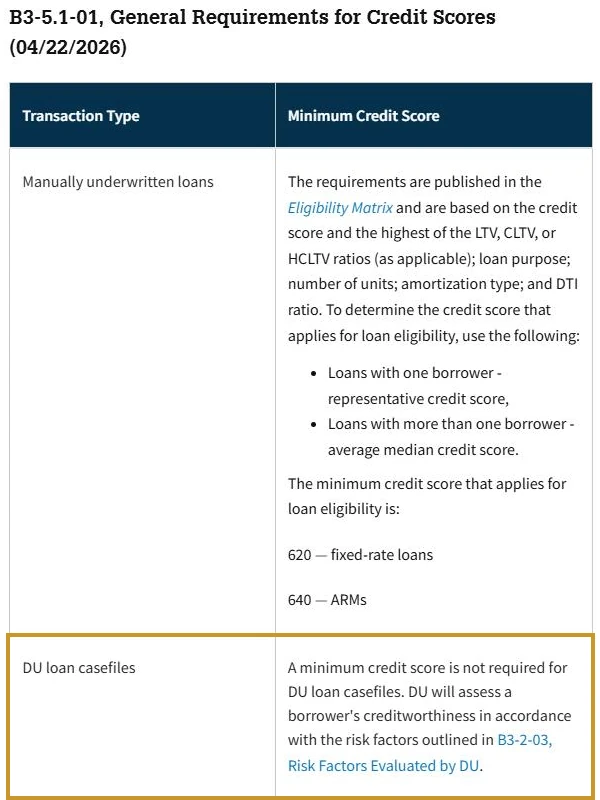
  • Conventional loans typically require 620, even though Fannie Mae officially dropped its minimum score requirement in November 2025.
  • VA loans have no government-mandated minimum, making them the most accessible option for eligible veterans and service members stationed near the Pentagon, Fort Belvoir, and Quantico.
  • USDA loans generally require a 640 for automated approval, with 100% financing in qualifying rural areas near the DMV.
  • A 760+ score unlocks the best available rates — currently around 5.8%–6.0% for 30-year fixed loans as of early March 2026.
  • New FICO 10T and VantageScore 4.0 models rolling out throughout 2026 weigh 24 months of behavior and may help renters and thin-file borrowers qualify.
  • The 2026 conforming loan limit in the DC metro high-cost area is $1,249,125 — up from $1,209,750 in 2025 — meaning more buyers can avoid jumbo requirements.

Minimum Credit Scores by Loan Type — At a Glance

Before diving into each program, here's the side-by-side comparison you need. This table covers every major loan type available to DMV-area buyers in 2026, including the minimum credit score, down payment, mortgage insurance rules, and the conforming loan limit that applies to this market.

Loan Type Min. Score Min. Down Payment Mortgage Insurance 2026 Loan Limit (DC Metro)
Conventional 620* 3% PMI if <20% down (removable) $1,249,125
FHA 500–580 3.5% (580+) / 10% (500–579) MIP for life of loan** $1,249,125
VA No official min. 0% No PMI (funding fee applies) No limit (full entitlement)
USDA 640 0% Guarantee fee (1% up + 0.35%/yr) Varies by county
Jumbo 680–700+ 10–20% Varies by lender Above $1,249,125

*Fannie Mae removed its official minimum score Nov. 15, 2025; most lenders still require 620+. **MIP removable after 11 years with 10%+ down payment. 2026 DC metro conforming limit per FHFA. Figures estimated as of March 2026, subject to change.

Conventional Loans: What's Changed in 2026

Conventional loans remain the most popular mortgage in America, financing over half of all home purchases. These loans follow Fannie Mae and Freddie Mac guidelines and aren't directly backed by a government agency.

Here's the headline change for 2026: Fannie Mae officially eliminated its minimum credit score requirement on November 15, 2025. Instead of mandating a specific FICO floor, risk decisions now weigh a broader set of factors — borrower reserves, debt levels, property type, and loan purpose. Freddie Mac is following a similar trajectory.

In practice, however, nearly all lenders still require a minimum of 620 to 640. Lenders set their own "overlays" — additional requirements beyond what the GSEs mandate — so 620 remains the practical benchmark.

Conventional Loan Quick Facts (2026)

  • Practical minimum score: 620 (some lenders require 640+)
  • Down payment: As low as 3% for first-time buyers, 5% for repeat buyers
  • PMI: Required below 20% down — but removable once you reach 20% equity
  • 2026 conforming loan limit (DC metro high-cost): $1,249,125
  • 2026 baseline limit (most US counties): $832,750
  • DTI allowance: Up to 50% with strong compensating factors
  • Best for: Buyers with 680+ scores who want removable mortgage insurance and competitive rates

For buyers in Fairfax County, Arlington, or Loudoun County, the $1,249,125 high-cost conforming limit is a game-changer. You can finance a home priced well over $1 million with a modest down payment without stepping into jumbo territory and its stricter requirements. That matters enormously in a market where the median is $675,000 and plenty of single-family homes exceed $900,000.

FHA Loans: The Low-Score Gateway to Homeownership

FHA loans, insured by the Federal Housing Administration, are purpose-built for buyers with lower credit scores and smaller down payments. They remain the single best option for buyers whose credit is still a work in progress.

FHA Credit Score Tiers

Credit Score Range Min. Down Payment MIP Duration What to Know
580 or higher 3.5% Life of loan* Most common FHA scenario; competitive rates available; 30-year FHA average around 5.90% in March 2026
500–579 10% 11 years** Harder to find lenders; strong compensating factors needed (low DTI, cash reserves, stable job history)
Below 500 N/A N/A Does not qualify for FHA financing

*With less than 10% down, MIP lasts the full loan term. **MIP drops after 11 years with 10%+ down.

FHA loans carry an upfront mortgage insurance premium of 1.75% of the loan amount (usually rolled into the loan) plus an annual MIP of 0.40%–0.85% depending on LTV and term. While these costs add up, FHA loans often make homeownership possible years sooner than waiting to build a 620+ conventional-qualifying score.

For first-time buyers in Virginia, down payment assistance programs through VHDA — including grants of 2–2.5%, the VHDA Plus program covering 3–5%, and the Mortgage Credit Certificate (MCC) offering a 20% federal tax credit on mortgage interest up to $2,000/year — can cover part or all of the 3.5% FHA down payment.

Not Sure Which Loan Fits Your Credit Profile?

Get pre-approved in minutes and see which programs you qualify for — no obligation, and your initial review won't impact your credit score.

Get Pre-Approved Today →

VA Loans: No Minimum Score, Maximum Benefit

For eligible veterans, active-duty service members, and surviving spouses, VA loans are the gold standard of mortgage financing. The Department of Veterans Affairs sets no official minimum credit score — one of the most borrower-friendly features in any loan program.

Individual lenders still set their own standards. Most VA-approved lenders require 580 to 620, and some will go as low as 500 for borrowers with a clean 12-month payment history and strong compensating factors.

Why VA Loans Stand Apart

  • No down payment — 100% financing, even on high-value properties
  • No private mortgage insurance (PMI) — significant monthly savings vs. FHA and conventional
  • No loan limit for borrowers with full entitlement (partial entitlement uses $832,750 baseline)
  • Lowest rates available — 30-year VA averaging ~5.41% in early March 2026
  • VA funding fee applies (1.25%–3.3%) but can be rolled into the loan; waived for service-connected disabilities
  • More flexible DTI — VA uses a "residual income" analysis alongside standard DTI calculations

VA loans are especially powerful in Northern Virginia given the concentration of military installations. Service members stationed at the Pentagon in Arlington, Fort Belvoir near Springfield, Marine Corps Base Quantico near Woodbridge, and Joint Base Andrews in Prince George's County, MD can purchase homes with zero down and no loan cap — a decisive advantage in a market where median prices range from $550,000 to $765,000 depending on the county.

USDA Loans: Zero Down Payment in Qualifying Areas Near the DMV

USDA loans offer 100% financing for low- to moderate-income buyers purchasing in designated rural areas. While "rural" may sound remote, qualifying zones sit surprisingly close to the DC metro — including parts of Stafford County, Fauquier County, western Loudoun County, and most of West Virginia's Eastern Panhandle.

USDA Requirement Details
Minimum Credit Score 640 for automated (GUS) approval; lower scores possible with manual underwriting
Down Payment 0% — full 100% financing available
Upfront Guarantee Fee 1% of loan amount (can be financed into the loan)
Annual Fee 0.35% of remaining balance, paid monthly
Income Limit Cannot exceed 115% of area median income
Location Requirement Property must be in a USDA-eligible area (check the USDA eligibility map online)

Jefferson County and Berkeley County in West Virginia — where property tax rates are just 0.58%–0.59% — qualify for USDA financing and sit within commuting distance of the DC metro. For buyers willing to look slightly outside core NoVA, USDA loans offer a combination of zero down payment and low annual fees that's hard to beat.

Jumbo Loans: Higher Standards for Larger Amounts

Shopping for a home above the $1,249,125 DC-metro conforming limit — which applies in neighborhoods like McLean, Great Falls, or luxury pockets of Vienna — means a jumbo loan. Since these aren't backed by Fannie Mae or Freddie Mac, lender requirements are stricter and vary considerably.

Typical Jumbo Loan Requirements (2026)

  • Credit score: 680+ minimum; 700+ for better LTV options; 720+ for the best rates
  • Down payment: 10–20% typical; some lenders accept 10% at 700+ scores
  • Cash reserves: 6–12 months of mortgage payments in liquid assets
  • DTI ratio: Generally capped at 43% (more conservative than conforming)
  • Current average jumbo rate: ~6.21% for 30-year fixed (as of early March 2026)

The good news for 2026: the jump from $1,209,750 to $1,249,125 means roughly $40,000 more buying power before you cross into jumbo territory. For a buyer putting 10% down, that translates to a maximum purchase price of approximately $1,388,000 while still qualifying for conforming-loan underwriting — a meaningful threshold in upper NoVA neighborhoods.

How Your Credit Score Affects Your Mortgage Rate — The Real Dollar Impact

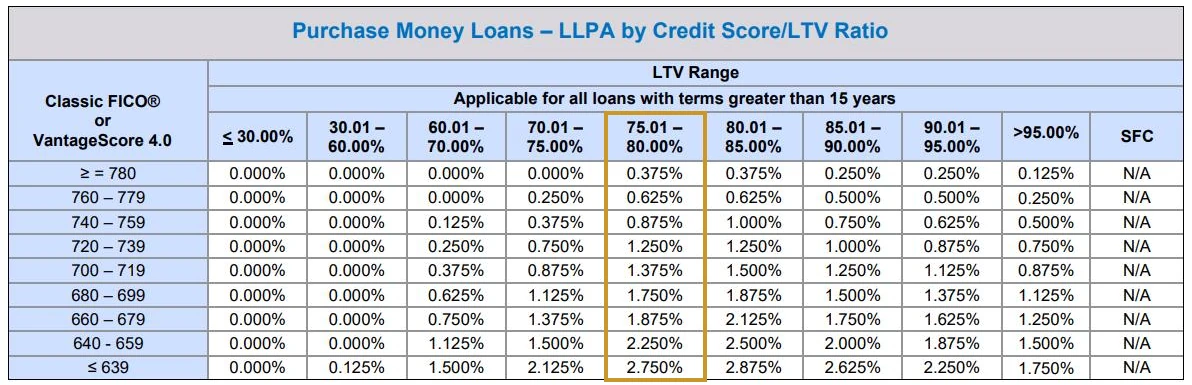
This is where credit scores stop being abstract and start costing (or saving) real money. Mortgage lenders price rates in tiers, and even a small score improvement can shift you into a more favorable bracket.

Below is an estimated breakdown of how different credit score ranges affect your rate and monthly payment on a $400,000, 30-year fixed conventional mortgage using Curinos/myFICO data from early 2026.

FICO Score Est. APR Monthly P&I Total Interest (30 yr) Extra Cost vs. 760+
760–850 ~6.18% $2,444 $479,840
700–759 ~6.40% $2,498 $499,280 +$19,440
680–699 ~6.58% $2,542 $515,120 +$35,280
660–679 ~6.79% $2,594 $533,840 +$54,000
620–659 ~7.31% $2,724 $580,640 +$100,800

Rates based on Curinos/myFICO data, Feb. 2026. Assumes $400K loan, 30-yr fixed, 20% down. Your actual rate will vary. Use our mortgage calculator for personalized estimates.

Monthly Payment by Credit Score Tier ($400K Loan)

760–850$2,444/mo
 
700–759$2,498/mo
 
680–699$2,542/mo
 
660–679$2,594/mo
 
620–659$2,724/mo
 

The gap between the highest and lowest tiers: $280/month and over $100,000 in total interest over 30 years.

What This Means in the Northern Virginia & DC Metro Market

National averages tell one story. Local prices tell another entirely. When the median sold price in Northern Virginia is $675,000 (NVAR, January 2026) and you're financing $540,000+ after a typical down payment, every basis point matters far more than it would on a $300,000 loan in a lower-cost market.

DMV Area Approx. Median Price Property Tax Rate 2026 Price Forecast
Arlington County $750,000+ 1.013% +3.8% (NVAR)
Fairfax County $700,000+ 1.11% +1.9% (NVAR)
Loudoun County $765,000 0.87% +3.3% (NVAR)
Prince William County $550,000 1.037% -0.2% (NVAR)
Alexandria City $650,000+ 1.09% +4.2% (NVAR)
Washington, D.C. $625,000+ 0.85% Moderate growth

Median prices approximate based on NVAR, Bright MLS, and Redfin data (Jan. 2026). 2026 price forecasts from NVAR/GMU Regional Housing Market Forecast.

Real Cost Example: Score Impact on a $675,000 NoVA Home

Here's what the credit score gap looks like on a real Northern Virginia purchase — a $675,000 home with 10% down ($67,500), financing $607,500 over 30 years:

Score Est. Rate Monthly P&I Total Interest (30 yr) Extra vs. 760+
760+ 6.18% $3,712 $728,820
700–759 6.40% $3,794 $758,340 +$29,520
660–679 6.79% $3,941 $811,260 +$82,440
620–659 7.31% $4,139 $882,540 +$153,720

Estimates for illustration only. Does not include property taxes, insurance, PMI, or HOA. Actual terms subject to qualification.

On a typical NoVA home, the gap between a 620 and 760+ score is roughly $427 more per month and over $153,000 in extra lifetime interest. That's equivalent to a college tuition fund or a significant investment property down payment.

See What Rate Your Score Qualifies For

Estimate your monthly payment on any Northern Virginia home with our free mortgage calculator.

Try the Mortgage Calculator →

2026 Credit Scoring Changes: FICO 10T & VantageScore 4.0

The most significant credit scoring shift in decades is underway. The FHFA has mandated that Fannie Mae and Freddie Mac accept FICO 10T and VantageScore 4.0 when purchasing conforming loans. VantageScore 4.0 is already available to the GSEs, while FICO 10T began rolling out in early 2026. VantageScore estimates roughly 5 million additional consumers could become scorable or see improved scores under the new models.

Feature Classic FICO (Current) FICO 10T (New) VantageScore 4.0 (New)
Data Approach Point-in-time snapshot 24-month trended data 24-month trended data
Rent Payments Not considered Limited inclusion Emphasized
Utility & Phone Bills Not considered May factor in Yes
Debt Paydown Trends Not visible Rewarded Rewarded
Thin Credit Files Often unscorable Better handling Scores more profiles
Revolving Balance Behavior Current balance only Rewards payoff patterns Rewards payoff patterns

Implementation Timeline


Nov 2025
Fannie Mae drops
min. score req.
Q1 2026
FICO 10T &
VS 4.0 available
to lenders
Mid 2026
Major lenders
begin adopting
new models
Q4 2026+
Full GSE
implementation
expected

What this means right now: If you're applying for a mortgage in early-to-mid 2026, your lender may still be using classic FICO scores (Score 2, Score 5, Score 4). But if you have a thin credit file or strong rent payment history, ask whether your lender has adopted the new models — early adopters like Guild Mortgage and AmeriHome already accept alternative credit data.

How to Improve Your Credit Score Before Applying for a Mortgage

Your credit score isn't fixed. Most buyers can improve by 20–40 points within 60–90 days with focused effort. Even a 20-point bump can shift you into a lower rate tier and save tens of thousands over the life of your loan.

Weeks 1–2: Check & Dispute

Pull free reports from all three bureaus at AnnualCreditReport.com. Dispute errors — incorrect balances, accounts that aren't yours, misreported late payments. Errors appear on roughly 1 in 4 reports and can be resolved within 30 days.

Weeks 2–4: Attack Credit Utilization

Pay credit card balances below 30% of your limit — ideally below 10%. This single factor accounts for roughly 30% of your FICO score and produces the fastest improvements. If you can't pay down balances quickly, request credit limit increases (without a hard pull) to improve the ratio.

Weeks 4–8: Build Positive History

Make every payment on time — credit cards, utilities, rent, subscriptions, medical bills. Set up autopay for at least the minimum on every account. Don't close old credit cards, because the length of your credit history factors into your score.

Weeks 8–12: Freeze & Protect

Stop applying for new credit entirely. Every hard inquiry can cost 3–5 points temporarily. No new store cards, no furniture financing, no auto loan applications before your mortgage. Let your improved habits compound.

Pro Tip: Ask About Rapid Rescoring

If you're a few points away from a critical threshold (e.g., 617 trying to hit 620), your loan officer can sometimes order a rapid rescore — a process that updates your report within days to reflect a recent payoff or corrected balance.

Common Credit Score Mistakes Homebuyers Make

Even well-prepared buyers accidentally tank their credit at the worst possible time. Avoid these common errors during the home-buying process.

  • Opening new credit accounts before closing — a new card triggers a hard inquiry and lowers your average account age, dropping your score 5–15 points.
  • Making large purchases on credit — spiking utilization right before closing can cost 20+ points overnight.
  • Closing old credit cards — reduces total available credit and shortens credit history length.
  • Missing even one payment — a single 30-day late payment can drop your score 80–110 points. Set up autopay everywhere.
  • Co-signing for someone else — their debt appears on your report and inflates your debt-to-income ratio.
  • Checking only one bureau — mortgage lenders use your middle tri-merge score. An error on just one bureau can drag it down.
  • Thinking Credit Karma = your mortgage score — free consumer tools typically show VantageScore 3.0, which can differ from mortgage FICO scores by 20–40 points or more.

Ready to See What You Qualify For?

Our team reviews your full financial picture — not just your score. Get pre-approved and discover your real options.

Start Your Pre-Approval →

Alternatives If Your Credit Score Isn't Mortgage-Ready

If your score falls below the minimum for your target loan, you still have several practical options — many of which move faster than you'd expect.

Alternative How It Works Timeline
Targeted credit repair Work with your loan officer on a specific plan to hit your target score threshold 60–180 days
Non-traditional credit Some lenders accept rent, utility, and phone payment records for thin-file borrowers Immediate
Co-borrower strategy Adding someone with a higher score may help qualify and improve your rate tier Immediate
DPA programs VHDA grants (2–5%), DC's HPAP (up to $202K), and MD's MMP can offset higher-rate costs Varies by program
Buy now, refinance later Purchase at today's available rate, refinance once your score improves or rates drop further 6–24 months

With Freddie Mac's 30-year fixed averaging 5.98% as of late February 2026 and Zillow data showing rates around 5.81% — the lowest since September 2022 — waiting months for a "perfect" score could cost more than the rate premium you'd pay today, especially as NVAR forecasts prices rising 1.9%–4.2% across most NoVA jurisdictions this year.

Frequently Asked Questions

What is the absolute lowest credit score to buy a house in 2026?

The lowest qualifying score is 500, through an FHA loan with 10% down. Finding lenders willing to work at this threshold is challenging — you'll need strong compensating factors like steady two-year employment, low debt, and cash reserves. Most buyers find 580 (FHA with 3.5% down) to be the practical starting point. Working with an experienced local lender who handles multiple loan programs — FHA, VA, conventional, and USDA — increases your chances of finding the right fit for your situation.

Can I buy a house in Virginia with a 600 credit score?

Yes. A 600 score qualifies you for FHA financing with 3.5% down, and potentially for a VA loan if you have military eligibility. Your interest rate will be higher than someone with 700+, but Virginia's VHDA down payment assistance programs can help offset upfront costs. In areas like Prince William County or Manassas, where median prices are lower than close-in NoVA, a 600-score buyer can find realistic options — especially with townhomes starting in the mid-$400s.

Is a 620 credit score good enough for the DC metro area?

A 620 meets the minimum for most conventional lenders and easily qualifies for FHA. However, in the high-cost DMV market, the rate premium at 620 versus 740+ translates to substantially more monthly dollars because loan amounts are much larger than the national average. If you're within 20–40 points of a higher tier, spending 2–3 months improving your score before applying may be worthwhile. Otherwise, buying now and refinancing later — especially with rates already at multi-year lows — is a proven strategy.

Do VA loans really have no minimum credit score?

Correct — the Department of Veterans Affairs sets no official minimum. But the VA doesn't lend directly; private lenders issue VA-backed loans and set their own overlays, typically 580–620. Some will work with scores as low as 500 given clean 12-month payment history. The combination of no down payment, no PMI, and no loan limit for full entitlement makes VA loans the most powerful financing option in the DMV for eligible borrowers.

What score do I need for the best mortgage rate in 2026?

A FICO score of 760 or higher typically earns the best available rate tier. As of early March 2026, top-tier borrowers are seeing 30-year fixed rates in the upper 5% to low 6% range depending on the lender, down payment, and property type. Scores between 740 and 759 receive very competitive rates with minimal premium over the best tier. The steepest rate penalties begin below 680, and particularly below 660.

How will FICO 10T and VantageScore 4.0 change my mortgage application?

These new models analyze 24 months of "trended data" instead of a single-day snapshot. They can see whether you've been consistently paying down debt or accumulating it, and they factor in rent and utility payment histories. If you've been steadily reducing balances and making on-time rent payments, your score under these models may be higher than your classic FICO. Lenders are adopting the new models throughout 2026, so ask your lender which scoring system they currently use.

How fast can I improve my credit score before buying in Northern Virginia?

Most buyers can gain 20–40 points within 60–90 days through targeted effort — paying credit card balances below 30% utilization, disputing errors on their reports, and avoiding new credit applications. In some cases, a rapid rescore through your lender can reflect improvements in just days. The speed depends on your starting point and which factors are weighing your score down most.

Does checking my own credit score hurt it?

No — checking your own score is a "soft inquiry" with zero impact. You should check all three bureau reports before starting the mortgage process. When a lender formally pulls your credit for an application, that's a "hard inquiry" that may cost 3–5 points temporarily. However, multiple mortgage inquiries within a 14–45 day window count as a single inquiry for scoring purposes, so rate-shopping across lenders won't penalize you repeatedly.

Which credit score do Virginia mortgage lenders actually use?

Most lenders currently use classic FICO scores: FICO Score 2 (Experian), FICO Score 5 (Equifax), and FICO Score 4 (TransUnion). They pull a tri-merge report combining all three and typically use the middle score for qualification. With a co-borrower, lenders generally use the lower of the two applicants' middle scores. These classic versions differ from the FICO 8 or VantageScore 3.0 shown on free consumer apps like Credit Karma.

Should I wait to improve my score or buy now in the DMV?

It depends on your individual situation. Waiting 3–6 months to gain 40+ points could save 0.25%–0.50% on your rate — significant over 30 years. But if prices in your target area are rising (NVAR forecasts 1.9%–4.2% growth across most NoVA jurisdictions in 2026), the appreciation you miss could outweigh the rate savings. Many savvy current buyers are purchasing at today's historically low rates and planning to refinance later as their score improves or if market rates decline further.

How do I choose the best mortgage lender in Northern Virginia for my credit situation?

Look for a lender experienced across multiple loan programs — conventional, FHA, VA, and USDA — so they can match you with the best option rather than force-fitting one program. A strong lender reviews your complete financial picture, not just your score, and may suggest credit improvement strategies or alternative programs you haven't considered. Local expertise matters; a lender familiar with VHDA assistance, county-level grants, and DC/Maryland programs can expand your options significantly. JB Financing, led by Ken Byrne (NMLS #187129) with over 20 years of experience and more than 4,000 families served, works across all loan types throughout Virginia, DC, and Maryland.

Can I buy a house after bankruptcy or foreclosure in Virginia?

Yes, but mandatory waiting periods apply. After Chapter 7 bankruptcy: 2 years for FHA and VA, 4 years for conventional. After foreclosure: 3 years for FHA/VA, 7 years for conventional (certain exceptions may reduce these). During the waiting period, focus aggressively on rebuilding credit with on-time payments and low utilization. Once the waiting period ends, a rebuilt score of 620+ opens access to most mainstream programs.

Have Questions About Your Credit & Mortgage Options?

Our team has helped thousands of DMV-area families find the right loan — regardless of starting credit score.

Get Pre-Approved Today →

Glossary of Key Terms

FICO Score
A credit score developed by Fair Isaac Corporation, ranging from 300–850. Higher = lower risk. The dominant score used in mortgage underwriting.

Credit Utilization Ratio
Total credit card balances divided by total credit limits. Keeping this below 30% (ideally under 10%) is one of the fastest ways to boost your score.

PMI (Private Mortgage Insurance)
Insurance required on conventional loans with less than 20% down payment. Unlike FHA's MIP, PMI is removable once you reach 20% equity.

MIP (Mortgage Insurance Premium)
FHA's version of mortgage insurance: 1.75% upfront + 0.40%–0.85% annually. Typically lasts the full loan term with less than 10% down.

DTI (Debt-to-Income Ratio)
Total monthly debt payments divided by gross monthly income. Most conventional lenders cap at 43–50%, while FHA may allow up to 57% with compensating factors.

Conforming Loan Limit
Maximum loan amount Fannie Mae/Freddie Mac will purchase. Baseline is $832,750 in 2026; the DC metro high-cost limit is $1,249,125. Loans above this require jumbo financing.

Trended Data
A credit scoring approach that analyzes 24 months of payment behavior rather than a single snapshot. Used by the new FICO 10T and VantageScore 4.0 models.

Tri-Merge Credit Report
A combined report pulling data from Experian, Equifax, and TransUnion. Mortgage lenders use the middle of your three scores from this combined report.

Your Next Steps

Your credit score opens doors — but it doesn't need to be perfect to start your homeownership journey. Whether you're at 580 exploring FHA options or at 740 hunting for the best rate on a Northern Virginia home, the key is knowing where you stand and which programs match your situation.

With 2026 bringing new scoring models, rates at their lowest since 2022, a higher $1,249,125 conforming limit for the DC metro, and a NoVA market that NVAR describes as "finding balance" with rising inventory and moderate price growth — this may be one of the most favorable buying windows in years.

Start by checking your credit reports, run numbers through our mortgage calculator, and get pre-approved to see your real options.

Let's Find the Right Loan for Your Credit Profile

Contact Ken Byrne at (703) 927-4456, email kbyrne@alcova.com, or get pre-approved online today.

Selling your home? The Jamil Brothers team lists homes for just 1.5% commission — full service, no compromises.

Get Pre-Approved Now →

Written by the JB Financing Team | ALCOVA Mortgage LLC, NMLS #40508
Ken Byrne, Branch Partner, NMLS #187129 | (703) 927-4456 | kbyrne@alcova.com

JB Financing | ALCOVA Mortgage LLC | NMLS #40508 | Equal Housing Lender


Name
Phone*
Message