DC's HPAP Program: Up to $202,000 in Homebuyer Assistance
by Arslan Jamil

DC's HPAP Program: Up to $202,000 in Homebuyer Assistance

Updated March 2026  ·  11 min read

Washington DC's Home Purchase Assistance Program (HPAP) is widely considered one of the most generous down payment assistance programs in the country — and for good reason. Eligible first-time homebuyers in the District can receive up to $202,000 in interest-free gap financing, plus an additional $4,000 toward closing costs, making homeownership realistic even in one of America's most expensive housing markets.

Washington DC cherry blossoms with the Washington Monument — DC HPAP homebuyer assistance program

With DC's median home price hovering around $617,000–$650,000, that level of assistance can be the difference between renting indefinitely and owning your first home. But the program has specific eligibility rules, limited annual funding, and a multi-step application process that trips up many applicants. This guide walks you through everything — who qualifies, how much you can receive, how to apply, and how to pair HPAP with a mortgage that works for your budget.

Quick Answer

HPAP provides DC first-time homebuyers with up to $202,000 in zero-interest, deferred down payment assistance plus $4,000 for closing costs. The loan amount depends on your household income and size, requires a minimum 630 credit score, and is administered through DC-approved community-based organizations. For very low- and low-income households, there are no monthly payments at all — the loan is only repaid when you sell, refinance, or move out.

Key Takeaways

  • Maximum assistance: $202,000 in gap financing + $4,000 for closing costs (up to $206,000 total)
  • Loan type: Interest-free, deferred loan — no monthly payments for qualifying low-income households
  • Who qualifies: First-time homebuyers (no ownership in past 3 years) purchasing a primary residence in DC
  • Minimum credit score: 630 for HPAP, though your mortgage lender may require higher
  • Buyer contribution: Just $500 minimum or 50% of liquid assets above $3,000, whichever is greater
  • Stackable: Can be combined with EAHP (for DC government employees) and DC Open Doors
  • FY2026 status: HPAP is funded for Fiscal Year 2026; applicants are assisted based on application priority date

What Is HPAP and How Does It Work?

The Home Purchase Assistance Program (HPAP) is administered by the DC Department of Housing and Community Development (DHCD) and processed through the DC Housing Finance Agency (DCHFA) and the Greater Washington Urban League (GWUL). The program has existed for decades, but the current assistance levels — up to $202,000 — make it one of the largest municipal homebuyer assistance programs in the nation.

HPAP functions as gap financing. That means it covers the difference between what you can afford out-of-pocket (your savings and mortgage) and what you need to close on a home. The funds come as a zero-interest, deferred loan — not a grant — meaning you will eventually repay the money, but under exceptionally favorable terms.

The program is designed for first-time homebuyers purchasing single-family homes, condominiums, or cooperative units located within Washington, DC. Multi-unit properties (2–4 units) are not eligible.

HPAP at a Glance

Maximum Down Payment Assistance $202,000
Closing Cost Assistance Up to $4,000
Total Maximum Assistance $206,000
Interest Rate 0%
Minimum Credit Score 630
Minimum Buyer Contribution $500
Eligible Property Types House, Condo, Co-op
Max First Trust Loan $834,977 (est. 2026)

How Much HPAP Assistance Can You Receive?

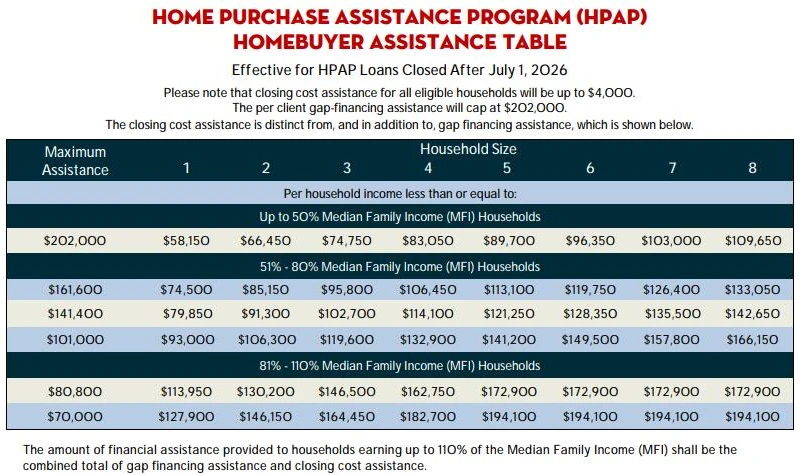
The amount of HPAP assistance you qualify for depends on two factors: your household income and your household size. The District classifies applicants into three income tiers — very low, low, and moderate — based on the Area Median Income (AMI) for the Washington, DC metro area as published by HUD.

For the DC metro area, the AMI for a four-person household is approximately $154,700. HPAP eligibility extends up to 110% of AMI, and the income limits vary by household size. Assistance amounts range from approximately $70,000 to $202,000, with larger households and lower incomes qualifying for greater amounts.

HPAP Assistance by Income Tier (Estimated Ranges)

Income Tier % of AMI Est. Income Range (1-person) Max Assistance
Very Low Income Up to 50% AMI Up to ~$54,000 $202,000
Low Income 50–80% AMI ~$54,000–$86,000 $150,000–$202,000
Moderate Income 80–110% AMI ~$86,000–$119,000 $70,000–$150,000

Income limits and assistance amounts are based on the DHCD HPAP Income Assistance Table effective June 2025. Exact figures vary by household size. Visit DHCD's official assistance table for current amounts.

The 28% Minimum Housing Payment Rule

One detail that catches many applicants off guard: HPAP is structured as gap financing, meaning the District expects your monthly housing payment to represent at least 28% of your gross monthly income. If the HPAP assistance would reduce your payment below that threshold, the loan amount is reduced accordingly. This ensures limited funds are directed toward buyers who genuinely need the assistance to afford their home.

For example, if you earn $50,000 per year ($4,167/month), your projected housing payment must be at least $1,167 per month. If the math shows your payment would be lower with the full HPAP amount, the assistance is reduced until the 28% minimum is met.

How Much Home Can You Afford With HPAP?

Use our free mortgage calculator to estimate your monthly payment with HPAP assistance factored in — then get pre-approved to see exactly what you qualify for.

Estimate Your Payment Get Pre-Approved

HPAP Eligibility Requirements

HPAP eligibility is straightforward on the surface, but the details matter. Here is the full checklist of what you need to qualify.

HPAP Eligibility Checklist

First-time homebuyer — No ownership interest in any residential property within the past 3 years
Head of household — You must be the head of the household on the application
Income eligible — Household income must fall within very low, low, or moderate income limits (up to 110% AMI)
Credit score of 630+ — HPAP minimum; your mortgage lender may require a higher score
DC primary residence — Property must be located in Washington, DC and occupied as your primary home
Eligible property type — Single-family home, condo, or co-op (no 2–4 unit properties)
Complete homebuyer education — 8-hour HUD-approved course through a CBO
Minimum cash contribution — $500 or 50% of liquid assets above $3,000, whichever is greater

Do You Have to Be a DC Resident?

Not technically — but practically, yes. DC residents are always given priority. Non-resident applications are only processed when there are no pending applications from District residents. Given that HPAP regularly exhausts its annual funding, non-residents face an extremely difficult path to assistance.

Debt-to-Income Requirements

HPAP permits a maximum debt-to-income (DTI) ratio of 45%, meaning your total monthly debt payments (including the projected housing payment) cannot exceed 45% of your gross monthly income. In some cases with approved compensating factors, DTI can extend up to 50%, with the housing payment alone allowed up to 45%.

HPAP Repayment Terms Explained

One of HPAP's biggest advantages is its repayment structure. The loan carries zero interest and the terms differ significantly based on your income level.

Income Level Monthly Payments When Full Balance Is Due
Very Low & Low Income
(Below 80% AMI)
No monthly payments — ever Upon sale, transfer, refinance (cash-out), or property ceases to be primary residence
Moderate Income
(80–110% AMI)
Deferred for first 5 years, then principal-only payments begin, amortized over 40 years Upon sale, transfer, refinance (cash-out), or property ceases to be primary residence

The critical takeaway: regardless of your income level, the entire remaining balance becomes immediately due if you sell the property, transfer ownership, refinance with cash-out, or stop living in the home as your primary residence. This means HPAP is designed for buyers who plan to stay in their home long-term — not for investors or anyone planning to convert the property to a rental.

Repayment Timeline (Moderate Income)

Years 1–5: No payments


Years 6–45: Principal-only payments (0% interest, amortized over 40 yrs)


For very low/low-income borrowers, the bar would show 0% — no payments at any point until a triggering event.

Step-by-Step: How to Apply for HPAP

The HPAP application process involves multiple steps and can take several months from start to closing. Starting early is critical — especially since program funding is limited and allocated on a first-come, first-served basis.

1

Contact a Community-Based Organization (CBO)

You cannot apply for HPAP directly. You must work with a DHCD-approved CBO such as Housing Counseling Services (HCS), the Latino Economic Development Corporation (LEDC), or the Greater Washington Urban League. Find the full list of approved CBOs here.

2

Attend a Pre-Purchase Orientation (2 hours)

Your CBO will host an orientation session (often available as a webinar) where you'll learn about the application requirements, timeline, and documentation you need to gather.

3

Complete an 8-Hour Homebuyer Education Course

A HUD-approved homebuyer education class is mandatory. This can typically be completed online or in-person through your CBO. Topics include budgeting, mortgage basics, home inspections, and the responsibilities of homeownership.

4

Submit Your Application Through the CBO

Gather your income documentation, tax returns, bank statements, credit report, and employment verification. Your CBO will review everything and forward your completed application to the HPAP administrator (GWUL or DCHFA).

5

Receive Your Notice of Eligibility (NOE)

Processing typically takes 1–2 months. If approved, you'll receive a Notice of Eligibility that outlines your maximum HPAP assistance amount and the next steps to follow. Keep all documents updated — an expired NOE requires resubmission.

6

Get Mortgage Pre-Approved

While waiting for or after receiving your NOE, work with a lender experienced in HPAP transactions to get pre-approved for a mortgage. HPAP requires a first trust mortgage from a participating lender. Your mortgage pre-approval combined with HPAP funds determines your total purchasing power.

7

Receive a Notice to Proceed (NTP) and Find a Home

Once funding is available and your priority date is reached, you'll receive a Notice to Proceed. This reserves HPAP funds for you and gives you six months to go under contract and close on a home in Washington, DC.

8

Close on Your Home

Your lender submits the HPAP lender package to DCHFA, the HPAP loan is finalized alongside your mortgage, and you close on your new home. The HPAP funds are recorded as a subordinate deed of trust on your property.

Estimated HPAP Timeline

Orientation + Education Course 2–4 weeks
Application + NOE Processing 1–2 months
Wait for Notice to Proceed Varies (depends on funding)
Home Search + Closing Window Up to 6 months
Total (Start to Closing) 4–10+ months

Ready to Start the HPAP Process?

Getting pre-approved for your mortgage early is one of the smartest moves you can make while your HPAP application is processing. Our team works with HPAP buyers regularly and can help you understand exactly how much purchasing power you'll have.

Get Pre-Approved Today

EAHP: Extra Assistance for DC Government Employees

If you work for the District of Columbia government, you may also qualify for the Employer Assisted Housing Program (EAHP) — and the best part is you can combine EAHP with HPAP for even more assistance.

EAHP provides eligible DC government employees with a $20,000 deferred, zero-interest loan plus a matching funds grant of up to $5,000 for down payment and closing costs. Unlike HPAP, EAHP has no income cap and no cash contribution requirement.

Additional Benefits for First Responders and Educators

DC first responders (police officers, firefighters, paramedics, EMTs, corrections officers) and teachers in public or public charter schools are eligible for enhanced EAHP benefits:

EAHP Benefit All DC Employees First Responders / Teachers
Deferred Loan $20,000 $20,000
Matching Grant Up to $5,000 Up to $15,000
Recoverable Grant Up to $10,000
Total Potential EAHP $25,000 Up to $45,000

When combined with HPAP's $206,000 maximum, a qualifying DC first responder could theoretically access up to $251,000 in homebuyer assistance — an extraordinary amount that can make a meaningful difference in one of America's most expensive housing markets.

DC Open Doors: An Alternative (or Complement) to HPAP

Not everyone qualifies for HPAP — or wants to wait for the funding cycle. DC Open Doors is a separate program from DCHFA that offers down payment assistance to both first-time and repeat buyers purchasing in the District.

DC Open Doors provides a Down Payment Assistance Loan (DPAL) equal to 3% of the purchase price for conventional loans or 3.5% for FHA loans. The DPAL is a deferred, zero-interest loan with no monthly payments — repayable upon sale, transfer, refinance, or after 30 years.

Key differences from HPAP: DC Open Doors is not income-restricted in the same way (income limit is approximately $199,200), doesn't require the CBO application process, and is generally faster to use. However, the assistance amount is significantly smaller — on a $500,000 condo, that's $15,000–$17,500 compared to HPAP's potential $202,000.

Important note: HPAP and DC Open Doors cannot always be combined on the same transaction. The availability of layering these programs depends on the loan product and current market conditions. Some DPA combinations have been unavailable due to market volatility, so check with your lender about current options.

HPAP vs. DC Open Doors vs. EAHP: Side-by-Side Comparison

Feature HPAP DC Open Doors EAHP
Max Assistance $202,000 + $4K closing 3–3.5% of price $25K–$45K
First-Time Buyer Only? Yes No First-time in DC only
Income Cap? Yes (110% AMI) ~$199,200 No
Interest Rate 0% 0% 0%
Monthly Payments None (low income) / Deferred 5 yrs (moderate) None (deferred) None (deferred)
DC Residency Required? Prioritized No DC Gov employee
Min Credit Score 630 640 630 (with HPAP)
Application Process Through CBO (longer) Through lender (faster) Through CBO

Real Buyer Scenario: How HPAP Changes the Math

Let's look at a realistic example to see how powerful this program can be.

Scenario: DC Renter Buying a $500,000 Condo

Buyer Profile Single, household income $65,000 (low income)
Purchase Price $500,000 (1BR condo in Brookland)
Savings Available $5,000
HPAP Assistance (est.) ~$150,000 + $4,000 closing
First Mortgage Needed ~$345,000
Buyer's Cash at Closing ~$500 (minimum contribution)
Monthly HPAP Payment $0 (low income = no payments)

Without HPAP, this buyer would need roughly $17,500 for a conventional 3.5% FHA down payment alone — more than triple their savings. With HPAP, they need just $500 cash at closing, and their mortgage is on the smaller $345,000 balance rather than the full purchase price, meaning a significantly lower monthly payment.

Cash Needed at Closing: With vs. Without HPAP

Without HPAP (FHA 3.5% down): ~$17,500 + closing costs

~$25,000+

With HPAP: $500 minimum contribution

$500

Common Mistakes That Delay or Disqualify HPAP Applicants

HPAP is a phenomenal program, but the process has enough complexity that many applicants stumble. Here are the most frequent pitfalls — and how to avoid them.

Mistakes to Avoid

1. Waiting too long to apply. HPAP funding is finite and allocated by priority date. Every month you delay means more applicants ahead of you. Begin the CBO orientation process even if you're not ready to buy for 6–12 months.

2. Not maintaining your documents. Your NOE can expire if supporting documents become outdated. Keep tax returns, pay stubs, and bank statements current throughout the process.

3. Choosing a lender unfamiliar with HPAP. Not all lenders regularly process HPAP transactions. Working with a lender who doesn't know the program's paperwork requirements can cause costly delays or missed deadlines.

4. Overlooking the 28% minimum housing payment rule. If your projected payment falls below 28% of your gross income, HPAP will reduce your assistance amount. Run the numbers with your lender before shopping for homes.

5. Accumulating too much liquid savings. Because your minimum contribution is the greater of $500 or 50% of liquid assets over $3,000, having $20,000 in savings means you'd need to contribute $8,500. Plan your savings strategy with your housing counselor.

6. Assuming you can convert the property later. HPAP requires the home to remain your primary residence. If you move out, the entire loan balance becomes due immediately. Do not plan to convert the property to a rental.

7. Missing the 6-month NTP window. Once you receive your Notice to Proceed, the clock starts. You have six months to find a home, go under contract, and close. Start your home search before you receive the NTP so you're ready to act.

Looking for Your First Home in DC?

The Jamil Brothers team helps first-time buyers navigate the DC market from pre-approval through closing day. Explore homes and neighborhoods, or start building your buyer strategy.

Browse Homes for Sale Get a Buyer Strategy Session

Pairing HPAP With the Right Mortgage

HPAP covers your down payment and closing costs, but you still need a first trust mortgage for the remaining purchase price. The type of mortgage you choose significantly affects your monthly payment, insurance costs, and long-term savings.

Which Loan Types Work With HPAP?

HPAP can be paired with several first mortgage products, provided the lender is a DCHFA participating lender. Common pairings include FHA loans, conventional loans through DC Open Doors (DCOD), and VA loans for eligible veterans.

Loan Type Min. Down Payment Min. Credit Score Notes With HPAP
FHA 3.5% 580–620 HPAP covers down payment; MIP required for life of loan
Conventional (DCOD) 3% 620–640 Possible reduced MI for incomes under 80% AMI; PMI removable
VA Loan 0% Varies No PMI; HPAP can reduce loan amount further

As of early 2026, DCHFA-published rates for DC Open Doors loans paired with HPAP range from approximately 6.125% (FHA, no DPA) to 7.0% (Conventional with 3% DPA for incomes above 80% AMI). Rates are published daily and subject to market conditions — use our mortgage calculator to estimate your payment at different rate scenarios.

Advantages of HPAP

• Up to $206,000 in total assistance

• Zero interest on the loan — ever

• No monthly payments for low-income buyers

• Only $500 minimum cash needed

• Stackable with EAHP for DC employees

Limitations to Know

• Funding is limited and can run out

• Application process takes months

• DC properties only — cannot use in VA or MD

• Full balance due if you sell, move, or refinance

• 28% housing payment minimum may reduce amount

Alternatives If You Don't Qualify for HPAP

If HPAP isn't the right fit — whether due to income limits, property location, or timeline — there are several other paths to affordable homeownership in the DC metro area.

Buying in Virginia instead? The Virginia Housing Development Authority (VHDA) offers grants of 2–2.5% toward down payment, plus a Mortgage Credit Certificate worth up to $2,000 per year in federal tax credits. Northern Virginia communities like Arlington, Fairfax County, and Alexandria offer a range of price points — from condos under $400,000 to single-family homes for growing families.

Buying in Maryland? The Maryland Mortgage Program offers 5% deferred down payment assistance, plus SmartBuy 2.0 can pay off up to $40,000 in student loan debt for qualifying buyers. Montgomery County and Prince George's County are popular with DC workers looking for more space at a lower price point.

Eligible for a VA loan? With the Pentagon, Fort Belvoir, and Joint Base Andrews all in the DC metro area, many buyers qualify for VA loans with 0% down and no PMI — no DPA program needed. Check your VA loan eligibility here.

Frequently Asked Questions

How much money can I get from DC's HPAP program?

The maximum HPAP assistance is $202,000 for down payment gap financing, plus up to $4,000 separately for closing costs, for a combined maximum of $206,000. The actual amount you receive depends on your household income, household size, the purchase price of the home, and how much gap financing you need to make the purchase affordable. Very low-income households typically qualify for the highest amounts, while moderate-income buyers may receive $70,000 to $150,000. Visit the DHCD Income Assistance Table for the specific amounts tied to your income tier and household size.

Do I have to pay back HPAP assistance in Washington DC?

Yes, HPAP is a loan — not a grant — but the terms are extremely favorable. The loan carries zero interest. For very low- and low-income households (below 80% of AMI), there are no monthly payments at all; the balance is only due when you sell, transfer the property, refinance with cash-out, or stop using the home as your primary residence. Moderate-income borrowers enjoy five years of deferred payments, after which principal-only payments begin and are amortized over 40 years. There is never any interest charged on the loan regardless of your income level.

What credit score do I need for HPAP in DC?

HPAP itself requires a minimum credit score of 630. However, keep in mind that you also need to qualify for a first trust mortgage from a participating lender, and that lender may have a higher minimum score requirement depending on the loan product. For example, a conventional loan through DC Open Doors typically requires a 640 score, while FHA loans may accept scores as low as 580 depending on the lender. Your CBO housing counselor can help you assess whether your credit is ready or if you need to take steps to improve it before applying.

Can I use HPAP if I'm not currently a DC resident?

Technically, yes — but DC residents are always given priority for HPAP funding. Non-resident applications are only processed when there are no pending applications from District residents. Given that HPAP regularly exhausts its annual budget and has a waitlist of DC residents, getting approved as a non-resident is very difficult. If you currently live in Virginia or Maryland and are considering buying in DC, the strongest strategy is to begin the process early and discuss your specific situation with a CBO.

How long does the HPAP application process take?

From initial orientation to closing on a home, the HPAP process typically takes 4 to 10 months or longer. The orientation and homebuyer education course take about 2–4 weeks to complete. The application review and Notice of Eligibility processing can take 1–2 months. After that, the wait for a Notice to Proceed depends on funding availability and your priority position. Once you receive the NTP, you have six months to go under contract and close. Starting the process early — even before you are actively house hunting — gives you the best chance of having funding reserved when you are ready to buy.

Can I combine HPAP with EAHP or DC Open Doors?

HPAP and EAHP can absolutely be combined if you meet the eligibility requirements for both programs. DC government employees who are also first-time buyers can apply for both through their CBO and potentially receive HPAP gap financing plus the EAHP deferred loan and matching grant. Combining HPAP with DC Open Doors is more complicated — availability depends on the specific mortgage product and current market conditions. Some DPA layering options have been intermittently unavailable due to market volatility, so always check with your lender about what's currently possible.

What types of properties can I buy with HPAP in DC?

HPAP can be used to purchase single-family homes, condominiums, and cooperative units within the District of Columbia. The property must be your primary residence — investment properties and second homes do not qualify. Multi-unit properties with 2–4 units are also not eligible. There is no specific purchase price cap for HPAP, but your first trust mortgage cannot exceed the conforming loan limit (currently estimated at $834,977 for DC). The practical purchasing power depends on combining your HPAP amount with the mortgage amount you qualify for.

Is HPAP funded right now in 2026?

As of Fiscal Year 2026 (which began October 1, 2025), HPAP has been funded. Applicants are being assisted on a first-come, first-served basis based on the order of their initial application and Notice of Eligibility date. Current NOE and NTC holders are being processed by the program administrators (GWUL and DCHFA). However, HPAP funding can be exhausted before the end of any fiscal year, so applying early is critical. Check the DHCD HPAP dashboard for real-time funding status.

What happens to my HPAP loan if I refinance my mortgage?

A cash-out refinance triggers immediate repayment of the full HPAP balance. However, a rate-and-term refinance — where you are simply lowering your interest rate or changing your loan term without taking cash out — may be permitted under certain conditions. The specifics depend on DHCD's approval and the terms of your HPAP promissory note. Always contact DHCD or DCHFA before pursuing any refinance to confirm whether your HPAP loan will be affected.

How do I choose the best mortgage lender for HPAP in Washington DC?

When choosing a lender for an HPAP transaction, prioritize experience with DC housing finance programs. Look for a lender who is a DCHFA participating lender, has a track record of closing HPAP deals on time, understands the paperwork and timeline requirements, and can coordinate smoothly with your CBO and the HPAP administrator. Ask how many HPAP transactions they've closed in the past year, whether they offer DC Open Doors products, and how they handle the unique timing challenges of HPAP closings. Our team at JB Financing, led by Ken Byrne (NMLS #187129) with 20+ years of experience and over 4,000 families served across VA, DC, and MD, regularly works with HPAP buyers and can help coordinate the entire process.

Can I use HPAP to buy a home in Virginia or Maryland instead of DC?

No — HPAP is exclusively for properties located within the District of Columbia. If you are looking to purchase in Virginia or Maryland, each jurisdiction has its own down payment assistance programs. Virginia offers the VHDA grant programs, and Maryland provides the Maryland Mortgage Program with deferred down payment assistance. Both programs offer meaningful support, though typically less than HPAP's maximum amount. Reach out to our team to explore all the programs available in the jurisdiction where you plan to buy.

Glossary of Key Terms

Gap Financing: A loan that covers the "gap" between what a buyer can afford (mortgage + savings) and what's needed to purchase a home. HPAP functions as gap financing.

Area Median Income (AMI): The midpoint household income for a geographic area, as determined by HUD. HPAP eligibility is based on a percentage of the DC metro area AMI.

Notice of Eligibility (NOE): The document HPAP issues confirming you qualify for the program and stating your maximum assistance amount. This is not a guarantee of funding.

Notice to Proceed (NTP): The document that reserves HPAP funds for your purchase. Once issued, you have six months to find and close on a home.

Deferred Loan: A loan where payments are postponed for a specific period. HPAP loans are deferred indefinitely for low-income buyers and for five years for moderate-income buyers.

Community-Based Organization (CBO): A DHCD-approved nonprofit that provides homebuyer counseling and processes HPAP applications. You must apply through a CBO — you cannot apply directly to DHCD.

First Trust Mortgage: Your primary mortgage loan from a bank or lender. HPAP sits behind this as a subordinate lien (second trust).

Subordinate Deed of Trust: A secondary lien on your property. HPAP funds are secured by a subordinate deed of trust, meaning the HPAP loan is repaid after your primary mortgage in the event of a sale.

Your Next Steps

DC's HPAP program is one of the most powerful homebuyer assistance programs in the country — but it requires planning, patience, and the right team behind you. The buyers who benefit most are the ones who start the process early, keep their documents organized, and work with a lender who knows the program inside and out.

Whether you're currently renting in DC and dreaming of your first home, or you're comparing DC's programs to what's available across the river in Loudoun County or Prince William County, the first step is always the same: understand what you qualify for.

Ready to See What You Qualify For?

Whether you're exploring HPAP, DC Open Doors, or a conventional mortgage, our team can help you find the best path to homeownership in the DC metro area.

Contact Ken Byrne at (703) 927-4456, email kbyrne@alcova.com, or get pre-approved online today.

Thinking about selling your current home before buying? The Jamil Brothers team lists homes for just 1.5% commission — full service, no compromises.

Get Pre-Approved Now

Written by the JB Financing Team | ALCOVA Mortgage LLC, NMLS #40508

Ken Byrne, Branch Partner, NMLS #187129 | (703) 927-4456 | kbyrne@alcova.com

JB Financing | ALCOVA Mortgage LLC | NMLS #40508 | Equal Housing Lender

Name
Phone*
Message