
FHA 203(k) Renovation Loans in Maryland: How They Work
Short answer: The 203k loan requirements split into two very different products before anything else matters. A 203(k) is one FHA loan that buys the house and pays for the work. There are two versions. The Limited 203(k) caps the repair budget at $75,000 and covers nonstructural work only. The Standard 203(k) has a $5,000 minimum, no repair ceiling of its own, allows structural work and requires a HUD approved consultant. In Maryland the binding constraint is almost never the program rule. It is the county FHA loan limit, which ranges from $541,287 to $1,249,125 in 2026 depending on where you buy, and the total of purchase plus repairs has to fit underneath it. JB Financing mortgage runs both sets of numbers before you write the offer.
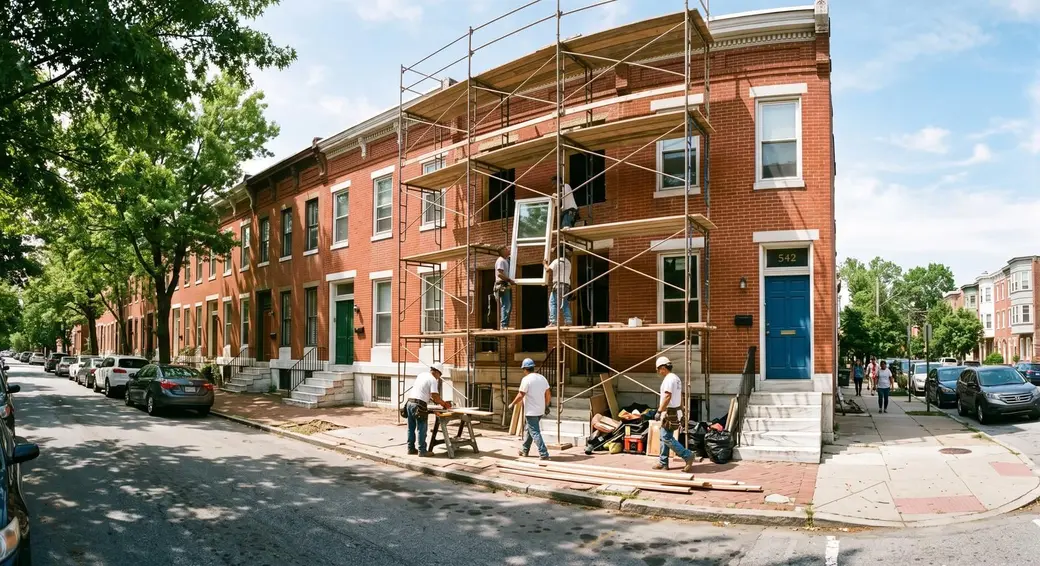
Maryland has a lot of housing that is worth buying and not worth financing in its current condition. Baltimore rowhouses that have been empty for two winters. Mid century ramblers in Anne Arundel County with original systems. Farmhouses on the Eastern Shore that need a roof before they need anything else. A conventional lender looks at those properties and sees an appraisal that will not support a loan. An FHA appraiser looks at them and writes repair conditions that have to be cured before closing, which the seller will not pay for and the buyer cannot pay for until they own the house.
The 203(k) program exists to break that circle. It underwrites the property against what it will be worth once the work is finished rather than what it is worth today, and it escrows the repair money at closing so the contractor gets paid from the loan rather than from your savings. It is genuinely useful and it is genuinely more complicated than a standard purchase, and most of what goes wrong on these deals goes wrong for reasons that were predictable on day one.
This guide covers the current rules with sources, the Maryland specific layers that a national article will not mention, and the places where the program quietly says no. We settle these files as mortgage lenders in Virginia, Maryland, DC and West Virginia and the pattern is consistent: the deals that work are the ones where the scope was priced before the offer went in.
203k loan requirements: the two products, and which one you actually qualify for
Everything starts with this choice, because the two versions have different paperwork, different costs and different limits. Choosing wrong wastes weeks.
| Limited 203(k) | Standard 203(k) | |
|---|---|---|
| Maximum repair cost | $75,000 | No program cap. The county loan limit binds instead |
| Minimum repair cost | None | $5,000 |
| Structural work | Not permitted | Permitted |
| HUD approved consultant | Optional | Required |
| Time to complete the work | 9 months | 12 months |
| Borrower displacement | 30 days maximum | Longer permitted |
| Financeable mortgage payment reserve | Not available | Up to 12 months |
| Draws per contractor | Up to 4 | Set by the draw schedule and inspections |
Sources: HUD Mortgagee Letter 2024-13, effective 4 November 2024; HUD Mortgagee Letter 2026-06, dated 23 June 2026.
The Limited 203(k), and the $75,000 number people still get wrong
The Limited 203(k) repair ceiling was raised to $75,000 in Mortgagee Letter 2024-13, effective for case numbers assigned on or after 4 November 2024. Before that it had sat at $35,000 for a very long time, and a large volume of material online still quotes the old figure. If a lender or a contractor tells you the cap is $35,000, they are working from stale guidance. The $75,000 figure remains current as of September 2026.
The trade for that simplicity is that the Limited product cannot touch anything structural. It is built for kitchens, bathrooms, flooring, roofing, windows, systems replacement, accessibility modifications, lead paint remediation and the kind of repair list an FHA appraiser generates. It is not built for moving a wall, adding a room or underpinning a foundation.
The Standard 203(k), and why there is no repair cap
The Standard 203(k) has a $5,000 minimum repair cost, which exists to keep small jobs out of a process designed for large ones. It has no repair maximum written into the program. That does not mean you can borrow without limit. It means the ceiling comes from somewhere else, namely the county FHA loan limit and the after improved value calculation, both of which we work through below.
The Standard product also carries a feature the Limited version does not: a financeable mortgage payment reserve of up to twelve months. If the house will be uninhabitable during the work, that reserve lets the loan cover your mortgage payments while you are living somewhere else. For a gut rehabilitation that is not a nicety, it is the difference between a workable deal and paying two housing costs out of pocket.
Where the line between structural and nonstructural actually falls
This is the judgment call that decides which product you are on, and contractors and lenders sometimes read it differently. The safe approach is to have the scope reviewed before the offer, not after.
| Typical scope item | Usually Limited | Usually Standard |
|---|---|---|
| Kitchen and bathroom replacement in place | Yes | |
| Roof replacement | Yes | |
| HVAC, plumbing and electrical replacement | Yes | |
| Windows, siding, flooring, paint | Yes | |
| Lead based paint remediation | Yes | |
| Accessibility modifications | Yes | |
| Moving or removing a load bearing wall | Yes | |
| Foundation repair or underpinning | Yes | |
| Room addition or second storey | Yes | |
| Converting the layout of the home | Yes | |
| Repairs requiring the borrower to move out for more than 30 days | Yes |
The practical test: if the work touches the structure of the building, requires the house to be vacant for more than a month, or costs more than $75,000, you are on the Standard product and you need a consultant. Everything else is a Limited question.

How much you can actually borrow in Maryland
This is the section that decides whether your deal exists, and it is the section most 203(k) articles skip. Two separate ceilings apply and your loan has to fit under both of them.
Ceiling one: the after improved value calculation
FHA will lend against the value the property will have once the work is complete, not the value it has today. The maximum mortgage is based on the lesser of the purchase price plus rehabilitation costs, or 110% of the after improved value. For condominium units that percentage drops to 100%.
Source: 24 CFR 203.50(f)(2).
The 110% figure is generous and it is also the reason the program works. It means the appraiser can value the finished house above the sum of what you paid and what you spent, which is what allows a buyer to capture some of the value the renovation creates rather than having to bring the gap in cash. It also means a badly chosen scope, one that spends money without adding value, will fail the calculation and kill the loan.
Ceiling two: the county FHA loan limit, which is the one that usually binds
Whatever the after improved value supports, the total loan cannot exceed the FHA loan limit for the county the property sits in. In Maryland those limits vary by a factor of more than two across the state, and this is where Maryland 203(k) deals most often run out of room.
| 2026 FHA one unit loan limit | Maryland jurisdictions |
|---|---|
| $1,249,125 | Montgomery, Prince George's, Charles, Frederick |
| $747,500 | Anne Arundel, Baltimore City, Baltimore County, Carroll, Harford, Howard, Queen Anne's |
| $541,287 | Allegany, Calvert, Caroline, Cecil, Dorchester, Garrett, Kent, St. Mary's, Somerset, Talbot, Washington, Wicomico, Worcester |
Derived from HUD's 2026 "Areas at Ceiling" and "Areas Above Floor and Below Ceiling" lists issued with Mortgagee Letter 2025-23. The national floor for 2026 is $541,287 and the ceiling is $1,249,125. Counties appearing in neither list take the floor. Confirm your county in HUD's lookup tool before writing an offer.
Two things in that table deserve a flag. First, Southern Maryland is at the floor. Calvert County and St. Mary's County both sit at $541,287 for 2026, which surprises buyers who assume proximity to the Washington market carries a Washington limit. It does not. Second, the Baltimore metro limit of $747,500 is comfortable for most rowhouse and rambler rehabilitation but tightens quickly once purchase price passes $600,000.
What that looks like on a real deal
The following is a labelled illustration of how the two ceilings interact, not a quote and not a prediction of what any particular property will appraise for. The point is to show which ceiling binds first, which is the question worth asking before you write an offer.
| Baltimore County rowhouse | Calvert County rambler | |
|---|---|---|
| Purchase price | $285,000 | $430,000 |
| Repair scope | $70,000 | $70,000 |
| Purchase plus repairs | $355,000 | $500,000 |
| County FHA limit | $747,500 | $541,287 |
| Which ceiling binds | After improved value | County limit, and it is close |
| Practical read | Room to expand the scope | Almost no room. Price the scope before offering |
The Calvert column is the situation that catches people. On paper the numbers work. In practice a buyer at that price point has around $41,000 of headroom for the mortgage insurance premium, the contingency reserve, the consultant fees and any change orders, and those items add up faster than anyone expects. If you are buying in a floor limit county, run the ceiling arithmetic first. Our guide to how much house you can afford in Maryland covers the underlying affordability side of the same question.

“Send me the address and a rough scope before you write the offer on a 203(k) property. I can tell you in about a day whether the county limit leaves you room, and if it does not, you have saved yourself a ratified contract you cannot close.”
Arslan Jamil, Broker Associate
Loans originated by Ken Byrne, NMLS ID# 187129 · ALCOVA Mortgage LLC, NMLS ID# 40508. Equal Housing Lender.
The contingency reserve, and why 15% is sometimes mandatory
Every 203(k) carries a contingency reserve, which is money held back inside the loan to cover what the contractor finds after the walls are open. It is not optional and it is not yours to spend on upgrades.
| Situation | Contingency reserve |
|---|---|
| Baseline requirement | 10% of the repair cost |
| Structure 30 years or older and utilities not operable at appraisal | Minimum 15% |
| Maximum permitted | 20% |
The 15% trigger is worth understanding because it applies to a very large share of the Maryland housing stock this program is used on. A vacant Baltimore rowhouse built in 1920 with the water shut off meets both conditions automatically. That extra five percentage points comes out of your borrowing capacity, so it needs to be in the arithmetic from the beginning rather than discovered at underwriting.
If the contingency is not spent, it does not simply vanish. Depending on how the loan was structured it can be applied to reduce the principal balance or, in some cases, released for additional approved work through a change order. Ask your lender which treatment applies to your file, because the answer affects whether it is worth requesting additional work late in the project.
The 203(k) consultant: what they do and what they cost
On a Standard 203(k) a HUD approved consultant is mandatory. On a Limited 203(k) they are optional, and plenty of borrowers skip them to save money. That is usually a mistake on anything but the simplest scope, because the consultant is the person who writes the work write up that the whole loan is priced against.
The consultant inspects the property, produces a detailed specification of repairs with cost estimates, reviews the contractor's bid against it, and performs the inspections that release each draw. They are working for the loan file, not for you and not for the contractor, which is precisely what makes them useful when a dispute arises.
| Consultant service | Published fee |
|---|---|
| Feasibility study | $375 |
| Work write up, repairs up to $50,000 | $1,000 |
| Work write up, repairs $50,001 to $100,000 | $1,300 |
| Work write up, repairs $100,001 to $150,000 | $1,600 |
| Work write up, repairs above $150,000 | $2,000 |
| Draw inspection | $375 |
| Change order | $120 |
| Re inspection | $225 |
Source: HUD Mortgagee Letter 2024-13 consultant fee schedule. Mileage and additional trip charges may apply separately.
Those fees are financeable into the loan, which is worth knowing because borrowers frequently assume they are out of pocket costs and skip the consultant for the wrong reason. A feasibility study at $375 before you write the offer is the cheapest insurance available on a 203(k) deal, and it is the single thing we recommend most often to buyers looking at a property that needs serious work.
How the money actually reaches the contractor
At closing the repair funds do not go to you and they do not go to the contractor. They go into an escrow account held by the lender, and they come out in stages as the work is completed and inspected. This is the mechanic that protects the lender and it is also the mechanic that frustrates contractors, so it needs to be explained to the contractor before they bid rather than after they start.
The Limited 203(k) draw rule changed in June 2026
This is recent and it materially improves the product. Mortgagee Letter 2026-06, dated 23 June 2026 and effective immediately, raised the maximum number of draws on a Limited 203(k) from two per contractor to four per contractor. Under the old rule a contractor on a $70,000 kitchen and systems job was carrying the cost of the work across two payments, which pushed a lot of good contractors to decline 203(k) work altogether. Four draws is a meaningfully different cash flow proposition.
If a contractor tells you they will not touch a 203(k) because of the payment structure, it is worth checking whether their objection predates June 2026. A great many of them are working from the old rule, and this is one of the few situations where the borrower knows something the trade does not.
The draw sequence in practice
- An initial draw may be released at closing for materials and permits, subject to the lender's policy.
- The contractor completes a defined stage of the work write up.
- The consultant or the lender's inspector visits and verifies the completed stage.
- Lien waivers are collected from the contractor and any subcontractors.
- The draw is released, less a holdback that is paid at final completion.
- The cycle repeats until the work write up is finished and a final inspection is passed.
The holdback exists to guarantee the contractor returns to finish punch list items, and it is the most common source of friction at the end of a project. Setting the expectation about the holdback in the contract, before work begins, prevents most of the arguments we see in the last two weeks of a renovation.
Maryland contractor licensing, which is stricter than most states
A 203(k) requires a licensed and insured contractor, and Maryland has its own regime that catches out of state operators and homeowners who assume a handyman can do the work. Home improvement contractors in Maryland must hold a license from the Maryland Home Improvement Commission.
One detail specifically trips people up. Maryland eliminated the separate subcontractor license category on 1 July 2016. Since then anyone performing home improvement work, whether they are the general contractor or working underneath one, needs to hold a full contractor license in their own right. A general contractor cannot lawfully cover an unlicensed subcontractor with their own license, and a 203(k) file that discovers this at the lien waiver stage is a file in trouble.
The licensing system also provides a backstop. The Maryland Home Improvement Guaranty Fund compensates homeowners for actual losses caused by a licensed contractor, up to a maximum of $30,000 per claim. That protection exists only if the contractor was licensed. It is the practical reason to verify the license number yourself against the Commission's register rather than accepting a photograph of a card.
Before you sign a contractor agreement: verify the MHIC license is current and in the contracting entity's exact legal name, confirm general liability and workers compensation coverage, and confirm every subcontractor on the job holds their own license. All three of those are quick checks and all three have killed 203(k) deals that were otherwise ready to close.
Lead paint: two different rulebooks, and Maryland's applies to fewer people than you think
Maryland has a well known lead law and it is routinely misdescribed. The state's lead risk reduction requirements apply to rental housing built before 1978. They do not regulate owner occupied housing. If you are buying a 1955 Baltimore rowhouse to live in, the Maryland registration and risk reduction regime is not what governs your renovation.
What does govern it is the federal Environmental Protection Agency Renovation, Repair and Painting rule, which applies to owner occupied pre 1978 housing as well as rental. Under that rule, work disturbing more than six square feet of painted surface inside, or more than twenty square feet outside, must be performed by a certified renovation firm using lead safe work practices.
| Maryland lead risk reduction law | EPA Renovation, Repair and Painting rule | |
|---|---|---|
| Applies to | Rental housing built before 1978 | All pre 1978 housing including owner occupied |
| Trigger | Tenancy and registration | Interior work above 6 sq ft, exterior above 20 sq ft |
| Who must be certified | Accredited inspectors and contractors | Certified renovation firm |
| Relevance to a 203(k) buyer occupant | Generally none | Directly applicable to most rehab scopes |
The practical effect is that a Maryland 203(k) on any pre 1978 house needs a contractor with EPA lead certification, and that certification narrows the pool of eligible bidders. Get it confirmed at the bid stage. Discovering that your chosen contractor is not certified after the loan is approved means rebidding the job and restarting the work write up.
Stacking Maryland programs on top of a 203(k)
Maryland runs several programs that can sit alongside a 203(k), and combining them well is where the real money is for a buyer with limited cash. Each one has conditions that are easy to breach by accident.
The Maryland Mortgage Program
The Maryland Mortgage Program offers an FHA 203(k) Limited product, and its down payment assistance can be layered onto it. That combination is the strongest cash position available to a Maryland renovation buyer. There are conditions. The program carried a 660 credit score overlay as of February 2026, which is well above FHA's own 580 threshold, and manufactured housing, condominium units and attached planned unit development homes were excluded from the 203(k) product. Our guide to the Maryland Mortgage Program in 2026 covers eligibility and the application sequence in detail.
Verify before you rely on this: program overlays and product exclusions are set by the master servicer and change without much notice. The 660 score and the property type exclusions described above were current as of February 2026. Confirm them against the Maryland Mortgage Program directory before building a plan around the combination.
The Maryland Housing Rehabilitation Program
This is a separate state program offering rehabilitation loans of up to $50,000 to households at or below 80% of area median income. It is aimed at existing owners rather than purchasers, so it is more often relevant to the second phase of a project than to the acquisition, but it is worth knowing about if your scope exceeds what the 203(k) ceiling allows.
The Maryland Historic Revitalization Tax Credit
If the property is a certified historic structure, Maryland offers a state income tax credit worth 20% of qualified rehabilitation expenditures, with a minimum expenditure of $5,000 and a cap of $50,000 within any 24 month period for owner occupied residential properties.
There is one condition on this credit that ruins more applications than any other, and it is worth reading twice: work begun before the Maryland Historical Trust approves the application does not qualify. On a 203(k) the pressure is to start the work quickly, because the completion clock runs from closing. Those two timelines pull in opposite directions and they have to be sequenced deliberately, with the Trust approval obtained before a single tool comes out.
| Program | What it provides | Key condition |
|---|---|---|
| Maryland Mortgage Program | FHA 203(k) Limited with stackable down payment assistance | 660 score overlay and property type exclusions as of Feb 2026 |
| Maryland Housing Rehabilitation Program | Rehabilitation loans up to $50,000 | Household income at or below 80% of area median income |
| Maryland Historic Revitalization Tax Credit | 20% state tax credit, $50,000 cap per 24 months | Minimum $5,000 spend, and no work before Trust approval |
Renovation financing in Maryland, priced before you offer
A 203(k) works when the scope, the county limit and the timeline line up. Send the property and the rough scope and we will tell you which product fits and whether the numbers leave room.
Loans originated by Ken Byrne, NMLS ID# 187129 · ALCOVA Mortgage LLC, NMLS ID# 40508. Equal Housing Lender.
What a 203(k) adds to your timeline
A 203(k) is not a slower version of a normal purchase. It is a normal purchase with an entire second workstream running alongside it, and that workstream starts before the loan does. The single biggest predictor of whether a 203(k) closes on schedule is how much of the front end was done before the contract was ratified.
| Stage | What happens | When it should start |
|---|---|---|
| Feasibility | Consultant walks the property and prices the scope | Before the offer |
| Contractor selection | Bids collected, licenses and certifications verified | Before or immediately at ratification |
| Work write up | Consultant produces the detailed specification | Within days of ratification |
| Appraisal | Appraiser values the property as if the work were complete | After the work write up exists |
| Underwriting | Loan reviewed against the finished scope and the county limit | Normal underwriting window |
| Closing | Repair funds escrowed, clock starts | Normal closing |
| Construction | 9 months on Limited, 12 months on Standard | From closing |
Notice that the appraisal cannot happen until the work write up exists, because the appraiser is being asked to value a house that does not exist yet and needs the specification to do it. That dependency is why a 203(k) with a vague scope stalls. There is nothing for the appraiser to value.
Where these deals fail
After enough of these you see the same six failures. Every one of them is avoidable and every one of them is cheaper to avoid before the contract than after.
| Failure | What actually happened | How to prevent it |
|---|---|---|
| The county limit binds | Purchase plus repairs exceeded the FHA limit for that county | Run the ceiling arithmetic before offering |
| Scope creep | Buyer added work after the write up was locked | Decide the full scope during feasibility |
| Contractor walks | Payment structure was explained after the bid | Explain the draw schedule before the bid |
| Licensing gap | A subcontractor had no MHIC license of their own | Verify every trade individually |
| Lead certification missing | Pre 1978 property, contractor not EPA certified | Confirm certification at bid stage |
| Tax credit forfeited | Work began before Historical Trust approval | Sequence the approval ahead of construction |
Who cannot use this program at all
The 203(k) is an owner occupant program. Investors are not eligible. You have to intend to occupy the property as your principal residence, which rules out the buy, renovate and rent strategy that a lot of people arrive at this program hoping to execute. A one to four unit property where you occupy one unit is permitted, which is the legitimate route to combining occupancy with rental income.
The program also does not finance luxury improvements. Swimming pools, outdoor kitchens and similar amenities are outside the scope. The test is broadly whether the improvement is a permanent part of the property and serves a functional purpose, and a consultant will tell you early if an item on your list will not survive review.
Frequently asked questions
What is the maximum I can borrow on a 203(k) in Maryland?
There is no single answer because it depends on your county. The loan cannot exceed the 2026 FHA one unit limit for the county, which is $1,249,125 in Montgomery, Prince George's, Charles and Frederick counties, $747,500 across the Baltimore metro, and $541,287 in the remaining thirteen Maryland jurisdictions. Within that ceiling, the mortgage is based on the lesser of purchase price plus rehabilitation cost, or 110% of the after improved value.
Can I do the work myself?
Self help is heavily restricted and in practice most lenders will not permit it. You would need to demonstrate the relevant skill and the ability to complete within the timeline, and the loan will only reimburse materials rather than paying you for labour. On a Maryland property the licensing regime makes this harder still. Assume you are hiring a licensed contractor.
How long do I have to finish the work?
Nine months from closing on a Limited 203(k) and twelve months on a Standard 203(k). Those clocks run from the closing date, not from the day work starts, which is another reason to have the contractor lined up before you close rather than after.
Does the $75,000 Limited cap include the contingency reserve and fees?
The $75,000 figure applies to the total rehabilitation cost. Ask your lender to show you the specific build up of your maximum mortgage worksheet, because the treatment of contingency, consultant fees, permit costs and inspection fees inside that total is the detail that decides whether a scope fits. Do not assume your $75,000 of construction budget leaves room underneath the cap for everything else.
Can I use a 203(k) on a condominium?
Yes, with two constraints. The after improved value percentage drops from 110% to 100% for condominium units, and the work is generally limited to the interior of the unit because the association controls the exterior and common elements. Note also that the Maryland Mortgage Program excluded condominiums from its 203(k) Limited product as of February 2026, so the combination may not be available.
Is a 203(k) rate higher than a standard FHA rate?
Renovation loans generally price above a standard purchase because the lender is carrying construction risk, but the size of that difference varies by lender and by market conditions and we are not going to publish a spread we cannot source. Ask for a quote on both a standard FHA purchase and a 203(k) on the same day so you are comparing like with like.
What happens if the contractor does not finish?
The escrowed funds are not released for work that was not completed and inspected, so the money is protected. Completing the project becomes your problem, and you may need to engage a replacement contractor within the remaining timeline. If the original contractor was MHIC licensed, the Maryland Home Improvement Guaranty Fund may compensate actual losses up to $30,000. If they were not licensed, that recourse does not exist.
Should I use a 203(k) or buy the house and renovate later?
If the property will not pass an FHA appraisal in its current condition, you may not have the option to buy first. If it will pass, the comparison is between financing the work at mortgage rates over thirty years inside a single loan, against paying cash or using a home equity product later at a different rate. The 203(k) usually wins on cash flow and loses on simplicity. Our overview of renovation loan options sets the alternatives side by side.
What are the 203k loan requirements in Maryland?
The same FHA credit and debt to income rules as any FHA purchase, plus four extras. The property has to be at least one year old and become your primary residence. The work has to be done by a licensed Maryland Home Improvement Commission contractor, and Maryland enforces that harder than most states. A Standard 203(k) requires a HUD approved consultant and the repair budget must exceed $5,000. The total loan still has to fit inside the FHA loan limit for your county, which is what actually caps most Montgomery and Howard County deals.
This guide is general information, not a commitment to lend or an offer of credit. Program rules, loan limits, fee schedules and state program terms change. Verify current figures with HUD, the Maryland Department of Housing and Community Development, the Maryland Home Improvement Commission and the Maryland Historical Trust before relying on them. Loans originated by Ken Byrne, NMLS ID# 187129, ALCOVA Mortgage LLC, NMLS ID# 40508. Equal Housing Lender.
Categories
Recent Posts









GET MORE INFORMATION

Broker Associate