
The Complete First-Time Homebuyer Guide for VA, DC & MD (2026)

Your first home purchase follows similar steps in each state. The loans, programs and tax breaks differ in Virginia, DC and Maryland.
Short answer: check your credit and savings, get pre-approved, choose a loan, take a homebuyer class if your loan or program requires one, then shop, make an offer and close. You can put as little as 0% down with VA or USDA, 3% with some conventional loans or 3.5% with FHA. There is no federal first-time buyer tax credit in 2026, but DC and Maryland cut certain closing taxes for first-time buyers.
By Ken Byrne, NMLS #187129 · ALCOVA Mortgage LLC, NMLS #40508 · Updated October 2026
This guide walks through each step, the loans that suit first-time buyers, and the programs, classes and tax breaks in Virginia, DC and Maryland, with their status as of October 2026.
If you want a plan built around your own numbers, talk to the Ken Byrne Team.
Who qualifies as a first-time home buyer?
For most loans and programs, you are a first-time buyer if you have not owned a home in the past three years. That means many past owners qualify again.
| Program or rule | First-time buyer means |
|---|---|
| Federal housing law (HUD programs) | No home owned in the 3 years before purchase; some exceptions for displaced homemakers and single parents |
| Fannie Mae (standard 3% down loans) | No ownership interest in any residential property, including a rental, in the past 3 years |
| Virginia Housing bond loans and grants, MMP, DC HPAP | No ownership of a primary home in the past 3 years. Virginia Housing and MMP waive this in targeted areas, and MMP also waives it for veterans. Virginia Housing’s non-bond loans have no first-time rule |
| Maryland transfer tax break | Never owned a principal residence in Maryland |
| DC recordation tax break | Never owned a DC home that received the homestead deduction; must be a DC resident |
42 U.S.C. 12704; Fannie Mae Selling Guide glossary; Virginia Housing, MMP and DC DHCD program guides; Maryland Tax-Property 13-203; DC Form ROD 11.
FHA, VA and USDA loans do not require you to be a first-time buyer, though USDA sets extra rules for people who already own a home. DC Open Doors is open to first-time and repeat buyers.
What are the steps to buying a house for the first time?
Most first-time buyers follow these 10 steps, though some overlap.
- Check your credit
- Set a budget and save
- Get pre-approved
- Take a homebuyer class, if required
- Shop and make an offer
- Get a home inspection
- Apply and lock your rate
- Appraisal and underwriting
- Review the Closing Disclosure
- Close and get the keys
Here is what happens at each step, with the federal rules that set the timing.
| Step | What happens | What to know |
|---|---|---|
| 1. Check your credit | Pull your reports and fix errors | Free weekly reports at AnnualCreditReport.com; checking your own credit does not lower your score |
| 2. Set a budget and save | Plan for the down payment, closing costs and reserves | Your total debts, including the new payment, are measured against gross income |
| 3. Get pre-approved | A lender reviews your credit, income and assets | Sellers often expect a pre-approval letter with your offer |
| 4. Take a homebuyer class | Required by many low down payment loans, by MMP and DC HPAP, and by Virginia Housing for first-time buyers | Finish it early. MMP wants it done before loan approval, and other programs before closing |
| 5. Shop and make an offer | Your agent writes the contract | An earnest money deposit shows you are committed and counts toward your costs at closing. You may lose it if you back out for a reason your contract does not cover |
| 6. Get a home inspection | An inspector reviews the home’s condition | An appraisal is not an inspection |
| 7. Apply and lock your rate | You get a Loan Estimate within 3 business days | Rate locks typically run 30, 45 or 60 days |
| 8. Appraisal and underwriting | The lender values the home and approves the loan | Avoid new debt and job changes until closing |
| 9. Review the Closing Disclosure | Final terms and cash to close | You must receive it at least 3 business days before closing |
| 10. Close | Sign, fund and get the keys | Bring certified funds or wire as instructed. Confirm wire instructions by calling your settlement agent at a number you already know |
CFPB and Regulation Z (12 CFR 1026.19); FTC; HUD form 92564-CN. Steps 4 and 6 depend on your loan and contract.
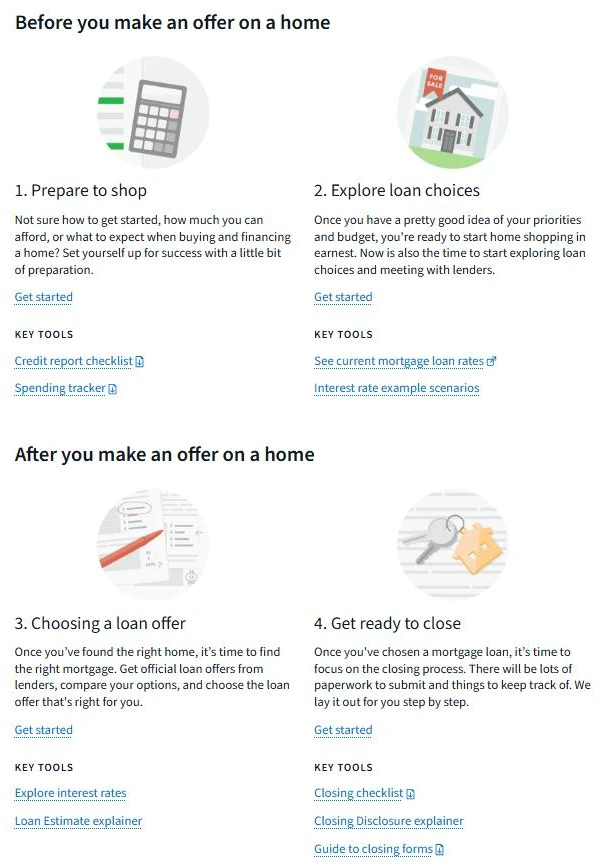
The CFPB groups the process into four stages, with free tools for each. Source: Consumer Financial Protection Bureau.
Pre-qualification and pre-approval are not the same thing. Our guide to pre-qualification vs pre-approval explains which one sellers want.
From signed contract to keys usually takes a few weeks. A week-by-week view is in our guide to how long it takes to close.
How much house can a first-time buyer afford?
It depends on income, debts, down payment and rate. Freddie Mac’s weekly survey put the 30-year fixed rate at 7.40% as of October 8, 2026. Fannie Mae’s automated approvals allow total debts up to 50% of gross income; many buyers aim lower.
| Area | Typical home value | Change in 1 year |
|---|---|---|
| Arlington County, VA | $806,890 | +0.8% |
| Loudoun County, VA | $795,391 | +1.4% |
| Fairfax County, VA | $760,599 | +0.9% |
| Alexandria, VA | $677,627 | +1.8% |
| Howard County, MD | $632,563 | +0.6% |
| Montgomery County, MD | $611,206 | -0.6% |
| Prince William County, VA | $581,036 | +1.1% |
| Washington, DC | $570,135 | -1.0% |
| Stafford County, VA | $537,904 | +0.6% |
| Frederick County, MD | $498,471 | -0.1% |
| Prince George’s County, MD | $425,252 | -1.0% |
Zillow Home Value Index, all homes, August 31, 2026, compared with August 31, 2025. This is a typical value, not a median sale price.
Loan limits are high here: $1,249,125 for a one-unit home in DC and most nearby counties in 2026. Howard County is lower, at $832,750 for conventional and $747,500 for FHA.
To see what one income buys, start with our guide to what a $100K salary buys in Northern Virginia.
Which loans work best for first-time buyers?
Most first-time buyers use one of four loan types. Each has its own down payment, credit and mortgage insurance rules.
| Loan | Minimum down | Credit score | Good to know |
|---|---|---|---|
| FHA | 3.5% (10% with a score of 500 to 579) | 500 or higher | The whole down payment can be a gift |
| Conventional 97 or HomeReady | 3% | No minimum for Fannie Mae automated approvals; lenders set their own | 97% loans need a first-time buyer, or income at or below 80% of the area median for HomeReady |
| VA | None, typically | No VA minimum | For eligible veterans and service members; no monthly mortgage insurance |
| USDA | None | No USDA minimum | Eligible rural areas and income limits only |
HUD; Fannie Mae Selling Guide B3-5.1-01 and 97% LTV options; VA; USDA. Rules for the 3% option exclude loans above $832,750.
ALCOVA Mortgage lists conventional, FHA, VA, USDA, HomeReady and Conventional 97 loans on its site. How much each one needs up front is in our guide to down payments in 2026.
Score rules for every loan are in our guide to the credit score you need for a mortgage.
What first-time buyer programs does Virginia offer?
| Program | What it offers | Status, October 13, 2026 |
|---|---|---|
| Virginia Housing Down Payment Assistance Grant | 2% or 2.5% of the price or appraised value, whichever is lower, with no repayment; bond loans only; the buyer puts in 1%; Northern Virginia income up to $148,000 (1 to 2 people) or $174,000 (3 or more), price up to $800,000 | Available |
| Virginia Housing Plus Second | A second mortgage of 3% to 5% with monthly payments | Available |
| Virginia DHCD down payment assistance | Up to $40,000 for buyers at or below 80% of area median income | No status notice posted |
| Fairfax County Down Payment Loan | Up to $50,000, at or below 80% of area median income | No status notice posted |
| Loudoun County DPCC | Up to 10% of the price or $70,000, whichever is less | Open, first-come, first-served |
| Arlington MIPAP | Up to 25% of the price | Not accepting applications |
| Mortgage credit certificate | Federal tax credit | Suspended since May 1, 2023 |
Virginia Housing, Virginia DHCD, Fairfax County, Loudoun County and Arlington County program pages, read October 13, 2026.
Each program uses approved lenders and has its own rules. Full details are in our guide to Virginia Housing first-time buyer programs.
What first-time buyer programs does Maryland offer?
The Maryland Mortgage Program (MMP) is the main state program. In Montgomery and Prince George’s counties, its income limits are $199,320 for 1 to 2 people and $232,540 for 3 or more.
| Program | What it offers | Status, October 13, 2026 |
|---|---|---|
| MMP 1st Time Advantage | $6,000, or 3%, 4% or 5% of the first mortgage, as a 0% deferred loan | Available |
| MMP SmartBuy 3.0 | Up to 15% of the price, $25,000 maximum, to pay off student debt; 720 score | Available |
| MMP First Homes for First Responders and Teachers | A new option for eligible first responders and teachers | Announced September 4, 2026 |
| MMP Montgomery Homeownership Program | County down payment help | Closed September 1, 2026 |
| MMP MEDPAL and HomeAbility | Specialty programs | Closed September 28, 2026 |
Maryland Mortgage Program product pages and directives, read October 13, 2026.
Rates, limits and how to apply are in our guide to the Maryland Mortgage Program.
What first-time buyer programs does DC offer?
| Program | What it offers | Status, October 13, 2026 |
|---|---|---|
| DC HPAP | Up to $202,000 in assistance plus up to $4,000 for closing costs, for income-eligible first-time buyers | Fiscal year 2027 details not yet posted |
| DC Open Doors | A 0% deferred loan for the minimum down payment; borrower income up to $275,400; first-time and repeat buyers | Available; the FHA assistance option showed no pricing on October 9 |
| HomeAdvantage DC | Down payment help up to 3% conventional or 3.5% FHA and VA; 660 score | Available |
| DC4ME and EAHP | Help for DC government employees | DC4ME is listed by DCHFA; EAHP depends on funding, and fiscal year 2027 details are not posted |
DC DHCD and DC Housing Finance Agency program pages and rate table, read October 13, 2026.
How HPAP works and how to apply are in our guide to DC HPAP.
Do first-time buyers need a homebuyer education class?
Often, yes. Many low down payment loans and most state programs here require one, at least for first-time buyers. Several courses are free.
| Loan or program | When it is required | Courses accepted |
|---|---|---|
| Fannie Mae 97% loans and HomeReady | When all borrowers (all occupying borrowers for HomeReady) are first-time buyers, and for some files with no credit score | Courses meeting national industry standards, including Fannie Mae’s free HomeView |
| Freddie Mac Home Possible and HomeOne | When all occupying borrowers are first-time buyers | Freddie Mac’s free CreditSmart course, other courses meeting national standards, or a HUD-approved counseling agency |
| Virginia Housing | All first-time buyers | Virginia Housing’s free class, a HUD-approved agency, Framework or CreditSmart; not HomeView |
| Maryland Mortgage Program | All purchase borrowers, before approval | Approved online or in-person courses; some charge a fee |
| DC HPAP | All applicants | An 8-hour course from a participating DC counseling group |
Fannie Mae Selling Guide B2-2-06; Freddie Mac fact sheets and CreditSmart FAQ; Virginia Housing, MMP and DC DHCD program pages.
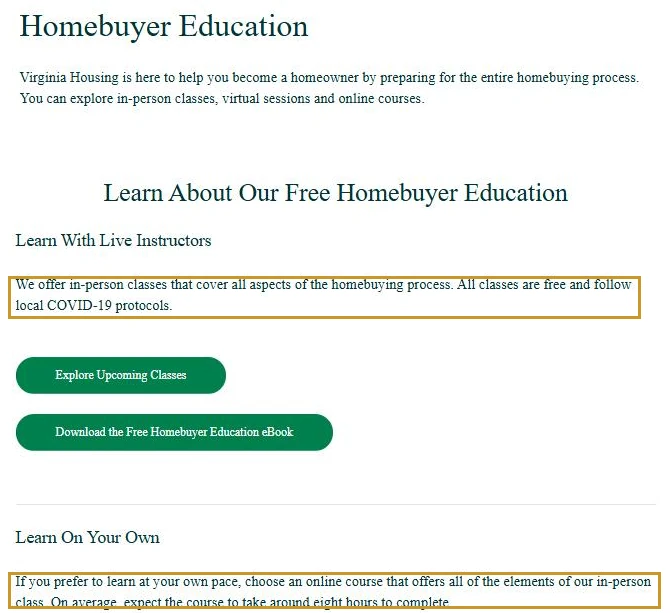
Virginia Housing’s classes are free, and its online course takes about eight hours. Source: Virginia Housing.
If you might use a Virginia Housing loan, pick a course it accepts, because its list differs from Fannie Mae’s.
What tax breaks do first-time buyers get?
There is no federal first-time homebuyer tax credit in 2026. A credit of up to $15,000 has been proposed in Congress (S. 2402 and H.R. 4717, 2025), but it has not passed.
| Benefit | Who gets it | What it is worth |
|---|---|---|
| IRA early withdrawal | IRA owners buying a first home for themselves or close family; here, first-time means no home owned in the past 2 years | Up to $10,000 over your lifetime avoids the 10% early-withdrawal tax; income tax may still apply; 401(k) plans do not qualify |
| Virginia first-time homebuyer savings account | Savers whose account is for a buyer who has never owned a single-family home and will live in Virginia | Earnings are subtracted from Virginia taxable income; contributions are not deductible |
| Maryland transfer tax | First-time Maryland buyers who will live in the home; every buyer on the deed must qualify | The state transfer tax drops from 0.5% to 0.25%, and the seller pays it |
| DC recordation tax | First-time DC buyers within income limits, price up to $794,000 | 0.725% instead of the usual 1.1% or 1.45%; on a $600,000 home, $4,350 instead of $8,700 |
IRS Topic 557 and early distribution exceptions table; Virginia Tax; Maryland Tax-Property 13-203 and Real Property 14-104; DC Form ROD 11, effective October 1, 2026.
In Maryland, the seller also pays the recordation and local transfer taxes for a first-time buyer, unless the contract says otherwise.
How do you compare mortgage lenders?
Get a Loan Estimate from more than one lender. The form is the same everywhere, so you can compare offers line by line.
| What to compare | Where to find it |
|---|---|
| Interest rate and APR | Page 1 and page 3 of the Loan Estimate; APR includes certain fees |
| Lender charges and points | Section A on page 2 |
| Cash to close | The total on page 1 and page 2 |
| Rate lock | Page 1 shows whether the rate is locked and until when; locks typically run 30, 45 or 60 days |
CFPB Loan Estimate explainer and rate lock guidance.
Shopping does not have to hurt your score. The CFPB says mortgage credit checks within 45 days are recorded as one inquiry, and FICO says some older score versions use a 14-day window, so a short window is safer.
What ongoing costs should first-time buyers budget for?
The mortgage payment is only part of owning a home. Plan for these costs every month or year.
| Cost | What to know |
|---|---|
| Property tax | Set by your county, city or the District, plus a small state rate in Maryland; many lenders collect it monthly through escrow |
| Homeowners insurance | Lenders require it before closing; 2022 averages were $1,332 a year in Virginia, $1,392 in Maryland and $1,384 in DC |
| Mortgage insurance | On conventional loans with less than 20% down, and on FHA loans |
| HOA or condo fees | Count toward your debt-to-income ratio |
| Repairs and upkeep | Not part of the loan, so keep an emergency fund for them |
Homeowners insurance averages: NAIC data via the Insurance Information Institute. Your quote will differ.
What will closing cost a first-time buyer?
Closing costs include lender fees, title, settlement, prepaid taxes and insurance, and state and local taxes. The taxes differ the most by location.
In Virginia, buyers typically pay recordation tax of $0.25 per $100 on the deed and the loan, plus a local share. In DC, a qualifying first-time buyer pays the reduced 0.725% recordation rate.
You can ask the seller to pay part of your costs. With less than 10% down, Fannie Mae caps seller help at 3% of the price or appraised value, whichever is lower. A side-by-side breakdown is in our guide to closing costs in Virginia, DC and Maryland.

Get a Mortgage Estimate for Free
Find out which first-time buyer loans fit your income, savings and county.
✓Free, no obligation✓Licensed in VA, MD, DC and WV✓Loan officer Ken Byrne, NMLS #187129
Frequently asked questions
What is the first step to buying a house for the first time?
Check your credit and savings, then get pre-approved. The pre-approval tells you your price range before you start touring homes.
How much money do I need to buy my first home?
As little as 0% down with VA or USDA, 3% with some conventional loans, or 3.5% with FHA. You also need closing costs, and it is wise to keep some savings after closing.
Can I be a first-time buyer if I owned a home before?
Usually, yes, if you have not owned a home in the past three years. The Maryland, DC and Virginia tax breaks are stricter.
Is there a first-time homebuyer tax credit in 2026?
Not at the federal level. A credit of up to $15,000 has been proposed in Congress but has not passed. DC and Maryland cut certain closing taxes for first-time buyers.
What credit score do first-time buyers need?
FHA allows 580 with 3.5% down. Fannie Mae’s automated approvals set no minimum, but lenders and state programs often require 620 to 640 or more.
Do I have to take a homebuyer class?
Often. MMP and DC HPAP require one, and Virginia Housing requires one for first-time buyers. Many 3% down conventional loans do too. Several approved courses are free.
Can my down payment be a gift?
Yes, on most owner-occupied loans, with a signed gift letter. FHA allows the whole down payment to come from a gift.
How long does it take to buy a house?
It varies. After your offer is accepted, closing often takes a few weeks. Federal rules require the Closing Disclosure at least 3 business days before you sign.
Do first-time buyers get a better interest rate?
Not automatically. Fannie Mae waives its price adjustments for first-time buyers within its income limits, and state housing agencies set their own program rates.
What is the average age of a first-time home buyer?
A record 40, according to NAR’s 2025 survey. First-time buyers made up 21% of purchases, the lowest share since NAR began tracking in 1981.
Which loan is best for a first-time buyer?
It depends on your credit, savings and eligibility. If you qualify, VA is often a strong choice because it usually needs no down payment and has no monthly mortgage insurance. Otherwise compare FHA, USDA and conventional loans with 3% to 5% down.
This article is general information, not financial, tax or legal advice and not a commitment to lend or an offer of credit. Program rules, funding and limits change often. Assistance programs, homebuyer education and tax benefits are run by federal, state and local agencies, not by JB Financing or ALCOVA Mortgage. Confirm anything you plan to act on with the agency, a tax professional or a licensed mortgage professional. Program details, rates, limits and tax rules were checked against official sources on October 13, 2026.
Categories
Recent Posts






GET MORE INFORMATION

Broker Associate