
How Much House Can I Afford on an $80K Salary in the DMV? 2026 Numbers by County

On $80,000 a year, a townhouse or condo is often the first home in the DMV.
Short answer: on an $80,000 salary with no other monthly debts, you can afford a home of about $340,000 to $365,000 in most of the DMV with an FHA loan at September 2026 rates, keeping total debts at 43 percent of income. If the lender’s automated approval allows 50 percent, the range rises to about $400,000 to $425,000. A $500 car payment cuts it by roughly $63,000, and HOA dues cut it further. With down payment assistance, the down payment you bring can be under $5,000, before closing costs.
By Ken Byrne, NMLS #187129 · ALCOVA Mortgage LLC, NMLS #40508 · Updated September 2026
$80,000 is about 63 percent of the Washington area’s median household income and about 48 percent of the area median family income HUD uses for housing programs. That puts you under the limits for most down payment programs in Virginia, Maryland and DC, which is the good news. The hard part is the price: the typical home in most DMV counties costs more than $80,000 can carry. This guide shows exactly how far it goes, county by county, and where it works. For numbers on your own debts and savings, talk to JB Financing, the Ken Byrne Team at ALCOVA Mortgage.
How lenders decide what $80,000 can afford
Lenders do not use a rule of thumb like three times your salary. They add up your monthly housing payment and every other monthly debt, and divide by your gross monthly income of $6,667. That debt to income ratio, or DTI, has limits that depend on the loan.
| Loan and approval type | Maximum total DTI |
|---|---|
| Conventional, manual underwriting | 36%, up to 45% with strong credit and reserves |
| Conventional, Fannie Mae automated approval (DU) | Up to 50% |
| FHA, manual underwriting | 43% standard; 47% or 50% with compensating factors |
| FHA, automated approval | No fixed HUD maximum; set by the automated findings, which can approve strong files at 50% or more |
| VA | 41% guideline, with residual income deciding the rest |
Fannie Mae Selling Guide B3-6-02; HUD Handbook 4000.1 (from Mortgagee Letter 2014-02); 38 CFR 36.4340.
At 43 percent, your total monthly debts can be $2,867. At 50 percent, $3,333. Every dollar of car, student loan or credit card payment comes out of that before the mortgage. How lenders count each kind of debt is in our guide to debt to income ratio and mortgage approval.
How much house $80,000 buys in each part of the DMV
Property taxes differ enough across the region to move the answer, so here is the maximum price by area for an FHA loan with 3.5 percent down, next to what a typical home there costs.
| Area | Typical home value | Max price, no other debts | Max price with a $500 car payment | Max price, VA loan, no debts |
|---|---|---|---|---|
| Washington DC (with homestead deduction) | $570,082 | $366,000 | $301,000 | $374,000 |
| Jefferson County, WV | $400,340 | $363,000 | $297,000 | $372,000 |
| Spotsylvania County, VA | $456,897 | $362,000 | $296,000 | $370,000 |
| Woodbridge, VA | $498,767 | $354,000 | $290,000 | $362,000 |
| Stafford County, VA | $537,904 | $352,000 | $288,000 | $360,000 |
| Prince George’s County, MD | $425,252 | $347,000 | $284,000 | $355,000 |
| Frederick County, MD | $498,471 | $343,000 | $281,000 | $351,000 |
| Charles County, MD | $446,976 | $340,000 | $278,000 | $348,000 |
Calculated at 7.03 percent (Freddie Mac, September 24, 2026), 43 percent total DTI, homeowners insurance of $115 a month, no HOA dues. FHA: 1.75 percent upfront premium financed, 0.55 percent annual premium. VA: 2.15 percent funding fee financed. Typical values: Zillow Home Value Index, August 2026. Tax rates: 2026 county and state rates; DC $0.85 per $100 with the $91,950 homestead deduction.
The pattern is clear. On $80,000 alone, the typical house is out of reach almost everywhere in the region; what fits is a townhouse, a condo, or a home in the outer counties. Jefferson County in West Virginia is the closest to typical, and Hagerstown, where the typical home is about $301,000, is one of the few places in the wider area where $80,000 covers an average home.

Get a Mortgage Estimate for Free
See your real price range on $80,000, with your debts and your county’s taxes.
✓Free, no obligation✓Licensed in VA, MD, DC and WV✓Loan officer Ken Byrne, NMLS #187129
What the payment looks like
Here is the maximum FHA purchase, about $347,000, in Prince George’s County on $80,000 with no other debts.
| $347,377 home, FHA | Amount |
|---|---|
| Down payment (3.5%) | $12,158 |
| Loan, with upfront premium | $341,085 |
| Principal and interest | $2,276 |
| FHA mortgage insurance | $154 |
| Property tax | $322 |
| Homeowners insurance | $115 |
| Total monthly payment | $2,867, or 43% of income |
Calculated at 7.03 percent. Prince George’s County rate $1.112 per $100 including the state rate, unincorporated areas; towns add their own rate.
Rates move this more than anything else. At 6.53 percent, the same budget buys about $362,000; at 7.53 percent, about $333,000. A half point either way is worth roughly $15,000 of price.
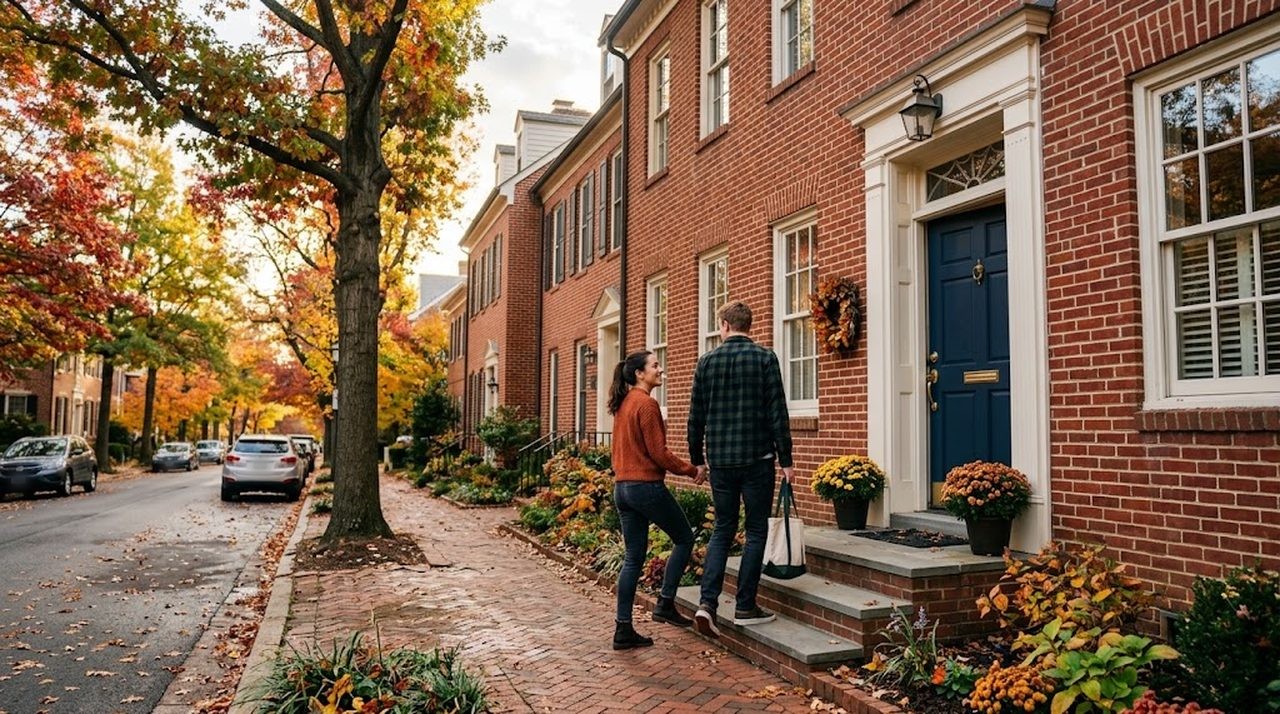
Townhouses in the outer suburbs are where an $80,000 budget usually lands.
How your debts change the answer
| Other monthly debts | Housing budget at 43% DTI | Housing budget at 50% DTI |
|---|---|---|
| None | $2,867 | $3,333 |
| $500 (a typical car payment) | $2,367 | $2,833 |
| $800 (car plus student loan) | $2,067 | $2,533 |
Calculated on gross monthly income of $6,667.
Each $100 of monthly debt removes about $12,500 of buying power at today’s rates. Paying off a small card balance or a car with a few payments left can matter more than saving the same amount toward the down payment. For the same math at the next income level, see how much house you can afford on $100,000.
Condos, townhouses and HOA dues
Most homes in reach on $80,000 have HOA or condo fees, and lenders count them in the housing payment dollar for dollar.
| Monthly HOA or condo fee | Max price, Prince George’s County | Max price, Washington DC |
|---|---|---|
| $0 | $347,000 | $366,000 |
| $300 | $310,000 | $327,000 |
| $450 | $291,000 | $307,000 |
Calculated. FHA at 7.03 percent, 43 percent DTI, no other debts.
Every $100 of monthly fee takes about $12,500 off your price. A condo also has to be approved by FHA for an FHA loan, or meet Fannie Mae or Freddie Mac rules for a conventional one, so check the building before you fall for a unit.
Get Pre-Approved Today
Shop with a budget built on your income, not an online guess.
✓Free, no obligation✓Licensed in VA, MD, DC and WV✓Loan officer Ken Byrne, NMLS #187129
The best loan options on an $80,000 salary
| Loan | Down payment | Best for |
|---|---|---|
| FHA | 3.5% | Credit in the 600s, or debts that push DTI above conventional limits |
| Conventional | 3% | Credit around 700 or higher, where mortgage insurance costs less than FHA’s |
| VA | None | Eligible veterans and service members; no monthly mortgage insurance |
| USDA | None | Homes in eligible rural areas, with household income under the county limit |
On $80,000, FHA and conventional often come out close, and the right choice depends on your credit score. The side by side is in our guide to FHA vs conventional loans.
Veterans get the most room of all: no down payment and no monthly mortgage insurance, which is why the VA column in the table above is the highest. Check where you stand in our guide to VA loan eligibility.
USDA is worth a look in the Eastern Panhandle and the outer Virginia counties, where much of the map is eligible. See USDA loans in Virginia and West Virginia.
Down payment help you qualify for on $80,000
This is where $80,000 has an edge. It is under the income limits for the main programs in all three jurisdictions.
| Where you buy | Program | What it gives |
|---|---|---|
| Virginia | Virginia Housing Down Payment Assistance Grant | 2% (conventional) or 2.5% (FHA) of the price, no repayment; Northern Virginia income limit $148,000 for 1 or 2 people; first-time buyers, with a Virginia Housing FHA or conventional bond loan |
| Maryland | Maryland Mortgage Program 1st Time Advantage | $6,000, or 3% to 5% of the loan, as a 0% deferred second loan; with the $6,000 option, Partner Match can match employer or local help up to $2,500; first-time buyers |
| DC | Home Purchase Assistance Program (HPAP) | $80,800 for a single buyer at $80,000; $161,600 for a household of two at $80,000; plus up to $4,000 for closing costs. A single buyer’s loan at this income is deferred 5 years, then repaid over 40; a household of two defers until sale or refinance |
| DC | DC Open Doors | 3% (conventional) or 3.5% (FHA) of the price as a 0% deferred loan; no first-time buyer requirement |
Virginia Housing program guides, August 2026; Maryland DHCD Directive 2026-04 (limits for loans reserved on or after June 24, 2026); DC DHCD HPAP table for loans closing after July 1, 2026; DC Housing Finance Agency, DC Open Doors. HPAP funding for the fiscal year starting October 1, 2026 had not been announced when this was written.
On a $362,000 FHA purchase in Virginia, the grant pays $9,050 of the $12,670 down payment, so you bring about $3,620. In DC, HPAP can change the picture entirely: $80,800 of assistance on top of what your income supports lifts the price range well beyond the table above. Rules, limits and the Plus Second alternative are in our guide to Virginia Housing programs.
Maryland buyers can see how the state’s programs and taxes change the math in our guide to how much house you can afford in Maryland.
Ways to stretch $80,000 further
| Move | Effect on buying power |
|---|---|
| Pay off a $300 a month debt | About $38,000 more |
| Choose a home with no HOA over one with $300 dues | About $37,000 more |
| Buy with a co-borrower earning $40,000 | About $180,000 more on the same terms |
| Rate half a point lower | About $15,000 more |
| Use a VA loan if eligible | About $8,000 more than FHA, with no down payment |
Calculated on the same terms as the tables above.
Frequently asked questions
How much house can I afford on $80,000 a year?
About $340,000 to $365,000 in most of the DMV with an FHA loan and no other debts at a 7.03 percent rate, and up to about $425,000 if your approval allows a 50 percent debt to income ratio.
What is the monthly payment I can afford on $80,000?
About $2,867 for all housing costs at a 43 percent debt to income ratio with no other debts, or $3,333 at 50 percent.
How much income do I need for a $400,000 house?
About $87,000 to $94,000 a year with an FHA loan and no other debts at today’s rates and a 43 percent ratio, depending on the county’s tax rate.
Can I buy a house in Northern Virginia on $80,000?
Yes, but mostly a condo or townhouse, or a home farther out in Prince William, Stafford or Spotsylvania. The typical single family home in Fairfax or Loudoun is out of reach on $80,000 alone.
Can I buy a home in DC on $80,000?
Often, yes, especially with HPAP, which can add $80,800 for a single buyer or $161,600 for a household of two at that income, if funding is available.
What credit score do I need?
FHA loans are available from 580 with 3.5 percent down, though many lenders set 620. Most lenders set 620 for conventional loans, since Fannie Mae dropped its fixed 620 floor for automated approvals in November 2025, and Virginia Housing’s programs need 620 to 640.
Do I qualify for down payment assistance on $80,000?
Usually, yes. $80,000 is under the income limits for the Virginia Housing grant, the Maryland Mortgage Program and DC’s HPAP for most household sizes.
How much do I need to save?
The down payment is 3 to 3.5 percent, or about $12,000 on a $350,000 FHA purchase, plus closing costs. Assistance programs and seller credits can bring the cash you bring to closing well below that.
Is a condo easier to afford than a townhouse?
The price is often lower, but condo fees count against your budget. Each $100 of monthly fee reduces what you can borrow by about $12,500.
Next stepStart Your Pre-Approval
Start online, and Ken Byrne’s team will run your numbers and the assistance you qualify for.
✓Free, no obligation✓Licensed in VA, MD, DC and WV✓Loan officer Ken Byrne, NMLS #187129
This article is general information, not financial or legal advice and not a commitment to lend or an offer of credit. Loan limits, program rules, premium schedules and rates change, and individual eligibility depends on a full review of your credit, income, assets and the property. Every figure here is an illustration, not a quote, built from published sources and a weekly survey average rather than underwriting decisions. Insurance and mortgage insurance amounts are planning estimates. Confirm anything you plan to act on with a licensed mortgage professional. Affordability figures are illustrations at a 7.03 percent rate from Freddie Mac’s survey of September 24, 2026, and use county tax rates for 2026 and an assumed insurance cost. Assistance programs are subject to funding and to each program’s current limits.
Categories
Recent Posts







GET MORE INFORMATION

Broker Associate