
How to Get Pre-Approved for a Mortgage: Step-by-Step Guide for 2026
How to Get Pre-Approved for a Mortgage: Step-by-Step Guide for 2026
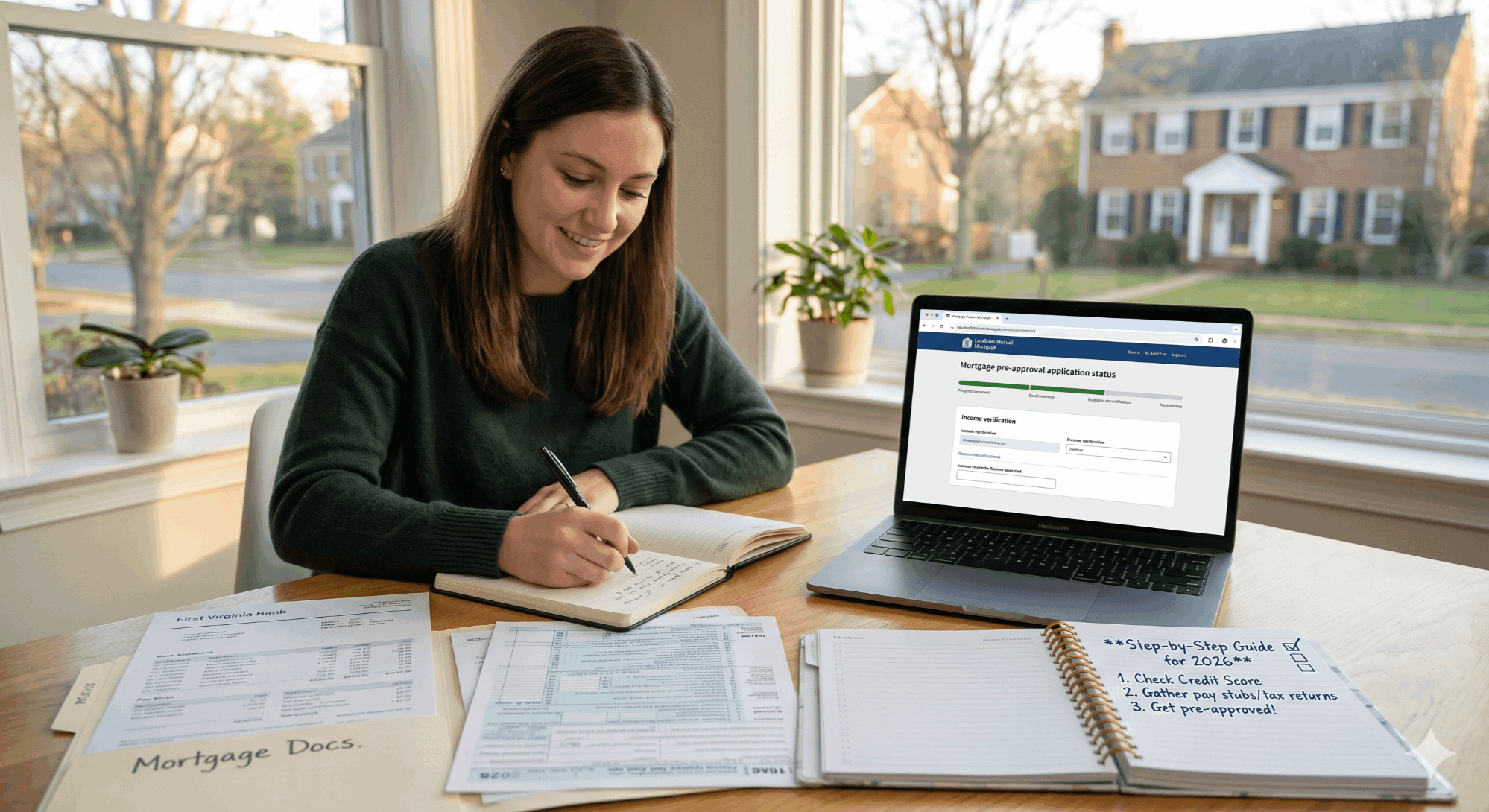
Getting pre-approved for a mortgage is the single most important first step in buying a home in 2026. In the competitive DMV market — where homes in Loudoun, Fairfax, Arlington, and Montgomery County routinely receive multiple offers — sellers won't seriously consider a buyer who hasn't been pre-approved. A pre-approval letter tells everyone in the transaction that a lender has verified your income, assets, and credit, and is prepared to issue you a loan up to a specific amount.
This guide walks you through the entire pre-approval process from start to finish: what documents you need, how lenders evaluate your application, how long it takes, what credit score you need, and how to avoid the common mistakes that delay or derail approvals. Whether you're a first-time buyer in Northern Virginia, a move-up buyer in Maryland, or relocating to the DC area, the framework is the same — and the better prepared you are, the faster and stronger your offer will be when you find the right home.
Quick Answer: To get pre-approved for a mortgage in 2026, gather two years of W-2s and tax returns, two months of pay stubs and bank statements, and government-issued ID. Submit a full application to a licensed lender, authorize a credit pull, and the lender will issue a pre-approval letter — typically within 24 to 72 hours — stating the maximum loan amount you qualify for. Most pre-approval letters are valid for 60 to 90 days.
Key Takeaways
- Pre-approval is not pre-qualification. Pre-qualification is an estimate based on stated information. Pre-approval is verified — credit pulled, income documented, assets confirmed.
- You need pre-approval before you tour homes in the DMV. Most listing agents won't schedule showings without it, and offers without it won't be competitive.
- Most pre-approvals take 24–72 hours once you've submitted complete documentation. Rush approvals are possible same-day for fully prepared borrowers.
- Minimum credit scores vary by loan type: 580 for FHA (with 3.5% down), 620 for conventional, 620 for most VA lender overlays, 640 for USDA.
- The 2026 conforming loan limit in the DC metro is $1,249,125 for a single-family home — well above the national baseline of $806,500.
- Pre-approval letters expire in 60–90 days. After that you'll need to refresh credit and income documentation.
Table of Contents
- What Pre-Approval Actually Means
- Why Pre-Approval Matters in the DMV Market
- Pre-Qualification vs. Pre-Approval vs. Underwritten Approval
- Documents You Need for Pre-Approval
- Step-by-Step Pre-Approval Process
- Credit Score Requirements by Loan Type
- How Lenders Calculate Debt-to-Income (DTI)
- How Long Pre-Approval Takes
- What Happens After Pre-Approval
- Common Pre-Approval Mistakes to Avoid
- How to Choose a Mortgage Lender
- Frequently Asked Questions
- Glossary of Mortgage Terms
What Pre-Approval Actually Means
Mortgage pre-approval is a written commitment from a lender stating that, based on a verified review of your financial documents and credit, you qualify to borrow a specific amount under specific terms. It's not a final loan approval — that comes later, after you have a property under contract and the home goes through underwriting and appraisal — but it's a real, conditional commitment from a licensed lender.
During pre-approval, your lender will pull your credit report, review your income and asset documentation, calculate your debt-to-income ratio, and determine the maximum loan amount you qualify for under the loan program you're applying through. The output is a pre-approval letter — typically a one- or two-page document — that you and your real estate agent will submit alongside any offer you make.
The key distinction: pre-approval involves the lender actually verifying your information, not just taking your word for it. That verification is what gives the letter weight with sellers.
Why Pre-Approval Matters in the DMV Market
In Northern Virginia, Maryland's DC suburbs, and Washington DC itself, inventory remains tight relative to buyer demand in most price tiers. Well-priced homes in desirable school districts — Loudoun's Brambleton and Ashburn, Fairfax's Vienna and Oakton, Montgomery's Bethesda and Potomac, Arlington's Lyon Park — frequently see multiple offers within the first weekend on the market.
In that environment, pre-approval is not optional. Here's what it does for you:
- Establishes your budget with precision. You learn exactly what you can borrow before you fall in love with a home that's out of reach.
- Allows you to tour homes. Most listing agents in the DMV require a pre-approval letter before scheduling private showings.
- Makes your offer competitive. A pre-approval letter is required to submit a serious offer in virtually all DMV markets. Sellers and their agents won't take cash-equivalent offers seriously without it.
- Shortens the path to closing. Because verification has already happened, the underwriting process post-contract moves faster.
- Identifies issues early. If there's a problem with your credit, employment history, or DTI, you find out now — when there's still time to fix it — not after you've written an offer.
Free · No Commitment
See What You Qualify For Today
Get pre-approved in minutes and know exactly how much home you can afford in the DC metro market. No cost, no obligation.
Ken Byrne NMLS #187129 · ALCOVA Mortgage LLC NMLS #40508
Pre-Qualification vs. Pre-Approval vs. Underwritten Approval
These three terms get used interchangeably in casual conversation, but they mean very different things to lenders, sellers, and listing agents. Knowing the difference matters when you're competing for a home.
| Stage | Credit Pulled? | Documents Verified? | Strength of Letter | Best For |
|---|---|---|---|---|
| Pre-Qualification | No | No | Weakest | Early budget estimate |
| Pre-Approval | Yes | Yes | Strong | Touring & offers |
| Underwritten / TBD Approval | Yes | Yes + underwriter review | Strongest | Multiple-offer situations |
Pre-Qualification
A pre-qualification is a rough estimate based on information you tell the lender — income, debts, down payment — without any verification. It can be done in five minutes online. It's useful for early planning, but it's not a real commitment from the lender, and most listing agents in the DMV won't accept a pre-qualification letter as proof of buyer readiness.
Pre-Approval
A pre-approval involves a full application, a credit pull, and review of your income, asset, and employment documentation. It's the standard letter required for offers in the DMV. It's strong, credible, and recognized by every listing agent.
Underwritten Pre-Approval (TBD Approval)
Some lenders, including ALCOVA, offer a more rigorous version where your file is actually run through underwriting before you have a property under contract. The only outstanding items are property-specific: appraisal, title, and homeowners insurance. In a multiple-offer situation, an underwritten approval can be the deciding factor — sellers know your loan is essentially already approved.
Documents You Need for Pre-Approval
Lenders need to verify three things: your income, your assets, and your identity. The faster and more completely you provide documentation, the faster your pre-approval can issue.
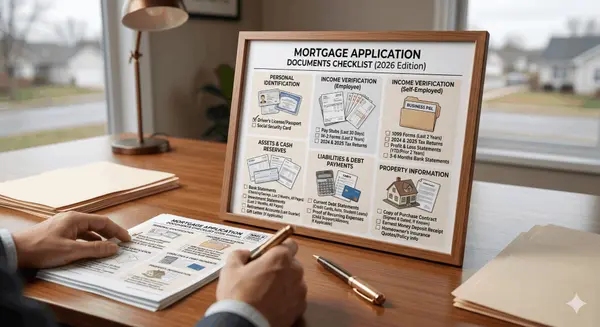
Pre-Approval Document Checklist
Identity
- Government-issued photo ID (driver's license or passport)
- Social Security number
Income (W-2 employees)
- Most recent 30 days of pay stubs
- Last two years of W-2s
- Last two years of federal tax returns (all pages, all schedules)
- Employer name, address, and phone number
Income (Self-employed)
- Last two years of personal federal tax returns (all pages, all schedules)
- Last two years of business tax returns (if applicable)
- Year-to-date profit and loss statement
- Business license (if applicable)
Assets
- Last two months of statements for all checking, savings, and money market accounts (all pages)
- Most recent statements for retirement accounts (401(k), IRA) and investment accounts
- Documentation for any large deposits in the past 60 days (gift letter, sale of asset, etc.)
Other
- VA borrowers: Certificate of Eligibility (COE) — your lender can pull this for you
- Divorced or paying support: divorce decree, child support order
- Bankruptcy or foreclosure within 7 years: discharge papers and explanation letter
- Currently renting: landlord contact information for verification of rent (VOR)
A note on bank statements: lenders need all pages, even the blank ones. The page count on the statement (e.g., "Page 1 of 7") must be complete. This is one of the most common reasons pre-approvals get delayed — borrowers send pages 1–6 of a 7-page statement.
Step-by-Step Pre-Approval Process
Here's the full pre-approval timeline from first contact to letter in hand.
Choose a Lender
Select a licensed mortgage lender. Local lenders familiar with DMV programs and county-level nuances often outperform call-center national lenders for purchase transactions.
Submit a Loan Application (1003)
The Uniform Residential Loan Application — Form 1003 — captures your personal information, employment, income, assets, debts, and the loan amount you're applying for. Most lenders offer this online.
Authorize a Credit Pull
The lender pulls a tri-merge credit report (Equifax, Experian, TransUnion). This is a hard inquiry and may temporarily lower your score by a few points. Multiple mortgage inquiries within 45 days count as one for FICO scoring purposes.
Upload Income and Asset Documents
Send everything from the document checklist above. Most lenders use a secure portal — never email tax returns or bank statements as plain attachments.
Loan Officer Reviews Your File
Your loan officer calculates your qualifying income, debts, DTI, and reserves. They run your file through automated underwriting (Fannie Mae's Desktop Underwriter or Freddie Mac's Loan Product Advisor) to confirm eligibility.
Conditions Cleared
If automated underwriting flags any conditions (large deposits, employment gaps, address mismatches), your loan officer will request explanations or additional documentation.
Pre-Approval Letter Issued
You receive a letter stating the maximum loan amount, loan program, and any remaining conditions. The letter is typically valid for 60–90 days. Send it to your real estate agent — you're ready to make offers.
Credit Score Requirements by Loan Type
Different loan programs have different minimum credit score thresholds. Lenders often add their own "overlays" — internal minimums above the program floor — so your actual minimum may be slightly higher than the agency standard.
| Loan Type | Min. Down | Min. Credit | Loan Limit (DC Metro) | Best For |
|---|---|---|---|---|
| Conventional | 3% (first-time) | 620 | $1,249,125 | Strong credit, flexibility |
| FHA | 3.5% | 580 | $1,149,825 | Lower credit, low down payment |
| VA | 0% | 620 (lender) | No cap (full entitlement) | Active duty, veterans, eligible spouses |
| USDA | 0% | 640 | Income-based, eligible areas only | Outer NOVA, rural MD/WV |
| Jumbo | 10–20% | 700+ | Above $1,249,125 | Luxury & high-end markets |
Beyond the minimum threshold, your credit score also affects pricing. Borrowers with FICO scores of 740 or higher generally qualify for the lowest rates and the lowest mortgage insurance premiums on conventional loans. The difference between a 680 and a 760 FICO can translate into thousands of dollars in interest over the life of the loan.
How Lenders Calculate Debt-to-Income (DTI)
Your debt-to-income ratio is one of the two primary factors (alongside credit) that determine how much you can borrow. DTI compares your monthly debt obligations to your gross monthly income.
There are two DTI ratios lenders look at:
- Front-end (housing) ratio: Total proposed monthly housing payment (principal, interest, taxes, insurance, HOA, mortgage insurance) divided by gross monthly income.
- Back-end (total) ratio: Total monthly debt obligations (housing + car loans, student loans, minimum credit card payments, child support, etc.) divided by gross monthly income.
Maximum DTI by Loan Type
In high-cost markets like the DMV, DTIs in the 45–50% range are common, especially for first-time buyers stretching to enter the market. Note that HOA dues for condos and townhomes — common in Reston, Brambleton, Tysons, Bethesda, and Arlington — are included in your housing ratio. A $400/month HOA can meaningfully reduce your maximum loan amount.
Run the Numbers
What Will Your Monthly Payment Be?
Use our mortgage calculator to estimate your monthly payment for any home price in Virginia, Maryland, or DC.
How Long Pre-Approval Takes
For a well-prepared borrower with all documentation ready, pre-approval can be issued in 24–72 hours. The variables that affect timing are usually on the borrower's side, not the lender's.
Same-Day Pre-Approval
Possible if you're a W-2 employee with strong credit (700+), low DTI, no large deposits or unusual transactions, and you upload all documents at once. Some lenders, including ALCOVA, can issue letters within hours under these conditions.
24–72 Hour Standard
Most pre-approvals fall in this window. Application Monday morning, letter issued by mid-week is the standard rhythm.
5–10 Days for Complex Files
Self-employed borrowers, those with rental income, recent job changes, gift funds requiring documentation, or unusual income sources should expect a longer review. The work isn't harder — it's just more documentation cycles.
What Happens After Pre-Approval
A pre-approval letter is the starting line, not the finish line. Here's what comes next:
- Choose a real estate agent and begin home shopping with a clear budget.
- Find a property and write an offer. Your pre-approval letter goes with the offer.
- Offer accepted — go under contract. Your lender begins the formal loan process.
- Submit updated documents. The lender refreshes anything older than 30 days.
- Appraisal and inspection. The lender orders the appraisal; you order the home inspection.
- Underwriting. The underwriter reviews everything — your finances, the appraisal, the title, the property — and issues a clear-to-close.
- Final walkthrough and closing. Sign documents, fund the loan, take possession.
Total timeline from pre-approval to closing is typically 30–45 days once you have a property under contract.
Common Pre-Approval Mistakes to Avoid
These are the issues that delay or derail pre-approvals — and the post-pre-approval moves that can blow up an otherwise solid file.
Mistakes That Delay or Sink Pre-Approval
- Applying for new credit during the process. Don't open a new credit card, finance a car, or co-sign a loan after applying. New credit changes your DTI and your scores.
- Making large undocumented deposits. Any deposit outside of normal payroll over the past 60 days will be questioned. If you receive a gift, document it with a gift letter and the giver's bank statements.
- Changing jobs during the process. A job change before closing can stall or kill an approval, especially if it involves a different industry, commission structure, or self-employment.
- Sending incomplete bank statements. Always send all pages, including blank ones. A missing page 7 of 7 will hold up your file.
- Paying off old collections without consulting your lender. Paying an old collection can re-age it on your credit report and temporarily lower your score.
- Lying or omitting on the application. Lenders verify everything. Disclose all debts, all properties, all employment, all income — including any rental properties or side businesses.
- Stopping payment on existing debts. Keep paying every bill on time. A single 30-day late during the process can derail approval.
- Co-signing for someone else. Don't co-sign a loan for a family member while you're in the process. The full payment counts against your DTI.
- Moving large sums of money between accounts. Lenders need to source and season funds. Random transfers create paper-trail problems.
- Using cash for the down payment. Cash that wasn't in a bank account 60 days before application generally cannot be used. Deposit early and document the source.
Free · No Commitment
Start Your Pre-Approval Application
Apply online in minutes and get a pre-approval letter you can use to compete for any home in Virginia, Maryland, or DC.
Ken Byrne NMLS #187129 · ALCOVA Mortgage LLC NMLS #40508
How to Choose a Mortgage Lender
Not all lenders are equal — especially in a market as fast-moving as the DMV. Use these objective criteria to evaluate any lender you're considering.
- NMLS license verification. Every loan officer in the U.S. must be licensed and registered with the Nationwide Multistate Licensing System. You can search any officer at nmlsconsumeraccess.org.
- Local market knowledge. A lender who closes loans in Loudoun, Fairfax, Montgomery, and Prince George's every week understands county-level closing costs, local DPA programs, and HOA dynamics in a way a national call center can't.
- Responsive communication. In a multiple-offer situation, your lender may need to talk to a listing agent at 9 PM on a Sunday. Call-center models often can't deliver that.
- Loan program breadth. Confirm the lender offers all the programs you might need: Conventional, FHA, VA, USDA, jumbo, and any state DPA programs (Virginia Housing, MMP, HPAP).
- Closing track record. Ask the loan officer how often they close on time, and how they handle unexpected issues during underwriting.
- Transparent fees. A Loan Estimate (LE) is required by federal law within three days of application. Compare LEs across lenders — total fees matter, not just the rate.
JB Financing is the mortgage lending operation of Ken Byrne (NMLS #187129), Branch Partner at ALCOVA Mortgage LLC (NMLS #40508). ALCOVA is licensed in Virginia, Maryland, DC, and West Virginia and offers Conventional, FHA, VA, USDA, jumbo, and Virginia Housing programs. Direct contact: kbyrne@alcova.com or (703) 927-4456.
Ready to Start Your Search?
Browse Homes for Sale in Northern Virginia
Once you know your budget, explore available homes across Loudoun, Fairfax, Prince William, Arlington, and Alexandria.
Frequently Asked Questions
How long does it take to get pre-approved for a mortgage in 2026?
For a W-2 employee with complete documentation, pre-approval typically takes 24–72 hours. Same-day approvals are possible with strong credit and immediate document upload. Self-employed borrowers and complex files generally take 5–10 business days.
What credit score do I need to get pre-approved for a mortgage in Virginia?
Minimum credit scores depend on the loan type: 580 for FHA (with 3.5% down), 620 for conventional and most VA lenders, and 640 for USDA loans. Jumbo loans typically require 700+. Higher scores generally qualify for better rates and lower mortgage insurance costs.
How much down payment do I need for a home in Northern Virginia?
As little as 0% with a VA or USDA loan, 3% with a conventional first-time buyer program, or 3.5% with an FHA loan. Virginia Housing and other DPA programs can reduce or eliminate the cash needed at closing for qualifying buyers.
What are the closing costs for a mortgage in Virginia?
Closing costs in Virginia typically run 2–4% of the purchase price. Virginia-specific items include the grantor tax (typically paid by seller), recordation tax (typically paid by buyer at $0.25 per $100 of loan amount plus state portion), title insurance, and lender fees. A $600,000 home in Loudoun typically generates $12,000–$22,000 in buyer closing costs and prepaids.
How do I get pre-approved for a mortgage in Northern Virginia?
Submit a full application to a licensed lender, authorize a credit pull, and upload two years of W-2s and tax returns, two months of pay stubs and bank statements, and government-issued ID. The lender will issue a pre-approval letter — typically within 24–72 hours — stating the maximum loan amount you qualify for.
What is the conforming loan limit in the DC metro for 2026?
The 2026 conforming loan limit for a single-family home in the DC metro high-cost area is $1,249,125. The FHA loan limit in the same area is $1,149,825. Loans above the conforming limit are jumbo loans and follow different qualifying guidelines.
Is it a good time to buy a house in Northern Virginia in 2026?
Market conditions vary by submarket and price tier. The DMV continues to see strong demand in well-located, school-district-driven neighborhoods. The best time to buy is when you're financially ready — pre-approved, with stable employment, sufficient reserves, and a clear sense of how long you plan to stay in the home.
Does getting pre-approved hurt my credit score?
A mortgage pre-approval involves a hard credit inquiry, which may temporarily lower your score by a few points. However, FICO scoring treats multiple mortgage inquiries within a 45-day window as a single inquiry, so you can shop multiple lenders without compounding the effect.
How long is a mortgage pre-approval letter good for?
Most pre-approval letters are valid for 60 to 90 days. After that, the lender will need updated pay stubs, bank statements, and a fresh credit pull to refresh the letter. The good news: refreshing a pre-approval is usually fast since most of the file is already on record.
Can I get pre-approved before I find a home?
Yes — and you should. Pre-approval is meant to happen before you start touring. It establishes your budget, allows you to schedule showings, and lets you make offers immediately when you find the right property.
How do I find a good mortgage lender in Northern Virginia?
Look for a licensed loan officer (verifiable at nmlsconsumeraccess.org), with strong DMV market knowledge, responsive communication, a full slate of loan programs (Conventional, FHA, VA, USDA, jumbo, Virginia Housing), and transparent fees disclosed in a Loan Estimate. Ken Byrne (NMLS #187129) at ALCOVA Mortgage LLC (NMLS #40508) operates JB Financing and serves buyers across Virginia, Maryland, DC, and West Virginia.
What's the difference between pre-approval and a commitment letter?
A pre-approval is conditional on a property being identified and appraised. A commitment letter (or final loan approval) is issued after underwriting reviews the specific property's appraisal, title, and homeowners insurance, and clears all final conditions. Commitment letters typically arrive 7–14 days before closing.
Glossary of Mortgage Terms
Automated Underwriting System (AUS): Software (Fannie Mae's DU or Freddie Mac's LPA) that evaluates loan applications against agency guidelines and returns an approval recommendation.
Conforming Loan Limit: The maximum loan amount Fannie Mae and Freddie Mac will purchase. For 2026 in the DC metro high-cost area, this is $1,249,125 for single-family homes.
Debt-to-Income Ratio (DTI): Total monthly debt obligations divided by gross monthly income. Lenders use DTI to determine how much you can borrow.
Earnest Money Deposit (EMD): A good-faith deposit from the buyer at contract acceptance, typically 1–3% of purchase price in the DMV. Held in escrow and applied to closing costs at closing.
Loan Estimate (LE): A standardized federal disclosure of loan terms, monthly payment, and closing costs. Lenders must provide an LE within three business days of receiving a complete application.
NMLS: Nationwide Multistate Licensing System. Every U.S. mortgage loan officer must be registered and licensed through NMLS.
PITI: Principal, Interest, Taxes, and Insurance — the four components of a typical monthly mortgage payment. Add HOA dues and mortgage insurance if applicable.
Tri-Merge Credit Report: A combined credit report pulling data from all three major bureaus (Equifax, Experian, TransUnion) used in mortgage underwriting.
Next Steps
Pre-approval is the moment your home search becomes real. With a verified letter in hand, you have a precise budget, the ability to schedule showings, and the credibility to make offers that sellers take seriously. The earlier you start the process, the more time you have to address any issues — credit, debt, employment documentation — that might come up.
Two ways to take action right now:
Free · No Commitment
Get Pre-Approved Today
Apply online and receive your pre-approval letter — usually within 24–72 hours. Use it to compete for any home in Virginia, Maryland, or DC.
Ken Byrne NMLS #187129 · ALCOVA Mortgage LLC NMLS #40508
Disclaimer: This article is for informational purposes only and does not constitute financial or legal advice. Mortgage programs, rates, and eligibility requirements are subject to change. Contact a licensed mortgage professional for guidance specific to your situation. Ken Byrne, NMLS #187129 · ALCOVA Mortgage LLC, NMLS #40508 · Licensed in VA, MD, DC, WV.
Categories
Recent Posts







GET MORE INFORMATION

Broker Associate