
Maryland Mortgage Program (MMP) 2026: Eligibility, Rates and How to Apply
The Maryland Mortgage Program pairs a 30-year fixed loan with down payment help for buyers under its income limits.
Short answer: the Maryland Mortgage Program (MMP) is the state’s home loan program. It offers 30-year fixed mortgages through approved lenders, with optional down payment help of $6,000 or 3 to 5 percent of the loan (6 percent for lower-income buyers) as a zero-interest deferred second loan. You need a 640 credit score, household income under your county’s limit ($199,320 for one or two people in the DC-area counties) and a homebuyer education class. On October 2, 2026, program rates ran from 7.125 to 8.125 percent, and more assistance means a higher rate.
By Ken Byrne, NMLS #187129 · ALCOVA Mortgage LLC, NMLS #40508 · Updated October 2026
The program is run by the Maryland Department of Housing and Community Development, and it changes often. In 2026 alone the state raised the SmartBuy student loan payoff to $25,000, launched a loan for first responders and teachers, and closed one county program. This guide covers who qualifies, every current product and its rate, the 2026 income and price limits, what the help really costs, and how to apply. To compare a program loan with a standard one, talk to the Ken Byrne Team at JB Financing.
What is the Maryland Mortgage Program?
MMP loans are FHA, VA, USDA and conventional 30-year fixed mortgages made by private lenders the state has approved. The state sets the rate each day, limits who can use the program by income and price, and can add a second loan for your down payment and closing costs. You do not apply to the state; you apply through an approved lender.
One point trips up many buyers: the down payment help is a loan, not a grant. It carries no interest and no monthly payment, but it comes due when the first mortgage ends, whether you sell, refinance, transfer the home or pay it off. Only the SmartBuy student debt payoff is forgiven over time.
Maryland Mortgage Program, 1st Time Advantage and down payment assistance pages (2026).
Who qualifies for MMP in 2026
| Requirement | Rule |
|---|---|
| Credit score | 640 minimum for FHA, VA, USDA and conventional; 720 for SmartBuy |
| First-time buyer | No ownership interest in a principal residence in the past three years; waived in targeted areas and for veterans using the exemption for the first time |
| Repeat buyers | Can use Flex products statewide |
| Income | Household income, counting everyone 18 or older in the home, under the county limit |
| Debt-to-income | FHA, VA and USDA automated approvals: 45% with a score under 680, up to 50% at 680 or higher. Conventional: per the automated approval, up to 50% |
| Homebuyer education | Required for every borrower, completed within 12 months before settlement |
| Occupancy | Primary residence only; you cannot own other residential property |
| Assets | An asset test applies if liquid assets reach 20% of the price |
| Co-signers | Not permitted |
| Property | Houses, townhouses, condos and eligible manufactured homes; new construction only in Priority Funding Areas |
MMP loan eligibility and homebuyer education pages; Compliance Manual (January 28, 2026); Standard 30-Year Purchase Loans fact sheet. Meeting the program rules does not guarantee loan approval, and lenders may add their own requirements.
The debt-to-income limits matter as much as the credit score. How lenders count each debt is in our debt-to-income guide.
MMP loan products and interest rates
| Product | Who it is for | Down payment help | Rate, conventional | Rate, FHA, VA or USDA |
|---|---|---|---|---|
| 1st Time Advantage Direct | First-time buyers | None | 7.375% | 7.250% |
| 1st Time Advantage $6,000 | First-time buyers | $6,000 | 7.750% | 7.375% |
| 1st Time Advantage 3% | First-time buyers | 3% of the loan | 7.750% | 7.375% |
| 1st Time Advantage 4% | First-time buyers | 4% of the loan | 7.875% | 7.500% |
| 1st Time Advantage 5% | First-time buyers | 5% of the loan | 8.000% | 7.625% |
| HomeStart | First-time buyers at or below 50% of area median income | 6% of the loan | 7.625% | 7.375% |
| UPLIFT | First-time buyers of listed UPLIFT properties | 5% of the loan | 7.500% | 7.125% |
| First Responders and Teachers | First-time buyers working in Maryland in those jobs | 5% of the loan | 7.500% | 7.125% |
| Flex Direct | First-time and repeat buyers | None | 7.750% | 7.625% |
| Flex $6,000 or Flex 3% | First-time and repeat buyers | $6,000 or 3% of the loan | 8.125% | 7.750% |
| SmartBuy 3.0 | First-time buyers with student debt, through an approved SmartBuy lender | Student debt payoff; optional $6,000 | 7.750% | Not offered |
Maryland Mortgage Program daily interest rate sheet, Friday, October 2, 2026, 10:00 AM, and program fact sheets. Rates are the state’s note rates with zero points, not annual percentage rates; your APR will be higher and appears on your Loan Estimate. They change daily and are not an offer.
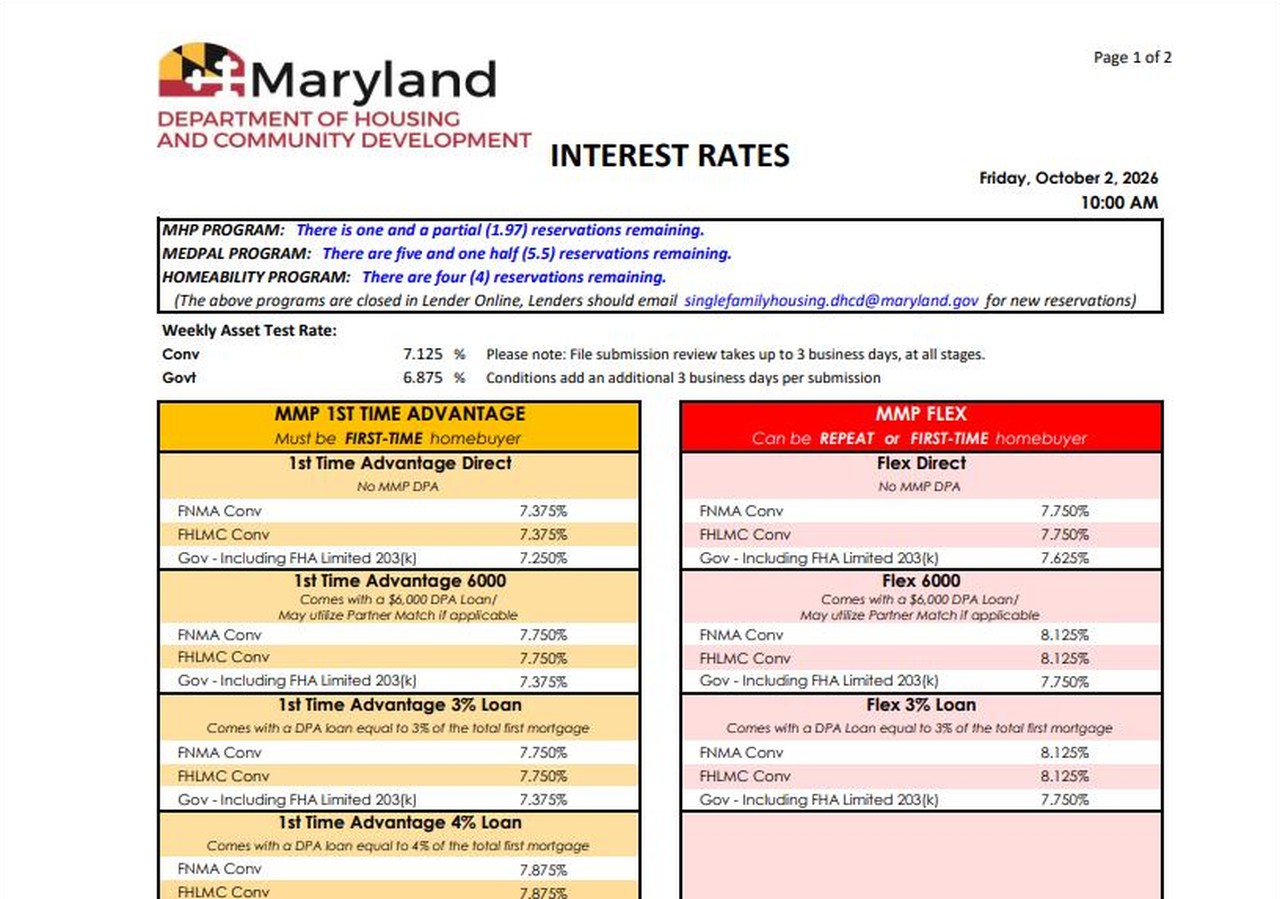
The state posts its rates every business day. This is the October 2, 2026 sheet. Source: Maryland Department of Housing and Community Development.
For comparison, the national average 30-year fixed rate was 7.28 percent on October 1, 2026. A program loan without assistance is close to that; each step up in assistance adds to the rate.
Freddie Mac Primary Mortgage Market Survey, October 1, 2026.

Get a Mortgage Estimate for Free
See your payment with and without Maryland Mortgage Program help before you choose.
✓Free, no obligation✓Licensed in VA, MD, DC and WV✓Loan officer Ken Byrne, NMLS #187129
What the down payment help really costs
Here is a $400,000 home bought with an FHA loan and 3.5 percent down ($14,000). The loan is $392,755 with the upfront FHA premium financed.
| Option | Assistance you receive | Rate | Principal and interest |
|---|---|---|---|
| 1st Time Advantage Direct | $0 | 7.250% | $2,679 |
| 1st Time Advantage $6,000 | $6,000 | 7.375% | $2,713 |
| 1st Time Advantage 3% | $11,783 | 7.375% | $2,713 |
| 1st Time Advantage 4% | $15,710 | 7.500% | $2,746 |
| 1st Time Advantage 5% | $19,638 | 7.625% | $2,780 |
Calculated from the October 2, 2026 rate sheet. FHA annual mortgage insurance of about $177 a month, property tax and homeowners insurance are the same in every row and not shown.
Taking the 5 percent option gives you $19,638 at closing and costs about $101 a month more than the no-assistance loan, or about $8,450 over seven years, and the $19,638 is still owed when you sell or refinance. On a loan this size the 3 percent option beats the flat $6,000 at the same rate. Assistance is the right call when cash is what stands between you and buying; if you have the down payment, the lower rate usually wins.
SmartBuy 3.0: student loan payoff
SmartBuy pays off student debt at closing, up to 15 percent of the purchase price and no more than $25,000, a cap the state raised from $20,000 on June 1, 2026. You need at least $1,000 of remaining student debt, the full balance of at least one borrower must be paid off, the loan must be conventional, and the minimum middle credit score is 720. The payoff is a zero-interest loan forgiven at 20 percent a year over five years.
MMP SmartBuy 3.0 page (September 15, 2026) and fact sheet (June 1, 2026); Directive 2026-03.
First Homes for First Responders and Teachers
Launched September 4, 2026, this $50 million initiative gives first-time buyers who work in Maryland as first responders or as certified pre-K to 12 teachers or school counselors a 5 percent assistance loan at a rate half a percentage point below the standard 5 percent product.
MMP Directive 2026-10 and fact sheet (September 4, 2026).
Partner Match and local programs
If an approved employer, builder or local government partner contributes to your purchase, the state matches it dollar for dollar up to $2,500 with the 1st Time Advantage $6,000 or Flex $6,000 loans. County and city programs can be layered on top. What that does to your budget is in our guide to how much house you can afford in Maryland.
2026 MMP income and purchase price limits
| Area | Income limit, 1 or 2 people | 3 or more people | Maximum price | Maximum loan |
|---|---|---|---|---|
| Montgomery, Prince George’s, Frederick, Charles | $199,320 | $232,540 | $1,306,974 | $832,750 |
| Calvert | $190,320 | $222,040 | $1,255,921 | $832,750 |
| Howard, Anne Arundel, Baltimore County, Harford, Carroll, Queen Anne’s | $140,759 | $161,873 | $782,118 | $747,500 |
| Baltimore City (all targeted) | $164,520 | $191,940 | $955,922 | $747,500 |
| St. Mary’s | $141,600 | $162,840 | $566,354 | $541,287 |
| Washington, Wicomico, Talbot, Worcester | $137,100 | $157,665 | $566,354 | $541,287 |
| Cecil | $137,100 | $157,665 | $659,385 | $630,200 |
Maryland Mortgage Program 2026 income limits, maximum acquisition costs and maximum mortgage limits, effective June 24, 2026, non-targeted figures except Baltimore City. Allegany, Caroline, Dorchester, Garrett, Kent and Somerset are fully targeted: $164,520 and $191,940, with a $692,211 price limit.
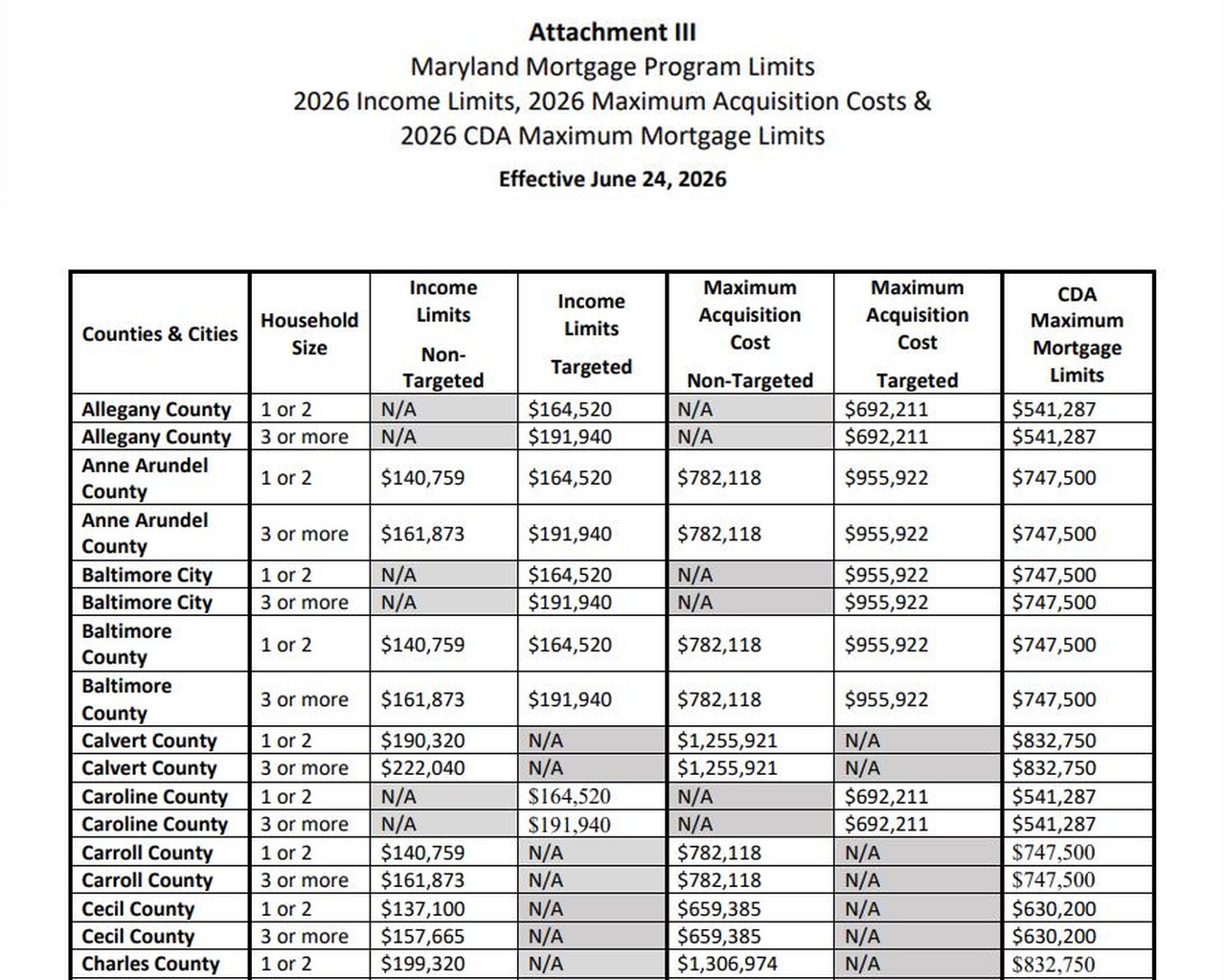
The official 2026 limits chart. Check your county and household size before you shop. Source: Maryland Department of Housing and Community Development.
Targeted areas
Targeted areas are census tracts where you do not need to be a first-time buyer and the income or price limits are higher. Seven jurisdictions are fully targeted, including Baltimore City, and parts of Anne Arundel, Baltimore County, Frederick, Harford, Montgomery, Prince George’s, Washington and Wicomico are targeted. The state’s online mapper checks any address. In Montgomery County, local detail is in our Montgomery County mortgage guide.
Get Pre-Approved Today
Get pre-approved and ask whether a Maryland Mortgage Program loan fits your income.
✓Free, no obligation✓Licensed in VA, MD, DC and WV✓Loan officer Ken Byrne, NMLS #187129
What is no longer available
| Program | Status |
|---|---|
| Maryland HomeCredit (mortgage credit certificate) | Closed to new buyers since June 19, 2020; existing certificates can be reissued on a refinance |
| Montgomery Homeownership Program | Closed September 1, 2026 because funds were fully committed; existing reservations honored |
| Flex 5000 | No longer on the state’s product list; current Flex help is $6,000 or 3% |
MMP Directive 2020-11, Directive 2026-09 and Program Code Matrix (September 4, 2026).
Older articles still describe a $2,000 a year tax credit for new buyers. That credit has not been issued to new buyers since 2020.
How to apply for a Maryland Mortgage Program loan
| Step | What happens |
|---|---|
| 1. Homebuyer education | Complete an approved class, online or in person |
| 2. Pre-approval | An approved lender reviews income, assets, debts and credit |
| 3. Find an agent | Choose a real estate agent |
| 4. Make an offer | Sign a contract on a home under the price limit |
| 5. Apply and lock | The lender takes the full application and reserves your rate with the state |
| 6. State review | The lender submits the file to MMP; reviews take up to three business days at each stage |
| 7. Closing | You sign the first mortgage and any assistance loan |
MMP, 7 Steps to Getting an MMP Loan (2026) and rate sheet notes.
ALCOVA Mortgage appears in the state’s directory of approved MMP lenders. Lenders may not charge points on program loans. The full buying process is in our first-time homebuyer guide.
MMP lender directory (June 2026); Compliance Manual.
Recapture tax
Because many program loans are funded with tax-exempt bonds, a federal recapture tax can apply if you sell within nine years, at a gain, and your income has risen above set limits. The maximum is 6.25 percent of the original loan amount or half the gain, whichever is less, and the state reimburses borrowers who actually pay it if they apply by July 15 of the following year. Ask your lender for the recapture notice.
Maryland CDA Recapture Tax Notice; IRS Form 8828.
MMP vs a standard FHA or conventional loan
| Maryland Mortgage Program | Standard loan | |
|---|---|---|
| Rate | Set daily by the state; rises with assistance | Set by the lender; you can buy points |
| Down payment help | $6,000 or 3% to 5% as a deferred loan (6% for lower incomes) | None, unless a local program applies |
| Income and price limits | Yes | No |
| First-time buyer rule | Yes, with exceptions | No |
| Refinancing later | Assistance loan comes due | No second loan to repay |
FHA limits and rules by county are in our guide to FHA loan limits in Maryland.
First-time Maryland buyers also get a break on transfer and recordation taxes; see our guide to closing costs in Maryland.
Other Maryland loan options and resources are on our Maryland mortgage page.
Frequently asked questions
What is the Maryland Mortgage Program?
The state’s home loan program: 30-year fixed FHA, VA, USDA and conventional mortgages through approved lenders, with optional down payment assistance as a zero-interest deferred loan.
What credit score do I need for the Maryland Mortgage Program?
640 for standard products and 720 for SmartBuy 3.0. Lenders may set higher minimums.
What are the Maryland Mortgage Program income limits for 2026?
For one or two people: $199,320 in Montgomery, Prince George’s, Frederick and Charles counties, and $140,759 in Howard, Anne Arundel, Baltimore County, Harford and Carroll. Limits are higher for three or more people and in targeted areas.
What are Maryland Mortgage Program interest rates today?
On October 2, 2026 they ran from 7.125 to 8.125 percent, depending on the product and the amount of assistance. The state updates them each business day.
Is MMP down payment assistance a grant?
No. It is a zero-interest loan with no monthly payment that is due when you sell, refinance or pay off the first mortgage. Only SmartBuy’s student debt payoff is forgiven, over five years.
Do I have to be a first-time homebuyer?
For most products, yes: no ownership in the past three years. The rule is waived in targeted areas and for veterans using their exemption, and Flex loans allow repeat buyers.
How much does Maryland SmartBuy pay off?
Up to 15 percent of the purchase price, capped at $25,000, for borrowers with a 720 credit score using a conventional loan.
Does Maryland still offer the HomeCredit tax credit?
Not for new buyers. The program closed to new reservations on June 19, 2020; existing certificates can be reissued when the loan is refinanced.
How do I apply for the Maryland Mortgage Program?
Take an approved homebuyer education class, then get pre-approved by a state-approved lender. The lender reserves the loan with the state after you have a signed contract.
Next stepStart Your Pre-Approval
Start online, and Ken Byrne’s team will go over your loan options and how the state program compares.
✓Free, no obligation✓Licensed in VA, MD, DC and WV✓Loan officer Ken Byrne, NMLS #187129
This article is general information, not financial or legal advice and not a commitment to lend or an offer of credit. Loan limits, program rules, premium schedules and rates change, and individual eligibility depends on a full review of your credit, income, assets and the property. Every figure here is an illustration, not a quote, built from published sources and a weekly survey average rather than underwriting decisions. Insurance and mortgage insurance amounts are planning estimates. Confirm anything you plan to act on with a licensed mortgage professional. Program rules, limits and rates were checked against Maryland Department of Housing and Community Development sources on October 2, 2026 and change without notice. Program eligibility does not guarantee loan approval.
Categories
Recent Posts






GET MORE INFORMATION

Broker Associate