
Physician Mortgage Loans in Northern Virginia: 2026 Doctor Loan Guide
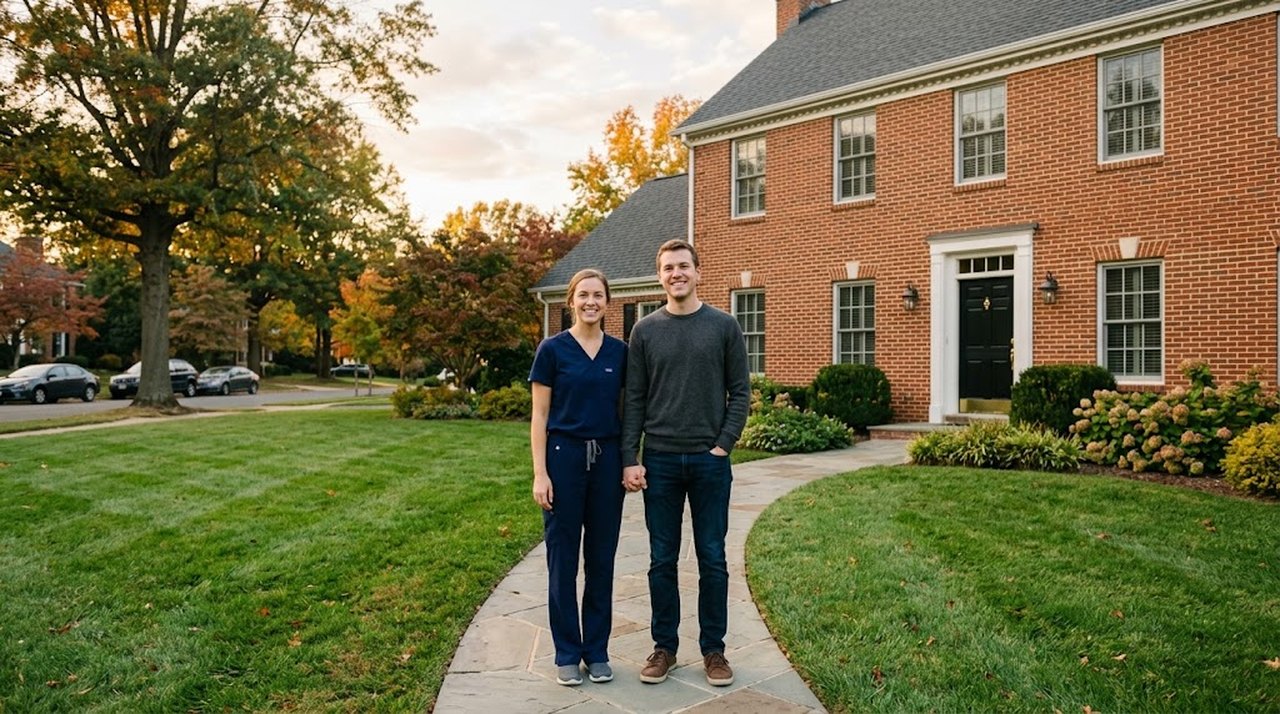
A physician loan trades a low down payment and no mortgage insurance for terms that each bank sets on its own.
Short answer: a physician mortgage loan is a bank program that lets doctors, and often dentists and other medical professionals, buy with little or no money down and no private mortgage insurance, and close on a signed employment contract. Published 2026 programs commonly allow 100 percent financing up to $1 million, 95 percent up to $1 million to $1.75 million, and about 90 percent up to $1.5 million to $2.5 million. They are not Fannie Mae or government loans, so every bank’s terms differ, and the only fair comparison is a written quote against a conventional, jumbo or VA loan.
By Ken Byrne, NMLS #187129 · ALCOVA Mortgage LLC, NMLS #40508 · Updated October 2026
Northern Virginia is a hard place to be a new attending: typical homes run about $760,000 in Fairfax County and $800,000 in Loudoun and Arlington, while medical graduates with education debt owe a median of $215,000. Physician loans exist for exactly that gap. This guide explains how they work, what published programs look like, how student loans and employment contracts are treated under each loan type, and how the numbers compare on a Northern Virginia purchase. For a second opinion on any offer, talk to the Ken Byrne Team.
Zillow Home Value Index, August 31, 2026; AAMC, Medical Student Education: Debt, Costs, and Loan Repayment Fact Card for the Class of 2025.
What is a physician mortgage loan?
It is a portfolio loan: the bank keeps it instead of selling it to Fannie Mae or Freddie Mac. Because no outside investor’s rules apply, the bank can waive mortgage insurance, accept a small down payment on a large loan and be flexible about student debt. That same freedom is why no two programs match.
| Feature | Physician loan (typical published terms) | Conventional loan |
|---|---|---|
| Down payment | 0% to 10%, by loan size | 3% to 5% minimum; 5% on high-balance loans |
| Mortgage insurance | None | Required under 20% down |
| Loan size | Often to $2 million or more | $1,249,125 in Northern Virginia before it becomes jumbo |
| Student loans | Often flexible if deferred or income-driven | Fannie Mae formula (below) |
| Job not started yet | Some allow closing up to 90 days before | Allowed up to 90 days before, with reserves |
| Who sets the rules | Each bank | Fannie Mae and Freddie Mac |
Published doctor loan pages of five national banks, checked October 2, 2026; Fannie Mae Selling Guide and Eligibility Matrix (August 5, 2026).
What published physician loan programs look like in 2026
These are the terms five national banks publish on their own websites. They are examples of the range, not offers, and availability in Virginia or DC varies by bank.
| Term | What the published programs show |
|---|---|
| 100% financing | Up to $1 million at three of the five; one requires at least 3% down |
| 95% financing | Up to $1 million to $1.75 million |
| About 90% financing | Up to $1.5 million to $2.5 million |
| Eligible degrees | MD and DO at all five; dentists (DDS, DMD) at all five; podiatrists, veterinarians and optometrists at some |
| Residents and fellows | Eligible at most, sometimes with a lower maximum loan |
| Years since training | One limits the program to doctors less than 10 years out of residency; another to 15 years unless you are a wealth client |
| Mortgage insurance | None at the four banks that state it |
| Closing before your start date | Up to 90 days, where stated |
| Occupancy | Primary residences, where stated |
Bank program pages, October 2, 2026. Terms change without notice; rates are not published and vary by bank, credit and down payment.
What the pages do not show is the rate. A loan with nothing down and no mortgage insurance carries more risk for the bank, and that is priced in. Ask for the rate, the points and whether the rate is fixed or adjustable, then compare the total monthly cost, not just the down payment.

Get a Mortgage Estimate for Free
See what a conventional or jumbo loan costs on your price range, to set beside any doctor loan quote.
✓Free, no obligation✓Licensed in VA, MD, DC and WV✓Loan officer Ken Byrne, NMLS #187129
How the numbers compare on a $900,000 Northern Virginia home
| Loan | Down payment | Loan amount | Principal and interest | Mortgage insurance |
|---|---|---|---|---|
| Physician loan, 0% down | $0 | $900,000 | $6,158 | None |
| Conventional, 5% down | $45,000 | $855,000 | $5,850 | About $378 a month |
| Conventional, 10% down | $90,000 | $810,000 | $5,542 | About $257 a month |
| Conventional, 20% down | $180,000 | $720,000 | $4,926 | None |
All rows at 7.28% (Freddie Mac 30-year average, October 1, 2026) so the structures can be compared; a physician loan’s actual rate will differ. Mortgage insurance from one insurer’s published rates for a 740 to 759 score. Property tax, insurance and HOA dues are the same in every row and not shown.
The $855,000 conventional loan is above the $832,750 national limit, which makes it a high-balance conforming loan in Northern Virginia: still conventional, with 5 percent as the minimum down. How that tier works is in our guide to jumbo vs conforming loans.
Conventional mortgage insurance is temporary. You can ask to cancel it at 80 percent of the original value, and sooner if the home gains value. The rules are in our guide to PMI.
How student loans are counted
With a median debt of $215,000, the way a lender counts student loans often decides the price range. Each loan type has its own rule.
| Loan type | Payment used for qualifying | On $215,000 of deferred debt |
|---|---|---|
| Conventional (Fannie Mae) | The credit report payment; a documented $0 income-driven payment can be used; if deferred or in forbearance, 1% of the balance or the documented full payment | $2,150 a month at 1% |
| FHA | The reported payment if above zero; otherwise 0.5% of the balance | $1,075 a month |
| VA | No payment counted if deferred at least 12 months past closing; otherwise compared with 5% of the balance divided by 12 | $0 if deferred 12 months or more; otherwise tested against $896 a month |
| Physician loan | Set by the bank; some exclude deferred loans | Ask the bank |
Fannie Mae Selling Guide B3-6-05 (August 2026); HUD Mortgagee Letter 2021-13; VA Circular 26-17-02.
That difference is large. At today’s rates, a $2,150 monthly payment counted against you removes roughly $275,000 to $335,000 of buying power, depending on the down payment. If you are in repayment on an income-driven plan, the conventional rule may already work in your favor.
The federal repayment plans changed in 2026. The SAVE plan was ended by court order, and for loans disbursed on or after July 1, 2026 the Repayment Assistance Plan is the only income-driven option, with a $10 minimum payment. Bring your current servicer statement to your lender so the right payment is used.
Federal Student Aid, income-driven repayment questions and answers (2026).
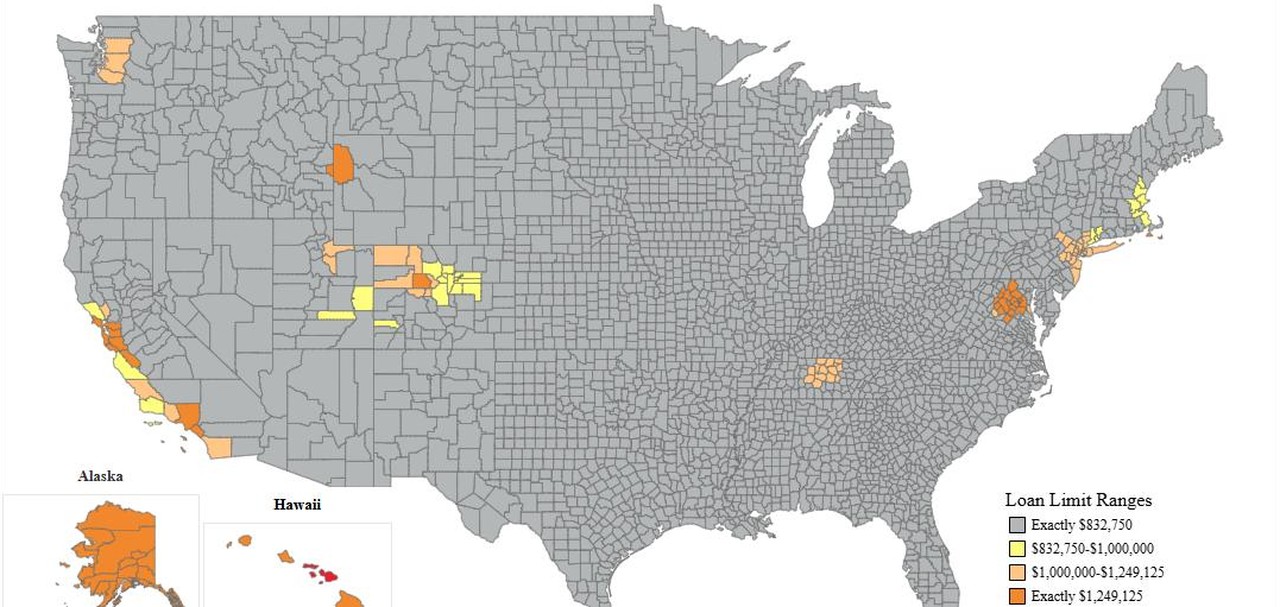
FHFA’s 2026 map: the Washington area, including Northern Virginia, is one of the few places at the $1,249,125 limit (dark orange), the line where a conventional loan becomes a jumbo. Source: Federal Housing Finance Agency.
Buying before your first paycheck
Closing on an employment contract is not unique to physician loans. Fannie Mae allows a conventional loan to close before you start work if you have a signed, non-contingent offer or contract, the start date is no later than 90 days after closing, the home is a one-unit primary residence you are buying, you qualify on base pay only, and you have extra reserves: either six months of housing payments, or enough to cover all your monthly bills from closing until you start, plus one month.
Fannie Mae Selling Guide B3-3.3-03, Employment Offers or Contracts (March 2026).
Residents moving to an attending role should also know how lenders treat a jump in income: the contract salary counts, not the residency stipend, once the conditions above are met. The median first-year resident stipend is $66,986, which is why timing the purchase around the contract matters.
AAMC fact card, Class of 2025.
Get Pre-Approved Today
Get pre-approved with your contract income and student loans counted correctly.
✓Free, no obligation✓Licensed in VA, MD, DC and WV✓Loan officer Ken Byrne, NMLS #187129
Physician loan vs conventional, jumbo and VA
| Physician loan | Conventional or high-balance | Jumbo | VA | |
|---|---|---|---|---|
| Best for | Little cash, high income ahead | 5% to 20% down, loan up to $1,249,125 | Loans above $1,249,125 | Eligible veterans and service members |
| Down payment | 0% to 10% | 3% to 5% minimum | Set by the lender, often 10% or more | None with full entitlement |
| Mortgage insurance | None | Yes under 20% down, removable | None on some programs | None; funding fee unless exempt |
| Rate | Set by the bank; ask | Market rate, with pricing by score | Set by the lender | Market rate |
| Property types | Primary home only; condo rules vary | Primary, second home, investment | Varies | Primary home only |
Military physicians and those who served should look at VA first: no down payment, no monthly mortgage insurance and no loan limit with full entitlement. Details are on our VA loans page.
For a sense of what your income supports, see our guide to what a $200K salary buys in Northern Virginia.
Pros and cons
| Pros | Cons |
|---|---|
| Buy sooner, with little or no cash down | Rate and fees can be higher than a conventional loan |
| No monthly mortgage insurance | No equity cushion if prices dip and you need to sell |
| Flexible treatment of student debt | Fixed and adjustable versions exist; check which rate you are quoted |
| Can close on a contract before starting | Limited to certain degrees, career stages and banks |
| Higher loan amounts than conforming limits | Primary residences only |
Northern Virginia costs to plan for
Virginia charges recordation tax on both the deed and the loan, $0.25 per $100 each, and counties add one third more. On a $900,000 home with an $855,000 loan that is about $5,850 for the buyer. Title, settlement and lender charges are in our guide to closing costs in Virginia.
Va. Code 58.1-801, 58.1-803 and 58.1-814.
Property tax differs by county: $0.805 per $100 in Loudoun, $1.053 in Arlington, $1.12 in Fairfax County and $1.135 in Alexandria for 2026. On $900,000 that is $604 to $851 a month. Every rate is in our guide to Northern Virginia property tax rates.
Buying across the river instead? Our companion guide covers physician mortgage loans in Maryland.
Frequently asked questions
What is a physician mortgage loan?
A bank portfolio loan for doctors and some other medical professionals with a low or zero down payment, no private mortgage insurance and flexible treatment of student debt and employment contracts.
Who qualifies for a doctor loan?
It depends on the bank. Published programs cover MDs and DOs, usually dentists, and sometimes podiatrists, veterinarians and optometrists. Residents and fellows are eligible at most, and some programs limit how many years out of training you can be.
How much can I borrow with no money down?
Published programs commonly allow 100 percent financing up to $1 million, with 5 to 10 percent down required above that. One national program requires at least 3 percent down.
Do physician loans require PMI?
No. That is the main feature. The bank prices the added risk into the rate instead.
Are physician loan rates higher?
They can be. Banks do not publish them, so get the rate and points in writing and compare the total monthly cost with a conventional or jumbo quote.
Can I buy a house before I start my new job?
Often, yes. Two of the five published physician programs state a 90 day window before your start date, and Fannie Mae allows the same on a conventional loan with a signed non-contingent contract and reserves.
How do lenders count my student loans?
Conventional loans use the credit report payment, a documented $0 income-driven payment, or 1 percent of the balance if deferred. FHA uses 0.5 percent when the payment is zero. Physician programs set their own rules.
Is a physician loan better than a conventional loan?
It is better when cash is the constraint. If you can put 5 to 20 percent down, a conventional loan may cost less over time, and its mortgage insurance comes off.
Can I use a physician loan for a condo or investment property?
Published programs are for primary residences only. Condo eligibility varies by bank.
Next stepStart Your Pre-Approval
Start online, and Ken Byrne’s team will lay out your loan options side by side.
✓Free, no obligation✓Licensed in VA, MD, DC and WV✓Loan officer Ken Byrne, NMLS #187129
This article is general information, not financial or legal advice and not a commitment to lend or an offer of credit. Loan limits, program rules, premium schedules and rates change, and individual eligibility depends on a full review of your credit, income, assets and the property. Every figure here is an illustration, not a quote, built from published sources and a weekly survey average rather than underwriting decisions. Insurance and mortgage insurance amounts are planning estimates. Confirm anything you plan to act on with a licensed mortgage professional. Physician loans are offered by individual banks on their own terms; the examples here come from published bank pages checked on October 2, 2026 and are not offers from JB Financing or ALCOVA Mortgage. Ask any lender which programs it can offer you. Payments are estimates at a 7.28 percent rate.
Categories
Recent Posts








GET MORE INFORMATION

Broker Associate