
Bank Statement Loans in Northern Virginia: 2026 Guide for Self-Employed Buyers

A bank statement loan measures your income from deposits, not from the bottom line of your tax return.
Short answer: a bank statement loan is a mortgage for self-employed borrowers. It verifies income from 12 or 24 months of bank deposits instead of tax returns. For business accounts, published programs usually count half of the deposits as income. Published minimums run from a 620 to 660 credit score and from 10 percent down. Rates may be higher than on a conventional loan. It is not a no-doc loan. Federal rules still require the lender to verify that you can repay.
By Ken Byrne, NMLS #187129 · ALCOVA Mortgage LLC, NMLS #40508 · Updated October 2026
This guide explains how bank statement loans work, how lenders turn deposits into income, and what published programs require in 2026. Lender terms shown are published examples, not ALCOVA terms.
To see what your own statements support, talk to JB Financing mortgage specialists.
What is a bank statement loan?
It is a mortgage for self-employed borrowers whose tax returns understate what they earn. The lender reviews your bank deposits to determine income.
ALCOVA Mortgage lists a bank statement loan among its products. Its page describes the loan this way:
| Feature | What ALCOVA’s bank statement loan page says |
|---|---|
| Who it is for | Self-employed borrowers, business owners, freelancers and independent contractors |
| Income | Eligible personal or business bank statement deposits may be used to help determine income |
| Loan purpose | Home purchases and refinances |
| Down payment | Typically larger than some traditional loan programs |
| Rates | May be higher than conventional financing |
| Reserves | Additional reserves may be required |
| Deposits | Not all deposits are eligible or counted |
Source: ALCOVA Mortgage, Bank Statement Loan product page, read October 7, 2026. The page publishes no minimums. Requirements vary by program and borrower profile.
If your returns already show enough income, a standard loan may cost less. See our self-employed mortgage requirements guide.
How does a bank statement loan work?
In published programs, you provide 12 or 24 months of statements. The lender totals the eligible deposits, adjusts for business expenses, and averages the result into a monthly income.
| Statement type | How published programs count deposits |
|---|---|
| Personal account | 100% of eligible deposits, not counting transfers from your other accounts |
| Business account | Deposits minus an expense factor, 50% by default |
| Both | Divided by 12 or 24, to match the months provided |
Third-party examples from seven national lenders’ published program pages and guides, read October 7, 2026. Dated documents run from March to September 2026. Some pages carry no date. These are not ALCOVA terms.
That income then goes through normal underwriting. The lender still checks your credit, debts, down payment and reserves.
How do lenders calculate income from bank statements?
For a business account, the formula is deposits, times one minus the expense factor, divided by the number of months.
The expense factor is the share of deposits treated as business costs. The published default is 50 percent.
| Business deposits over 12 months | Expense factor | Qualifying income per month |
|---|---|---|
| $360,000 | 50% (default) | $15,000 |
| $360,000 | 30% (with a preparer letter) | $21,000 |
| $360,000 | 15% (lowest allowed by one program) | $25,500 |
Calculated from the published formula. The deposits are a hypothetical example.
A lower factor needs support. Published programs ask for a letter from a CPA or licensed tax preparer stating the real expense ratio of the business.
The floor differs by lender. One published program stops at 15 percent and another at 10 percent. One lender uses 70 percent for industries with high costs.
Income is half of the equation. Debts are the other half. See how your debt-to-income ratio affects approval.
Which deposits count as income?
Only deposits the lender can tie to your business or work. Transfers between your own accounts do not count.
| Deposit | Usually counted? | Why |
|---|---|---|
| Client payments and sales | Yes | They are business revenue |
| Transfers from your other accounts | No | The money is not new income |
| Large or irregular deposits | Only if documented | They must be sourced as income or backed out |
| Loan proceeds | No | They are not income |
| Unidentified deposits | No | The lender must confirm that funds are income |
Source: official comment 43(c)(4)-4 to Regulation Z, Consumer Financial Protection Bureau; published lender program guides.
The official commentary to the rule is direct on this point. A lender does not meet the verification standard if it sees money come in without confirming that it is income.
Expect questions about bounced payments too. One published program allows no more than six non-sufficient funds events in any 12 months.
What are bank statement loan requirements in 2026?
Requirements vary by lender. Most published programs set a minimum credit score, a maximum loan-to-value, a maximum debt-to-income ratio and a reserve requirement.
| Requirement | Range in published programs | Examples |
|---|---|---|
| Statements | 12 or 24 months | Personal, business or both |
| Minimum credit score | 620 to 660 | Three of the six lenders start at 620. One alternative documentation program starts at 600 |
| Minimum down payment | 10% at best | 10% down is tied to a score of 680 to 720 and a loan size cap. One program asks 20% down at a 620 score |
| Maximum debt-to-income ratio | 50% to 55% | 50% is the most common. 55% appears at one lender and by exception at another |
| Reserves | 3 months or more | One program: 3, 6 or 9 months by loan size |
| Time self-employed | 2 years | Some allow 1 year with a higher score or prior experience in the field |
| Ownership of the business | 25% or 50% | Varies by program |
| Maximum loan | $3 million to $4.5 million | Above the conforming limit |
Third-party examples from six national lenders’ published program pages and guides, read October 7, 2026. Dated documents run from March to September 2026. Some pages carry no date. These are not ALCOVA terms. ALCOVA publishes no minimums; ask for current requirements.
A stronger score opens better terms. See the credit score needed to buy a house.
Compare these down payments with standard loans in our down payment guide.
Is a bank statement loan a no-doc or stated-income loan?
No. Your income is verified. The proof comes from bank records instead of tax returns.
Federal rules require a lender to make a reasonable, good faith determination that you can repay. The lender must verify income with reliable third-party records.
The rule lists the records a lender may use. Financial institution records are on the list, next to tax returns, W-2s and payroll statements.
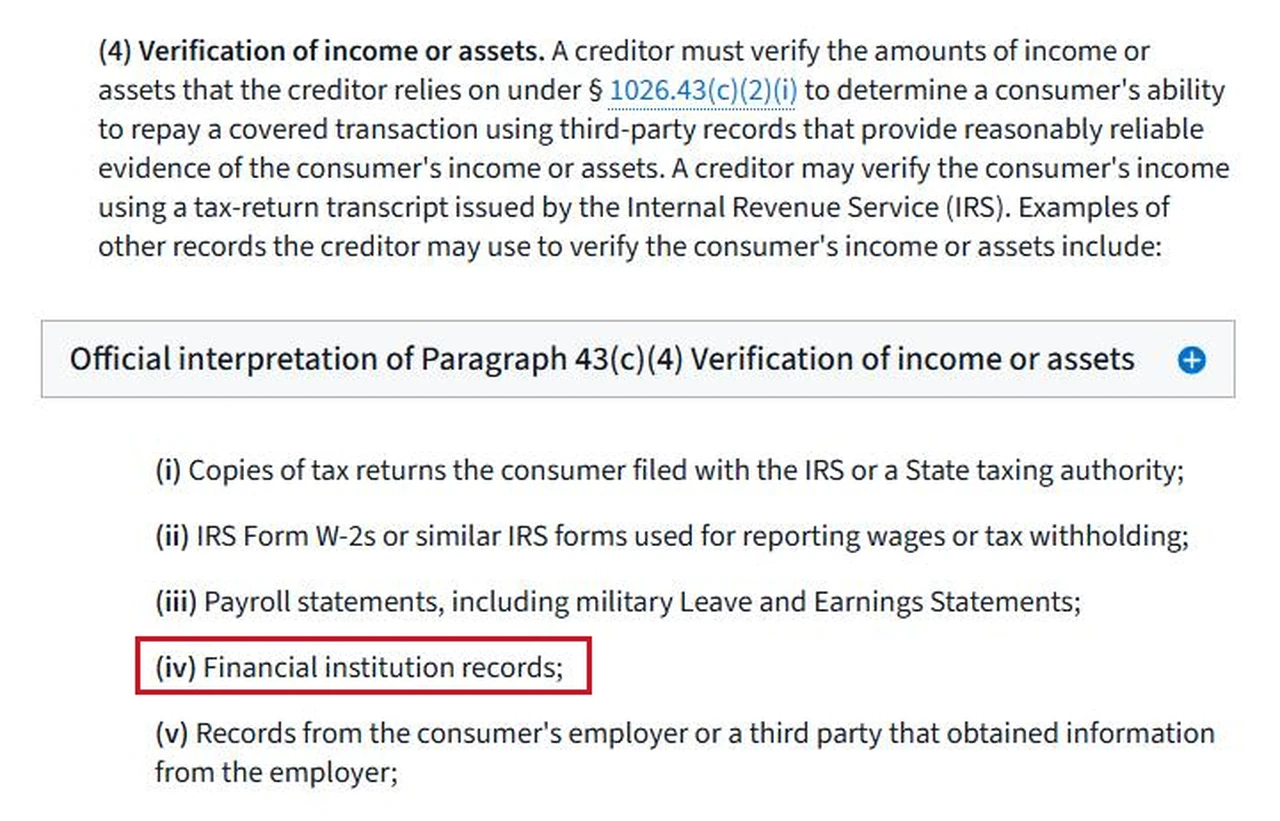
Regulation Z lists financial institution records among the records a lender may use to verify income. Source: Consumer Financial Protection Bureau.
Source: 12 CFR 1026.43(c), the ability-to-repay rule.
The CFPB’s compliance guide says it is no longer possible to originate loans based on stated income. The rule took effect January 10, 2014.
Source: CFPB, Ability-to-Repay and Qualified Mortgage Rule Small Entity Compliance Guide, version 3.1, April 2021.
A lender that asks for no statements, or counts every deposit without questions, is a warning sign.
Is a bank statement loan a qualified mortgage?
Generally not. Lenders offer bank statement loans as non-qualified mortgages, often shortened to non-QM. They still have to meet the ability-to-repay rule.
| Qualified mortgage | Non-QM loan | |
|---|---|---|
| Interest-only payments | Not allowed | Offered by some programs |
| Loan term | 30 years or less | 40-year terms are offered by some programs |
| Price limit | The annual percentage rate must stay under a set margin | No price limit |
| Lender’s compliance with the ability-to-repay rule | Presumed when the rules are met | No presumption. The lender must show it weighed all eight factors |
| Income verification | Required | Required |
Source: 12 CFR 1026.43(e); CFPB, What is a Qualified Mortgage? Last reviewed January 2, 2025.
For 2026, the general qualified mortgage definition has a price test. A first mortgage of $137,958 or more fails it if the annual percentage rate is 2.25 percentage points or more above the average prime offer rate.
Source: CFPB, Regulation Z annual threshold adjustments, 90 FR 57890, effective January 1, 2026.
Non-QM is a legal category, not a judgment about the borrower. It means the loan sits outside one set of product and pricing rules.
Are rates higher on a bank statement loan?
They can be. ALCOVA says rates may be higher than conventional financing. We found no official average for bank statement loans, so compare written quotes.
For context, the Freddie Mac average for a 30-year conventional loan was 7.28 percent for the week of October 1, 2026. That survey does not cover bank statement loans.
Ask for a conventional quote and a bank statement quote on the same day. Compare the rate, the points and the cash to close.
A higher rate can also trigger an escrow rule. It covers first mortgages on a primary home priced 1.5 percentage points or more above the average prime offer rate, or 2.5 on a jumbo loan. Those loans generally must carry an escrow account for at least five years.
Source: ALCOVA Mortgage; Freddie Mac Primary Mortgage Market Survey; 12 CFR 1026.35(b).
How large a bank statement loan can you get in Northern Virginia?
Published programs go above the conforming limit. Their maximums run from $3 million to $4.5 million. The 2026 one-unit conforming limit in Northern Virginia is $1,249,125. ALCOVA publishes no maximum, so ask.
Here is what 10 and 20 percent down look like at typical local values.
| County or city | Typical home value | 10% down | 20% down | Principal and interest, 20% down |
|---|---|---|---|---|
| Fairfax | $760,599 | $76,060 | $152,120 | $4,163 |
| Loudoun | $795,391 | $79,539 | $159,078 | $4,354 |
| Arlington | $806,890 | $80,689 | $161,378 | $4,417 |
| Alexandria | $677,627 | $67,763 | $135,525 | $3,709 |
| Prince William | $581,036 | $58,104 | $116,207 | $3,180 |
Values: Zillow Home Value Index, August 2026. Payment at 7.28 percent, the Freddie Mac conventional average for October 1, 2026, used as a placeholder. A bank statement loan rate may be higher. Taxes and insurance are not included.
At the default 50 percent expense factor, $360,000 of yearly deposits supports $15,000 a month of income. At a 50 percent debt-to-income ratio, that allows $7,500 a month for all debts, including the new housing payment.
Loans above the limit have their own rules. See our guide to jumbo loans in Northern Virginia.
Bank statement loan vs conventional loan: what is the difference?
A conventional loan starts from the net profit on your tax return. A bank statement loan starts from your deposits.
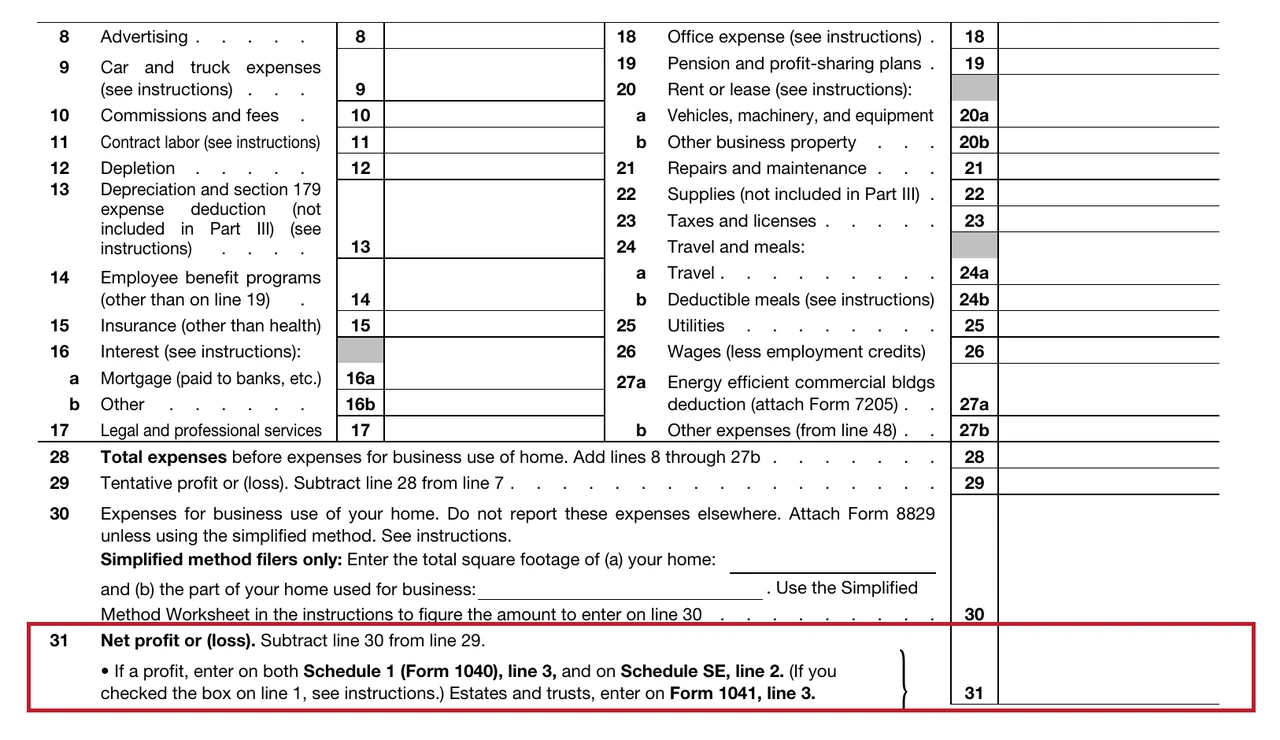
Line 31 of Schedule C, net profit or loss, is where a conventional lender starts. Source: Internal Revenue Service.
| Bank statement loan | Conventional loan (Fannie Mae) | |
|---|---|---|
| Income comes from | 12 or 24 months of deposits | Tax returns, generally two years |
| Effect of write-offs | None on business statements. An expense factor applies | Each cash expense lowers qualifying income |
| Minimum down payment | 10% at best in published programs | 3% to 5%. High-balance loans need 5% |
| Maximum debt-to-income ratio | Commonly 50% | 50% through automated underwriting |
| Loan size | Up to $3 million or more | Up to $1,249,125 in Northern Virginia |
| Rate | May be higher | The market benchmark |
Source: published lender examples above; Fannie Mae Selling Guide B3-3.5-01 and B3-6-02; Fannie Mae Eligibility Matrix, August 5, 2026; IRS, Schedule C.
Standard loan rules are on our conventional loans page.
What documents do you need for a bank statement loan?
Your statements, proof that the business exists, and the usual identity, credit and asset documents.
| Document | Detail |
|---|---|
| Bank statements | 12 or 24 months, as the program requires |
| Proof of the business | A CPA or tax preparer letter, or formation documents filed with the state |
| Expense letter | Only if you want a factor below the default |
| Explanations | Short letters for large or unusual deposits |
| Asset statements | For the down payment and reserves |
| ID and loan application | Standard for every mortgage |
Based on published lender program guides read October 7, 2026.
In Virginia, local and state records can help show that a business exists. Fairfax County requires a business license filing within 75 days of starting. Loudoun County requires registration within 30 days.
Source: Fairfax County, BPOL tax; Loudoun County, Business License Tax. Ask which records your lender accepts.
The standard paperwork list is in our mortgage documents checklist.
What other options do self-employed borrowers have?
Some lenders publish other ways to document income. Availability varies, so ask what is offered.
| Option | How published programs describe it |
|---|---|
| Profit and loss statement | A 12-month statement signed by a CPA or tax preparer. One program caps it at 75% loan-to-value |
| 1099 income | One or two years of 1099s, in some cases with a 10% expense factor |
| Asset-based | Assets are converted to an income figure |
| DSCR loan | For rentals only. The property’s rent qualifies the loan |
Third-party published examples. ALCOVA lists a bank statement loan and a DSCR loan; ask about the others.
Buying a rental instead of a home? Read our guide to DSCR loan requirements in Virginia.
Can you refinance a bank statement loan into a conventional loan later?
Yes, once your tax returns support the income. A conventional lender generally wants two years of returns.
Fannie Mae allows one year of returns when the business is five years old and you have owned 25 percent or more of it for those five years.
For a cash-out refinance, Fannie Mae requires the existing first mortgage to be at least 12 months old. Its rate-and-term refinance topic sets no such age rule.
Source: Fannie Mae Selling Guide B3-3.5-01, B2-1.3-02 and B2-1.3-03.
Check for a prepayment penalty before you plan an exit. Under Regulation Z, a consumer mortgage can carry a penalty only if it is a fixed-rate qualified mortgage that is not higher priced. Business-purpose loans on rentals fall outside that rule. One published non-QM program states that penalties are not permitted.
Source: 12 CFR 1026.43(g).
To judge the timing, read should you refinance in 2026.
What are the pros and cons of a bank statement loan?
The main benefit is qualifying on real cash flow. The main costs are a larger down payment and a rate that may be higher.
| Pros | Cons |
|---|---|
| Income based on deposits, not net profit after write-offs | Larger down payment than many standard loans |
| Designed for self-employed and 1099 borrowers | Rates may be higher than conventional loans |
| Loan sizes above the conforming limit | Additional reserves may be required |
| Purchase or refinance | Not every deposit counts |
| Can be refinanced later if your returns support the income | Requirements differ from lender to lender |
Based on ALCOVA’s bank statement loan page and the published examples above.

Get a Mortgage Estimate for Free
Send us your recent bank statements and we will review what income they may support.
✓Free, no obligation✓Licensed in VA, MD, DC and WV✓Loan officer Ken Byrne, NMLS #187129
Frequently asked questions
How many months of bank statements do you need?
Published programs use 12 or 24 months. ALCOVA says the number varies by program and borrower profile.
What credit score do you need for a bank statement loan?
Published minimums run from 620 to 660 in the bank statement programs we read. Three of the six lenders start at 620. ALCOVA publishes no minimum, so ask for current requirements.
How much down payment does a bank statement loan need?
The lowest figure in the programs we read is 10 percent, tied to a score of 680 to 720 and a loan size cap. One program asks 20 percent down at a 620 score.
What is the expense factor on a bank statement loan?
It is the share of business deposits treated as expenses. The published default is 50 percent. A preparer letter can support a lower figure.
Do you need tax returns for a bank statement loan?
Published programs say tax returns are not required for the self-employed income. ALCOVA’s page does not state a rule, so ask before you apply.
Can a 1099 contractor get a bank statement loan?
It can be a fit. ALCOVA lists borrowers who receive 1099 income among those the loan may suit. Some lenders also offer a 1099-only option.
How long do you need to be self-employed?
Two years in most published programs. Some allow one year with a higher credit score or prior experience in the same field.
Does the conforming loan limit apply to bank statement loans?
No. These loans are not sold to Fannie Mae or Freddie Mac. Published maximums run from $3 million to $4.5 million.
Can you use a bank statement loan for a second home or rental?
Published programs allow primary homes, second homes and investment properties. One program lowers the maximum loan-to-value for homes you do not live in. ALCOVA’s page does not say, so ask.
This article is general information, not financial or legal advice and not a commitment to lend or an offer of credit. Loan limits, program rules, premium schedules and rates change, and individual eligibility depends on a full review of your credit, income, assets and the property. Every figure here is an illustration, not a quote, built from published sources and a weekly survey average rather than underwriting decisions. Insurance and mortgage insurance amounts are planning estimates. Confirm anything you plan to act on with a licensed mortgage professional. Third-party lender terms are published examples read on October 7, 2026 and are not offers. Zillow values are from the Zillow Research data file for August 2026. The Freddie Mac figure was checked on October 7, 2026. Examples are illustrations, not quotes. This is not tax or legal advice.
Categories
Recent Posts








GET MORE INFORMATION

Broker Associate