
Selling Your First Home in Falls Church: Complete VA Guide
Selling Your First Home in Falls Church: Complete VA Guide
By Ken Byrne, NMLS #187129 · ALCOVA Mortgage LLC, NMLS #40508
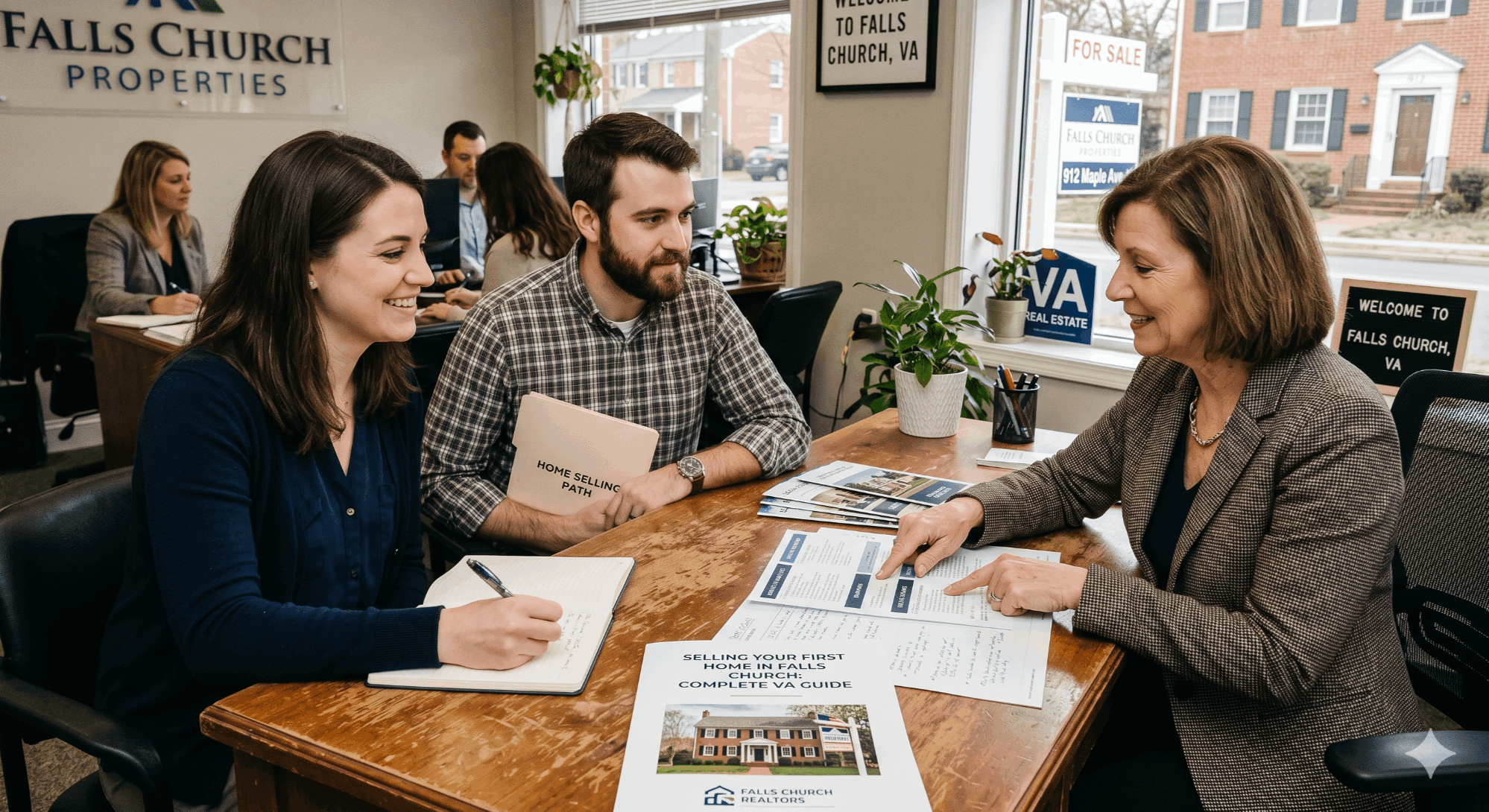
Quick Answer: Selling your first home in Falls Church involves four big decisions: pricing the property correctly for the City's premium market, choosing a listing structure (3% vs. 1.5% commission), preparing the home for one of the most discerning buyer pools in the DMV, and coordinating closing with your next mortgage. Total seller costs typically run 6%–8% of the sale price under a traditional listing, but a 1.5% listing in Falls Church can save first-time sellers $15,000–$25,000+ on a typical sale.
Key Takeaways
- Falls Church is a top-tier seller's market — the median sale price in Falls Church City sits well above $1 million, driven by award-winning schools and a fixed, tiny geographic footprint (about 2.2 square miles).
- Total selling costs run 6%–8% under traditional structures. A 1.5% listing program can cut that by roughly 1.5 percentage points — meaningful money on a $1M+ home.
- Virginia grantor tax is the seller's responsibility — in Northern Virginia, it works out to roughly $2.50 per $1,000 of sale price (state plus regional WMATA tax).
- Most first-time Falls Church sellers owe zero federal capital gains tax — the Section 121 exclusion shields up to $250,000 of gain ($500,000 married filing jointly) if you've owned and lived in the home as a primary residence for 2 of the last 5 years.
- Pricing matters more than prep in Falls Church. Overpricing by 5% can add 30–60 days to time on market and eventually force a reduction that lands below where a correct initial list would have closed.
- If you're buying your next home before selling, financing options like a HELOC, cash-out refinance, or bridge loan let you avoid contingencies and compete in NoVA's tight inventory environment.
Table of Contents
- The Falls Church Seller's Market in 2026
- The Step-by-Step Selling Process
- What It Costs to Sell a Home in Falls Church
- Commission Choice: 3% vs. 1.5% Listing
- Virginia Grantor Tax and Capital Gains
- Pricing Strategy for Falls Church
- Pre-Listing Prep Checklist
- Selling and Buying at the Same Time
- First-Time Seller Mistakes to Avoid
- Frequently Asked Questions
- Glossary
Selling a home for the first time is intimidating in any market. Selling a first home in Falls Church City raises the stakes even higher: the median price sits north of $1 million, the buyer pool is sophisticated, school-driven demand keeps inventory tight, and Virginia's tax structure puts a meaningful share of closing costs in the seller's column.
For most Falls Church owners, the equity built up over 5–10 years of ownership represents the single largest financial transaction of their lives. Getting the process right — from pricing to commission structure to coordinating the next mortgage — is the difference between walking away with full value and quietly leaving $20,000 to $40,000 on the table.
This guide walks first-time Falls Church sellers through every step: the local market dynamics, the full cost stack, the commission decision, the tax rules that actually apply, pricing strategy, prep work, and how to coordinate selling with buying your next home.
The Falls Church Seller's Market in 2026
Falls Church City is an independent city of just over 2.2 square miles, geographically surrounded by Fairfax County and Arlington County but with its own government, school system, and tax structure. That tiny footprint — combined with one of the highest-rated public school systems in Virginia — creates a permanent supply-demand imbalance that favors sellers almost regardless of broader rate cycles.
What buyers are willing to pay
Median sale prices in Falls Church City consistently run above $1 million for single-family homes, with well-prepared homes in walkable neighborhoods near the Metro and downtown commanding meaningful premiums. Townhomes and condos transact at lower price points but still considerably above the broader Northern Virginia median.
Days on market
In normal conditions, well-priced Falls Church homes go under contract in 7–21 days. Homes that linger past 30 days almost always have a price problem, a presentation problem, or both — buyers in this market are well-informed and won't reward overpricing.
Who's buying in Falls Church
The typical Falls Church buyer is a dual-income professional family relocating from elsewhere in NoVA, DC, or out of state, often with children entering or already in the school system. Federal employees, government contractors, healthcare professionals, and tech workers dominate the buyer pool. These buyers come pre-approved, often with substantial down payments, and they expect a turnkey product at a turnkey price.
The Step-by-Step Selling Process
From the moment you decide to sell to the day funds hit your account, expect 45–75 days under normal conditions. Here's what each phase looks like.
Save Thousands on Commission
List Your Falls Church Home at 1.5%
Full-service listing — professional photography, MLS exposure, marketing, negotiation — at 1.5% instead of the traditional 3%. On a $1M Falls Church home, that's $15,000 back in your pocket at closing.
What It Costs to Sell a Home in Falls Church
First-time sellers often focus on commission alone, missing the half-dozen smaller fees that add up to real money on a Falls Church transaction. Here's the full cost stack on a hypothetical $1,000,000 sale.
| Cost Item | Traditional (3% Listing) | 1.5% Listing | Who Pays |
|---|---|---|---|
| Listing agent commission | $30,000 | $15,000 | Seller |
| Buyer agent commission (negotiated) | ~$25,000 | ~$25,000 | Seller or Buyer |
| Virginia grantor tax (state + regional) | ~$2,500 | ~$2,500 | Seller |
| Settlement fees, deed prep, title work | ~$1,200 | ~$1,200 | Seller |
| Pre-listing prep (paint, staging, repairs) | $10,000–$30,000 | $10,000–$30,000 | Seller |
| Prorated property tax & HOA | Varies | Varies | Seller |
| Approximate seller total | ~$68,700 | ~$53,700 | — |
Note: Figures are illustrative for a $1,000,000 sale and assume seller pays buyer-agent commission, which is now separately negotiated post-NAR settlement. Actual costs vary by transaction, contract terms, and chosen service providers. Prep costs depend heavily on home condition.
The math is straightforward: on a million-dollar Falls Church sale, switching from a 3% to a 1.5% listing structure saves approximately $15,000 — money that goes directly into your equity check at closing.
Visualizing the savings
Traditional 3% listing total cost
1.5% listing total cost
Money saved
Commission Choice: 3% vs. 1.5% Listing
The single most consequential decision a first-time Falls Church seller makes — after pricing — is choosing the listing commission structure. The 2024 NAR settlement changed how commissions are negotiated and disclosed, but the underlying math hasn't changed: every percentage point you pay your listing agent comes out of your equity.
What you get at 3% (and what you get at 1.5%)
In most cases, the actual scope of service is identical: MLS listing, professional photography, marketing across major portals, open houses, offer review, negotiation, and management through closing. The 1.5% structure isn't a stripped-down "discount brokerage" — it's the same full-service model at a lower fee, supported by higher transaction volume.
When 1.5% makes sense
For most Falls Church homes — which are well-located, well-built, and naturally attractive to the buyer pool — paying 3% to attract attention is unnecessary. The home largely sells itself once professionally presented. The 1.5% structure is a particularly good fit for first-time sellers at the $700K–$2M price point where the equity savings are most meaningful.
When the higher-fee model might be worth it
Niche homes — unusual price points, extensive renovations needed, or estate situations — sometimes benefit from a more bespoke marketing approach. But for a typical Falls Church single-family or townhome, the 1.5% structure delivers equivalent service at meaningfully lower cost.
Virginia Grantor Tax and Capital Gains
Two tax categories matter when you sell in Virginia: state and local transfer taxes (paid at closing) and federal capital gains tax (paid at tax time the following year). The first is small and unavoidable. The second is much larger in potential — but most first-time sellers owe nothing.
Virginia grantor tax (seller pays)
The Virginia state grantor tax is $0.50 per $500 of sale price (effectively $1.00 per $1,000). In Northern Virginia jurisdictions including Falls Church, an additional regional WMATA congestion tax of $0.15 per $100 ($1.50 per $1,000) is also paid by the seller. Combined, this works out to roughly $2.50 per $1,000 of sale price.
| Sale Price | Virginia State Grantor Tax | NoVA Regional Tax | Combined Seller Total |
|---|---|---|---|
| $750,000 | ~$750 | ~$1,125 | ~$1,875 |
| $1,000,000 | ~$1,000 | ~$1,500 | ~$2,500 |
| $1,250,000 | ~$1,250 | ~$1,875 | ~$3,125 |
| $1,500,000 | ~$1,500 | ~$2,250 | ~$3,750 |
Federal capital gains tax (Section 121 exclusion)
If you've owned and used the home as your primary residence for at least 2 of the last 5 years, the Internal Revenue Code Section 121 exclusion shields up to $250,000 of gain for single filers and $500,000 of gain for married couples filing jointly. For most first-time Falls Church sellers — even those whose homes appreciated significantly — this exclusion eliminates federal capital gains tax entirely.
The "gain" is calculated as: sale price minus selling costs minus original purchase price minus capital improvements. Keep records of any major upgrades — kitchen remodels, additions, new roof, HVAC replacements — because each adds to your cost basis and reduces taxable gain.
Important: Tax law is complex and personal. Always confirm your specific tax situation with a licensed CPA or tax attorney before relying on any general rule about gain exclusion or basis calculation.
Pricing Strategy for Falls Church
Pricing is the lever that moves the most in a Falls Church sale. The City's small footprint means there are typically only a handful of true comparable sales within any 6-month window — and buyers (and their agents) know exactly what those comps are.
The three pricing strategies
1. Price at market. List right at the comparable sales line. Typical outcome: under contract in 7–14 days, often at or slightly above list with multiple offers.
2. Price below market. List 2%–5% below comparable sales. Typical outcome: a deliberate bidding war that drives the final number above where a "priced at market" listing would have closed. This is the riskiest approach but historically produces the highest sale prices in Falls Church.
3. Price above market. List 3%–8% above comparable sales. Typical outcome: extended time on market, eventual price reductions, and a final sale price that often lands below where the home would have closed at a correct initial list. This is the most common first-time-seller mistake in Falls Church.
Plan Your Next Move
What Will Your Next Mortgage Payment Be?
Once you have an estimated sale price, model the payment on your next home — whether you're moving up, downsizing, or relocating outside Falls Church.
Pre-Listing Prep Checklist
Falls Church buyers expect turnkey product. They tour multiple properties in a single afternoon and form opinions in the first 30 seconds. Prep work is not optional — but it should be targeted.
High-ROI prep tasks
- Fresh interior paint in neutral tones (warm whites, soft grays)
- Deep professional cleaning including carpets, baseboards, and inside cabinets
- Declutter aggressively — remove at least 30% of furniture and personal items
- Refresh landscaping — mulch, edge beds, power-wash walkways and siding
- Replace dated light fixtures in entry, dining, and primary bath
- Address obvious maintenance items — leaky faucets, scuffed doors, dead bulbs
- Light staging — even partial staging of living and primary bedroom adds significant value
- Pre-listing inspection — optional but often worth it on older homes to surface and resolve issues before a buyer's inspector finds them
Low-ROI prep tasks to skip
Don't replace kitchens or baths right before selling. The recoup rate on major pre-sale renovations is rarely positive in Falls Church — buyers prefer to renovate to their own taste. Likewise, don't replace a functioning roof or HVAC unless they're at end of life and would otherwise fail inspection.
Selling and Buying at the Same Time
Most first-time Falls Church sellers aren't done with homeownership — they're trading one home for another, whether right-sizing up within the City, moving to a larger county like Loudoun for more land, or downsizing into a condo. Coordinating the two sides of that transaction is where mortgage strategy becomes critical.
Option 1: Sell first, then buy
The cleanest path: list and sell your Falls Church home, then make an offer on your next home with the proceeds in hand. You qualify for the new mortgage based on just one housing payment. The downside is timing risk — you may need to lease-back from the buyer or rent for a few months between sales.
Option 2: Buy first using a HELOC or cash-out refinance
If you don't want to risk losing your dream home while waiting for yours to sell, you can tap equity in your current Falls Church home through a HELOC or cash-out refinance, use those proceeds for the next down payment, then pay back the HELOC when your home sells. You'll need to qualify for both mortgage payments simultaneously, but a licensed mortgage professional can model the scenario for your income, equity, and target purchase price.
Option 3: Bridge loan
A short-term loan that uses your current home as collateral to fund the down payment on your next home. Bridge loans typically carry higher rates than conventional mortgages but provide flexibility for sellers who need to close on a new home before selling.
Free · No Commitment
Get Pre-Approved for Your Next Mortgage
Whether you're buying before you sell, after, or simultaneously — pre-approval gives you a clear picture of what you qualify for and how to structure the transition.
Ken Byrne NMLS #187129 · ALCOVA Mortgage LLC NMLS #40508
First-Time Seller Mistakes to Avoid
After years of helping DMV homeowners coordinate sale-and-purchase transactions, these are the most common — and most expensive — mistakes first-time Falls Church sellers make.
- Overpricing the initial listing. The single most damaging mistake. The first 7–14 days of market exposure are irreplaceable; an overpriced listing wastes that window and is then forced to chase the market down.
- Skipping professional photography. At Falls Church price points, phone photos signal an amateur listing and depress offer prices by 3%–5%.
- Defaulting to 3% commission without comparing structures. The 1.5% listing is a legitimate full-service option that puts $15,000+ back in your closing wire.
- Over-renovating before selling. Kitchen and bath remodels rarely recoup 100% in Falls Church; buyers prefer to renovate to their own taste.
- Ignoring small repairs. Inspectors and buyers magnify visible flaws (sticking doors, cracked tiles, missing caulk). A few hundred dollars of handyman work protects thousands in negotiation.
- Failing to plan the next purchase. Selling without a clear plan for where you're going next creates timing pressure that costs money — both in temporary housing and in rushed purchase decisions.
- Negotiating only on price. Closing date, financing strength, contingencies, and post-settlement occupancy all carry real value. The "highest" offer isn't always the best offer.
- Forgetting to document capital improvements. Receipts and records of major upgrades increase your cost basis and reduce taxable gain if you exceed the Section 121 exclusion.
Ready to Start Your Search?
Browse Homes for Sale in Northern Virginia
Once you've sold your Falls Church home — or are planning your next move — explore current listings across Loudoun, Fairfax, Prince William, Arlington, and Alexandria.
Frequently Asked Questions
How long does it take to sell a home in Falls Church?
In normal market conditions, well-priced and well-prepared Falls Church homes go under contract within 7–21 days of listing, then take an additional 30–45 days to close. Total time from listing to wire transfer is typically 45–75 days.
Do I pay taxes when I sell my home in Virginia?
Yes, in two categories. Virginia grantor tax (state and Northern Virginia regional) totals roughly $2.50 per $1,000 of sale price and is paid at closing. Federal capital gains tax may apply if your gain exceeds the Section 121 exclusion of $250,000 (single) or $500,000 (married filing jointly) — but most first-time sellers owe zero federal capital gains tax on a primary residence sale.
What does it cost to sell a home in Falls Church?
Total seller costs typically run 6%–8% of sale price under a traditional 3% listing structure, or roughly 4.5%–6.5% under a 1.5% listing structure. On a $1M Falls Church home, that's approximately $68,700 traditional versus $53,700 at 1.5% — a $15,000 difference. Costs include listing commission, buyer-agent commission (now negotiated separately), Virginia grantor tax, settlement fees, and prep work.
Is Falls Church a good market for sellers in 2026?
Yes. Falls Church City's tiny geographic footprint, top-rated school system, and Metro access create permanent supply constraints that favor sellers across rate cycles. Well-priced homes sell quickly, often with multiple offers. The market is particularly strong for single-family homes in walkable neighborhoods near downtown and the East and West Falls Church Metro stations.
Can I sell my Falls Church home and buy my next home at the same time?
Yes, and most sellers do. The three common approaches are: (1) sell first, then buy with proceeds in hand; (2) tap equity in your current home through a HELOC or cash-out refinance to fund the next down payment, then pay it back at sale; (3) use a bridge loan. A licensed mortgage professional can model the trade-offs for your specific income, equity, and target purchase price.
What is the Virginia grantor tax in Falls Church?
The Virginia state grantor tax is $0.50 per $500 of sale price (approximately $1.00 per $1,000), paid by the seller. In Northern Virginia jurisdictions including Falls Church City, an additional regional WMATA congestion tax of $0.15 per $100 ($1.50 per $1,000) is also paid by the seller. Combined, that's approximately $2.50 per $1,000 of sale price. On a $1 million sale, expect to pay around $2,500 in grantor tax.
Should I list at 3% or 1.5% commission?
For most Falls Church homes, the 1.5% structure delivers equivalent full-service listing (MLS, professional photography, marketing, negotiation, closing management) at half the listing-side commission. On a typical $1M Falls Church sale, that saves approximately $15,000. The higher-fee model can occasionally make sense for unusual properties or estate situations, but for a standard single-family or townhome in the City, the math strongly favors 1.5%.
Do I need to do a pre-listing inspection?
It's optional but often valuable, especially for older Falls Church homes. A $400–$700 pre-listing inspection identifies issues before a buyer's inspector does, lets you address them on your own timeline, and removes negotiation leverage at the contract stage. For first-time sellers, it also reduces the surprise factor during the inspection period.
What is the Section 121 capital gains exclusion?
The Section 121 exclusion is a federal tax rule that lets homeowners exclude up to $250,000 of capital gain ($500,000 married filing jointly) from federal income tax when selling a primary residence — as long as they've owned and used the home as a primary residence for at least 2 of the last 5 years. For most first-time Falls Church sellers, this exclusion eliminates federal capital gains tax entirely. Confirm specifics with a licensed CPA.
How do I price my Falls Church home correctly?
Start with a comparative market analysis (CMA) from a licensed Falls Church agent who can pull the most recent 3–6 months of comparable sales within the City. Adjust for square footage, lot size, condition, and proximity to schools and Metro. Most successful Falls Church listings price at or slightly below the comparable sales line to invite multiple offers, rather than testing above-market pricing that lengthens time on market.
How do I find a good mortgage lender if I'm selling and buying in Falls Church?
Look for a licensed local lender with strong DMV experience, transparent fee disclosures, and the ability to structure financing creatively (HELOC, cash-out refinance, bridge loan) if you're selling and buying simultaneously. Ken Byrne, NMLS #187129, of ALCOVA Mortgage LLC (NMLS #40508) is licensed in Virginia, Maryland, DC, and West Virginia and specializes in financing solutions for DMV homebuyers, including buy-and-sell coordination.
What if my Falls Church home doesn't sell quickly?
Falls Church homes that don't sell within 30 days almost always have a pricing or presentation issue. Options include a strategic price reduction, refreshing photography, adjusting marketing copy, or temporarily withdrawing and re-listing after addressing the underlying issue. Your listing agent should proactively diagnose and fix the issue rather than waiting passively for offers.
Glossary
- Grantor Tax
- Virginia transfer tax paid by the seller at closing — approximately $2.50 per $1,000 of sale price in Northern Virginia jurisdictions.
- Section 121 Exclusion
- A federal tax rule excluding up to $250,000 of capital gain ($500,000 married jointly) on the sale of a primary residence, provided 2-of-5-year ownership and use tests are met.
- Cost Basis
- Original purchase price plus capital improvements. Used to calculate taxable gain on the sale.
- Comparative Market Analysis (CMA)
- An agent-prepared report estimating home value based on recent comparable sales, active listings, and pending contracts in the immediate area.
- Bridge Loan
- A short-term loan secured by your current home that funds the down payment on your next home, repaid when the current home sells.
- HELOC (Home Equity Line of Credit)
- A revolving line of credit secured by your home equity, often used to access funds without a full refinance.
- Settlement (Closing)
- The final transaction where the deed transfers, the buyer's loan funds, the seller's mortgage is paid off, and the seller receives net proceeds.
- Days on Market (DOM)
- The number of days a property has been actively listed since its most recent listing date. A key signal of pricing accuracy.
Keep More of Your Equity
List Your Falls Church Home at 1.5% Commission
Full-service listing — pricing strategy, professional marketing, expert negotiation, closing coordination — at half the traditional listing commission. Most Falls Church first-time sellers save $15,000–$25,000.
Conclusion & Next Steps
Selling your first home in Falls Church is a once-or-twice-in-a-lifetime financial event. Done well, it converts a decade of mortgage payments and appreciation into the down payment on your next chapter — whether that's a larger family home, a downsized condo, or a relocation to a new market.
The single biggest lever first-time sellers control is the commission structure. Pairing a full-service 1.5% listing with smart pricing, focused prep, and well-coordinated next-home financing is the formula that consistently delivers maximum net proceeds in Falls Church City's premium market.
Whether you're 90 days out or just starting to think about it, the right time to start the conversation is now — before pricing decisions are made, before money is spent on prep, and before the financing strategy for your next home is locked in.
Disclaimer: This article is for informational purposes only and does not constitute financial, tax, or legal advice. Mortgage programs, rates, tax rules, and eligibility requirements are subject to change. Real estate market conditions vary by neighborhood and over time. Always consult a licensed mortgage professional, licensed real estate agent, and qualified CPA or tax attorney for guidance specific to your situation. Ken Byrne, NMLS #187129 · ALCOVA Mortgage LLC, NMLS #40508 · Licensed in VA, MD, DC, WV.
Categories
Recent Posts

GET MORE INFORMATION

Broker Associate