
USDA Income Limits 2026 and Eligible Areas in Virginia and West Virginia
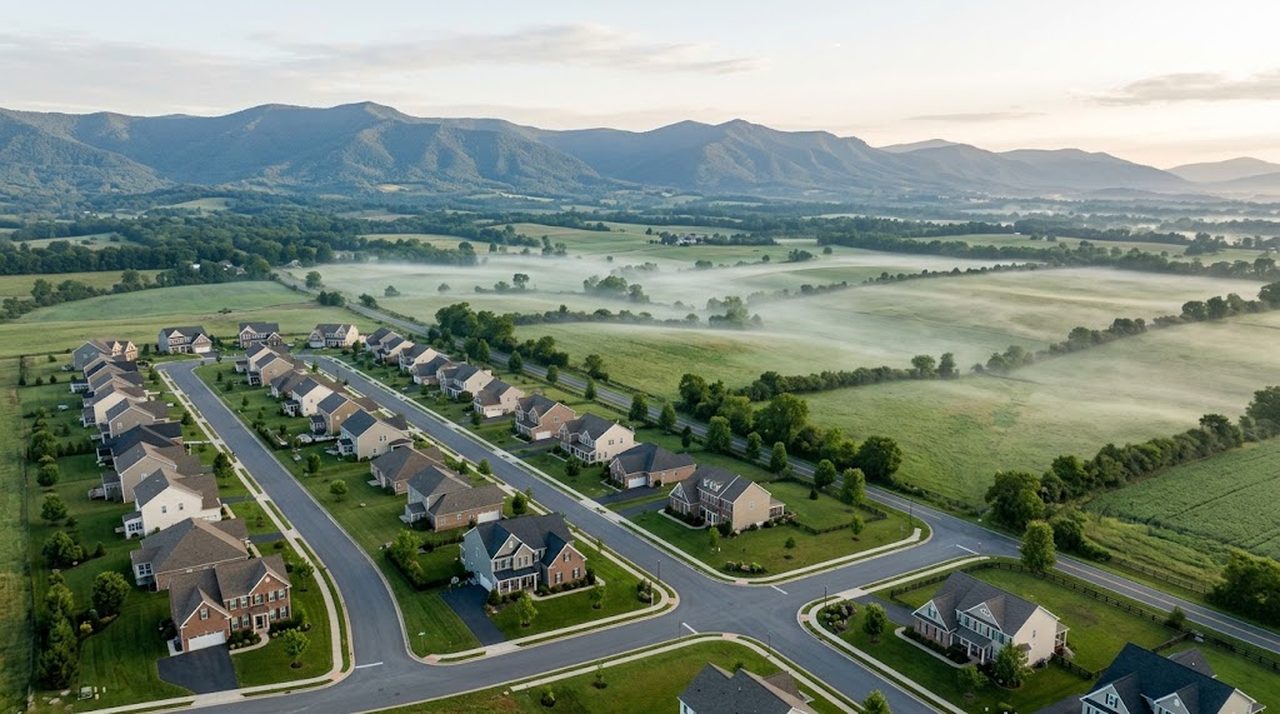
Much of the countryside and many small towns within reach of Northern Virginia sit inside USDA eligible areas.
Short answer: a USDA guaranteed loan needs two things to line up: a property in a USDA eligible rural area, and adjusted household income at or below the 2026 limit for the county. In the Washington metro counties of Virginia, including Loudoun, Fauquier, Stafford, Spotsylvania and Clarke, the limit is $153,550 for a household of one to four people and $202,700 for five to eight. Most rural Virginia and West Virginia counties are $122,800 and $162,100. On the map, towns such as Purcellville, Warrenton, Culpeper, Front Royal, Martinsburg and Charles Town came up eligible in September 2026, while Leesburg, Winchester, Fredericksburg and Haymarket did not.
By Ken Byrne, NMLS #187129 · ALCOVA Mortgage LLC, NMLS #40508 · Updated September 2026
USDA loans have two gates that other loans do not: where the home is and how much the whole household earns. Buyers often rule themselves out on the first because they assume rural means remote, and on the second because they compare their gross pay with the limit without the deductions USDA allows. This guide shows how the eligibility map works, which towns around Northern Virginia and the Eastern Panhandle came up eligible when we checked, the full 2026 income limit table for the region, and how to work out your own household income the way USDA does. To check a specific address and your income together, talk to JB Financing.
How USDA eligible areas work
USDA lends in rural areas as defined by federal housing law, which uses population bands of 10,000, 20,000 and 35,000 along with an area’s character and access to credit. In practice you do not apply those tests yourself. USDA Rural Development shows its determination by address on its property eligibility site, and the agency reviews areas every five years, and every three in fast growing metro areas, to find places that no longer qualify.
HB-1-3555 chapter 12; USDA Rural Development property eligibility site.
Using the map takes a minute. Open the Single Family Housing Guaranteed section of the USDA eligibility site, choose Property Eligibility, accept the disclaimer, and type the full street address. The result box says whether the address is located in an eligible area, or that it is unable to determine. On the map itself, shaded areas are ineligible and unshaded areas are eligible. Check the exact address, not just the town: boundaries can run through a neighborhood, the lender confirms at application, and USDA makes the final determination.
USDA eligible areas near Northern Virginia
We searched the USDA map for towns across the outer Washington region on September 24, 2026. Each result is for the point the map returns for that town name, so treat it as a guide to the area, not a ruling on any particular house.
| Town | County | Map result |
|---|---|---|
| Purcellville, Lovettsville, Round Hill, Middleburg | Loudoun | Eligible |
| Leesburg | Loudoun | Not eligible |
| Warrenton, Marshall, Bealeton, Remington | Fauquier | Eligible |
| Culpeper | Culpeper | Eligible |
| Front Royal | Warren | Eligible |
| Berryville | Clarke | Eligible |
| Stephens City | Frederick | Eligible |
| Winchester | City of Winchester | Not eligible |
| Strasburg, Woodstock | Shenandoah | Eligible |
| Luray | Page | Eligible |
| Stafford, courthouse area | Stafford | Eligible |
| Spotsylvania, courthouse area | Spotsylvania | Eligible |
| Fredericksburg | City of Fredericksburg | Not eligible |
| King George | King George | Eligible |
| Haymarket | Prince William | Not eligible |
| Martinsburg, Inwood, Hedgesville | Berkeley, WV | Eligible |
| Charles Town, Ranson, Shepherdstown, Harpers Ferry | Jefferson, WV | Eligible |
| Berkeley Springs | Morgan, WV | Eligible |
| Romney | Hampshire, WV | Eligible |
USDA Rural Development property eligibility map, Single Family Housing Guaranteed, searched by town name on September 24, 2026.
The pattern on the map is clear. Fairfax County, Arlington, Alexandria, eastern Loudoun and eastern Prince William are shaded as ineligible, as are the larger independent cities. Western Loudoun, most of Fauquier, and the counties beyond them are largely open. How the loan itself works, and what it costs, is on our USDA loans page.

Get a Mortgage Estimate for Free
See the payment on homes in USDA eligible areas, with the fee and your county’s taxes included.
✓Free, no obligation✓Licensed in VA, MD, DC and WV✓Loan officer Ken Byrne, NMLS #187129
USDA income limits for 2026 in Virginia and West Virginia
The guaranteed loan income limit is at least 115 percent of median income, and USDA publishes it by county or metro area; rural counties sit at a floor set from national and state medians. The current table took effect July 13, 2026. Households of one to four people share one limit and households of five to eight share a higher one; above eight, add 8 percent of the four person limit per person.
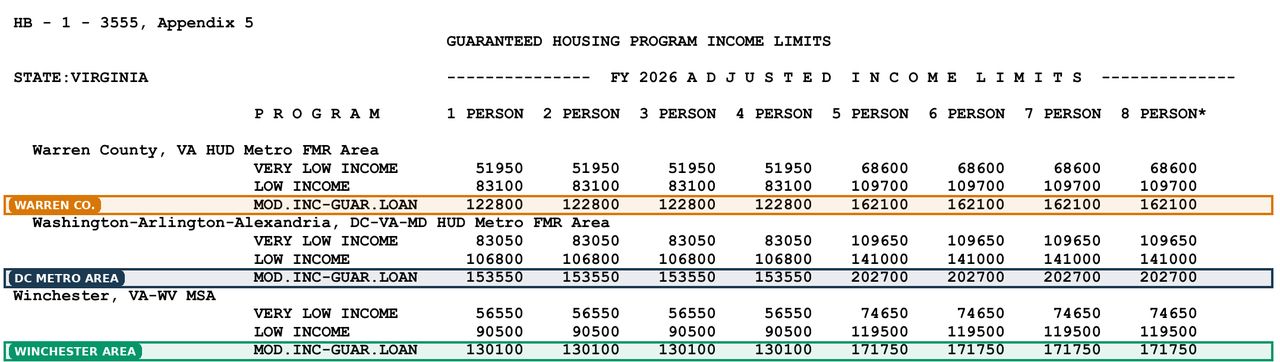
The guaranteed loan income limit is the MOD.INC-GUAR.LOAN row, not the very low or low income rows above it, which apply to USDA’s direct loans. Source: USDA HB-1-3555 Appendix 5, page 311, effective July 13, 2026.
| County or area | 1 to 4 people | 5 to 8 people |
|---|---|---|
| Washington metro area in Virginia: Loudoun, Fauquier, Stafford, Spotsylvania, Clarke and the inner counties | $153,550 | $202,700 |
| King George County | $153,550 | $202,700 |
| Jefferson County, WV | $147,650 | $194,900 |
| Culpeper County | $138,700 | $183,100 |
| Orange County | $134,000 | $176,900 |
| Winchester area: Frederick County, VA, Winchester and Hampshire County, WV | $130,100 | $171,750 |
| Rappahannock County | $124,550 | $164,450 |
| Caroline County | $124,400 | $164,250 |
| Warren, Shenandoah, Page and Madison counties | $122,800 | $162,100 |
| Berkeley and Morgan counties, WV | $122,800 | $162,100 |
| Most other rural Virginia and West Virginia counties | $122,800 | $162,100 |
USDA HB-1-3555 Appendix 5, Guaranteed Housing Program Income Limits, effective July 13, 2026 (PN 657). Washington metro area membership per HUD’s income limits documentation.
Jefferson County’s limit is set on its own rather than with Berkeley County, which is why the two neighbors differ by almost $25,000. Local lending in Jefferson County is covered in our guide to mortgages in Charles Town and Shepherdstown.
How USDA counts household income
This is where most people misjudge their eligibility, in both directions. USDA counts the income of every adult household member, whether or not they will be on the loan. Then it subtracts allowances to reach adjusted income, which is the figure compared with the limit.
| Deduction | Amount |
|---|---|
| Each dependent, such as a child under 18 | $480 |
| Elderly or disabled family, once per household | $400 |
| Child care for children 12 and under, so an adult can work or study | Actual reasonable cost |
| Medical expenses, elderly or disabled families only | Amount above 3% of income |
7 CFR 3555.152; HB-1-3555 chapter 9.
An example in Culpeper County. Two parents earn $141,000 between them and have two children, 8 and 11, with $6,200 a year of after school care. Gross income is above the $138,700 limit, but after $960 of dependent deductions and the child care, adjusted income is $133,840, under the limit. If a 20 year old son who works full time, is not a student and earns $22,000 also lives with them, household income rises to $163,000, but the household is now five people, the limit rises to $183,100, and adjusted income of $155,840 still qualifies.
Illustration. Limits from HB-1-3555 Appendix 5, effective July 13, 2026. Calculated.
The income limit is separate from what you can borrow, which depends on your own repayment ability and the debt ratios. How the loan is underwritten and priced against FHA is in our guide to USDA loans vs FHA in Virginia and West Virginia.
What a household at the limit can buy
USDA has no set loan limit, but a household at the income limit is capped in practice by the 29 percent housing ratio. Here is roughly what that supports.
| Household income at the limit | Housing payment at 29% | Home price, about | Where this limit applies |
|---|---|---|---|
| $122,800 | $2,968 | $361,000 | Warren, Shenandoah, Berkeley WV and most rural counties |
| $130,100 | $3,144 | $386,000 | Frederick County VA, Winchester area |
| $138,700 | $3,352 | $416,000 | Culpeper |
| $147,650 | $3,568 | $447,000 | Jefferson County WV |
| $153,550 | $3,711 | $467,000 | Washington metro counties of Virginia |
USDA loan at 6.95%, the Freddie Mac survey average for the week of September 17, 2026, with the 1% fee financed and the 0.35% annual fee; property tax and insurance assumed at $450 a month. Automated approvals can allow higher ratios. Calculated.
Compare that with typical home values: $396,534 in Warren County, $345,419 in Shenandoah, $322,791 in Berkeley County and $492,356 in Culpeper, according to Zillow for August 2026. In the outer Washington metro counties, where typical values run from $456,897 in Spotsylvania to $649,336 in Fauquier, USDA tends to fit the lower half of the market. Other Virginia programs and limits are on our Virginia mortgage page.
Get Pre-Approved Today
Get pre-approved and know whether USDA fits your household income and the homes you like.
✓Free, no obligation✓Licensed in VA, MD, DC and WV✓Loan officer Ken Byrne, NMLS #187129
If the address or the income does not qualify
An ineligible address or an income over the limit rules out USDA, not low down payment buying. In Virginia, grants and second loans can cover much of the down payment on FHA and conventional loans; see our guide to Virginia down payment assistance programs.
Veterans and service members can buy with no down payment anywhere, with no income limit, on a VA loan; the rules are on our VA loans page.
Across the state line, the options for first time buyers are set out in our guide to West Virginia first time homebuyer programs.
Frequently asked questions
What are the USDA income limits for 2026?
In this region, $122,800 for a household of one to four and $162,100 for five to eight in most rural counties, rising to $153,550 and $202,700 in the Washington metro counties of Virginia. The table took effect July 13, 2026.
How do I check the USDA eligibility map?
On the USDA eligibility site, open Single Family Housing Guaranteed, choose Property Eligibility, accept the disclaimer and enter the full address. The result says whether it is in an eligible area.
Is Loudoun County eligible for a USDA loan?
Parts of it. Purcellville, Lovettsville, Round Hill and Middleburg came up eligible on the map in September 2026; Leesburg and the eastern part of the county did not.
Is Fauquier County eligible for USDA?
Much of it. Warrenton, Marshall, Bealeton and Remington all came up eligible on the map in September 2026.
Does USDA count my spouse’s income if they are not on the loan?
Yes. USDA counts the income of every adult household member, whether or not they are a borrower.
What is adjusted income for USDA?
Household income minus allowed deductions: $480 per dependent, $400 for an elderly or disabled family, child care for children 12 and under, and some medical costs for elderly or disabled families.
Is there a USDA loan limit in Virginia?
No set dollar limit. The loan is limited by the appraised value plus the upfront fee and by your ability to repay, which in practice depends on income.
What is the USDA income limit in Berkeley County, WV?
$122,800 for one to four people and $162,100 for five to eight. Neighboring Jefferson County is higher, at $147,650 and $194,900.
Can USDA eligible areas change?
Yes. USDA reviews areas every five years, and every three in fast growing metro areas, and can remove places that no longer qualify, so check the map again when you are ready to buy.
Is the eligibility map result final?
No. The site says its maps do not make a final determination. The lender and USDA confirm eligibility when you apply.
Next stepStart Your Pre-Approval
Start online, and Ken Byrne’s team will check the address and the 2026 income limit with you.
✓Free, no obligation✓Licensed in VA, MD, DC and WV✓Loan officer Ken Byrne, NMLS #187129
This article is general information, not financial or legal advice and not a commitment to lend or an offer of credit. Loan limits, program rules, premium schedules and rates change, and individual eligibility depends on a full review of your credit, income, assets and the property. Every figure here is an illustration, not a quote, built from published sources and a weekly survey average rather than underwriting decisions. Insurance and mortgage insurance amounts are planning estimates. Confirm anything you plan to act on with a licensed mortgage professional. Income limits are USDA guaranteed program limits effective July 13, 2026. Map results are town name searches on September 24, 2026 and do not determine the eligibility of any property; USDA Rural Development makes the final determination.
Categories
Recent Posts





GET MORE INFORMATION

Broker Associate