
How to Get Rid of PMI in 2026: When and How to Remove Mortgage Insurance

Removing PMI is a request you make to your loan servicer. Knowing the rules can get it done sooner.
Short answer: on a conventional loan you can ask your servicer to cancel PMI once your balance reaches 80 percent of the home’s original value, and it must end automatically at 78 percent. On a $500,000 home bought with 5 percent down at today’s average rate, those points arrive in about 11 and 12 years with no extra payments. You can get there sooner by paying extra principal, by using the home’s current value after two years on loans owned by Fannie Mae or Freddie Mac, or by refinancing. FHA mortgage insurance follows different rules.
By Ken Byrne, NMLS #187129 · ALCOVA Mortgage LLC, NMLS #40508 · Updated October 2026
Private mortgage insurance does not fall off on its own until late in the loan, and servicers do not always make the early routes obvious. This guide is the how-to: the federal rules, the Fannie Mae and Freddie Mac shortcuts, a step-by-step request, what to do if you are denied, and when a refinance is the better tool. If you are weighing a refinance to drop mortgage insurance, talk to JB Financing.
When can you get rid of PMI? The three federal triggers
The Homeowners Protection Act covers conventional loans on single-family primary homes that closed on or after July 29, 1999. Loans the lender classed as high risk at closing are an exception. The 80 and 78 percent triggers are measured against the original value: for a purchase, the lower of the price you paid or the appraised value at closing.
| Trigger | When it happens | What you have to do |
|---|---|---|
| Cancellation at your request | Balance is scheduled to reach, or is actually paid down to, 80% of original value | Ask in writing and meet the conditions below |
| Automatic termination | Balance is scheduled to reach 78% of original value | Nothing, as long as you are current on payments. If you are behind, it ends the first day of the month after you catch up |
| Final termination | The first day of the month after the loan’s midpoint, which is just past 15 years on a 30-year loan | Nothing, as long as you are current |
12 U.S.C. 4901 and 4902; CFPB Compliance Bulletin 2015-03.
For a request at 80 percent, the law requires a written request, a good payment history and a current loan. The lender can also ask for evidence that the home’s value has not fallen below the original value and a certification that there is no second mortgage or other junior lien. What PMI costs in the first place is covered in our guide to PMI.
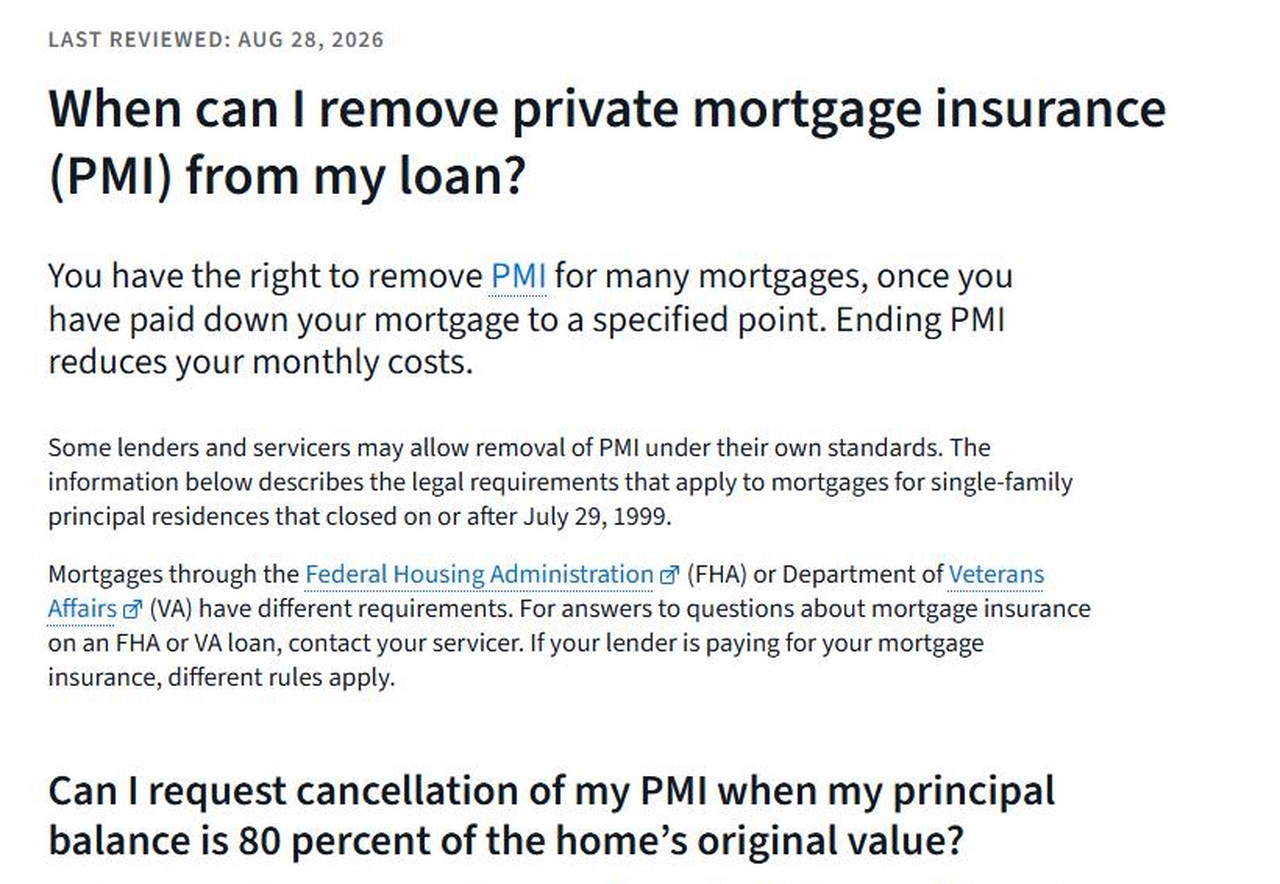
The federal consumer agency’s summary of your right to remove PMI. Source: Consumer Financial Protection Bureau.
Loans these rules do not cover
| Loan or insurance type | What applies instead |
|---|---|
| Lender-paid mortgage insurance | It cannot be canceled; it ends when you refinance or pay off the loan |
| FHA loans | FHA’s own mortgage insurance premium rules, covered below |
| VA loans | No monthly mortgage insurance to remove |
| USDA loans | An annual fee that lasts for the life of the loan |
| Second homes, investment properties and two-to-four unit homes | The investor’s rules, not the federal Act |
12 U.S.C. 4901 and 4905; HUD; VA.gov; USDA Rural Development.
How long until PMI comes off on a normal schedule
At current rates a loan pays down slowly in its first decade, so the 80 percent point is further away than many owners expect.
| Down payment on a $500,000 home | Reaches 80% (you can ask) | Reaches 78% (automatic) |
|---|---|---|
| 3% | Month 143, about 11.9 years | Month 154, about 12.8 years |
| 5% | Month 133, about 11.1 years | Month 145, about 12.1 years |
| 10% | Month 104, about 8.7 years | Month 119, about 9.9 years |
| 15% | Month 63, about 5.2 years | Month 83, about 6.9 years |
30-year fixed at 7.28% (Freddie Mac average, October 1, 2026), no extra payments. A loan with a lower rate reaches these points sooner.
What extra principal payments do
| Extra principal each month | 5% down: months to reach 80% | 10% down: months to reach 80% |
|---|---|---|
| None | 133 (11.1 years) | 104 (8.7 years) |
| $100 | 113 (9.4 years) | 86 (7.2 years) |
| $200 | 98 (8.2 years) | 73 (6.1 years) |
| $500 | 70 (5.8 years) | 51 (4.2 years) |
Same $500,000 home and 7.28% rate. Calculated from the standard amortization formula.
You can ask for cancellation as soon as the balance actually reaches 80 percent, not only on the scheduled date. A lump sum works the same way. Automatic termination at 78 percent follows the original schedule, so after prepaying you still have to ask. If you make a large one, a recast can also lower the payment; see our guide to mortgage recasting.

Get a Mortgage Estimate for Free
See what your payment looks like once mortgage insurance comes off.
✓Free, no obligation✓Licensed in VA, MD, DC and WV✓Loan officer Ken Byrne, NMLS #187129
How to remove PMI sooner with your home’s current value
If your loan is owned by Fannie Mae, the servicer can also cancel PMI based on what the home is worth today. This is the route that helps owners whose home has gained value or who have renovated.
| How long you have had the loan | Loan must be at or below | Applies to |
|---|---|---|
| 2 to 5 years | 75% of current value | One-unit primary or second home |
| More than 5 years | 80% of current value | One-unit primary or second home |
| Any time, after improvements that raised the value | 80% of current value | One-unit primary or second home; the two-year wait is waived |
| More than 2 years | 70% of current value | 2-to-4 unit primary home or investment property |
Fannie Mae Servicing Guide B-8.1-04. Requires no payment 30 or more days late in the past 12 months and none 60 or more days late in the past 24, plus a valuation the servicer obtains that includes an interior and exterior inspection.
Fannie Mae describes qualifying improvements as renovations that substantially improve marketability and extend the useful life of the property, such as kitchen and bathroom renovations or added square footage. Repairs do not count. Loan basics are on our conventional loans page.
Freddie Mac loans work in a similar way. Mortgage insurers’ summaries of the Freddie Mac guide list 75 percent of current value after two years and 80 percent after five; we could not read the guide section itself, so ask your servicer for the exact requirement. Since September 16, 2026, Fannie Mae servicers may also contact borrowers who appear to qualify.
How much the home has to be worth
| Time since closing | Loan balance | Value needed | Gain from the $500,000 price |
|---|---|---|---|
| 2 years | $465,515 | $620,700 (75% rule) | 24% |
| 3 years | $460,230 | $613,600 (75% rule) | 23% |
| Just over 5 years | $447,908 | $559,900 (80% rule) | 12% |
| 7 years | $434,802 | $543,500 (80% rule) | 9% |
$500,000 home, 5% down, 30-year fixed at 7.28%, no extra payments. Thresholds from Fannie Mae B-8.1-04.
The five-year mark is a real step: the required gain falls from about 20 percent to about 12 percent. If your home is close to the line late in year five, waiting a few months can be the cheapest route.
How to get PMI removed, step by step
| Step | What to do |
|---|---|
| 1. Find your numbers | Your original value and loan balance are on your closing documents and monthly statement. Your servicer’s annual statement must list a phone number and address for PMI questions |
| 2. Find out who owns the loan | Fannie Mae and Freddie Mac each have a free loan lookup tool on their consumer websites. The owner decides which current-value rules apply |
| 3. Check your payment record | You need to be current, with a good payment history |
| 4. Send a written request | Ask for cancellation, state which rule you are using and ask what valuation is required |
| 5. Complete the valuation | The servicer tells you which valuation it needs. One mortgage insurer, Enact, says the borrower usually pays for it, so ask the cost first |
| 6. Get the answer in writing | If the loan does not qualify, the servicer must send written notice of the grounds |
12 U.S.C. 4902, 4903 and 4904; Fannie Mae Servicing Guide B-8.1-04; Enact Mortgage Insurance, August 2026.
Once you qualify, the servicer cannot require premiums more than 30 days after the later of your written request or you meeting its evidence requirements. After PMI is canceled or terminated it must return any unearned premium within 45 days. It must also tell you in writing, within 30 days, that the insurance has ended. If your premium is paid through escrow, your payment is recalculated; how that works is in our escrow account guide.
If your servicer says no
Ask for the reason in writing; the law requires it, and if an appraisal was used you are entitled to the results. Then check the answer against the rules above. The Consumer Financial Protection Bureau has found servicers getting this wrong:
| CFPB finding | Report |
|---|---|
| Servicers failed to terminate PMI automatically for borrowers who were current on the termination date | Supervisory Highlights, Fall 2015 |
| Borrowers were wrongly told they had to wait until the balance reached 75% of current value | Supervisory Highlights, Fall 2015 |
| Unearned premiums were held for an average of 152 days instead of 45 | Supervisory Highlights, Fall 2015 |
| Denial letters gave inaccurate reasons for refusing cancellation | Supervisory Highlights, Winter 2019 |
CFPB Supervisory Highlights, Issue 9 (Fall 2015) and Issue 18 (Winter 2019).
If the servicer will not correct a mistake, you can file a complaint with the CFPB online or at (855) 411-2372. The Bureau says companies generally respond within 15 days. The Act also lets a borrower sue for actual damages plus statutory damages of up to $2,000 in an individual case, within two years of discovering the violation. That is a question for an attorney, not a lender.
consumerfinance.gov/complaint; 12 U.S.C. 4907.
Get Pre-Approved Today
Find out whether a refinance would remove your mortgage insurance and what it would cost.
✓Free, no obligation✓Licensed in VA, MD, DC and WV✓Loan officer Ken Byrne, NMLS #187129
FHA loans: can you remove mortgage insurance?
FHA mortgage insurance is not PMI, and the federal cancellation rules do not apply. What matters is when your FHA case number was assigned and how much you put down.
| FHA loan | When the annual premium ends |
|---|---|
| Case number assigned on or after June 3, 2013, original loan-to-value 90% or less | After 11 years |
| Case number assigned on or after June 3, 2013, original loan-to-value above 90% | It lasts for the full loan term |
| Closed after December 31, 2000 with a case number before June 3, 2013 | Can be canceled at 78% loan-to-value; loans longer than 15 years also need five years of payments |
HUD Mortgagee Letter 2013-04; HUD, Single Family Mortgage Insurance Premiums.
If you put down less than 10 percent, the premium ends only when the loan is paid off or refinanced into a conventional loan. The upfront premium is not refunded when you refinance out of FHA. A side-by-side is in our guide to FHA vs conventional loans.
Refinancing to remove PMI
A new conventional loan at 80 percent or less of the home’s current appraised value does not require mortgage insurance. That makes a refinance the usual exit for FHA borrowers, for lender-paid mortgage insurance and for owners whose servicer rules are stricter than the gain they have.
It is not automatically the better choice. A refinance replaces your interest rate and brings closing costs. If your current rate is lower than today’s, giving it up can cost more than the insurance you remove, and a request to your servicer costs little by comparison. The simple test is closing costs divided by the monthly saving. As a hypothetical, $6,000 in costs against $210 a month in PMI takes about 29 months to recover, before any change in rate. Current options are on our refinance page.
| Route | Best when | Main cost |
|---|---|---|
| Request at 80% of original value | You have paid the balance down | Possibly a valuation |
| Current-value request | The home has gained value and you have had the loan two years or more | A valuation with an interior inspection |
| Wait for 78% | You are close to the automatic date | More months of premiums |
| Refinance | FHA or lender-paid insurance, or today’s rate is at or below yours | Closing costs and a new rate |
General comparison based on the rules cited above; Fannie Mae Selling Guide B7-1-01.
For the wider decision, including rate and break-even, see should you refinance in 2026.
State rules in Virginia and Maryland
The federal Act overrides most state PMI laws. It preserves only a short list of older state laws that give borrowers more, and the Federal Reserve’s list of those states includes Maryland. We could not confirm the current Maryland provision, so the federal rules above are the ones to rely on. Virginia law separately requires a lender to return any portion of a PMI premium that is not used to buy the insurance.
12 U.S.C. 4908; Federal Reserve Consumer Compliance Handbook, Homeowners Protection Act; Va. Code 6.2-413.
Frequently asked questions
When can you remove PMI from your mortgage?
You can request cancellation when your balance reaches 80 percent of the home’s original value. It ends automatically at 78 percent if you are current, and no later than the month after the midpoint of the loan term.
How do I get rid of PMI without refinancing?
Send your servicer a written request once the balance is at 80 percent of the original value, or use the home’s current value: on Fannie Mae loans, 75 percent or less after two years or 80 percent or less after five.
Does PMI go away automatically?
Yes, on the date the balance is scheduled to reach 78 percent of the original value, if you are current on payments. On a 30-year loan at 7.28 percent with 5 percent down, that is about 12 years in.
Do I need an appraisal to remove PMI?
Often. For a current-value request Fannie Mae requires a valuation based on an interior and exterior inspection, ordered by the servicer. An appraisal you order yourself may not be accepted.
How long does it take to remove PMI after I ask?
If you qualify, the servicer cannot require premiums more than 30 days after the later of receiving your written request or you meeting its evidence requirements. If it turns the request down, it must send written grounds within that same 30 days.
Can I remove PMI after two years?
On a Fannie Mae loan, yes, if the balance is 75 percent or less of the home’s current value and your payment history is clean. With substantial improvements the two-year wait is waived.
Can I remove mortgage insurance from an FHA loan?
Only in limited cases. On FHA loans with case numbers assigned since June 3, 2013, the annual premium ends after 11 years if you put at least 10 percent down. Otherwise it lasts for the loan term unless you refinance.
Will I get a refund when PMI is removed?
Any unearned premium must be returned within 45 days of cancellation or termination.
Do home improvements help remove PMI?
They can. Fannie Mae counts renovations that raise value, such as kitchen and bathroom remodels or added square footage, and waives the two-year wait. Repairs do not count.
Next stepStart Your Pre-Approval
Start online, and Ken Byrne’s team will compare keeping your loan with refinancing it.
✓Free, no obligation✓Licensed in VA, MD, DC and WV✓Loan officer Ken Byrne, NMLS #187129
This article is general information, not financial or legal advice and not a commitment to lend or an offer of credit. Loan limits, program rules, premium schedules and rates change, and individual eligibility depends on a full review of your credit, income, assets and the property. Every figure here is an illustration, not a quote, built from published sources and a weekly survey average rather than underwriting decisions. Insurance and mortgage insurance amounts are planning estimates. Confirm anything you plan to act on with a licensed mortgage professional. Federal law, Fannie Mae guidelines and HUD rules were checked on October 5, 2026. Your servicer and loan owner set the requirements for your loan. This is not legal advice.
Categories
Recent Posts









GET MORE INFORMATION

Broker Associate