
DC HPAP Program 2026: Down Payment Assistance Explained
DC HPAP Program 2026: Down Payment Assistance Explained
By Ken Byrne, NMLS #187129 · ALCOVA Mortgage LLC, NMLS #40508 · Updated May 2026
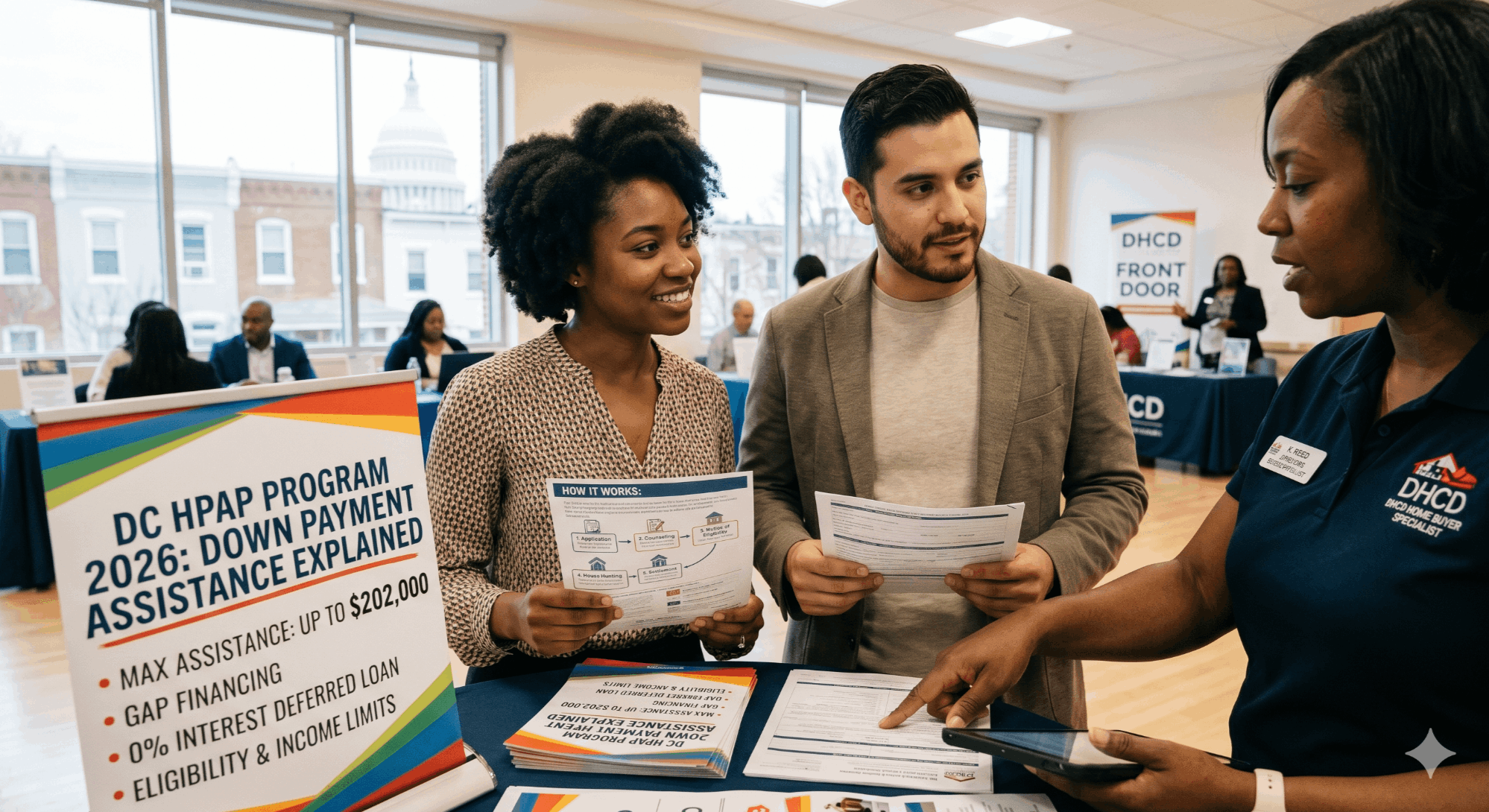
Quick Answer: The DC Home Purchase Assistance Program (HPAP) provides up to $202,000 in down payment assistance plus an additional $4,000 for closing costs to first-time homebuyers purchasing a primary residence in Washington, DC. Administered by the DC Department of Housing and Community Development (DHCD), HPAP is a deferred, zero-interest loan with payments waived for very low-income households and deferred five years for moderate-income households. Eligibility is based on household size, income, and DC residency priority.
Key Takeaways
- Up to $206,000 total assistance: $202,000 in gap financing + $4,000 toward closing costs.
- Zero interest, deferred loan: No payments for very low-income households; 5-year payment deferral for moderate-income households.
- DC residents get priority: Non-residents may apply but are processed only after DC resident applications.
- Must be a first-time homebuyer: No ownership interest in residential real estate in the previous 3 years.
- Income limits up to 110% AMI: 2026 Washington DC metro median family income is $163,900 for a 4-person household.
- Stackable with other programs: HPAP can be combined with DC Open Doors, EAHP, and FHA/conventional financing.
Table of Contents
- What Is the DC HPAP Program?
- How Much HPAP Assistance Can You Receive?
- HPAP Eligibility Requirements
- 2026 HPAP Income Limits
- HPAP Loan Amount Limits
- How HPAP Repayment Works
- How to Apply for HPAP: Step-by-Step
- Combining HPAP with Other DC Programs
- Common HPAP Mistakes to Avoid
- HPAP vs. DC Open Doors vs. EAHP
- Your Path Forward with HPAP
- Frequently Asked Questions
- Glossary
Buying a home in Washington, DC is one of the most expensive propositions in the country. With median home prices in the District hovering well above $600,000 and conventional 20% down payments easily exceeding $120,000, the down payment hurdle alone keeps thousands of qualified buyers stuck renting. That's exactly the gap the Home Purchase Assistance Program — known as HPAP — was designed to close.
HPAP is the District's flagship down payment assistance program, administered by the DC Department of Housing and Community Development (DHCD) and operated in partnership with the DC Housing Finance Agency (DCHFA) and the Greater Washington Urban League. It provides eligible first-time DC homebuyers with up to $202,000 in gap financing plus $4,000 for closing costs — money that can be the difference between staying on the sidelines and owning a home in the District.
This guide walks you through everything you need to know about HPAP in 2026: how much you can receive, who qualifies, how the loan repayment works, and the exact steps to apply. If you're a DC resident dreaming of homeownership, this program could fundamentally change what's possible for your household.
What Is the DC HPAP Program?
The Home Purchase Assistance Program (HPAP) is a District of Columbia government program that provides interest-free, deferred loans to help first-time homebuyers cover down payment and closing costs when purchasing a primary residence in DC. It's funded annually through the DC budget and administered by DHCD under Title 14, Chapter 25 of the DC Municipal Regulations.
In practical terms, HPAP fills the "gap" between what a buyer can afford to put down out of pocket and what's needed to close on a home. For a household earning 50% of area median income, that gap might be tens of thousands of dollars. For some moderate-income households purchasing in high-cost DC neighborhoods, the gap is even larger — and HPAP can cover up to $202,000 of it.
Who Operates HPAP?
HPAP involves several government and nonprofit agencies working together. Understanding the structure helps you know where to go for each part of the process:
| Agency | Role |
|---|---|
| DHCD (DC Dept. of Housing and Community Development) | Sets rules, income limits, and funds the program |
| DCHFA (DC Housing Finance Agency) | Co-administers loan processing and servicing |
| Greater Washington Urban League | Issues Notices to Proceed and assists in administration |
| Community Based Organizations (CBOs) | Provide housing counseling, intake, and applicant support |
| Participating Lenders (like ALCOVA Mortgage) | Originate the first mortgage that HPAP supplements |
You apply through a CBO, get approved by DHCD, and then work with a participating mortgage lender to close on a home. Each agency plays a defined role, and the process moves sequentially from one to the next.
How Much HPAP Assistance Can You Receive?
The maximum HPAP gap financing assistance is $202,000, plus a separate $4,000 for closing cost assistance, for a total potential package of $206,000. The actual amount you receive depends on three factors: household size, household income, and demonstrated financial need.
Generally, the lower your income relative to area median income (AMI), the larger your HPAP loan. Households at the very-low-income tier typically receive the maximum, while moderate-income households receive proportionally less because they can contribute more themselves.
HPAP Assistance by Income Tier (Approximate Ranges)
Ranges are approximate based on DHCD's June 2025 Homebuyer Assistance Table. Exact award amount is determined by household size, income, and current funding availability.
Important: HPAP assistance cannot exceed the first mortgage loan amount. So if you're getting a $400,000 mortgage, your HPAP assistance is capped at $400,000 — but in practice, the $202,000 maximum will almost always be the binding constraint.
Free · No Commitment
See What You Qualify For Today
Get pre-approved in minutes and find out how HPAP can stack with your mortgage to get you into a DC home.
Ken Byrne NMLS #187129 · ALCOVA Mortgage LLC NMLS #40508
HPAP Eligibility Requirements
To qualify for HPAP, you must meet the following requirements set by DHCD. These criteria are strict — there's no flexibility on residency, first-time buyer status, or DC property location.
HPAP Eligibility Checklist
- First-time homebuyer: You cannot have had any ownership interest in residential real estate in the 3 years before applying.
- DC primary residence: The home you purchase must be located within the District of Columbia and must be your primary residence.
- Income within limits: Your household income must fall within DHCD's very low- to moderate-income thresholds (up to 110% AMI).
- Head of household: The applicant must be the head of the household.
- Good credit rating: DHCD does not publish a specific minimum credit score, but lenders typically require 620+ for the first mortgage.
- DC residency priority: District residents are processed first. Non-residents may apply but only when DC resident applications are not pending.
- Minimum buyer contribution: $500 or 50% of liquid assets above $3,000 — whichever is greater. Gifted funds add to this minimum.
- Homebuyer education: You must complete an HPAP orientation session and a first-time homebuyer class.
Who Counts as a "First-Time Homebuyer"?
DHCD's definition is stricter than the standard federal definition. You're a first-time homebuyer for HPAP purposes if you have not had any ownership interest in residential real estate anywhere in the world during the three years immediately preceding your application date. This includes inherited property, jointly held property with a spouse or family member, or property you sold years ago but reacquired interest in.
If you owned a home five years ago and have rented since, you qualify. If you owned a home two years ago and sold it, you don't — yet. The three-year clock is strict.
2026 HPAP Income Limits
HPAP income limits are based on the Washington DC Metropolitan Statistical Area Median Family Income (MFI), as published by HUD. For 2026, the MFI for a household of 4 in the DC metro area is $163,900. HPAP serves households at very low- (≤50% AMI), low- (51–80% AMI), and moderate- (81–110% AMI) income levels.
The exact dollar limit depends on your household size. Here's an approximate snapshot based on 2025–2026 figures (always confirm current limits with your CBO or DHCD, as numbers update annually):
| Household Size | Very Low (50% AMI) | Low (80% AMI) | Moderate (110% AMI) |
|---|---|---|---|
| 1 person | ~$57,400 | ~$91,800 | ~$126,200 |
| 2 people | ~$65,600 | ~$104,900 | ~$144,200 |
| 3 people | ~$73,800 | ~$118,000 | ~$162,300 |
| 4 people | ~$82,000 | ~$131,100 | ~$180,300 |
| 5 people | ~$88,500 | ~$141,600 | ~$194,700 |
| 6 people | ~$95,100 | ~$152,100 | ~$209,200 |
Figures based on DHCD's June 2025 HPAP Homebuyer Assistance Table and HUD's 2026 DC metro MFI of $163,900. Verify current limits with your CBO before applying.
What Counts as Household Income?
DHCD looks at gross annual income for all household members 18 and older. This includes wages, salaries, self-employment income, alimony, child support, Social Security, pensions, investment income, and rental income. Some sources are excluded — student financial aid for educational expenses, for example. Your housing counselor will help you calculate the right figure.
HPAP Loan Amount Limits
HPAP doesn't limit the home price you can buy directly, but it does limit the size of the first mortgage that can be combined with HPAP. As of DCHFA's current guidance, the maximum first trust loan amount cannot exceed $834,977 when paired with HPAP. This is DCHFA's program-specific cap and is subject to change.
For reference, the 2026 FHFA conforming loan limit for the DC metro high-cost area is $1,249,125. So while a buyer could theoretically borrow more under standard conventional financing, HPAP buyers are capped at the lower DCHFA threshold.
What Home Price Can You Actually Afford with HPAP?
Here's a realistic scenario for a moderate-income buyer using HPAP:
| Component | Amount |
|---|---|
| Home purchase price | $550,000 |
| First mortgage (FHA, 3.5% down) | $530,750 |
| Down payment needed | $19,250 |
| HPAP gap financing (covers down payment + closing) | $30,000 |
| HPAP closing cost assistance | $4,000 |
| Buyer out-of-pocket | $500–$1,500 |
In this example, a moderate-income buyer purchases a $550,000 home in DC with effectively zero down payment of their own — the HPAP gap loan covers the full FHA 3.5% down payment plus most closing costs. For very low-income households, the assistance amount can be substantially higher, opening up homes priced well above $700,000.
How HPAP Repayment Works
HPAP is structured as a deferred, zero-interest second mortgage. The repayment terms vary significantly by income tier, which is one of the program's most generous features.
Repayment Terms by Income Level
| Income Tier | Repayment Structure |
|---|---|
| Very Low (≤50% AMI) | No monthly payments. Loan due only upon sale, refinance, or change of primary residence. |
| Low (51–80% AMI) | No monthly payments. Loan due only upon sale, refinance, or change of primary residence. |
| Moderate (81–110% AMI) | Payments deferred for 5 years. Repayment begins in year 6 over a long amortization schedule. |
When HPAP Becomes Immediately Due
Regardless of your income tier, the entire HPAP loan balance becomes immediately due and payable if any of the following happen:
- You sell or transfer the property
- You refinance the first mortgage (unless the refinance meets DHCD's exception conditions)
- The property ceases to be your primary residence
- You rent out the entire property
This is important to understand: HPAP is not a forgivable grant. It's a loan that sits in second-lien position on your home, and if you sell in five years, you'll repay the full balance from your sale proceeds. The benefit is that during the years you own and occupy the home, you owe nothing — making HPAP effectively interest-free housing capital.
How to Apply for HPAP: Step-by-Step
The HPAP application process moves through a sequence of agencies and milestones. Plan for 2–6 months from initial intake to closing, depending on funding cycles and your readiness.
Choose a Community Based Organization (CBO)
DHCD partners with several CBOs that handle HPAP intake. Examples include Housing Counseling Services (HCS), Latino Economic Development Corporation (LEDC), and University Legal Services (ULS). Pick one and call to schedule an orientation.
Attend the HPAP Orientation Session
A mandatory 2-hour session explaining program rules, eligibility, and what documents you'll need. This is your formal entry point into HPAP.
Submit Application & Documents
Provide your CBO with proof of income, tax returns, bank statements, credit report, ID, and DC residency documents. The CBO forwards your file to the HPAP administrator.
Receive Your Notice of Eligibility (NOE)
After processing (typically 1–2 months), DHCD issues an NOE outlining the maximum assistance you qualify for. This is not the same as having funds reserved — it's confirmation you're eligible.
Complete First-Time Homebuyer Education
Complete the required first-time homebuyer education class. This can typically be completed online or in person through your CBO.
Get Mortgage Pre-Approval
Work with a participating HPAP-approved lender to secure pre-approval for the first mortgage that HPAP will supplement. This is where ALCOVA Mortgage can help walk you through loan options compatible with HPAP layering.
Receive Your Notice to Proceed (NTP)
When HPAP funds are allocated to you, you'll receive a Notice to Proceed from either DCHFA or the Greater Washington Urban League. This is the green light to start house hunting.
Find a Home & Go Under Contract (90 Days)
After your NTP, you have 90 days to find a DC home, get under contract, and proceed toward closing. Work with a licensed real estate professional familiar with HPAP-approved properties.
Close on Your Home
At closing, your first mortgage funds combine with HPAP gap financing and closing cost assistance. You sign promissory notes for both the first mortgage and the HPAP second-lien loan, and you take ownership of your DC home.
Run the Numbers
What Will Your Monthly Payment Be?
Use our mortgage calculator to estimate your monthly payment for any DC home price after HPAP assistance is applied.
Combining HPAP with Other DC Programs
One of HPAP's biggest strengths is that it can stack with other federal, district, and employer-sponsored programs. Smart layering can stretch your buying power even further.
DC Open Doors
DC Open Doors, administered by DCHFA, provides a fully forgivable down payment assistance loan equal to the minimum down payment required for your first mortgage. It can be combined with HPAP when eligibility overlaps. Open Doors income limits are higher than HPAP's, so even moderate-income buyers who exceed HPAP thresholds may qualify for Open Doors alone.
Employer-Assisted Housing Program (EAHP)
DC government employees and certain qualifying private-sector workers can stack EAHP with HPAP. EAHP provides additional down payment assistance — up to $20,000 for general DC government employees and higher for first responders. Stacking EAHP on top of HPAP can push your total assistance well over $222,000.
FHA, VA, and Conventional Loans
HPAP works as a second-lien layer behind your primary mortgage. You can use HPAP with:
- FHA loans (3.5% down minimum — the most common HPAP pairing)
- Conventional loans (typically 3–5% down with Fannie Mae HomeReady or Freddie Mac Home Possible)
- VA loans (0% down — HPAP can cover closing costs and reserve requirements)
A licensed mortgage professional can help you figure out which first-mortgage product pairs best with HPAP for your specific financial profile.
Ready to Start Your Search?
Browse Homes for Sale in the DC Metro
Once you know your HPAP-supported budget, explore available homes across DC and the surrounding DMV market.
Common HPAP Mistakes to Avoid
Most HPAP applications that fail or stall fail for predictable reasons. Avoid these common pitfalls:
- Underestimating the timeline: HPAP is not a 30-day process. From orientation to closing typically takes 3–6 months. Start early.
- Going under contract before NTP: Sellers want certainty. Don't sign a contract before you have a Notice to Proceed in hand.
- Missing the 90-day window: Once you receive your NTP, the clock starts. Have a real estate agent ready and a pre-approval letter in your pocket.
- Forgetting the buyer contribution: Even with HPAP, you must contribute at least $500 or 50% of liquid assets above $3,000. Plan for this out-of-pocket cost.
- Choosing a non-HPAP-approved lender: Not all lenders process HPAP transactions. Work with a participating lender experienced in DC down payment assistance layering.
- Not maintaining DC residency intent: The home must remain your primary residence. Plans to convert to a rental within 5 years trigger immediate repayment.
- Skipping the homebuyer education: Required and non-negotiable. Skipping or delaying this step holds up the entire file.
HPAP vs. DC Open Doors vs. EAHP
DC offers three flagship homebuyer assistance programs, and they serve different needs. Here's how they compare side by side:
| Feature | HPAP | DC Open Doors | EAHP |
|---|---|---|---|
| Administered by | DHCD | DCHFA | DHCD |
| Max assistance | $206,000 | 3–3.5% of loan | $20,000+ |
| Income limit | ≤110% AMI | Higher (~140% AMI) | ≤120% AMI |
| First-time buyer required? | Yes | No | Yes |
| DC residency required? | Priority | No | Yes (for employees) |
| Loan type | Deferred 0% | Forgivable | Deferred / Forgivable |
| Stackable with HPAP? | — | Yes | Yes |
For maximum assistance, eligible buyers should pursue HPAP first (the largest single source), then layer DC Open Doors and EAHP on top where applicable. A skilled mortgage professional can map out the optimal stacking sequence based on your specific situation.
Your Path Forward with HPAP
The DC HPAP program is, dollar for dollar, one of the most generous homebuyer assistance programs in the United States. Up to $206,000 in combined down payment and closing cost assistance — interest-free, with payments waived or deferred — can turn the math of DC homeownership from impossible into achievable for tens of thousands of households.
But HPAP is also competitive. Funding is allocated annually on a first-come, first-served basis, with DC residents prioritized over non-residents. The application process takes time, and the 90-day clock after your Notice to Proceed moves fast. The buyers who succeed are the ones who start the process early, complete every step in order, and partner with experienced housing counselors, real estate professionals, and mortgage lenders who know how HPAP layers with first mortgages.
If you're a DC resident dreaming of homeownership and have been told you can't afford it — the truth is, you might be wrong. HPAP exists precisely so that working DC families don't get priced out of their own city. Talk to a CBO, get a mortgage pre-approval, and find out exactly how far this program can take you.
Selling and Buying?
Sell Your Current Home for Just 1.5% Listing Commission
If you're moving up or relocating and need to sell first, save thousands with a full-service 1.5% listing program — and free up more cash for your DC purchase.
Free · No Commitment
Start Your HPAP-Compatible Pre-Approval
Get pre-approved with a lender experienced in HPAP layering. We'll map out your full assistance stack and target home price range.
Ken Byrne NMLS #187129 · ALCOVA Mortgage LLC NMLS #40508
Frequently Asked Questions
How much down payment assistance can I get from HPAP in 2026?
Up to $202,000 in gap financing plus an additional $4,000 for closing costs — a maximum total of $206,000. The exact amount depends on household size, income, and demonstrated financial need. Very low-income households typically receive the maximum.
What credit score do I need for HPAP?
DHCD doesn't publish a hard minimum, but you'll need a "good credit rating." In practice, participating lenders typically require a 620+ FICO score for the first mortgage (FHA), or 640–680+ for conventional first-mortgage products that pair with HPAP.
Do I have to be a DC resident to qualify for HPAP?
DC residents receive priority. Non-residents may apply, but their applications are processed only when no DC resident applications are pending. In practice, this means non-residents face long waits and uncertain outcomes.
Can I use HPAP with an FHA loan?
Yes — pairing HPAP with an FHA loan is the most common configuration. The FHA loan provides the first mortgage with a 3.5% down payment requirement, and HPAP covers that down payment plus most or all of the closing costs.
Do I have to pay back HPAP?
Yes — HPAP is a loan, not a grant. However, repayment is deferred indefinitely while you live in the home as your primary residence (for very low- and low-income borrowers) or for the first 5 years (for moderate-income borrowers). The full balance becomes due when you sell, refinance (with exceptions), or vacate the property.
Is HPAP forgivable?
HPAP itself is not a forgivable loan — it's a zero-interest, deferred-payment loan that must be repaid when the property is sold, refinanced, or no longer your primary residence. DC Open Doors, by contrast, offers a fully forgivable second loan, which is why many buyers combine the two.
What is the HPAP loan limit for 2026?
The HPAP assistance amount is capped at $202,000 in gap financing plus $4,000 in closing cost assistance. Additionally, the first mortgage loan that HPAP supplements cannot exceed $834,977 per DCHFA's current guidance.
How long does the HPAP application process take?
Plan for 3–6 months from initial orientation to closing. The Notice of Eligibility review typically takes 1–2 months. After receiving a Notice to Proceed, you have 90 days to go under contract and close.
Can HPAP be combined with DC Open Doors?
Yes. HPAP and DC Open Doors can be layered together when a borrower qualifies for both, increasing total assistance. DC Open Doors provides a forgivable second loan covering the minimum down payment, while HPAP provides additional deferred-payment gap financing.
How do I find an HPAP-approved lender?
Look for licensed mortgage lenders with experience originating loans paired with DC down payment assistance programs. ALCOVA Mortgage LLC (NMLS #40508), led locally by Ken Byrne (NMLS #187129), originates HPAP-compatible mortgages across DC, VA, MD, and WV. Always confirm your lender has direct HPAP closing experience.
Is HPAP still funded for fiscal year 2026?
Yes — DC fiscal year 2026 (October 1, 2025 through September 30, 2026) includes HPAP funding. Applicants must close on a home by August 1, 2026 to use FY 2026 funds. Funding allocations are subject to change in future fiscal years, so applying as early as possible is recommended.
What happens to HPAP if I refinance my mortgage?
A standard refinance typically triggers immediate repayment of the HPAP loan unless the refinance meets specific exception conditions outlined by DHCD (such as a rate-and-term refinance with no cash out, where the HPAP lien remains in second position). Always consult with your housing counselor and lender before refinancing an HPAP-assisted mortgage.
Glossary
AMI (Area Median Income): The midpoint household income for a metropolitan area, published annually by HUD. HPAP eligibility tiers are defined as percentages of AMI.
CBO (Community Based Organization): A nonprofit organization approved by DHCD to provide HPAP intake, housing counseling, and application support.
DCHFA (DC Housing Finance Agency): A District agency that co-administers HPAP and operates the DC Open Doors program. Provides bond-financed mortgage products to DC homebuyers.
DHCD (DC Department of Housing and Community Development): The DC agency that sets HPAP rules, income limits, and funding allocations.
Gap Financing: A loan that bridges the difference between what a borrower can pay out of pocket and what is needed to close on a home purchase. HPAP is structured as gap financing.
MFI (Median Family Income): The newer terminology for what was historically called Area Median Income. Used by HUD to set affordable housing program income limits.
NOE (Notice of Eligibility): A document issued by DHCD confirming an applicant qualifies for HPAP and specifying the maximum assistance amount they can receive.
NTP (Notice to Proceed): A document confirming that HPAP funds have been allocated to a specific applicant, allowing them to begin house hunting within a 90-day window.
Disclaimer: This article is for informational purposes only and does not constitute financial or legal advice. Mortgage programs, rates, income limits, and eligibility requirements are subject to change. HPAP assistance amounts and policies are set by the DC Department of Housing and Community Development and may be updated without notice. Contact a licensed mortgage professional and an approved Community Based Organization for guidance specific to your situation. Ken Byrne, NMLS #187129 · ALCOVA Mortgage LLC, NMLS #40508 · Licensed in VA, MD, DC, WV.
Categories
Recent Posts




GET MORE INFORMATION

Broker Associate