
DC Open Doors Program 2026: Down Payment Assistance for DC Home Buyers
DC Open Doors can lend the minimum down payment on a one-unit home. It is a loan you repay later, not a grant.
Short answer: DC Open Doors is a DC Housing Finance Agency program. It pairs a 30-year fixed mortgage with a down payment loan equal to 3 percent of the price (conventional) or 3.5 percent (FHA). You repay it, with no interest and no monthly payment, when you sell, refinance, move out or reach 30 years. You need a 640 credit score and borrower income of $275,400 or less. One caution: on October 5, 2026, the agency’s rate sheet showed no rate for the options with down payment help.
By Ken Byrne, NMLS #187129 · ALCOVA Mortgage LLC, NMLS #40508 · Updated October 2026
This guide answers the questions DC buyers ask most about DC Open Doors. Each answer is sourced, mostly from the agency’s own pages and lender manual, and was checked on October 6, 2026.
Want to see how standard low down payment loans compare? Talk to the Ken Byrne Team.
What is the DC Open Doors program?
DC Open Doors is a home purchase program run by the DC Housing Finance Agency (DCHFA). It offers a 30-year fixed first mortgage and an optional Down Payment Assistance Loan, called the DPAL.
You do not apply to the agency. You apply through a lender on its participating lender list, and that lender handles the loan from application to settlement.
| Feature | DC Open Doors |
|---|---|
| Who runs it | DC Housing Finance Agency |
| First mortgage | 30-year fixed: conventional (HFA Preferred or HFA Advantage) or FHA |
| Down payment help | Optional loan of 3% (conventional) or 3.5% (FHA) of the purchase price |
| First-time buyer required? | No. Repeat buyers are eligible |
| Where | An eligible home in the District of Columbia that you will live in |
Source: DCHFA, DC Open Doors; DC Open Doors Lender Manual (November 2025).
How much down payment assistance does DC Open Doors give?
On a one-unit home, the DPAL covers your full minimum down payment. That is 3 percent of the price on a conventional loan, or 3.5 percent on an FHA loan. Two-to-four unit buildings and larger loans need more down.
| Purchase price | Conventional: 3% DPAL | First mortgage (97%) | FHA: 3.5% DPAL | FHA base loan (96.5%) |
|---|---|---|---|---|
| $500,000 | $15,000 | $485,000 | $17,500 | $482,500 |
| $650,000 | $19,500 | $630,500 | $22,750 | $627,250 |
Calculated from the lender manual: 3% of the sales price for conventional loans and 3.50% for FHA loans.
The money can go toward the down payment, closing costs or prepaid items. Closing costs are still yours to plan for.
See what those add up to in our guide to closing costs in Washington DC.
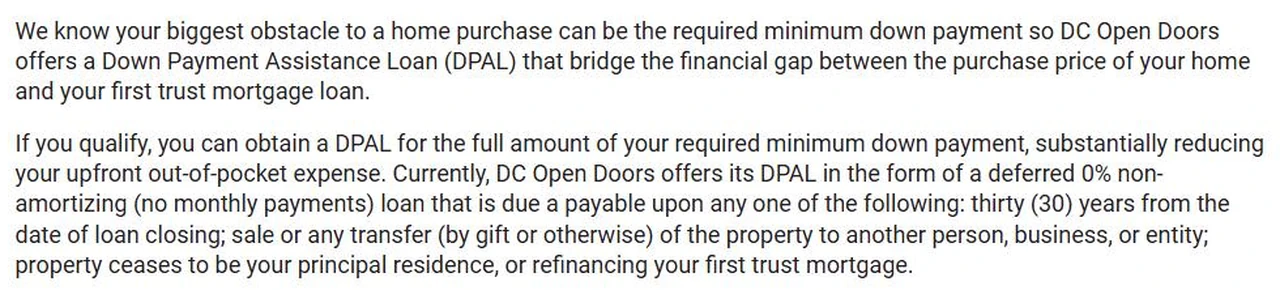
How the agency describes the down payment loan. Source: DC Housing Finance Agency, dchfa.org, captured October 6, 2026.
Is DC Open Doors down payment assistance forgiven?
No. The DPAL is a loan you repay in full. It was a five-year forgivable loan for loans reserved before September 9, 2019, and some older articles still describe it that way.
Today it charges 0 percent interest and has no monthly payment. The whole balance comes due at the first of these events:
| The DPAL is due when | Detail |
|---|---|
| You sell or transfer the home | Including a transfer by gift |
| You refinance the first mortgage | The DPAL cannot be moved behind a new loan |
| You move out | The home must stay your principal residence |
| 30 years pass | The maturity date of the note |
Source: DC Open Doors Lender Manual; DCHFA loan disclosure for down payment assistance; DCHFA sample subordinate note; DCHFA Program Notification 2019-05.
You can prepay it at any time without a penalty. Plan for it when you estimate what you will keep at sale.
Who qualifies for DC Open Doors in 2026?
You qualify on income, credit score and debt. You do not need to be a first-time buyer or a current DC resident.
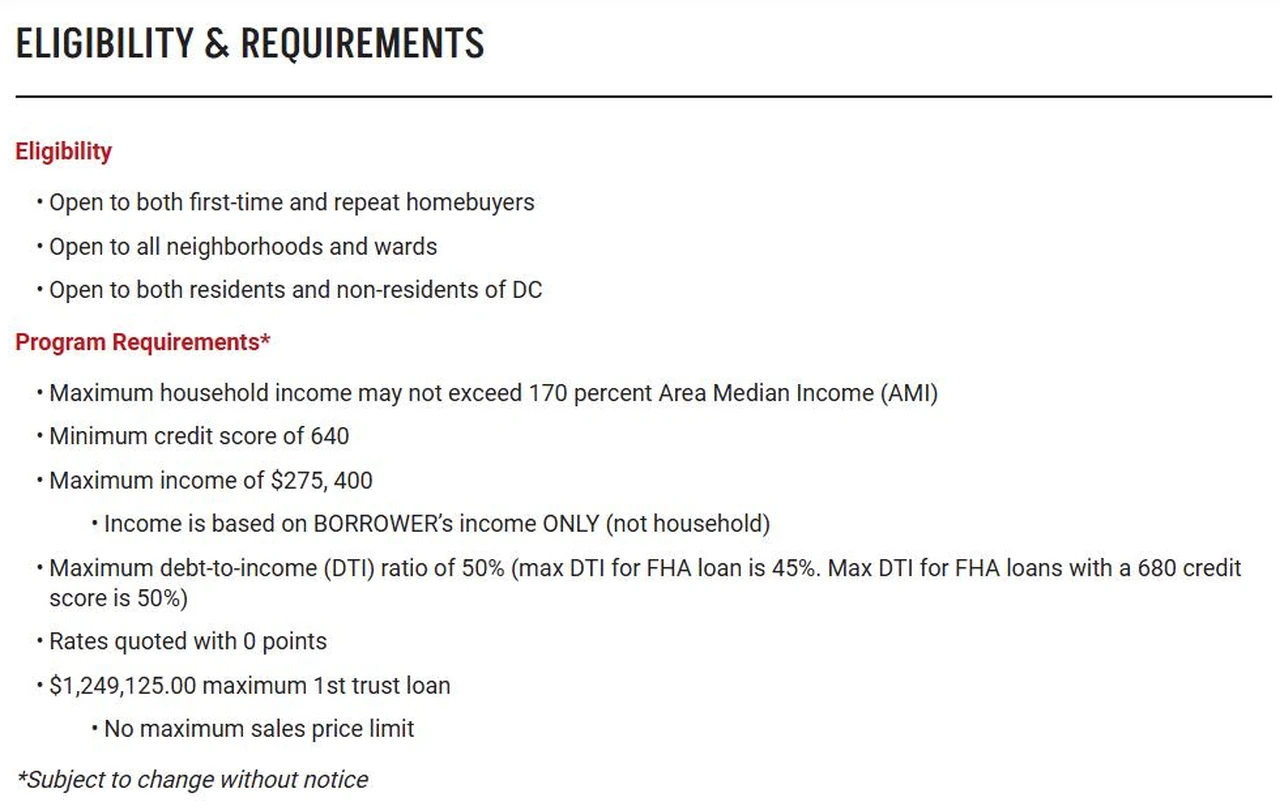
The agency’s published eligibility list. Source: DC Housing Finance Agency, dchfa.org, captured October 6, 2026.
| Requirement | Rule |
|---|---|
| Income | $275,400 or less. It counts the borrowers on the loan, not the whole household |
| Credit score | 640 minimum. The lowest middle score among borrowers is used |
| Debt-to-income | Up to 50% on conventional. FHA is 45%, or 50% with a 680 score |
| Loan size | First mortgage up to $1,249,125, per the agency’s page. Larger loans have tighter rules, so ask a participating lender. No sales price limit |
| Underwriting | Automated approval is required. Manual underwriting is not allowed |
| Occupancy | You must move in within 60 days and live there |
| Homebuyer education | Required when every borrower on a conventional loan is a first-time buyer |
Source: DCHFA, DC Open Doors; DC Open Doors Lender Manual (November 2025). The agency says terms can change without notice.
Not sure where your score stands? Start with our guide to the credit score needed to buy a house.
The debt limit is explained in our guide to the debt-to-income ratio.
What types of homes qualify?
Houses, townhomes, condos and buildings with two to four units qualify. Co-ops and manufactured homes do not.
| Property | Eligible? |
|---|---|
| Single-family house, detached or semi-detached | Yes |
| Townhome | Yes |
| Condominium | Yes, if it meets the loan’s condo rules |
| Two-to-four unit building | Yes, if it meets the loan’s rules |
| Cooperative unit | No |
| Manufactured home | No |
Source: DC Open Doors Lender Manual (November 2025).
What are DC Open Doors interest rates?
On October 5, 2026, the posted rates were 7.750 to 7.875 percent with zero points, for loans without down payment help. The agency updates them often.
| Loan | Posted rate, October 5, 2026 |
|---|---|
| Conventional, no down payment help, income at or below 80% of area median | 7.750% |
| Conventional, no down payment help, income above 80% of area median | 7.875% |
| Conventional with 3% down payment help | Not available (N/A) |
| FHA, no down payment help | 7.750% |
| FHA with 3.5% down payment help | Not available (N/A) |
Source: DCHFA lender rate page, “Last Updated: 10/5/2026.” Rates change and are not an offer from any lender.
For context, Freddie Mac’s weekly survey average for a 30-year fixed loan was 7.28 percent on October 1, 2026. That survey assumes 20 percent down and strong credit, so it is not a like-for-like comparison.
Is the down payment help available right now?
Ask before you plan around it. On October 5, 2026, every DC Open Doors option with down payment help showed “N/A” in place of a rate.
A participating lender can tell you whether a rate is being offered on the day you apply.
What fees and mortgage insurance apply?
The fixed program fees are $85 and $250. Your lender can also charge an origination fee of up to 1 percent. Mortgage insurance depends on your loan type and income.
| Cost | Amount |
|---|---|
| Tax service fee | $85 |
| Funding fee | $250 |
| Lender origination fee | Capped at 1% of the loan |
| Fees on the down payment loan | Only the cost to record the lien |
| Conventional mortgage insurance | Reduced coverage if your income is at or below 80% of area median |
| FHA mortgage insurance | Upfront premium of 1.75% of the loan, plus a monthly premium |
Source: DCHFA Fees by Program (effective May 26, 2026); Fannie Mae HFA Preferred fact sheet (March 2026); HUD Mortgagee Letter 2023-05.
How monthly mortgage insurance is priced is covered in our guide to PMI.
How do you apply for DC Open Doors?
You apply through a participating lender. The agency says your first step is to connect with an approved lender from its list.
| Step | What happens |
|---|---|
| 1. Check the lender list | Only lenders on DCHFA’s list can make these loans. Check it before you apply with any lender, including us |
| 2. Get pre-approved | The lender checks income, credit and debt against the program rules |
| 3. Take homebuyer education if required | Needed when all borrowers on a conventional loan are first-time buyers |
| 4. Find a home in DC | Any ward or neighborhood |
| 5. Lender reserves the loan | The base rate lock is 60 days |
| 6. Close | You sign the first mortgage and, if used, the down payment loan |
Source: DCHFA, Find a Lender; DC Open Doors Lender Manual.
The agency says the program should not add time to your purchase.
More on buying in the District is on our Washington, DC home loans page.
DC Open Doors vs HPAP vs HomeAdvantage DC: which fits?
DC Open Doors has the widest eligibility. HPAP offers far more money but only to first-time buyers within lower income limits. HomeAdvantage DC launched in May 2026 for first-time buyers. Its posted rate was lower on October 5, 2026.
| DC Open Doors | HPAP | HomeAdvantage DC | |
|---|---|---|---|
| Run by | DCHFA | DC Department of Housing and Community Development | DCHFA |
| Help offered | 3% or 3.5% of the price as a 0% loan | Up to $202,000 in gap financing plus $4,000 for closing costs | Up to 3% or 3.5% as down payment help |
| First-time buyer only? | No | Yes | Yes, with some exceptions |
| Income limit | $275,400, borrower income | Up to 110% of area median, by household size | Household income limits apply |
| Minimum credit score | 640 | Good credit required | 660, per the program page |
| Posted rate, no down payment help, October 5, 2026 | 7.750% to 7.875% | None. HPAP is not a first mortgage | 6.750% |
| Price limit | None | Not covered here | $1,306,974, higher in targeted areas |
Source: DHCD, Home Purchase Assistance Program; DCHFA program and rate pages. HPAP depends on funding, and DHCD had not posted details for the fiscal year that began October 1, 2026 when we checked.
More first-time buyer options across the region are in our first-time homebuyer guide.
Can you combine DC Open Doors with other DC help?
Possibly. The lender manual provides for it: when an HPAP loan is in second position, the DPAL takes third. Confirm with your lender and your HPAP counselor.
DC’s tax breaks are separate from the loan. First-time DC buyers may pay a 0.725 percent recordation tax on homes up to $794,000, within income limits. Lower-income buyers may qualify for the Tax Abatement Program. Ask your settlement company which you qualify for.
Source: DC Open Doors Lender Manual; DC Office of Tax and Revenue, Forms ROD 11 and ROD 9 (Rev. 10/2026).
Is DC Open Doors worth it?
It is worth pricing if cash for the down payment is your main obstacle. It is less attractive if you expect to refinance soon, because the down payment loan comes due.
| Advantages | Trade-offs |
|---|---|
| Covers the minimum down payment on a one-unit home | It is debt you repay, not a grant |
| 0% interest and no monthly payment on the DPAL | Due in full if you refinance or move out |
| Open to repeat buyers and to people moving into DC | Posted rates were 7.750% to 7.875% on October 5, 2026 |
| Borrower income limit of $275,400 | Down payment help showed no rate on October 5, 2026 |
| Fixed program fees total $335, before the lender’s origination fee | Only participating lenders can offer it |
Based on the DCHFA sources above. Not a recommendation for any individual buyer.
A standard low down payment loan is another option. Which costs less depends on your rate, credit score and mortgage insurance. See our conventional loans page.
FHA rules and costs are on our FHA loans page.
For other ways to fund a down payment, see our down payment guide.

Get a Mortgage Estimate for Free
Compare low down payment options for a DC home, with real numbers for your budget.
✓Free, no obligation✓Licensed in VA, MD, DC and WV✓Loan officer Ken Byrne, NMLS #187129
Frequently asked questions
Do I have to be a first-time buyer for DC Open Doors?
No. The agency says the program is open to first-time and repeat homebuyers.
What is the income limit for DC Open Doors?
$275,400, per the agency’s page as of October 2026. It is based on the income of the borrowers on the loan, not the whole household.
What credit score do I need for DC Open Doors?
A minimum of 640. The lender uses the lowest middle score among the borrowers.
Do I have to pay back DC Open Doors assistance?
Yes. The down payment loan is due in full when you sell, refinance, move out or reach 30 years. It carries no interest and no monthly payment.
Can I use DC Open Doors on a condo?
Yes, if the condo meets the loan’s rules. Co-ops and manufactured homes are not eligible.
Do I have to live in DC already?
No. Residents and non-residents can apply, but the home must be in DC and you must live in it.
Can I use DC Open Doors with HPAP?
Possibly. The lender manual says the DC Open Doors loan takes third position behind an HPAP loan. HPAP has its own first-time buyer and income rules, so confirm with your lender.
How do I find a DC Open Doors lender?
Use the Find a Lender list on the DC Housing Finance Agency website. Only lenders on that list can make these loans.
Is there a maximum home price?
No. There is no sales price limit. The agency lists a $1,249,125 maximum first mortgage, and larger loans have tighter rules.
This article is general information, not financial or legal advice and not a commitment to lend or an offer of credit. Loan limits, program rules, premium schedules and rates change, and individual eligibility depends on a full review of your credit, income, assets and the property. Every figure here is an illustration, not a quote, built from published sources and a weekly survey average rather than underwriting decisions. Insurance and mortgage insurance amounts are planning estimates. Confirm anything you plan to act on with a licensed mortgage professional. Program terms and posted rates were checked against DC Housing Finance Agency sources on October 6, 2026 and can change without notice. Confirm current terms with a participating lender.
Categories
Recent Posts






GET MORE INFORMATION

Broker Associate