
Down Payment Requirements in Virginia: What Buyers Actually Need (2026)
Down Payment Requirements in Virginia: What Buyers Actually Need (2026)
By Ken Byrne, NMLS #187129 · ALCOVA Mortgage LLC, NMLS #40508 · Updated May 2026
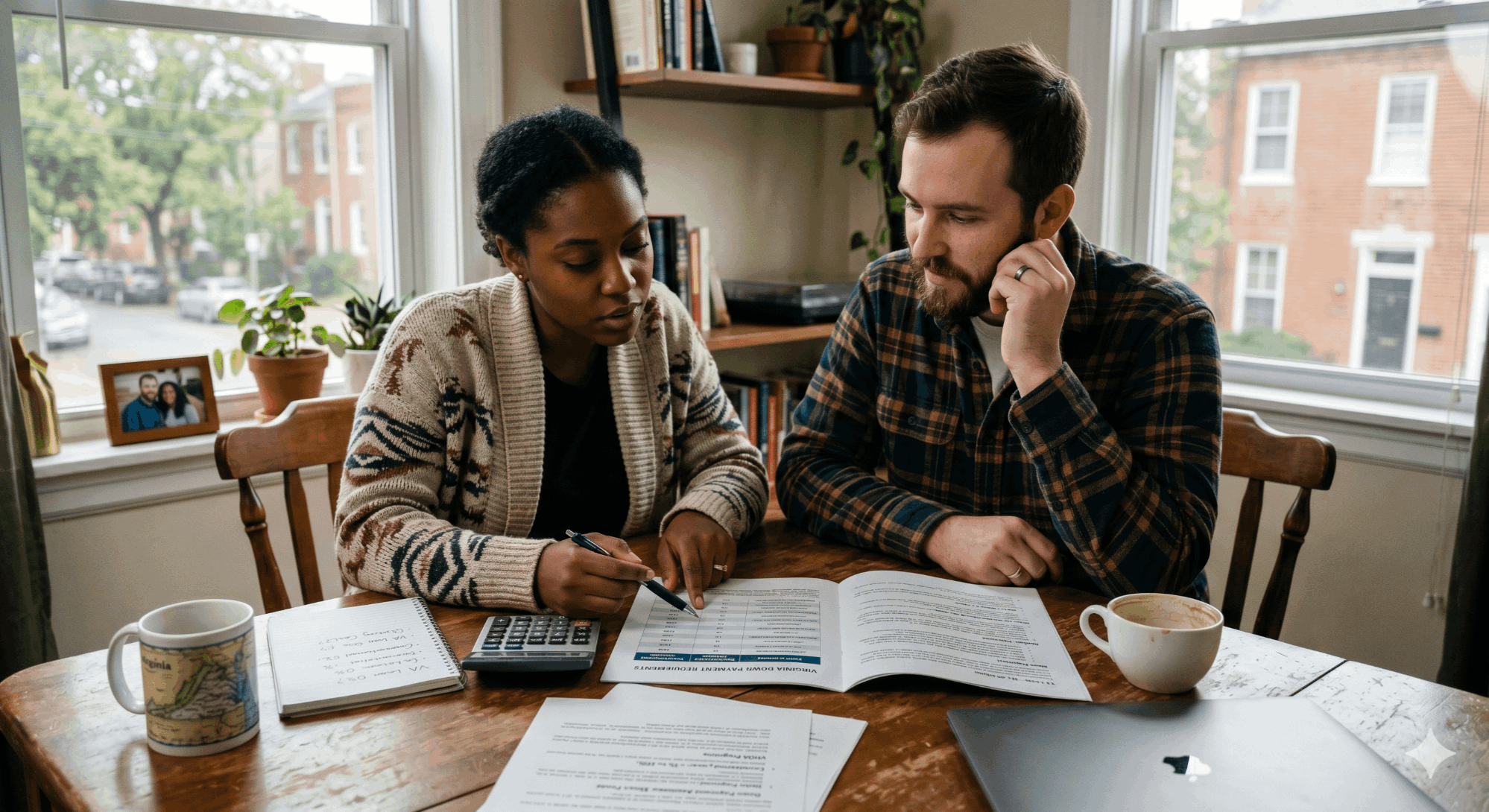
Quick Answer: You don't need 20% down to buy a house in Virginia. Minimums range from 0% for VA and USDA loans, 3% for conventional loans, and 3.5% for FHA loans. On a $600,000 Northern Virginia home, that means as little as $0–$21,000 out of pocket — and Virginia Housing's DPA Grant can reduce that further for qualifying buyers.
Key Takeaways
- The 20% myth is dead: The median first-time buyer in the U.S. puts down 9% — not 20%.
- VA and USDA loans require $0 down if you qualify — a major advantage in Virginia given the military and rural eligibility footprint.
- Conventional loans now allow 3% down for first-time and qualifying buyers through Fannie Mae HomeReady and Freddie Mac Home Possible.
- FHA requires 3.5% down with a 580+ credit score, or 10% with scores 500–579.
- Virginia Housing's DPA Grant provides 2–2.5% of the sales price toward down payment for eligible buyers — and you don't have to pay it back.
- DC metro conforming loan limit for 2026: $1,249,125 — meaning even high-priced NOVA homes can stay within conventional territory.
Table of Contents
- The 20% Down Payment Myth — Where It Came From
- Down Payment by Loan Type: The Real Minimums
- Real Dollar Examples by Virginia County
- PMI, MIP, and Why Your Down Payment Affects Them
- Virginia Housing Down Payment Assistance
- Where Your Down Payment Funds Can Come From
- How Long It Takes to Save in Northern Virginia
- Higher vs. Lower Down Payment: Which Is Smarter?
- Common Down Payment Mistakes to Avoid
- The Bottom Line: Your Virginia Down Payment Plan
- Frequently Asked Questions
- Glossary
If you've delayed buying a home in Virginia because you don't have $120,000 sitting in a savings account, here's the truth: you may not need anywhere close to that. The "20% down" rule that defined home buying for previous generations is no longer the standard — and in many cases, it's not even the smartest financial move.
In 2026, qualified Virginia buyers are closing on homes with as little as 0% down through VA and USDA programs, 3% down through conventional financing, and 3.5% down through FHA. Combine those minimums with state assistance programs like the Virginia Housing DPA Grant, and the actual cash you need to bring to closing can be dramatically smaller than most people assume.
This guide walks through every down payment scenario available to Virginia buyers — what the real minimums are, how much that translates to in dollars at typical NOVA price points, where assistance programs fit in, and how to decide how much to actually put down for your situation.
The 20% Down Payment Myth — Where It Came From
The "20% down" benchmark dates back to a different era of lending — one where private mortgage insurance (PMI) wasn't widely available and lenders required a substantial equity buffer to approve a loan. That world doesn't exist anymore.
According to recent data from the National Association of Realtors, the median first-time homebuyer in the United States puts down about 9% — not 20%. Among all buyers (including repeat purchasers using equity from prior homes), the median is closer to 18%. Translation: if you're a first-time buyer waiting until you have 20% saved, you're holding yourself to a standard that virtually nobody else is meeting.
The 20% number persists because it's the threshold at which PMI is no longer required on conventional loans. That's a real cost worth discussing — and we'll cover it below — but it's not a loan requirement. It's a pricing tier.
Down Payment by Loan Type: The Real Minimums
Every loan program has its own minimum down payment, eligibility requirements, and cost tradeoffs. Here's how the major options compare for Virginia buyers in 2026:
| Loan Type | Min. Down | Min. Credit | Loan Limit (DC Metro) | Best For |
|---|---|---|---|---|
| VA Loan | 0% | 580 typical | No limit* | Active duty, veterans, eligible spouses |
| USDA Rural Development | 0% | 640 typical | Varies by area | Buyers in USDA-eligible areas |
| FHA Loan | 3.5% | 580 (3.5%) 500 (10%) |
$1,249,125 | Lower credit, smaller savings |
| Conventional 97 | 3% | 620 typical | $1,249,125 | First-time buyers with good credit |
| Conventional Standard | 5% | 620 typical | $1,249,125 | Repeat buyers, investment properties |
| Jumbo Loan | 10–20% | 700+ typical | Above $1,249,125 | High-priced homes (Arlington, McLean) |
*VA loans have no maximum loan amount for eligible borrowers with full entitlement. Credit minimums are typical industry standards — individual lender overlays may apply.
VA Loans: The Best Deal in Virginia
If you're a veteran, active-duty service member, National Guard or Reserve member with qualifying service, or an eligible surviving spouse, the VA loan is almost always the most cost-effective option. Beyond the 0% down feature, VA loans require no PMI, allow seller-paid closing costs of up to 4% of the loan amount, and historically carry competitive interest rates.
Virginia's military footprint — Fort Belvoir, Quantico, the Pentagon, Joint Base Myer–Henderson Hall — makes VA loans particularly common in Northern Virginia. If you qualify, ask your lender to run the numbers on a VA loan even if you have enough for a conventional down payment. The lifetime savings often favor the VA option.
USDA Loans: Yes, Even Parts of Virginia Qualify
USDA Rural Development loans also require 0% down, with no PMI (though there's a guarantee fee). The catch is geographic: the property has to sit in a USDA-eligible area. While that excludes most of Northern Virginia's denser counties, large parts of outer Loudoun, Stafford, Spotsylvania, Culpeper, and Fauquier counties — plus much of central and southern Virginia — remain eligible. There are also income limits that vary by household size and county.
FHA: The Workhorse for Modest Credit
FHA loans accept credit scores down to 580 with 3.5% down (or 500 with 10% down) and have more lenient debt-to-income ratios than conventional loans. The 2026 FHA loan limit in the DC metro area is $1,249,125 for a single-family home, which covers the vast majority of NOVA inventory.
The catch with FHA: mortgage insurance is more expensive and lasts longer. If you put down less than 10%, MIP stays on the loan for its full life — you'd have to refinance to get rid of it.
Conventional 97 and Conventional 5%: The First-Time Buyer's Friend
If your credit is reasonably strong (typically 620+), Fannie Mae's HomeReady and Freddie Mac's Home Possible programs let qualifying first-time buyers put down just 3%. Repeat buyers can use a standard 5% down conventional loan. The 2026 conforming loan limit in the DC metro is $1,249,125 — generous enough to cover most NOVA single-family homes without crossing into jumbo territory.
Free · No Commitment
See What You Qualify For Today
Get pre-approved in minutes and find out which loan type — and which down payment level — actually works for your situation. No cost, no obligation.
Ken Byrne NMLS #187129 · ALCOVA Mortgage LLC NMLS #40508
Real Dollar Examples by Virginia County
Percentages are abstract. Let's translate down payment minimums into the dollars you'd actually need to write a check for at closing, using approximate 2026 median home prices across Virginia's most active counties.
Median prices below are approximate and used for illustration. Actual prices vary by neighborhood, condition, and timing. Confirm current pricing with your real estate agent.
| County / City | Approx. Median Price | 3% Down | 3.5% Down (FHA) | 5% Down | 20% Down |
|---|---|---|---|---|---|
| Loudoun County | $780,000 | $23,400 | $27,300 | $39,000 | $156,000 |
| Fairfax County | $760,000 | $22,800 | $26,600 | $38,000 | $152,000 |
| Arlington County | $830,000 | $24,900 | $29,050 | $41,500 | $166,000 |
| Prince William County | $620,000 | $18,600 | $21,700 | $31,000 | $124,000 |
| Stafford County | $540,000 | $16,200 | $18,900 | $27,000 | $108,000 |
| Alexandria (City) | $720,000 | $21,600 | $25,200 | $36,000 | $144,000 |
Look at the gap between the 3% and 20% columns. On a $620,000 home in Prince William, the difference is roughly $105,000 — money that, for most buyers, would take years to accumulate. Choosing a lower down payment isn't about cutting corners. It's about getting into a home before prices and rates move further against you.
How Much Cash Will You Actually Need?
Down payment is only one component. Your total cash to close also includes closing costs (typically 2–4% of the purchase price in Virginia), prepaid items like property taxes and homeowner's insurance, and any earnest money you didn't already deposit. On a $600,000 home with 5% down, your true cash to close is more likely $42,000–$54,000 than $30,000.
Quick Tip: When budgeting, plan for total cash to close — not just the down payment line. A good rule of thumb for Virginia: budget your down payment plus another 3% of purchase price for closing costs and prepaids.
PMI, MIP, and Why Your Down Payment Affects Them
Mortgage insurance is what allows lenders to offer low down payment loans. It protects the lender — not you — in the event of default. But it's a real monthly cost, and how much you put down has a direct impact on whether you pay it and for how long.
Conventional PMI
On conventional loans, private mortgage insurance (PMI) is required when your down payment is less than 20%. The cost varies based on credit score and down payment but typically runs 0.3%–1.5% of the loan amount annually, billed monthly. The good news: PMI on a conventional loan automatically drops off when your loan balance reaches 78% of the original purchase price, and you can request removal at 80%.
FHA MIP
FHA loans charge two forms of mortgage insurance: an upfront premium (1.75% of the loan amount, financed into the loan) and an annual MIP paid monthly. Here's the key catch: if you put down less than 10% on an FHA loan, MIP stays for the life of the loan. To remove it, you'd refinance into a conventional loan once you have enough equity — typically when you reach 20% equity.
VA Funding Fee
VA loans don't carry PMI, but they do include a one-time VA funding fee (typically 2.15% for first-time use with 0% down, less if you put down 5% or more). This fee can be financed into the loan. Veterans with service-connected disabilities are exempt from the funding fee entirely — a meaningful savings.
Virginia Housing Down Payment Assistance
Virginia Housing (formerly VHDA) administers several programs designed to help first-time buyers reduce or eliminate their out-of-pocket down payment. The flagship program is the Down Payment Assistance (DPA) Grant, and it works differently than people often assume.
Virginia Housing DPA Grant
The DPA Grant provides 2–2.5% of the home's sales price (the specific percentage depends on the loan program you pair it with) and — critically — it's a true grant. You do not have to pay it back. It's not a second lien on your home. Income limits apply and vary by household size and the locality of the property.
Other Virginia Housing Programs
Beyond the DPA Grant, Virginia Housing offers conventional, FHA, and VA loan options often paired with the grant, plus a Closing Cost Assistance (CCA) Grant for VA and USDA loans that helps with closing costs rather than down payment. The Plus Second Mortgage program can also provide additional down payment and closing cost assistance through a small second lien.
Note: The Virginia Housing Mortgage Credit Certificate (MCC) program has been suspended since May 2023 and is not currently available. If you see older articles or guides listing it as an active option, that information is out of date.
Who Qualifies
To use the Virginia Housing DPA Grant, you generally need to be a first-time buyer (or someone who hasn't owned a home in the last three years), meet credit score minimums (usually 620+), complete an approved homebuyer education course, and stay within program income and sales price limits. The limits vary by county — Fairfax and Loudoun, for example, allow higher incomes than rural counties because of the higher cost of living.
Run the Numbers
What Will Your Monthly Payment Be?
Use our mortgage calculator to model different down payment scenarios on the same home and see exactly how monthly payment changes.
Where Your Down Payment Funds Can Come From
Lenders are particular about the source of your down payment because they need to ensure the money is yours and not a hidden loan you'd have to repay. The good news: there are more acceptable sources than most buyers realize.
Acceptable Down Payment Sources
Checking, savings, money market, and CD accounts. Lenders typically want to see 60 days of statements to source the funds.
Parents, grandparents, siblings, and other qualifying family can gift you down payment money. Conventional, FHA, and VA all accept gifts, but each program has its own paperwork. A signed gift letter is always required.
You can borrow from a 401(k) or withdraw from an IRA. First-time buyers can pull up to $10,000 from an IRA without the 10% early withdrawal penalty. Talk to a tax professional first — there are still tax consequences.
The Virginia Housing DPA Grant and similar programs can supply some or all of your down payment.
If you're selling a current home to buy your next, the equity from the sale can fund your down payment. Lenders will want to see the closing disclosure from your sale.
Some Virginia employers — particularly hospitals, universities, and federal agencies — offer down payment assistance to recruit or retain employees. Check with your HR department.
What Lenders Don't Accept
Cash from undocumented sources, personal loans, credit card cash advances, and large unexplained deposits will all create problems. If a friend hands you $20,000 in cash, that money cannot be used for a down payment until it has been deposited, seasoned in your account for at least 60 days, and properly sourced. Plan ahead.
How Long It Takes to Save in Northern Virginia
A common question we hear: "How long will it actually take to save up a down payment in Northern Virginia?" The honest answer is that it depends entirely on which down payment target you're aiming at — and that's why the difference between 3% and 20% matters so much.
Below is a rough breakdown of how long it would take to save for a down payment on a $700,000 NOVA home, assuming you can dedicate $1,500 per month to a savings goal.
The gap between roughly 14 months and 7.8 years has nothing to do with willpower. It's the difference between buying in 2027 versus 2033 — and over that window, NOVA home prices and rents almost certainly continue moving. Each year of delayed homeownership is also a year of lost equity-building and lost mortgage interest deduction.
Higher vs. Lower Down Payment: Which Is Smarter?
There's no universally correct down payment amount. The right number depends on your cash position, your other financial goals, and how soon you want to be in the home. Here's an honest look at both sides.
| Strategy | Pros | Cons |
|---|---|---|
| Lower Down (3–5%) |
Buy sooner. Keep cash reserves for emergencies, renovations, or investing. Faster equity build via appreciation than via savings. | Higher monthly payment. PMI/MIP required. Less equity buffer if values fall. |
| Moderate (10–15%) |
Lower PMI cost. Reasonable monthly payment. Faster path to dropping PMI on conventional loans. | Longer save time. Still some mortgage insurance cost. |
| 20%+ Down | No PMI. Lowest monthly payment. Best loan pricing. Immediate equity position. | Long wait. Opportunity cost of large cash position. Less liquidity. |
A Practical Framework
A useful way to think about it: don't put down more than the amount that still leaves you with 3–6 months of mortgage payments in reserve after closing. If hitting 20% would drain your emergency fund, it's likely the wrong choice. If you can put down 10%, keep a healthy reserve, and still hit your other goals, that's often a sweet spot.
For most first-time buyers in Northern Virginia, the answer is to buy when they qualify — with the lowest practical down payment that gets them in the door — and then build equity over time through appreciation and principal pay-down, while keeping cash reserves intact.
Common Down Payment Mistakes to Avoid
- Waiting until you have 20%. If you qualify with 3–5%, the math almost always favors buying sooner.
- Draining your emergency fund. A larger down payment is only valuable if you still have reserves.
- Accepting cash without sourcing it. Undocumented deposits within 60 days of closing will create underwriting problems.
- Skipping DPA programs. Many buyers assume they won't qualify and never check — but income limits in NOVA are higher than people expect.
- Forgetting about closing costs. Down payment plus closing costs and prepaids is the real number — budget accordingly.
- Pulling from retirement without a plan. The numbers can work, but it requires tax-aware planning.
- Not getting pre-approved first. Pre-approval tells you which loan types — and which down payment minimums — are actually available to you.
Ready to Start Your Search?
Browse Homes for Sale in Northern Virginia
Once you know your down payment number, explore available homes across Loudoun, Fairfax, Prince William, Arlington, and Alexandria.
Also Selling a Home?
List for Just 1.5% Commission
If your move involves selling first, explore a full-service listing option at 1.5% — and keep more of your equity to put toward your next down payment.
The Bottom Line: Your Virginia Down Payment Plan
If you've read this far, you should already see the headline more clearly: the down payment number that keeps you out of the housing market is almost certainly not the actual minimum. For most Virginia buyers, the practical floor is 0% to 5% — not 20% — and the difference between those two worlds is the difference between waiting most of a decade and being a homeowner inside the next 12 to 18 months.
Your next move is straightforward. Talk to a licensed mortgage professional who knows the Virginia market, get pre-approved so you see exactly which loan types you qualify for, and then build your down payment plan around your actual numbers — not a rule from your parents' generation. Pre-approval is free, takes minutes, and gives you the only real answer to "how much do I need?"
Free · No Commitment
Find Out Your Real Down Payment Number
Get pre-approved with Ken Byrne and find out exactly which loan programs and down payment levels work for your situation — including DPA grant eligibility.
Ken Byrne NMLS #187129 · ALCOVA Mortgage LLC NMLS #40508
Frequently Asked Questions
What is the minimum down payment to buy a house in Virginia?
The absolute minimum is 0% if you qualify for a VA loan (military service required) or USDA loan (eligible rural areas). Otherwise, the minimum is 3% for a conventional loan or 3.5% for an FHA loan. On a $600,000 home, that's $0–$21,000.
Can I buy a house in Virginia with no down payment?
Yes. VA loans (for eligible veterans, active-duty, and qualifying spouses) require 0% down. USDA Rural Development loans also require 0% down if the property is in a USDA-eligible area and you meet income limits. The Virginia Housing DPA Grant can also be paired with other loan types to effectively eliminate your down payment.
What credit score do I need for a low down payment in Virginia?
For FHA at 3.5% down, you typically need a 580 credit score. For conventional 3% down (HomeReady/Home Possible), 620 is the common minimum. VA loans typically work with 580+, and USDA usually requires 640+. Individual lenders may apply additional overlays.
How much is the down payment for an FHA loan in Virginia?
3.5% with a credit score of 580 or higher, or 10% with a score between 500 and 579. On a $500,000 home, that's $17,500 at 3.5% down. The 2026 FHA loan limit for the DC metro is $1,249,125 for a single-family home.
What is the conforming loan limit in Northern Virginia for 2026?
The 2026 conforming loan limit for the DC metro (which includes all of Northern Virginia) is $1,249,125 for a one-unit home. Loans above this amount are jumbo loans and typically require 10–20% down with stronger credit.
How does the Virginia Housing DPA Grant work?
Virginia Housing provides 2–2.5% of the sales price as a true grant — you do not have to pay it back. It's paired with a Virginia Housing first mortgage (conventional, FHA, or VA). You must meet income limits, sales price limits, complete a homebuyer education course, and typically need a 620+ credit score.
Can I use gift money for my down payment?
Yes. Conventional, FHA, and VA loans all allow gift funds from qualifying family members. You'll need a signed gift letter stating the funds are a gift (not a loan) and a paper trail showing the transfer. FHA also allows gifts from approved nonprofit and government sources.
Do I have to pay PMI in Virginia if I put less than 20% down?
On conventional loans, yes — PMI is required below 20% down and automatically drops off when your loan balance reaches 78% of the original purchase price. FHA loans charge MIP, which lasts the life of the loan if you put down less than 10%. VA loans don't have PMI at all (just a one-time funding fee). USDA charges a guarantee fee instead of PMI.
How long does it take to save for a down payment in Northern Virginia?
It depends on your target. Saving $1,500/month gets you to a 3% down payment on a $700,000 home in about 14 months. The same savings rate takes nearly 8 years to reach 20%. Most buyers shorten the timeline significantly by choosing a lower down payment loan or pairing with the Virginia Housing DPA Grant.
What are the closing costs in Virginia in addition to the down payment?
Virginia closing costs typically run 2–4% of the purchase price and include lender fees, title insurance, attorney/settlement fees, Virginia recordation tax, grantor tax (paid by seller), and prepaid items like property taxes and homeowner's insurance. On a $600,000 home, plan for $12,000–$24,000 in closing costs on top of your down payment.
Is it a good time to buy a house in Northern Virginia in 2026?
Market conditions vary by county and price point. NOVA inventory has improved from pandemic-era lows but remains tight in the most desirable areas. The right time to buy is when your finances are ready — meaning stable income, manageable debt, and adequate reserves — not when rates or prices hit a specific target. Pre-approval is the best way to find out where you stand.
How do I find a good mortgage lender in Virginia?
Look for a local lender with a strong reputation, transparent pricing, multiple loan program options, and experience with Virginia Housing DPA programs and DMV-specific requirements. Ken Byrne (NMLS #187129) at ALCOVA Mortgage (NMLS #40508) is licensed across Virginia, Maryland, DC, and West Virginia and works with all major loan programs including VA, FHA, conventional, jumbo, and Virginia Housing DPA-eligible loans.
Glossary
Down Payment: The portion of a home's purchase price you pay upfront in cash. The rest is financed through your mortgage.
Loan-to-Value (LTV): The ratio of your loan amount to the home's value, expressed as a percentage. A 5% down payment creates a 95% LTV loan.
PMI (Private Mortgage Insurance): Insurance required on conventional loans when down payment is under 20%. Cancels automatically at 78% LTV.
MIP (Mortgage Insurance Premium): The FHA equivalent of PMI. Includes upfront and annual portions; lasts life of loan if down payment is under 10%.
Conforming Loan Limit: The maximum loan size eligible for purchase by Fannie Mae and Freddie Mac. In the DC metro for 2026: $1,249,125 for a one-unit home.
Gift Letter: A signed document from a family member stating that down payment funds they provided are a gift, not a loan, and don't have to be repaid.
DPA (Down Payment Assistance): Grants, loans, or other funds provided by state or local agencies to help cover a buyer's down payment.
Seasoning: The period of time funds must sit in your account (typically 60 days) before a lender accepts them as your own assets.
Disclaimer: This article is for informational purposes only and does not constitute financial or legal advice. Mortgage programs, rates, loan limits, and eligibility requirements are subject to change. All dollar examples are illustrative. Contact a licensed mortgage professional for guidance specific to your situation. Ken Byrne, NMLS #187129 · ALCOVA Mortgage LLC, NMLS #40508 · Licensed in VA, MD, DC, WV.
Categories
Recent Posts




GET MORE INFORMATION

Broker Associate