
FHA vs. Conventional Loan: Which Is Better for You in 2026?

Short answer: In an FHA vs conventional loan comparison the deciding difference is not the down payment. It is the mortgage insurance. On most FHA loans written today the annual mortgage insurance premium runs for the entire life of the loan and only ends when you refinance or sell. Conventional private mortgage insurance is required by federal law to cancel once you reach 78% of the original value, and you can request cancellation at 80%. FHA wins when your credit or your file needs it. Conventional wins when it will take you. In the Washington metro area there is a third factor most guides miss entirely: the 2026 FHA and conforming loan limits are identical at $1,249,125, and a first time buyer under the income threshold pays no conventional loan level price adjustments at all. JB Financing prices both side by side before you write the offer.
The question in the title is the wrong question, and almost every article answering it makes the same mistake. FHA and conventional are not two products competing for the same buyer. They are two different answers to two different problems. One is designed to get a borrower into a house when the credit file or the down payment will not support anything else. The other is designed to be cheap over time for a borrower who already qualifies. Asking which is better in the abstract is like asking whether a wheelchair ramp is better than a staircase.
The useful question is narrower and it has two halves. First: which program will actually approve your file? Second: given the length of time you realistically expect to hold this loan, which one costs less? Those two questions have different answers for different people, and the answer flips depending on your credit score, your down payment, your county and whether you are a first time buyer. This guide walks both halves with the 2026 numbers, and it is explicit about the places where no published government figure exists and we will not invent one.
We write files on both programs every week across Virginia, Maryland, DC and West Virginia. The pattern we see most often is a buyer who was told FHA was their only option two years ago, never revisited it, and is now paying mortgage insurance they could have cancelled. Working with mortgage lenders in Virginia, Maryland, DC and West Virginia who run both sets of numbers side by side is the whole point of the exercise.
FHA vs conventional loan: the one difference that drives everything else
Strip away the noise and there is a single structural difference between these two programs. Both require mortgage insurance when you put down less than 20%. Only one of them lets you get rid of it.
| FHA mortgage insurance | Conventional private mortgage insurance | |
|---|---|---|
| Upfront charge | 1.75% of the base loan amount, usually financed into the loan | None on most programs |
| Annual charge | Charged monthly, rate set by HUD, same for every borrower | Charged monthly, rate set by the insurer and priced to your credit score and loan to value |
| How it ends on most loans | It does not. It runs for the loan term | Cancels by law at 78% of original value, or on request at 80% |
| The exception | If you put 10% or more down, it drops off after 11 years | Not applicable |
| Who sets the rate | HUD, published in a mortgagee letter | Private insurers, quoted per file |
| Refundable | A partial upfront refund exists on an FHA to FHA refinance within 3 years | No |
Sources: HUD Mortgagee Letter 2023-05 and Mortgagee Letter 2012-4; Homeowners Protection Act, 12 U.S.C. 4902.
How FHA mortgage insurance works in 2026
FHA charges twice. There is an upfront mortgage insurance premium of 1.75% of the base loan amount, which almost every borrower rolls into the loan rather than paying at the table. Then there is an annual mortgage insurance premium, divided by twelve and added to the monthly payment. The annual rate depends on three things: the loan term, the base loan amount and the loan to value ratio.
Here are the current published rates for the 30 year term, which is what the overwhelming majority of buyers take. Note the second block, which applies once the base loan amount crosses $726,200. In this region that threshold is reached routinely, and a lot of online calculators quietly ignore it.
| Base loan amount | Loan to value | Annual MIP | Duration |
|---|---|---|---|
| $726,200 or less | 90% or below | 0.50% | 11 years |
| $726,200 or less | Above 90% up to 95% | 0.50% | Loan term |
| $726,200 or less | Above 95% | 0.55% | Loan term |
| Above $726,200 | 90% or below | 0.70% | 11 years |
| Above $726,200 | Above 90% up to 95% | 0.70% | Loan term |
| Above $726,200 | Above 95% | 0.75% | Loan term |
Source: HUD Mortgagee Letter 2023-05, annual MIP rates for mortgages with terms greater than 15 years. Verify the current schedule before relying on it.
Read the duration column carefully, because that is where the money is. A buyer putting the FHA minimum 3.5% down is at 96.5% loan to value, which lands in the "loan term" row. That premium does not stop when you hit 20% equity. It does not stop when you hit 50% equity. It stops when the loan stops.
How conventional PMI works, and why cancellation is the point
Private mortgage insurance on a conventional loan is governed by the Homeowners Protection Act, and the law gives you three separate exits. At 80% of the original property value, based on the amortization schedule, you can request cancellation in writing. At 78% of the original value the servicer must terminate it automatically without you asking. And at the midpoint of the amortization schedule it terminates regardless of where the loan to value sits, provided you are current.
There is a fourth exit the statute does not cover but most servicers allow: cancellation based on a new appraisal showing current market value rather than original value. In a market that has appreciated, that can move the cancellation date forward by years. It is worth asking your servicer what their policy is, because the answer varies and it is not something they volunteer. Our guide to how PMI works and when it disappears walks the request process in detail.
What we will not tell you: we are not going to publish a PMI rate table. Private mortgage insurance is priced by six private companies against their own rate cards, and those cards change. There is no government published schedule the way there is for FHA. Any article showing you a clean PMI percentage is showing you an estimate dressed up as a fact. Ask for an actual quote on your actual credit score.
Why the life of loan premium is the biggest single cost difference
Consider two borrowers buying the same house at the same time, one on FHA at 96.5% loan to value and one on conventional at 95%. In year one the payments may be close. By year eight the conventional borrower has likely crossed the 80% threshold through a combination of amortization and appreciation, cancelled the insurance and permanently reduced the payment. The FHA borrower is still paying, and will keep paying for another twenty two years unless they act.
This is why the honest FHA answer is almost never "take FHA and stay there." It is "take FHA now, and plan the exit." The exit is a refinance into a conventional loan once the credit file and the equity position both support it. That plan should be written down at the closing table, not discovered five years later.

“If you took an FHA loan in the last few years and your score has moved, send me the note rate and the current balance. It takes about ten minutes to work out whether refinancing out of the mortgage insurance actually pays, and often enough it does not. I will tell you either way.”
Arslan Jamil, Broker Associate
Loans originated by Ken Byrne, NMLS ID# 187129 · ALCOVA Mortgage LLC, NMLS ID# 40508. Equal Housing Lender.
Credit score: what each program actually requires
This is the area where published rules and lived experience diverge the most, so it is worth separating what the program says from what the lender in front of you will do.
What FHA publishes
FHA has two published tiers and they have not changed in years. At a credit score of 580 or above, the minimum down payment is 3.5%. At a score between 500 and 579, the minimum down payment is 10%. Below 500 the borrower is not eligible for FHA financing at all. Those thresholds come straight from the program and are not negotiable by a lender in the borrower's favor.
Source: HUD Mortgagee Letter 10-29 and the FHA Single Family Housing Policy Handbook 4000.1.
What conventional requires in 2026
Conventional underwriting changed meaningfully in late 2025 and a lot of guidance online has not caught up. As of 15 November 2025, Fannie Mae's automated underwriting system no longer applies a minimum representative credit score to loans it approves. The credit score still drives pricing and it still feeds the risk assessment, but there is no longer a hard floor that the system checks against.
That change applies to loans running through automated underwriting. Manually underwritten conventional loans still carry published minimums: 620 for fixed rate and 640 for adjustable rate. Most files run through the automated system, so in practice the manual floors come up less often than they used to.
| Program | Published minimum score | Where it comes from |
|---|---|---|
| FHA, 3.5% down | 580 | HUD, program rule |
| FHA, 10% down | 500 | HUD, program rule |
| Conventional, automated underwriting | No minimum applied as of 15 Nov 2025 | Fannie Mae selling guide update |
| Conventional, manual underwriting, fixed rate | 620 | Fannie Mae selling guide |
| Conventional, manual underwriting, adjustable rate | 640 | Fannie Mae selling guide |
The overlay problem, which is the part that actually decides your file
A lender is free to require more than the program requires. Those extra requirements are called overlays and they are the single most common reason two lenders give the same borrower two different answers on the same day. A lender with a 640 FHA overlay will decline a 600 score borrower that FHA itself would insure without comment.
The practical consequence is that "I was denied for FHA" almost never means what the borrower thinks it means. It usually means one lender declined. The right follow up question is whether the decline came from the program or from the lender's own credit policy, and any loan officer worth working with will tell you plainly which it was. If your score is the constraint, our 90 day plan for improving a score before buying is a more productive use of three months than shopping the same file to twelve lenders.
A gap we are not going to paper over: FHA's maximum qualifying debt to income ratios, the compensating factors that allow a lender to exceed them, and FHA's waiting periods after bankruptcy, foreclosure or short sale all live in Handbook 4000.1. We could not verify the current figures against HUD's own published text at the time of writing, so we are not printing numbers for them. Ask your loan officer to show you the handbook section rather than quoting a blog. On the conventional side, Fannie Mae's published maximum debt to income ratio through automated underwriting is 50%.

Down payment: the difference is smaller than you think
The popular framing is that FHA is the low down payment loan and conventional is the 20% loan. That has not been true for well over a decade. Conventional programs go lower than FHA does.
| Program | Minimum down payment | Notes |
|---|---|---|
| FHA, score 580 or above | 3.5% | Standard FHA minimum |
| FHA, score 500 to 579 | 10% | Limited lender participation in practice |
| Conventional 97 | 3% | Fixed rate, one unit principal residence |
| HomeReady | 3% | Income limits apply, and price adjustments are waived |
| Conventional, standard | 5% | Typical entry point without a special program |
| Conventional, no mortgage insurance | 20% | Removes the insurance question entirely |
So the conventional minimum is actually lower than the FHA minimum by half a percentage point. On a $500,000 purchase that is a $2,500 difference in cash at the table, which is real but is not the deciding factor for most buyers. The deciding factor remains whether the file qualifies. Buyers in this region should also look hard at down payment assistance before assuming they need to bring the minimum themselves, and our roundup of Virginia down payment assistance programs covers the current options.
Gift funds and where the money is allowed to come from
Both programs allow gift funds toward the down payment on a principal residence, and both require the gift to be documented with a letter stating that no repayment is expected, plus a paper trail showing the funds leaving the donor and arriving in your account. The programs differ on who counts as an acceptable donor, and we are not going to reproduce FHA's donor list here because we could not confirm the current handbook text. Ask before you accept a gift from anyone other than a close family member, because an unacceptable donor is discovered at underwriting, which is the worst possible moment.
2026 loan limits, and the local twist most guides miss
Loan limits are where the FHA versus conventional comparison becomes genuinely local, and where the received wisdom that "FHA limits are lower" turns out to be wrong in one of our two major metros and right in the other.
FHA sets a national floor and a national ceiling and then assigns every county a limit somewhere between the two, based on local median home prices. The conforming conventional limit works on a similar structure with a different baseline.
| 2026 one unit limit | FHA | Conforming conventional |
|---|---|---|
| National floor or baseline | $541,287 | $832,750 |
| National ceiling | $1,249,125 | $1,249,125 |
| Washington Arlington Alexandria metro | $1,249,125 | $1,249,125 |
| Baltimore Columbia Towson metro | $747,500 | $832,750 |
Sources: HUD Mortgagee Letter 2025-23, effective 1 January 2026; Federal Housing Finance Agency 2026 conforming loan limit announcement.
In the Washington metro the two limits are identical
Every jurisdiction in the Washington Arlington Alexandria metropolitan area sits at the FHA ceiling for 2026, which is $1,249,125. The conforming conventional ceiling in high cost areas is the same figure. That means for a buyer in Fairfax, Arlington, Loudoun, Prince William, Alexandria, Falls Church, the District, Montgomery County, Prince George's County, Charles County or Frederick County, loan limit is not a differentiator between the two programs at all. Anyone telling you to go conventional in Northern Virginia because the FHA limit is too low has not looked at the 2026 table. The county by county detail sits in our guide to FHA loan limits in Northern Virginia for 2026.
In the Baltimore metro the FHA limit is genuinely lower
Move an hour north and the picture inverts. The Baltimore Columbia Towson metropolitan area carries a 2026 FHA limit of $747,500 for a one unit property, while the conforming conventional baseline is $832,750. That is a gap of $85,250 in borrowing capacity, and it applies to Anne Arundel County, Baltimore City, Baltimore County, Carroll County, Harford County, Howard County and Queen Anne's County. In that market, and only in that market, the old rule of thumb is correct.
Maryland counties outside those two metros are at the floor
Every Maryland jurisdiction that appears in neither HUD list sits at the 2026 national floor of $541,287. That includes Calvert County and St. Mary's County, which is worth flagging because Southern Maryland buyers frequently assume they carry a Washington metro limit. They do not, and the gap between $541,287 and the ceiling is large enough to change what house you can write an offer on.
| Maryland jurisdiction group | 2026 FHA one unit limit | 2026 conforming one unit limit |
|---|---|---|
| Montgomery, Prince George's, Charles, Frederick | $1,249,125 | $1,249,125 |
| Anne Arundel, Baltimore City, Baltimore, Carroll, Harford, Howard, Queen Anne's | $747,500 | $832,750 |
| All other Maryland counties, including Calvert and St. Mary's | $541,287 | $832,750 |
Derived from HUD's 2026 "Areas at Ceiling" and "Areas Above Floor and Below Ceiling" lists. Counties appearing in neither list take the national floor. Confirm your specific county with HUD's lookup tool before writing an offer.
The practical read: in the Baltimore metro and across most of rural and Southern Maryland, conventional gives you more borrowing capacity than FHA does. In the Washington metro it gives you exactly the same. Where you are buying changes the answer, which is why a blanket recommendation is worthless.
Loan level price adjustments: conventional's hidden pricing, and the local exemption
Conventional loans carry a pricing layer that FHA does not have at all. Fannie Mae and Freddie Mac apply loan level price adjustments, which are upfront fees expressed as a percentage of the loan amount and driven by credit score, loan to value, occupancy, property type and loan purpose. They are usually paid by taking a slightly higher interest rate rather than cash at closing, which is why most borrowers never see them itemized.
The current matrix, effective for loans delivered from 28 January 2026, runs from 0.000% to 2.875%. At the top of that range the adjustment is worth roughly a quarter point or more on the rate. This is the mechanism that makes conventional expensive for a borrower with a thin file, and it is the real reason FHA sometimes prices better even though its insurance never cancels.
Source: Fannie Mae loan level price adjustment matrix, effective for whole loans purchased and loans delivered into mortgage backed securities on or after 28 January 2026.
The exemption that changes the answer for a lot of local buyers
Here is the part that matters most for buyers in this region. Loan level price adjustments are waived entirely for first time homebuyers at or below the applicable area median income threshold, and that threshold is raised to 120% of area median income in designated high cost areas. The Washington metropolitan area is a high cost area. They are also waived on HomeReady loans.
For a first time buyer in Northern Virginia or the Maryland suburbs whose income falls under that threshold, the entire conventional pricing penalty disappears. That single fact overturns the standard advice more often than anything else in this article, because it removes the main reason a lower credit borrower would have chosen FHA on price. Confirm your county designation and the current income limit with your loan officer before you build a plan around it, because the income figures are refreshed periodically and the designation list can change.
| Buyer profile | FHA pricing exposure | Conventional pricing exposure |
|---|---|---|
| First time buyer, under the income threshold, high cost area | Standard MIP schedule applies | Price adjustments waived |
| First time buyer, over the income threshold | Standard MIP schedule applies | Full price adjustment matrix applies |
| Repeat buyer | Standard MIP schedule applies | Full price adjustment matrix applies |
| HomeReady borrower | Not applicable | Price adjustments waived |
Run both programs before you pick one
The comparison is worth doing on your actual numbers, not a national average. Send the score, the target price and the county and we will price FHA and conventional side by side.
Loans originated by Ken Byrne, NMLS ID# 187129 · ALCOVA Mortgage LLC, NMLS ID# 40508. Equal Housing Lender.
Seller credits and lender credits: where FHA is more generous
Interested party contributions are the money a seller, builder, agent or lender is allowed to put toward your closing costs. The two programs treat this very differently, and FHA is the more generous of the two for the low down payment buyer.
| Program and loan to value | Maximum interested party contribution |
|---|---|
| FHA, any loan to value | 6% |
| Conventional, above 90% loan to value | 3% |
| Conventional, 75.01% to 90% loan to value | 6% |
| Conventional, 75% or below | 9% |
| Conventional, investment property | 2% |
Read the conventional rows in order and the logic becomes clear. The less you put down, the less help you are allowed to accept. A conventional buyer at 3% down is capped at a 3% seller credit. An FHA buyer at 3.5% down can accept twice that. In a market where sellers are offering concessions, that gap is worth real money at the closing table and it is one of the few places FHA has a clean structural advantage. Our breakdown of what buyers actually pay in Virginia closing costs shows how far a 6% credit goes.
The lender incentive limit changed in 2025
A related rule quietly moved in 2025 and it is worth knowing about. Fannie Mae raised the maximum lender incentive that does not count as an interested party contribution from $500 to $2,500. The change is mandatory for loans with note dates on or after 3 September 2025. That is a modest amount but it is genuinely free to the borrower and does not eat into the seller credit cap, so it is worth asking whether your lender offers one.
Source: Fannie Mae Selling Guide Announcement SEL-2025-03.
The appraisal difference, which catches buyers off guard
A conventional appraisal answers one question: is the property worth what you agreed to pay. An FHA appraisal answers that question and a second one, which is whether the property meets FHA's minimum property requirements and minimum property standards. The appraiser is acting as a limited inspector as well as a valuer.
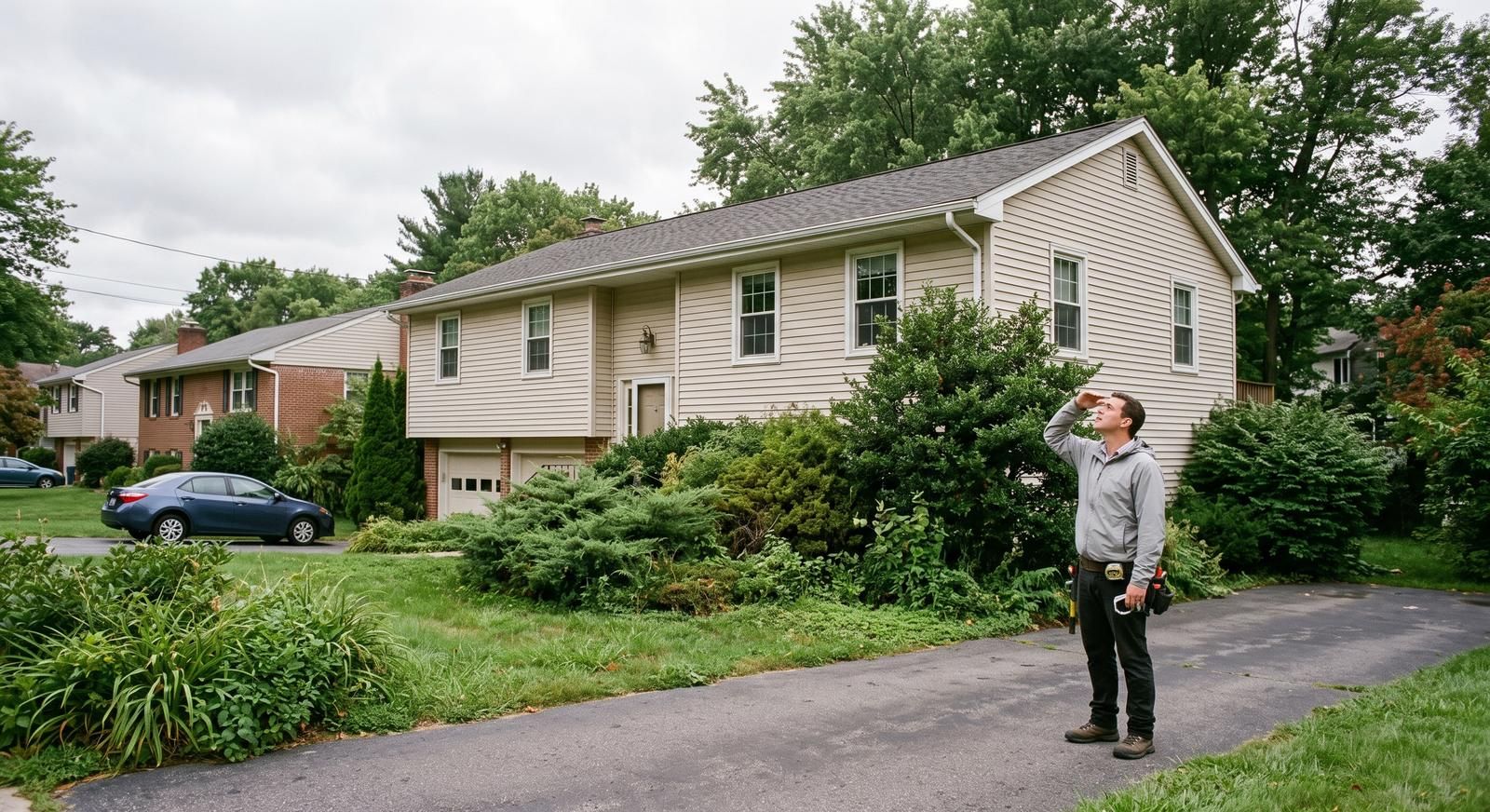
This is not a small procedural difference in an older housing stock, and the DC region has a great deal of older housing stock. Peeling paint on a pre 1978 home, a defective roof, missing handrails, inoperable systems, unsafe wiring or an unaddressed water intrusion issue can all generate repair conditions that must be cured before the loan closes. On a conventional loan the same house may appraise without comment.
The FHA case number follows the property, not the buyer
Here is the consequence that surprises people. An FHA appraisal is assigned to the property through the case number and remains valid for 180 days. If your contract falls apart after the appraisal, the next FHA buyer on that same property inherits the same appraised value and the same repair conditions. A seller who has had one FHA deal fall through cannot reset the number by finding a different FHA buyer.
Source: HUD Mortgagee Letter 2022-11 on appraisal validity periods.
That is why some listing agents in competitive segments quietly disfavor FHA offers. It is not that FHA buyers are less qualified. It is that an FHA appraisal creates a durable record attached to the house. Understanding that dynamic helps an FHA buyer write a stronger offer, because it explains the objection they are actually facing.
When the repair list is the reason to look at renovation financing
If the property you want cannot pass an FHA appraisal in its current condition, the answer is not always to walk. FHA's 203(k) program finances the purchase and the repairs in a single loan, which turns a failing appraisal into a scope of work. That is a different article and a different set of rules, and we cover it in our guide to how FHA 203(k) renovation loans work in Maryland.
Condominiums: two very different approval paths
If you are buying a condo, the program difference stops being about you and starts being about the building. Both FHA and conventional care whether the project is financeable, and they ask different questions about it.
FHA historically required the entire project to be on its approved list. Since 2019 there has also been a single unit approval path, which lets an individual unit in an unapproved project qualify. That path has a hard cap: the number of single unit approvals in any one project cannot exceed 10% of the units.
Source: HUD Mortgagee Letter 2019-13 establishing FHA single unit approval.
Conventional financing does not use an approved list in the same way. It uses a project review, which the lender or the automated system performs, looking at owner occupancy, delinquent assessments, litigation, reserve funding and commercial space. A project that fails FHA approval may pass a conventional review and vice versa, so the program question for a condo buyer often gets decided by the building rather than by the borrower.
What to do first: if you are shopping condos, ask your loan officer to check the project before you fall in love with a unit. It takes a day. Discovering the building is not FHA approved after you are under contract costs you the deal or forces a scramble into a different program at a worse rate.
Who is actually using FHA in this market
It helps to see the real profile rather than the stereotype. FHA's own annual report to Congress publishes the characteristics of the loans it insured, and the numbers do not describe a borrower in distress. They describe a first time buyer with average credit and very little cash.
| Metric, FHA purchase endorsements | Fiscal year 2025 |
|---|---|
| Average credit score | 679 |
| Share who were first time buyers | 83.03% |
| Average loan amount | $313,473 |
| Average loan to value | 94.74% |
Source: FHA Annual Report to Congress on the Financial Status of the Mutual Mortgage Insurance Fund, fiscal year 2025.
A 679 average score is the detail worth sitting with. That is not a subprime number. A large share of those borrowers would have qualified for conventional financing, and some of them would have paid less over the life of the loan by doing so. They went FHA because it was what they were offered, or because the down payment cash was not there, or because a specific item in the file made conventional harder.
Note also the average loan amount of $313,473 against our regional loan limits. FHA nationally is a modest loan size program. In the Washington metro it is being used at two and three times that figure, which pushes many local FHA borrowers over the $726,200 threshold into the higher annual premium tier. That is a regional cost the national averages hide completely.
How to actually decide
What follows is a framework, not a rate quote. We are deliberately not publishing a break even credit score, because the honest answer depends on private mortgage insurance pricing that no government body publishes and that varies by insurer, by file and by month. Anyone giving you a clean threshold is guessing. Use this to work out which conversation to have, then get both quotes.
FHA is usually the answer when
- Your credit score is below 620 and the file will not clear automated conventional underwriting.
- There is a recent derogatory event that conventional will not look past yet.
- You need a seller credit larger than 3% and you are putting down less than 10%.
- The property has condition issues and you are financing the repairs through 203(k).
- You expect your income or credit to improve materially within a few years, so the exit refinance is realistic rather than theoretical.
Conventional is usually the answer when
- You qualify for it, and particularly if you are a first time buyer under the income threshold in a high cost area, because the price adjustments disappear.
- You are buying in the Baltimore metro or elsewhere in Maryland at the floor limit and you need borrowing capacity above the FHA cap.
- You can put 10% or more down, which shortens or removes the insurance question.
- You intend to hold the loan for a long time, which is where the cancellable insurance compounds in your favor.
- You are buying a second home or an investment property, which FHA does not finance.
The escape hatch that makes FHA defensible
The strongest argument for taking FHA when you are on the edge is that the decision is reversible. You can refinance out of an FHA loan into a conventional loan once your equity and credit support it, and you can drop the mortgage insurance permanently when you do. The reverse manoeuvre is rarely needed. What makes this real rather than aspirational is writing the trigger down: a target score, a target loan to value and a date to check. Our guide on when refinancing actually makes sense in 2026 sets out the arithmetic for that decision.
One caution on timing. Mortgage rates moved a great deal over the past two years and a refinance only works if the market cooperates. As a reference point, Freddie Mac's Primary Mortgage Market Survey put the average 30 year fixed rate at 6.71% for the week ending 3 September 2026. If you take an FHA loan at a rate well below the prevailing market, the mortgage insurance saving may not be worth surrendering the note rate, and the right move is to keep the loan and live with the premium.
A comparison worth running on paper before you commit
| Question to answer | Why it decides the outcome |
|---|---|
| How long will I hold this loan | Short holds favor FHA. Long holds favor cancellable insurance |
| Am I a first time buyer under the income threshold | If yes, conventional pricing improves sharply |
| What is my county limit on each program | In Baltimore and most of Maryland, FHA borrows less |
| How much seller credit do I need | Above 3% at low down payment, only FHA reaches it |
| Will the property pass an FHA appraisal | If not, the choice may be made for you |
| Is the building approved | For condos, the project often decides the program |
What this article deliberately does not tell you
Most comparisons of these two programs contain numbers that cannot be sourced. We would rather be openly incomplete than quietly wrong, so here is what we left out and why.
| Figure you will see elsewhere | Why it is not here |
|---|---|
| A PMI rate table | No government source publishes one. Rates are set per file by six private insurers |
| A break even credit score for FHA versus conventional | It depends on the PMI quote above, so any threshold is an estimate presented as a fact |
| FHA maximum debt to income ratios | Could not be verified against HUD Handbook 4000.1 at the time of writing |
| FHA waiting periods after bankruptcy or foreclosure | Same reason. Ask your loan officer for the handbook citation |
| FHA acceptable gift donor list | Same reason. Confirm before accepting funds |
| A total cost comparison over 30 years | Requires an assumed PMI rate and an assumed rate spread. Ask for one built on your actual quotes |
If a lender hands you a comparison containing any of the first five, ask them where the number came from. A good answer names a mortgagee letter, a selling guide section or a specific insurer quote. A bad answer is a shrug.
Frequently asked questions
In an FHA vs conventional loan, is FHA always cheaper?
No. FHA is often cheaper in the first few years for a borrower with a lower credit score, because conventional pricing penalises thin files through loan level price adjustments. Over a longer hold conventional usually wins, because its mortgage insurance cancels and FHA's generally does not. The crossover point depends on your private mortgage insurance quote, which is why the comparison has to be run on your actual file rather than a national average.
Can I get rid of FHA mortgage insurance without refinancing?
Only if you put 10% or more down when you took the loan, in which case the annual premium drops off after 11 years. On a loan taken with the minimum 3.5% down, the annual premium runs for the loan term. Paying the balance down faster does not end it. Refinancing into a conventional loan does.
Does FHA have a maximum income limit?
No. FHA has no income ceiling and no first time buyer requirement. Anyone who qualifies can use it for a principal residence. The income thresholds discussed in this article attach to conventional programs such as HomeReady and to the waiver of conventional loan level price adjustments, not to FHA eligibility.
Can I use an FHA loan for an investment property?
Not as a pure investment. FHA finances principal residences, and the borrower must occupy the property. A two to four unit property can be financed with FHA if you live in one of the units, which is a legitimate route into small scale rental ownership. Buying a property you will not live in requires conventional or another form of financing.
Which program is better if I am buying a condo?
Whichever one the building supports. Check the project status before you check your own numbers. If the project is FHA approved, both routes are open. If it is not, the single unit approval path may still work but is capped at 10% of the units in the project, and a conventional project review may be the cleaner path.
My lender said I need a 640 score for FHA. Is that an FHA rule?
No. FHA's published minimum is 580 for 3.5% down and 500 for 10% down. A 640 requirement is a lender overlay, meaning that specific lender has chosen to be stricter than the program. Another lender may not apply it. Ask directly whether the requirement is FHA's or theirs.
If I take FHA now, how soon can I refinance into conventional?
There is no fixed waiting period imposed by the conventional side for this move, but the refinance has to make sense on its own terms. You need enough equity to avoid conventional mortgage insurance or to get a better insurance rate than the FHA premium, a credit profile that prices well, and a market rate that does not cost you more in interest than you save in insurance. In practice most borrowers look at this somewhere between year two and year five.
Do FHA and conventional have the same loan limit where I live?
In the Washington metropolitan area, yes: both are $1,249,125 for a one unit property in 2026. In the Baltimore metropolitan area, no: FHA is $747,500 against a conforming limit of $832,750. In the rest of Maryland, including Calvert and St. Mary's counties, FHA sits at the national floor of $541,287 while the conforming limit remains $832,750. Check your specific county, because the difference is large enough to change your price range.
Is FHA or conventional better in 2026?
Neither is better in the abstract, and anyone who answers without asking your credit score is guessing. In an FHA vs conventional loan decision the hinge is mortgage insurance: FHA charges it for the life of the loan at anything under 10 percent down, while conventional PMI comes off once you reach 20 percent equity. Below roughly a 680 score FHA usually costs less per month because conventional pricing adjustments bite hardest there. Above it, conventional usually wins, and the gap widens as the score rises.
This guide is general information, not a commitment to lend or an offer of credit. Program rules, loan limits, insurance premiums and pricing adjustments change. Verify current figures with HUD, the Federal Housing Finance Agency and your lender before relying on them. Loans originated by Ken Byrne, NMLS ID# 187129, ALCOVA Mortgage LLC, NMLS ID# 40508. Equal Housing Lender.
Categories
Recent Posts








GET MORE INFORMATION

Broker Associate