
How to Improve Your Credit Score for a Mortgage: 90-Day Plan Before You Buy

Ninety days gives you time to dispute errors, lower card balances and avoid new mistakes before you apply.
Short answer: to improve your credit score for a mortgage in 90 days, do five things. Pull your three free credit reports. Dispute any errors in writing. Pay credit card balances down before each statement date. Pay every bill on time. Open no new credit. Card balances usually update about once a month. A dispute investigation generally takes 30 to 45 days. Both fit inside 90 days. No official source promises a set number of points.
By Ken Byrne, NMLS #187129 · ALCOVA Mortgage LLC, NMLS #40508 · Updated October 2026
This plan covers what to do each month before a mortgage application, and why. The rules come from named sources, such as the CFPB, the FTC, FICO and Fannie Mae.
For a review of where you stand, talk to JB Financing, the Ken Byrne Team at ALCOVA Mortgage.
What is the 90-day plan to improve your credit score?
Work in three stages: find and dispute errors, lower your reported balances, then hold everything steady until you close.
| When | What to do | Why it fits the timeline |
|---|---|---|
| Days 1 to 30 | Pull all three reports. Dispute errors. Set every account to autopay | A bureau generally has 30 days to investigate, or 45 after a free annual report |
| Days 31 to 60 | Pay card balances down before each statement date. Leave old cards open | Card issuers typically report once a month |
| Days 61 to 90 | Open no new credit. Keep balances low. Get pre-approved | New debt found before closing can force the lender to re-underwrite the loan |
Source: 15 U.S.C. 1681i and 1681j; Equifax and Experian on reporting cycles; Fannie Mae Selling Guide B3-6-02.
The minimum score for each loan type is a separate question. Find it in our guide to the credit score needed to buy a house.
How long does it take to improve a credit score?
Some changes can show up within about a month, because creditors typically report once a month. Late payments take much longer to fade.
| Action | When it can show up |
|---|---|
| Paying down a card balance | After the issuer next reports, typically within a month |
| Correcting an error | After the investigation, generally 30 to 45 days |
| A rapid rescore requested by a lender | Often two to five days after documents are submitted |
| Recovering from a late payment | Months to years. It can stay on your report for seven years |
Source: Equifax; Experian (October 2025); CFPB.
FICO puts it plainly: there is no quick way to fix a credit score. It says you may notice small changes within three to six months.
Which credit score do mortgage lenders use?
Many mortgage lenders use older “classic” FICO scores from all three credit bureaus. They take your middle score. With two borrowers, pricing uses the lower of the two middle scores.
That changed in part in 2026. Since September 9, 2026, Fannie Mae and Freddie Mac also let any approved lender use VantageScore 4.0, one model per loan.
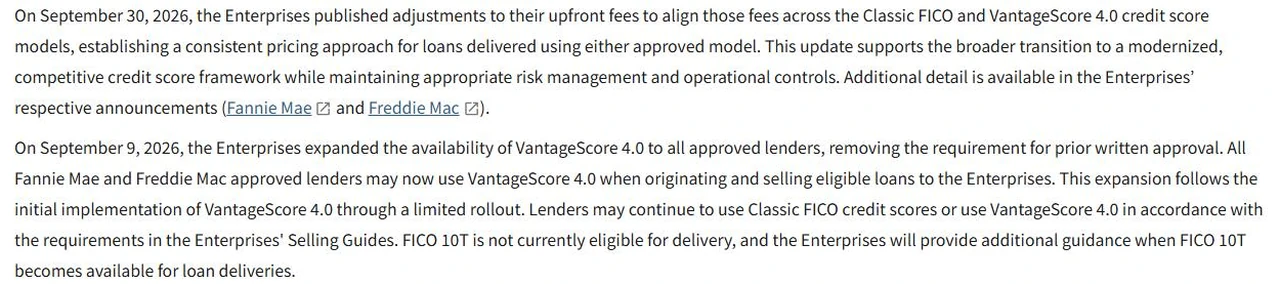
The federal regulator’s update on credit score models. Source: Federal Housing Finance Agency, fhfa.gov, captured October 6, 2026.
| Score model | Status for Fannie Mae and Freddie Mac loans, October 2026 |
|---|---|
| Classic FICO (FICO Score 2, 4 and 5) | Approved; remains eligible |
| VantageScore 4.0 | Accepted from all approved lenders since September 9, 2026 |
| FICO Score 10T | Approved but not yet eligible for delivery |
Source: Federal Housing Finance Agency, Credit Scores (updated October 2, 2026); Fannie Mae Selling Guide B3-5.1-01 and B3-5.1-02.
The score in a banking app may be a different version. Ask your lender which model it will use.
What goes into a FICO score?
Five things, and two of them make up 65 percent: paying on time and how much you owe.
| Factor | Share of a FICO score | What helps in 90 days |
|---|---|---|
| Payment history | 35% | Pay every account on time |
| Amounts owed | 30% | Lower your card balances |
| Length of credit history | 15% | Keep old accounts open |
| New credit | 10% | Do not apply for new accounts |
| Credit mix | 10% | Nothing; do not open accounts to change it |
Source: myFICO, What’s in my FICO Scores. FICO notes the weights can vary by person.
How do you check your credit reports for free?
Go to AnnualCreditReport.com. The three bureaus let you check each report once a week at no charge.
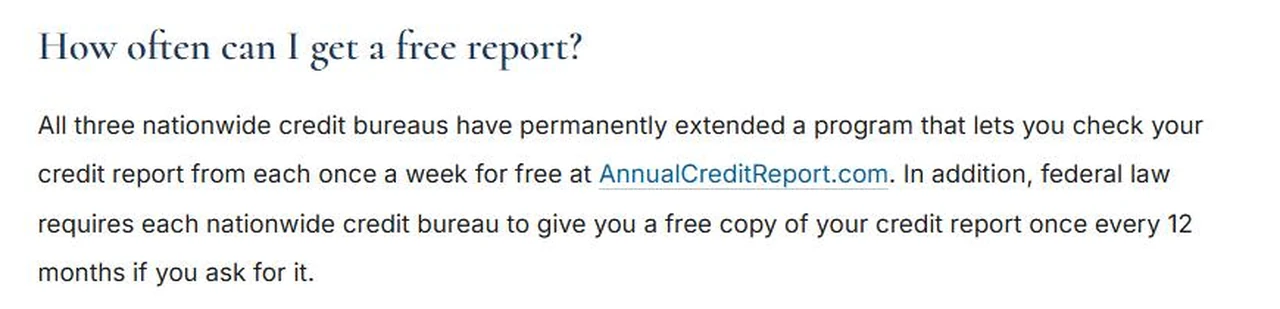
The FTC confirms weekly free reports are permanent. Source: Federal Trade Commission, consumer.ftc.gov.
Checking your own report is a soft inquiry. It does not affect your score.
Source: Federal Trade Commission, Free Credit Reports (June 2026); CFPB, What is a credit inquiry?
Look for accounts that are not yours, wrong balances or limits, payments marked late that were on time, and old debts that should have dropped off.
How do you dispute an error on your credit report?
Dispute it in writing with the credit bureau and with the company that reported it. Do it in week one. The investigation can take 30 days, or 45 if you dispute after a free annual report.
| Step | Detail |
|---|---|
| 1. Identify each error | List the account number and what is wrong |
| 2. Explain why | State the facts and ask for a correction or removal |
| 3. Attach proof | Send copies, not originals, plus a copy of the report with the item marked |
| 4. Send to both | The bureau and the company that furnished the information |
| 5. Keep records | Note dates. The bureau generally has 30 days, or 45 after a free annual report |
Source: CFPB, How do I dispute an error on my credit report? (reviewed September 2, 2026); 15 U.S.C. 1681i and 1681j.
Errors are common enough to check for. A Federal Trade Commission study released in 2013 found that one in five consumers had an error on at least one report.
How much should you pay down credit cards before applying?
As much as you comfortably can. The CFPB says experts advise using no more than 30 percent of your total credit limit. FICO says low use can have a positive effect.
Timing matters as much as the amount. Your report typically shows the balance from your latest statement. Pay before the statement closes, not just before the due date.
| Card limit $10,000 | Balance on statement | Utilization |
|---|---|---|
| Before | $6,000 | 60% |
| After paying $3,500 | $2,500 | 25% |
| After paying $5,100 | $900 | 9% |
Source: CFPB, How do I get and keep a good credit score?; myFICO, Amounts owed. Illustration only.
One caution on the newer model. Experian says VantageScore 4.0 considers 24 months of balance trends. One low statement may count for less there.
Lower card payments also help your debt ratio. See our guide to the debt-to-income ratio.
Should you pay off collections before buying a house?
Not always. Ask your loan officer first. Paying an old collection does not remove it from your report, FICO says.
The account stays for seven years from the first missed payment, paid or not. Experian notes that only newer score models ignore paid collections, so paying may not raise an older mortgage score.
Source: myFICO; Experian (September 2024); 15 U.S.C. 1681c.
A lender may still require certain debts to be paid as a condition of the loan. That is a separate question from the score.
Does medical debt count?
Less than it used to. The three bureaus removed paid medical collections and medical collections under $500, and they wait one year before reporting unpaid ones.
Check your own reports instead of assuming. A federal rule that would have kept medical bills off credit reports used by lenders was vacated by a federal court in July 2025.
Source: Equifax, Experian and TransUnion joint announcement (April 2023); CFPB notice of the July 11, 2025 court ruling.
What is a rapid rescore?
A rapid rescore is a paid service a mortgage lender can order from the credit bureaus. It updates your report quickly after a change, such as a paid-down balance.
| Question | Answer |
|---|---|
| Who can request it? | Only your mortgage lender. You cannot order one yourself |
| How long does it take? | Often two to five days after documents are submitted |
| Can the lender charge you for it? | Not directly, Experian says, though the cost may show up in closing costs or the rate |
| Is a higher score guaranteed? | No |
Source: Experian, What Is a Rapid Rescore? (October 2025).
It updates accurate, recent changes. It does not remove correct negative information.
Does shopping for a mortgage hurt your credit score?
Very little, if you shop within a short window. The CFPB says multiple mortgage credit checks within 45 days are recorded as a single inquiry.
Older FICO versions use a 14-day window, so finishing your lender comparisons within 14 days is the safe choice. FICO says one inquiry costs most people less than five points.
Source: CFPB, What effect will shopping for a mortgage have on my credit? (reviewed August 28, 2026); myFICO.
Know the difference between the two early steps in our guide to pre-qualification vs pre-approval.
What should you avoid before and during a mortgage application?
Avoid new debt, large card purchases and closing old cards. Each one can lower your score or raise your debt ratio at the wrong moment.
| Avoid | Why |
|---|---|
| A car loan or new credit card | New accounts and inquiries count against you, and add to your debts |
| Large purchases on existing cards | They raise your utilization |
| Closing unused cards | It cuts your available credit, which can raise utilization |
| Missing any payment | Payment history is the largest factor |
| Financing furniture or appliances before closing | The CFPB warns even a new refrigerator on credit can make approval harder |
Source: CFPB, Get your money situation in order; CFPB, Your home loan toolkit (July 2026); myFICO.
These rules hold until the day you close. See what happens between approval and closing in our guide to what happens after pre-approval.
How much is a higher credit score worth on a mortgage?
It can be worth thousands of dollars upfront and hundreds a month. Two published price lists show it: Fannie Mae’s fee by credit score, and a mortgage insurer’s rate card.
| Credit score | Fannie Mae fee on a $475,000 loan | Monthly PMI on the same loan |
|---|---|---|
| 780 or higher | 0.250%, or $1,188 | $150 |
| 740 to 759 | 0.625%, or $2,969 | $210 |
| 700 to 719 | 1.125%, or $5,344 | $309 |
| 660 to 679 | 1.625%, or $7,719 | $507 |
A $500,000 home with 5% down. Fee: Fannie Mae Loan-Level Price Adjustment Matrix dated September 30, 2026, purchase loans at 90.01% to 95% loan-to-value. It is charged to the lender and usually passed on through the rate or points; other adjustments and waivers can apply. PMI: Enact rate card (updated July 2025), one insurer’s base rates. Not a quote.
On this rate card, moving from the 660 to 679 band to the 700 to 719 band cuts mortgage insurance by $198 a month.
How mortgage insurance is priced and removed is in our guide to PMI.
A larger down payment changes the picture too; see our down payment guide.
How many points can your credit score change?
No official source gives a number for 90 days. FICO publishes simulated examples, and results depend on your starting profile.
| Action | Profile starting at 607 | Profile starting at 793 |
|---|---|---|
| Reduce revolving balances by 25% | 615 to 635 | 795 to 815 |
| Miss a payment by 30 days | 570 to 590 | 710 to 730 |
| Max out credit cards | 560 to 580 | 665 to 685 |
Source: myFICO, How Credit Actions Impact FICO Scores. Simulated on FICO Score 9, not the mortgage versions, for two sample profiles. FICO says results may vary.
The pattern is the useful part. In both profiles, a missed payment cost more than a paydown gained. The gap was widest for the higher score.
Should you pay a credit repair company?
Usually not. The FTC says anything a credit repair company can do legally, you can do yourself for little or no cost.
It is illegal for these companies to charge you before they perform the service. You also have three business days to cancel a contract at no charge.
Source: Federal Trade Commission, Fixing Your Credit FAQs; 15 U.S.C. 1679b and 1679e.
The FTC says no one promising to repair your credit can legally remove information that is accurate and current.
What should you do when the 90 days are up?
Get pre-approved, and keep your credit steady until closing. A pre-approval usually includes a lender credit check. Ask which scores the lender used.
The steps are in our guide to mortgage pre-approval.
Gather your paperwork with our mortgage documents checklist.
If your score still makes a conventional loan costly, FHA is one alternative to compare. Details are on our FHA loans page.

Get a Mortgage Estimate for Free
Find out where you stand before you apply.
✓Free, no obligation✓Licensed in VA, MD, DC and WV✓Loan officer Ken Byrne, NMLS #187129
Frequently asked questions
Can you raise your credit score in 30 days?
Sometimes. A paid-down card balance can show up once the issuer reports, typically within a month. A corrected error can post after the investigation, which generally takes 30 to 45 days.
Can you raise your credit score 100 points in 90 days?
No official source supports that promise. In a 2013 FTC study, one in 250 consumers saw a change of more than 100 points after errors were corrected. The result depends on what is on your report.
How do you fix your credit to buy a house?
Check all three reports, dispute errors, lower card balances, pay on time and avoid new credit. Then ask a lender to review your mortgage scores.
Does checking my own credit lower my score?
No. Checking your own report is a soft inquiry and does not affect your scores.
Should I close credit cards before applying for a mortgage?
Generally no. Closing a card reduces your available credit, which can raise your utilization and lower your score.
Is 30 percent credit utilization good enough?
Treat 30 percent as an upper limit, not a target. FICO says a low share of credit in use can have a positive effect.
Will becoming an authorized user help?
It can. FICO says authorized user accounts can affect your score, though newer versions give them less weight. The account’s history must be good.
Does Experian Boost help with a mortgage?
Do not count on it. Boost affects only your Experian file, and Experian says not all lenders use scores affected by it.
How long do late payments stay on a credit report?
Seven years. Bankruptcies can stay for up to ten years.
This article is general information, not financial or legal advice and not a commitment to lend or an offer of credit. Loan limits, program rules, premium schedules and rates change, and individual eligibility depends on a full review of your credit, income, assets and the property. Every figure here is an illustration, not a quote, built from published sources and a weekly survey average rather than underwriting decisions. Insurance and mortgage insurance amounts are planning estimates. Confirm anything you plan to act on with a licensed mortgage professional. Rules and published figures were checked on October 6, 2026. Credit results vary by person, and no score change is guaranteed. This is general information, not credit repair or legal advice.
Categories
Recent Posts










GET MORE INFORMATION

Broker Associate