
How Much Is a Mortgage on a $400,000 House? What It Really Costs Across the DMV
The Ken Byrne Team at JB Financing can run these numbers on the exact price you are shopping.
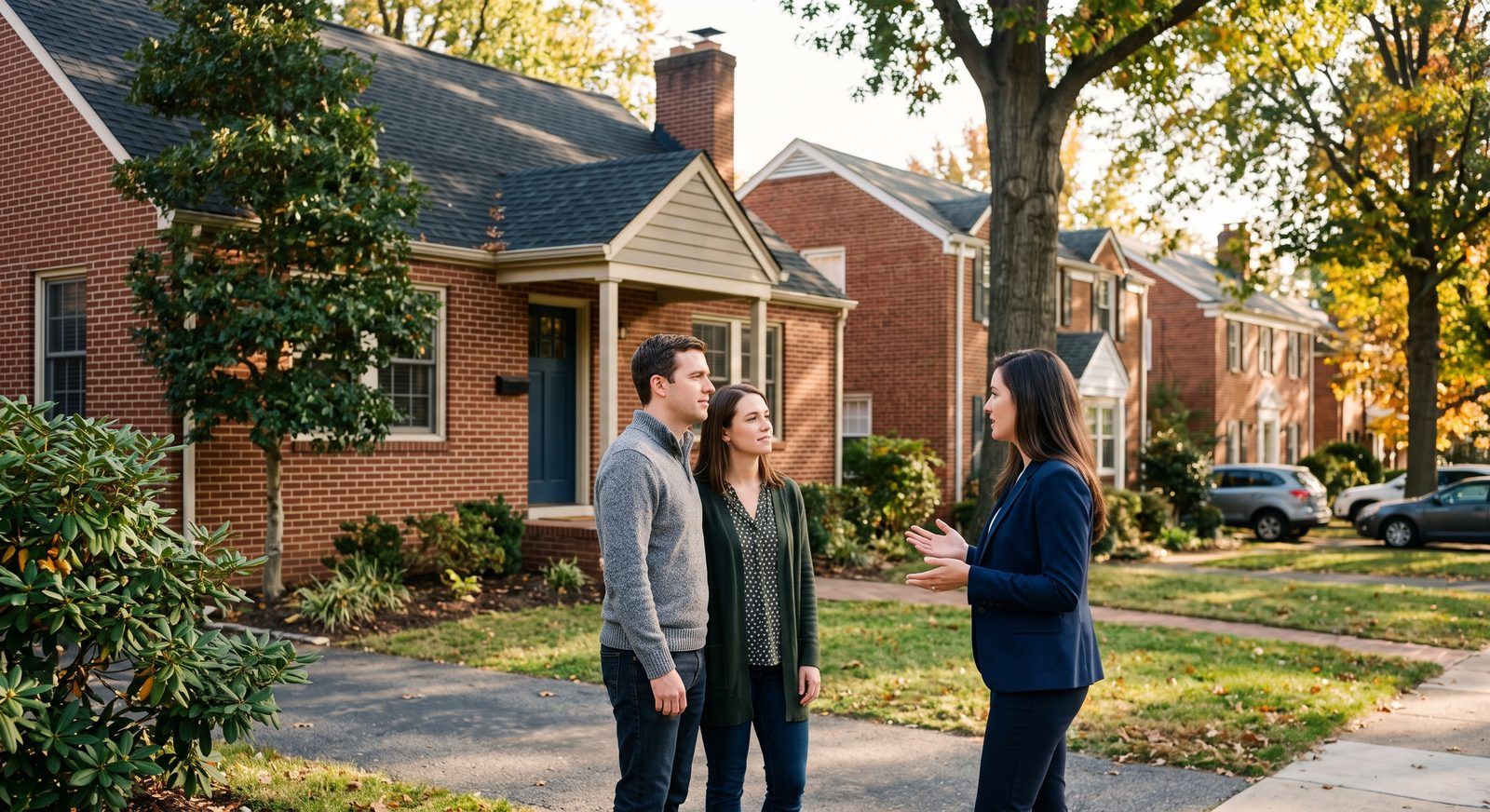
Short answer: Your 400k mortgage payment depends on the county more than most buyers expect. At 20% down and the 6.66% average 30-year rate Freddie Mac reported for the week of August 27, 2026, a $400,000 house is about $2,056 a month in principal and interest. Add taxes and insurance and you are realistically looking at $2,500 to $2,700 in Prince William County, and closer to $2,700 to $2,900 in Prince George’s County, on the same house. Put 3.5% down with an FHA loan and principal and interest runs about $2,524 once the upfront FHA premium is financed into the balance.
How much is a mortgage on a $400k house, really? Most articles about a $400,000 mortgage payment stop at the arithmetic. The arithmetic is the easy part. The harder question in the Washington DC region in 2026 is where $400,000 still buys a house at all, and which loan program makes the payment work once you find one. That is the conversation we have every day as mortgage lenders in Virginia, Maryland, DC and West Virginia. Those two questions are what this guide is actually about.
Every figure below traces to a public source, and each one is named where it appears. Rates move weekly, so the payment tables are built as ranges rather than a single number that goes stale the moment it is published.
The $400K mortgage payment, built from its parts
Your monthly payment has four pieces, and only the first one depends on the interest rate everyone obsesses over. Principal and interest is the loan itself. Property tax is set by your county. Homeowners insurance is set by your carrier. Mortgage insurance appears only if you put less than 20% down on a conventional loan, or on almost any FHA loan.
Here is principal and interest on a $400,000 purchase, by down payment, on a 30-year fixed loan. The middle column uses 6.66%, which is where Freddie Mac’s Primary Mortgage Market Survey put the national average for the week ending August 27, 2026.
| Down payment | Cash at closing | Loan amount | P&I at 6.00% | P&I at 6.66% | P&I at 7.25% |
|---|---|---|---|---|---|
| 3% conventional | $12,000 | $388,000 | $2,326 | $2,493 | $2,647 |
| 3.5% FHA | $14,000 | $386,000 | $2,314 | $2,481 | $2,633 |
| 5% | $20,000 | $380,000 | $2,278 | $2,442 | $2,592 |
| 10% | $40,000 | $360,000 | $2,158 | $2,313 | $2,456 |
| 20% | $80,000 | $320,000 | $1,919 | $2,056 | $2,183 |
Principal and interest calculated on a 30-year fixed amortization. Rate reference: Freddie Mac Primary Mortgage Market Survey, week ending August 27, 2026 (30-year fixed averaged 6.66%). The FHA row shows the base loan before the upfront premium is added; see the FHA section below.
Notice the shape of that table. Going from 3% down to 20% down saves you about $437 a month and costs you $68,000 in cash. That is a real trade, and it is not obviously worth it for everyone. The section on down payment assistance further down is often the better lever at this price point.

“Send me the address and I will run the actual payment for that house, with the real tax rate for that county.”
Arslan Jamil, Broker Associate
Loans originated by Ken Byrne, NMLS ID# 187129 · ALCOVA Mortgage LLC, NMLS ID# 40508. Equal Housing Lender.
Your 400k mortgage payment, county by county
This is the part that surprises people. Property tax rates in this region vary enough that the identical $400,000 house carries a payment gap of more than $240 a month depending on which side of a county line it sits on. Over a 30-year loan that difference is larger than most people’s entire down payment.
| Jurisdiction | Rate applied | Tax per year | Tax per month |
|---|---|---|---|
| Washington, D.C. | 0.85% after the $87,050 homestead deduction | $2,660 | $222 |
| Jefferson & Berkeley County, WV | 60% assessment ratio, $1.00 per $100 cap | $2,400 or less | $200 or less |
| Loudoun County, VA | 0.805% general county levy | $3,220 | $268 |
| Prince William County, VA | 0.937% including fire and rescue levy | $3,748 | $312 |
| Arlington County, VA | 1.053% plus a flat stormwater utility fee | $4,212 | $351 |
| Fairfax County, VA | 1.1535% including stormwater and pest levies | $4,614 | $384 |
| Prince George’s County, MD | 1.3320% including state, M-NCPPC, Metro and stormwater | $5,328 | $444 |
Rates from each jurisdiction’s published schedule: Fairfax County Tax Administration (TY2026 base $1.12 plus $0.0325 stormwater and $0.001 pest); Loudoun County Property Tax Rates 2026 (general levy $0.805, before any Metro or Route 28 district levy); Prince William County Tax Rates 2026 ($0.865 base, $0.0700 fire and rescue, $0.0020 mosquito, plus flat solid waste and stormwater fees); Arlington County FY2027 adopted revenue summary (CY2026 rate $1.053, stormwater now billed as a $268 per unit utility fee); DC Office of Tax and Revenue (Class 1A $0.85 per $100, homestead deduction $87,050); Prince George’s County FY2026 tax rate schedule (Class 1 total $1.3320 in unincorporated areas). West Virginia assesses at 60% of appraised value with the Class II combined levy capped at $1.00 per $100 by the state constitution. Figures shown assume the assessment equals the purchase price and exclude municipal or district add-ons.
The West Virginia detail almost everyone gets wrong. West Virginia does not tax you on what you paid. It assesses at 60% of appraised value first, and the combined Class II levy for an owner-occupied home is capped at $1.00 per $100 of that assessed value. The practical ceiling works out near 0.60% of the purchase price, which is why the Eastern Panhandle carries a $400,000 house more cheaply than anywhere else within commuting distance of the region.
If you are weighing counties rather than houses, our county-by-county property tax guide goes deeper than the summary above.
Where $400,000 still buys in this region
Be honest with yourself about geography before you get attached to a number. At $400,000 in 2026 you are generally shopping in Prince George’s County, the Berkeley and Jefferson County side of West Virginia, parts of Frederick County in Maryland, the outer edges of Prince William and Stafford on the Virginia side, and condos and townhouses rather than detached houses closer in. What you will not find at that price is a single-family home inside the Beltway.
That constraint is why the tax table above matters so much. The places where $400,000 still works are also, mostly, the places with the friendlier tax rates. Prince George’s County is the exception and it is a significant one: the highest carrying cost in the table sits in one of the few Maryland markets where the purchase price still lands near $400,000. Run that county’s number before you fall in love with a listing there.
Which loan actually fits at this price
Here is something that works in your favor at $400,000: no 2026 loan limit binds you. The conforming baseline is $832,750 and the limit across the Washington metro area is $1,249,125. The FHA floor is $541,287. Your loan is far below every one of them, so you are choosing a program on its merits rather than being forced into one.
Loan limits from the Federal Housing Finance Agency 2026 conforming loan limit values and HUD Mortgagee Letter 2025-23, both effective January 1, 2026.
Conventional, 3% or 5% down
A conventional loan is the lowest total cost if your credit is strong. Private mortgage insurance applies below 20% down, but it is cancellable once you reach 20% equity, and it is priced on your credit score, so a 760 borrower pays materially less than a 680 borrower for the identical loan. That cancellation right is the single biggest advantage conventional has over FHA.
FHA, 3.5% down
An FHA loan is built for credit in the 580 to 680 range, and it is genuinely more forgiving on debt ratios. The cost is the insurance. FHA charges an upfront premium of 1.75% of the base loan, which is normally financed into the balance, plus an annual premium collected monthly.
On a $400,000 purchase with 3.5% down, the base loan is $386,000. The upfront premium adds $6,755, so you actually finance $392,755. The annual premium at that loan-to-value is 55 basis points, roughly $177 a month in year one. And because your loan-to-value starts above 95%, that premium stays for the life of the loan rather than falling off at 20% equity.
Upfront premium of 175 basis points from HUD Appendix 1.0, Mortgage Insurance Premiums. Annual premium tiers from HUD Mortgagee Letter 2023-05, effective for case numbers assigned on or after March 20, 2023: 55 basis points where the base loan is $726,200 or less and loan-to-value exceeds 95%, for the mortgage term.
VA, nothing down
If you are eligible, a VA loan is almost always the answer at this price. No down payment, no monthly mortgage insurance at all. The trade is the VA funding fee, which is 2.15% for a first-time use with nothing down, so $8,600 on a $400,000 purchase. Financed into the loan, that puts you at $408,600 and about $2,626 a month in principal and interest at 6.66%. Higher than the conventional payment, but you kept $80,000 in the bank and you are paying no mortgage insurance for the life of the loan.
The fee is waived entirely if you receive or are eligible for VA compensation for a service-connected disability, and for surviving spouses receiving DIC. That waiver is worth $8,600 here and a surprising number of eligible borrowers do not know they qualify for it.
Funding fee percentages and exemption categories from the U.S. Department of Veterans Affairs, VA funding fee and closing costs, rates effective April 7, 2023.
USDA, nothing down, if the address qualifies
A USDA loan is geographically restricted, but the eligible map covers more of this region than people expect, particularly in the West Virginia panhandle and the outer parts of Virginia.
At $400,000 it is worth checking the address before you assume it does not apply. Our guide to eligible USDA areas in Virginia has the map.
Not sure which of these you qualify for?
Arslan can tell you in one call, before you spend a weekend touring.
Loans originated by Ken Byrne, NMLS ID# 187129 · ALCOVA Mortgage LLC, NMLS ID# 40508. Equal Housing Lender.
The price point where down payment assistance actually matters
Assistance programs have income and purchase price caps. At $1.2 million they are irrelevant. At $400,000 they are often the difference between buying this year and buying in three years, and this is the band where they are designed to work. In the District, the HPAP program is the largest of the three.
| Program | Where it applies | What it does |
|---|---|---|
| Virginia Housing | Statewide Virginia | Down payment grants and a Mortgage Credit Certificate that converts part of your mortgage interest into a federal tax credit |
| Maryland Mortgage Program | Statewide Maryland | First mortgage plus a down payment assistance loan. The CDA maximum mortgage amount is $832,750 for the five high-cost counties, so a $400,000 purchase is comfortably inside it |
| DC HPAP | Washington, D.C. | Up to $202,000 in down payment assistance for income-eligible first-time buyers, structured as a deferred loan |
| West Virginia programs | Berkeley, Jefferson and statewide | State homeownership programs pairing a first mortgage with down payment help |
Maryland figure from Maryland Mortgage Program Directive 2026-04, effective for loans reserved on or after June 24, 2026. Program terms and income limits change; confirm current eligibility with the administering agency before relying on any of this.
Full detail on the Virginia side is in our guide to Virginia down payment assistance programs.
What income you need
The common guideline, and the one behind our affordability calculator, puts housing at no more than 28% of gross monthly income, with total debt including car loans, student loans and credit card minimums under about 36%. Underwriters will stretch beyond that, particularly on FHA, but it is a sane starting point.
| All-in monthly payment | Income at the 28% guideline | Roughly the scenario |
|---|---|---|
| $2,500 | $107,000 | 20% down in a lower-tax county |
| $2,800 | $120,000 | 20% down in Fairfax, or 10% down further out |
| $3,100 | $133,000 | FHA with 3.5% down in a mid-rate county |
| $3,400 | $146,000 | FHA or 3% down conventional in Prince George’s County |
Income figures are the payment divided by 0.28, annualised. They are a screening guideline, not an underwriting decision. Your actual approval depends on your full debt picture, credit and reserves.
If you would rather work from income to price than from price to payment, start with what an $80,000 salary buys in the DMV instead.
Questions people actually ask
Is $400,000 a jumbo loan?
No, and it is not close. The 2026 conforming baseline is $832,750, and across the Washington metro area the limit is $1,249,125. A $400,000 loan is a standard conforming loan anywhere in this region.
How much do I need for closing costs on top of the down payment?
Budget 2% to 3% of the price, so roughly $8,000 to $12,000 on a $400,000 purchase, covering lender fees, title insurance, the appraisal, recordation tax and prepaid escrows. In Virginia the buyer pays recordation tax of $0.25 per $100 on the deed and the deed of trust, and the seller pays the grantor tax.
Can I buy a $400,000 house with no money down?
Yes, with a VA loan if you are eligible, or a USDA loan if the address is in an eligible area. In Maryland the Maryland Mortgage Program can cover the down payment on a conventional loan. Outside those two, the practical floor is 3% down on a conventional loan or 3.5% on FHA, and down payment assistance can cover part or all of that.
What credit score do I need?
FHA opens up at 580 with 3.5% down. Conventional generally starts at 620, though pricing improves sharply as you move up and a 760 score materially lowers both your rate and your mortgage insurance. VA has no set minimum from the VA itself, but most lenders look for 620.
Does the payment change if I buy a condo?
Yes, and people forget this. Condo and townhouse HOA fees are not part of your mortgage payment but they are part of what you pay every month, and lenders count them in your debt ratios. At this price point in the DMV a condo fee of $300 to $500 is common and it affects what you qualify for.
How much is the 400k mortgage payment per month?
At a 30 year fixed rate around 6.66 percent with 20 percent down, the 400k mortgage payment is roughly $2,056 a month in principal and interest. That is the part every lender quotes. The number you actually pay adds county property tax, homeowners insurance and, below 20 percent down, mortgage insurance, which is why the same $400,000 house costs meaningfully more per month in one DMV county than another. Use the county table above rather than a national average.
Each of these runs the same math at a different number, with the detail that matters at that level.
- Mortgage payment on a $500,000 house
- Mortgage payment on a $600,000 house in the DMV
- Mortgage payment on a $700,000 house in Northern Virginia
Disclaimer: This article is for informational purposes only and does not constitute financial or legal advice. Mortgage programs, rates, tax rates and eligibility requirements change. Payment figures are illustrations calculated from the stated assumptions, not quotes. Contact a licensed mortgage professional for guidance specific to your situation. Ken Byrne, NMLS #187129 · ALCOVA Mortgage LLC, NMLS #40508 · Licensed in VA, MD, DC, WV. Equal Housing Lender.
Categories
Recent Posts







GET MORE INFORMATION

Broker Associate