
Should You Refinance Your Mortgage in 2026? When It Makes Sense and How to Decide

With rates higher than earlier this year, a refinance has to clear a higher bar in 2026.
Short answer: refinance when the monthly savings repay your closing costs well before you expect to sell or refinance again. With the 30-year average at 7.40% on October 8, 2026, that mostly means borrowers with higher rates, adjustable loans facing a reset, FHA borrowers who can drop mortgage insurance, or owners who need cash or a shorter term.
By Ken Byrne, NMLS #187129 · ALCOVA Mortgage LLC, NMLS #40508 · Updated October 2026
This guide shows how to run the numbers, which refinance types fit which goals, and what a refinance costs in Virginia, Maryland and Washington DC.
For a side-by-side quote on your own loan, talk to JB Financing, the Ken Byrne Team at ALCOVA Mortgage.
Is now a good time to refinance your mortgage?
For a lower rate alone, usually not in fall 2026. Rates have risen since February.
| Freddie Mac 30-year average | Rate |
|---|---|
| October 8, 2026 (latest) | 7.40% |
| 2026 low, February 26 | 5.98% |
| One year earlier | 6.30% |
| 2023 peak, October 26, 2023 | 7.79% |
Source: Freddie Mac Primary Mortgage Market Survey and weekly releases, read October 9, 2026. These are national averages for purchase loans, not refinance quotes.
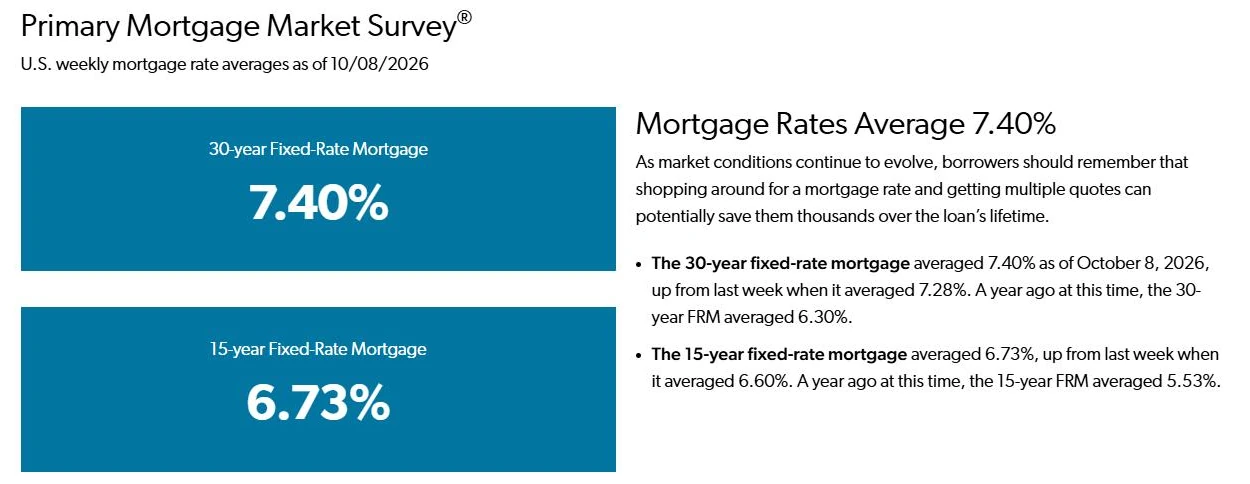
The 30-year average was 7.40% and the 15-year average 6.73% on October 8, 2026. Source: Freddie Mac.
The highest weekly average of 2023, 7.79% on October 26, is only 0.39 percentage points above today’s average.
The Federal Reserve raised its policy rate on September 16, 2026. Its next meeting is October 27 to 28.
Source: Federal Reserve, FOMC statement, September 16, 2026.
For where rates may head next, see mortgage rates in Fairfax County for 2026.
When does refinancing make sense in 2026?
When it solves a specific problem at a cost you can recover. These are the common reasons that still work at today’s rates.
| Goal | When it can work |
|---|---|
| Lower the rate | Your rate is well above current offers, and you will stay long enough to pass the break-even point |
| Leave an adjustable rate | Your ARM is close to a reset that would raise the payment |
| Drop FHA mortgage insurance | You have enough equity for a conventional loan without mortgage insurance |
| Take cash out | You need a large sum and the full cost beats a home equity line |
| Pay off sooner | You can afford a higher payment on a 15-year term |
General uses drawn from the CFPB’s “Should I refinance?” guide and ALCOVA Mortgage’s refinance pages. Not a recommendation for your loan.
If cash is the goal, compare both options in cash-out refinance vs HELOC.
How do you calculate a refinance break-even point?
Divide your total closing costs by your monthly savings. The result is the number of months until the refinance pays for itself.
| Rate change on $400,000 | New principal and interest | Monthly savings | Break-even at $6,000 in costs |
|---|---|---|---|
| 8.00% to 7.75% | $2,866 | $69 | 87 months |
| 8.00% to 7.50% | $2,797 | $138 | 44 months |
| 8.00% to 7.25% | $2,729 | $206 | 30 months |
| 8.00% to 7.00% | $2,661 | $274 | 22 months |
Illustration. Both payments are 30-year principal and interest on a $400,000 balance. The current payment at 8.00% is $2,935. The CFPB reported a 2022 median of $4,979 in total loan costs on refinance loans, so $6,000 is a cautious example. Months are rounded up. Your costs and savings will differ.
ALCOVA Mortgage says refinance closing costs are typically 2% to 5% of the loan amount.
The CFPB does not set a minimum rate drop. It says that if you expect to move in the next few years, you may not have time to recover the cost.
Source: CFPB, “Should I refinance?”; CFPB HMDA data point, September 27, 2023; ALCOVA Mortgage.
A new 30-year loan also restarts the clock. Ask for a shorter term, such as 20 or 25 years, if you want to keep your payoff date close.
Should you refinance to a 15-year mortgage?
Only if the higher payment fits your budget. You trade monthly room for much less interest.
| $400,000 loan | 30-year at 7.40% | 15-year at 6.73% |
|---|---|---|
| Monthly principal and interest | $2,770 | $3,535 |
| Total interest over the full term | $597,027 | $236,337 |
Illustration using the Freddie Mac averages for October 8, 2026. Taxes, insurance and mortgage insurance are not included.
To compare a fixed loan with an adjustable one, read fixed-rate vs adjustable-rate mortgages.
Which type of refinance fits your goal?
Each loan program has its own refinance rules.
| Refinance type | Key rules |
|---|---|
| Conventional rate-and-term | On a one-unit primary home, up to 97% loan-to-value on a fixed rate if Fannie Mae owns your current loan, otherwise 95%. No minimum score in Fannie’s automated system |
| Conventional cash-out | Up to 80% loan-to-value on a one-unit primary home. The current loan must be at least 12 months old |
| FHA Streamline | Current FHA loan, 210 days and six payments, a net tangible benefit, no cash out (at most $500 back at closing), usually no appraisal |
| FHA cash-out | Up to 80% of the home’s value |
| VA IRRRL | Fixed to fixed: rate at least 0.50 percentage point lower (2.00 if moving to an adjustable rate). Closing costs, not counting taxes, escrow or the funding fee, recouped through lower payments within 36 months. Six consecutive payments and 210 days past the first payment due date. 0.5% funding fee |
| VA cash-out | Up to 100% of the home’s value under VA rules; lenders may set lower limits. Funding fee 2.15% on first use, 3.3% after |
Sources: Fannie Mae Eligibility Matrix (August 5, 2026), Selling Guide B2-1.3-03 and B3-5.1-01; HUD Single Family Streamline and Mortgagee Letter 2019-11; FDIC Affordable Mortgage Lending Guide (FHA Streamline seasoning); 38 U.S.C. 3709; 38 CFR 36.4306; VA funding fee page, updated October 5, 2026. Lenders can add their own requirements.
VA borrowers can check fee exemptions in our guide to the VA funding fee.
If Fannie Mae or Freddie Mac owns your current loan and your income is at or below 100% of area median income, ask about Fannie Mae’s RefiNow or Freddie Mac’s Refi Possible. Fannie Mae says RefiNow has no expiration date. It requires a rate at least 0.50 percentage point lower and a lower payment. Both programs describe a $500 credit when an appraisal is needed.
How much more does a cash-out refinance cost?
Noticeably more. Fannie Mae’s pricing adds a larger upfront price adjustment to cash-out loans than to rate-and-term loans.
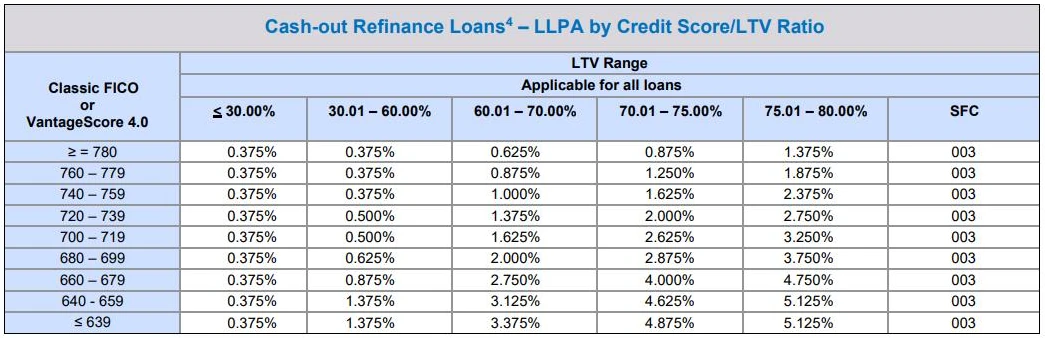
Cash-out refinance LLPAs from the matrix updated September 30, 2026. Source: Fannie Mae.
| Credit score, 75.01% to 80% LTV | Rate-and-term | Cash-out | Extra cost on $500,000 |
|---|---|---|---|
| 780 or higher | 0.500% | 1.375% | $4,375 |
| 740 to 759 | 1.125% | 2.375% | $6,250 |
| 700 to 719 | 1.875% | 3.250% | $6,875 |
| 660 to 679 | 2.500% | 4.750% | $11,250 |
Source: Fannie Mae Loan-Level Price Adjustment Matrix, September 30, 2026. Rate-and-term figures are for terms over 15 years. Lenders turn these charges into rate or points in different ways.
The CFPB notes that a cash-out refinance may be more or less expensive than a HELOC, depending on the terms.
Can refinancing get rid of mortgage insurance?
Yes, if you have enough equity for a conventional loan without it. This is one of the strongest reasons to refinance an FHA loan.
| Loan | When mortgage insurance ends |
|---|---|
| Conventional with PMI | Request removal when the balance is scheduled to reach 80% of original value; it generally ends automatically at 78%. After a refinance, the appraised value at the refinance becomes the original value |
| FHA, case number on or after June 3, 2013 | 11 years if the loan started at 90% loan-to-value or less; otherwise the life of the loan |
Sources: CFPB, When can I remove PMI?, modified August 31, 2026; HUD Mortgagee Letter 2013-04.
See all the options in how to get rid of PMI.
FHA program details are on our FHA loans page.
What does a refinance cost in Virginia, Maryland and DC?
Lender, title and appraisal fees apply everywhere. The big local difference is recordation tax.
| Location | Recordation tax on a refinance |
|---|---|
| Virginia | State tax on the full new loan at 18 cents per $100, plus a local tax of one-third of the state tax where the locality charges it |
| Maryland | No tax on the part that refinances the unpaid principal when the original borrower refinances and states the balance in the deed of trust or an affidavit. Any amount above that balance is taxed at the county rate |
| Washington DC | Fully exempt for a residential home with five or fewer units when the owner affidavit (ROD Form 21) is filed. Other refinances by the same borrower are generally taxed only on the amount above the old balance |
Sources: Va. Code 58.1-803(E) and 58.1-3800; Md. Code, Tax-Property 12-108(g); D.C. Code 42-1102(21) and OTR Tax Notice 2023-04.
Example: a $400,000 Virginia refinance carries $720 in state recordation tax and up to $240 in local tax.
A refinance usually opens a new escrow account too, with a new deposit at closing.
How do you get the best refinance offer?
Compare official Loan Estimates from more than one lender, and shop within a short window.
| Step | Why it matters |
|---|---|
| Request Loan Estimates from several lenders | Lenders must send one within three business days of your application |
| Shop within 45 days | The CFPB says mortgage credit checks in a 45-day window count as one inquiry |
| Compare total cost, not just the rate | Points, lender credits and fees change the break-even point |
| Lock when the numbers work | The CFPB says locks typically run 30, 45 or 60 days |
Sources: CFPB, What happens when a mortgage lender checks my credit?; CFPB Loan Estimate and rate lock explainers.
Freddie Mac research from 2023 estimated that, in late 2022, one extra quote could have saved a borrower up to $600 a year, and four or more quotes over $1,200 a year.
Learn where each fee sits in how to read your Loan Estimate.
What happens after you apply to refinance?
You get a Loan Estimate, then a Closing Disclosure at least three business days before closing.
On a refinance of your main home, you can generally cancel until midnight of the third business day after closing, or after you receive the required notice and disclosures if that is later. Saturdays count; Sundays and legal public holidays do not.
If the lender that originally made your current loan also makes the new one, the right to cancel generally covers only new money borrowed above your unpaid balance.
Source: 12 CFR 1026.23; CFPB rescission explainers.
Points paid on a refinance are generally deducted over the life of the loan, not all at once. From the 2026 tax year, borrowers who itemize can again deduct mortgage insurance premiums as mortgage interest. The deduction shrinks above $100,000 of adjusted gross income ($50,000 if married filing separately) and ends above $109,000 ($54,500).
Sources: IRS Publication 936, 2025 edition (points); Public Law 119-21, section 70108, and 26 U.S.C. 163(h) (2026 rules). Ask a tax adviser how this applies to you.
What are the alternatives to refinancing?
If you only want a lower payment and have a lump sum, a recast may cost far less.
| Option | How it works |
|---|---|
| Recast | Pay down the balance and the lender re-amortizes the loan. ALCOVA says most lenders charge a fee of around $250, with a lump sum typically $5,000 or more |
| Home equity line | Borrow against equity without replacing your first mortgage |
| Extra principal payments | Shorten the loan on your own schedule, with no closing costs |
Source: ALCOVA Mortgage, mortgage recast article, May 15, 2025. ALCOVA notes FHA, VA and USDA loans typically do not qualify for a recast.
See how mortgage recasting works.
Our refinance options are summarized on the refinance page.

Get a Mortgage Estimate for Free
See your break-even point with real numbers before you pay any closing costs.
✓Free, no obligation✓Licensed in VA, MD, DC and WV✓Loan officer Ken Byrne, NMLS #187129
Frequently asked questions
How much does the rate need to drop to refinance?
There is no official rule. Divide closing costs by monthly savings and compare the months with how long you plan to keep the loan.
How soon can you refinance after buying?
It depends on the loan. A Fannie Mae cash-out needs a loan at least 12 months old. FHA Streamline and VA IRRRL both need six payments and about 210 days of seasoning.
How much does it cost to refinance?
ALCOVA Mortgage says typically 2% to 5% of the loan amount. Local recordation tax and your credit pricing change the total.
Is a no-closing-cost refinance really free?
Usually not. The costs are often covered by a lender credit in exchange for a higher rate, or added to the loan.
Does refinancing hurt your credit score?
The credit check can lower it slightly. The CFPB says mortgage checks within 45 days count as one inquiry.
Can you refinance with a lower credit score?
Often. VA sets no minimum score, and FHA offers streamline refinances without credit qualifying. Lenders may set their own minimums, and lower scores pay more on conventional loans.
Should I refinance or get a HELOC?
If your current rate is low, a HELOC keeps it in place. A cash-out refinance replaces the whole loan at today’s rate.
Do I pay recordation tax when I refinance in DC?
Usually not, for a home with five or fewer units, when the owner affidavit is filed with the deed of trust.
Can I cancel a refinance after closing?
On your main home, generally yes, until midnight of the third business day. If your original lender makes the new loan, the right covers only new money borrowed.
This article is general information, not financial or legal advice, not tax advice and not a commitment to lend or an offer of credit. Rates, program rules and tax law change, and your terms depend on a full review of your credit, income, assets and the property. Payment figures are illustrations, not quotes. Confirm anything you plan to act on with a licensed mortgage professional and a tax adviser. Rates, rules and tax law were read on October 9, 2026.
Categories
Recent Posts








GET MORE INFORMATION

Broker Associate