
PMI in 2026: What It Costs, How to Avoid It and When It Goes Away

PMI is a monthly cost you can plan for, shrink with a better credit score and remove once you have enough equity.
Short answer: private mortgage insurance (PMI) is required on a conventional loan when you put less than 20 percent down. On a $500,000 home with 5 percent down, one insurer’s published rates put it at about $150 a month with a 760 credit score and $507 a month at 660. You can ask to cancel it when your balance reaches 80 percent of the home’s original value, it ends automatically at 78 percent, and you can remove it sooner if the home has gained value. Starting with tax year 2026, the premiums are deductible again for some households that itemize.
By Ken Byrne, NMLS #187129 · ALCOVA Mortgage LLC, NMLS #40508 · Updated October 2026
PMI protects the lender, not you, and nobody enjoys paying it. But it is also what lets buyers in Virginia, Maryland and DC purchase with 3 to 15 percent down instead of waiting years to save 20. This guide shows what PMI actually costs by credit score, the federal rules for when it comes off, how to remove it early, how it compares with FHA and VA, and when avoiding it makes sense. To price it for your own purchase, talk to Ken Byrne at JB Financing.
What is PMI and when is it required?
PMI is insurance a lender requires on a conventional loan with a down payment under 20 percent. If the loan defaults, the policy covers part of the lender’s loss. It does not pay your mortgage if you lose your job. Fannie Mae and Freddie Mac require it on any loan above 80 percent of the home’s value, including high-balance loans, and the amount of coverage rises as the down payment shrinks. Loan rules and options are on our conventional loans page.
| Down payment | Loan-to-value | Standard coverage the insurer provides |
|---|---|---|
| 3% to under 5% | 95.01% to 97% | 35% |
| 5% to under 10% | 90.01% to 95% | 30% |
| 10% to under 15% | 85.01% to 90% | 25% |
| 15% to under 20% | 80.01% to 85% | 12% |
| 20% or more | 80% or less | None required |
Fannie Mae Selling Guide B7-1-02 and B5-1-02; CFPB, What is private mortgage insurance.
The four ways to pay for PMI
| Type | How it works | Can you cancel it? |
|---|---|---|
| Monthly (borrower-paid) | A premium added to each mortgage payment; the most common | Yes, under federal law |
| Single premium | One payment at closing, which can be financed | No monthly premium to cancel |
| Split premium | A smaller upfront payment plus a lower monthly premium | Monthly part can be cancelled |
| Lender-paid | The lender pays and charges you a higher rate | No; it ends only when you refinance or pay off the loan |
CFPB; 12 U.S.C. 4905; insurer premium plan descriptions.
How much does PMI cost in 2026?
PMI is priced as a yearly percentage of the loan amount, divided by 12. Your credit score and down payment set the rate. These are the published monthly-premium rates from one national insurer for a 30-year fixed loan with standard coverage.
| Credit score | 3% down | 5% down | 10% down | 15% down |
|---|---|---|---|---|
| 760 or higher | 0.58% | 0.38% | 0.28% | 0.19% |
| 740 to 759 | 0.70% | 0.53% | 0.38% | 0.20% |
| 720 to 739 | 0.87% | 0.66% | 0.46% | 0.23% |
| 700 to 719 | 0.99% | 0.78% | 0.55% | 0.25% |
| 680 to 699 | 1.21% | 0.96% | 0.65% | 0.28% |
| 660 to 679 | 1.54% | 1.28% | 0.90% | 0.38% |
| 640 to 659 | 1.65% | 1.33% | 0.91% | 0.40% |
| 620 to 639 | 1.86% | 1.42% | 0.94% | 0.44% |
Enact Mortgage Insurance, monthly premium rate card for fixed-rate loans (effective June 22, 2023, updated July 17, 2025). One insurer’s base rates; adjustments apply, for example lower rates for two borrowers and higher rates for a debt-to-income ratio above 45%. Lenders and insurers price differently.
PMI on a $500,000 home
| Credit score | 3% down ($15,000) | 5% down ($25,000) | 10% down ($50,000) | 15% down ($75,000) |
|---|---|---|---|---|
| 760 or higher | $234 a month | $150 | $105 | $67 |
| 740 to 759 | $283 | $210 | $143 | $71 |
| 700 to 719 | $400 | $309 | $206 | $89 |
| 660 to 679 | $622 | $507 | $338 | $135 |
Calculated from the rates above: loan amount times the rate, divided by 12.
Two things stand out. A 100 point difference in credit score more than triples the cost at 5 percent down, and going from 5 to 10 percent down cuts the premium by about a third. Raising your score before you apply often saves more than a larger down payment. What lenders look for is in our down payment guide.

Get a Mortgage Estimate for Free
See your payment with mortgage insurance at your credit score and down payment.
✓Free, no obligation✓Licensed in VA, MD, DC and WV✓Loan officer Ken Byrne, NMLS #187129
When does PMI go away?
The federal Homeowners Protection Act gives you three ways out on a loan for your primary home, all measured against the original value: the lower of the price you paid or the appraised value at closing.
| Trigger | When | What you must do |
|---|---|---|
| Cancellation on request | Balance scheduled to reach, or actually paid down to, 80% of original value | Ask in writing, be current, have a good payment history, and show the value has not dropped and there is no second lien if the lender asks |
| Automatic termination | Balance scheduled to reach 78% of original value | Nothing, if you are current on payments |
| Final termination | The month after the midpoint of the loan term, such as year 15 of a 30-year loan | Nothing, if you are current |
12 U.S.C. 4901 and 4902; CFPB Compliance Bulletin 2015-03. Lender-paid mortgage insurance and FHA, VA and USDA loans are not covered by these rules.
The servicer must stop collecting within 30 days and return any unearned premium within 45 days. Automatic termination at 78 percent applies even if the home’s value has fallen.
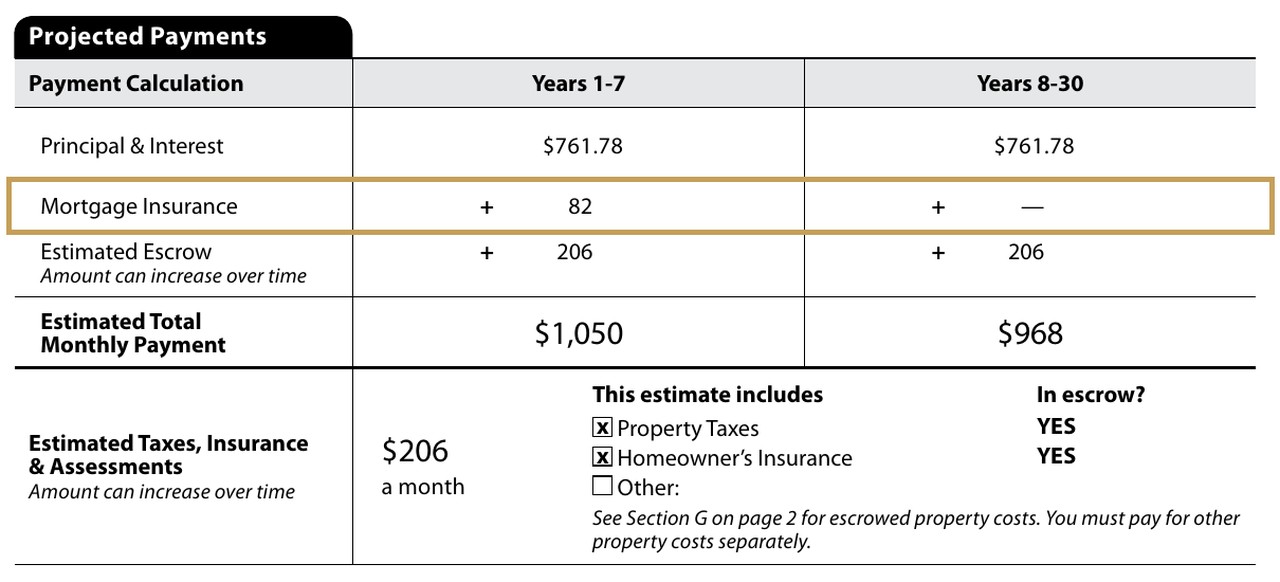
On a Loan Estimate, the Projected Payments table shows when mortgage insurance is expected to end. Source: Consumer Financial Protection Bureau sample Loan Estimate.
How long that takes on a normal payment schedule
| Down payment on a $500,000 home | Reaches 80% (you can ask) | Reaches 78% (automatic) |
|---|---|---|
| 3% | Month 143, about 11.9 years | Month 154, about 12.8 years |
| 5% | Month 133, about 11.1 years | Month 145, about 12.1 years |
| 10% | Month 104, about 8.7 years | Month 119, about 9.9 years |
| 15% | Month 63, about 5.2 years | Month 83, about 6.9 years |
30-year fixed at 7.28% (Freddie Mac average, October 1, 2026), no extra payments. A lower rate or extra principal payments shorten these times.
Left alone, the buyer with 5 percent down and a 740 score pays about $210 a month for 145 months, roughly $30,450 in total. That is why most owners should not wait for the automatic date. How this shows up on your loan paperwork is covered in our guide to reading your Loan Estimate.
How to remove PMI early
Pay the balance down
Extra principal payments move the 80 percent date closer. You can request cancellation as soon as the balance actually reaches 80 percent of the original value, not just when it was scheduled to.
Use the home’s current value
Fannie Mae also lets the servicer cancel PMI based on what the home is worth today, which helps if prices have risen or you have improved the house.
| How long you have had the loan | Loan must be at or below | Notes |
|---|---|---|
| 2 to 5 years | 75% of current value | One-unit primary or second home |
| More than 5 years | 80% of current value | One-unit primary or second home |
| Any time, after improvements that raised the value | 80% of current value | The two-year wait is waived |
| 2-to-4 unit or investment property | 70% of current value | More than two years |
Fannie Mae Servicing Guide B-8.1-04. Requires no payment 30 days late in the past 12 months or 60 days late in the past 24, and a valuation that includes an interior and exterior inspection. Since September 16, 2026, servicers may contact borrowers who appear to qualify (Lender Letter LL-2026-07). Freddie Mac loans have their own similar rules; ask your servicer.
Example: you bought for $500,000 with 5 percent down. After three years the balance is about $460,230. To cancel at 75 percent, the home must be worth about $613,600, a 23 percent gain. Just after five years the balance is about $447,900, and at 80 percent the home needs to be worth about $559,900, a 12 percent gain.
Refinance
If your home has gained value and rates make sense, a new loan at 80 percent or less of the current value has no PMI. Closing costs apply, so compare them with the premiums you would save. Options are on our refinance page.
Get Pre-Approved Today
Get pre-approved and compare PMI on a conventional loan with FHA and VA.
✓Free, no obligation✓Licensed in VA, MD, DC and WV✓Loan officer Ken Byrne, NMLS #187129
PMI vs FHA mortgage insurance vs the VA funding fee
| Conventional PMI | FHA | VA | USDA | |
|---|---|---|---|---|
| Upfront cost | None on monthly plans | 1.75% of the loan | Funding fee 1.25% to 3.3%; waived for some veterans | 1.00% guarantee fee |
| Monthly cost | About 0.19% to 1.86% a year by score and down payment | 0.50% to 0.75% a year | None | 0.35% a year |
| Depends on credit score | Yes, strongly | No | No | No |
| When it ends | On request at 80%, automatically at 78% | After 11 years with 10% or more down; otherwise the life of the loan | No monthly cost to end | Life of the loan |
HUD Mortgagee Letter 2023-05; VA.gov funding fee table (updated September 22, 2026); USDA Rural Development fiscal year 2027 fee notice; Enact rate card.
On a $500,000 home, FHA with 3.5 percent down costs about $221 a month in mortgage insurance plus an $8,444 upfront premium, and the monthly charge lasts for the life of the loan. Conventional with 5 percent down costs $210 a month at a 740 score and comes off. On the monthly premium alone, conventional is cheaper in this example from a 740 score up; below that, FHA’s flat premium can be lower, though it adds the upfront charge and usually never comes off. The full comparison is in our guide to FHA vs conventional loans.
Eligible veterans pay no monthly mortgage insurance at all. How the one-time fee works, and who is exempt, is in our VA funding fee guide.
How to avoid PMI without 20 percent down
| Option | How it works | Trade-off |
|---|---|---|
| VA loan | No down payment and no monthly mortgage insurance | Funding fee unless exempt; eligibility required |
| Piggyback second mortgage | An 80% first mortgage plus a second loan for part of the down payment | The second usually has a higher, often variable rate |
| Lender-paid PMI | The lender pays the premium and raises your rate | You cannot cancel it later |
| Single premium | Pay the whole premium at closing, sometimes with a seller credit | You may not get it back if you sell or refinance early |
| Some jumbo programs | Some published jumbo programs do not require PMI under 20% down | Stricter credit and reserve rules |
CFPB, What is a piggyback second mortgage; 12 U.S.C. 4905; published jumbo program guidelines (2026).
Avoiding PMI is not always the cheaper path. A higher rate for 30 years can cost more than a premium you remove in a few years. On larger loans the rules change again; see our guide to jumbo vs conforming loans.
Is PMI tax deductible in 2026?
Yes, again. The deduction for mortgage insurance premiums expired after 2021, and the tax law signed on July 4, 2025 restored it for tax years beginning after December 31, 2025. Premiums are treated as mortgage interest if you itemize. The deduction shrinks by 10 percent for each $1,000 of adjusted gross income over $100,000 ($50,000 if married filing separately), so it disappears above $109,000 ($54,500 if married filing separately). It covers private mortgage insurance and FHA, VA and USDA charges. The IRS had not yet published its 2026 guidance when we checked, so confirm with a tax professional.
26 U.S.C. 163(h)(3)(E) and (F), as amended by Public Law 119-21, section 70108.
How common is PMI in Virginia, Maryland and DC?
| State | Homeowners helped by PMI in 2025 (purchase and refinance) | Share who were first-time buyers | Average loan |
|---|---|---|---|
| Virginia | 18,982 | 53% | $436,659 |
| Maryland | 15,682 | 66% | $420,059 |
| Washington, DC | 1,105 | 69% | $540,530 |
| West Virginia | 2,744 | 64% | $257,786 |
U.S. Mortgage Insurers (industry trade group), MI in Your State report, August 2026.
Frequently asked questions
How much is PMI on a $500,000 house?
With 5 percent down, about $150 a month with a 760 credit score, $210 at 740 and $507 at 660, based on one insurer’s published rates. With 10 percent down, about $105, $143 and $338.
When does PMI go away?
You can request cancellation when your balance reaches 80 percent of the original value, and it ends automatically at 78 percent if you are current. It must end by the midpoint of the loan term.
Can I remove PMI if my home value went up?
Often, yes. On Fannie Mae loans the balance must be 75 percent or less of the current value after two to five years, or 80 percent or less after five years, with a clean payment history and a new valuation.
How do I avoid PMI?
Put 20 percent down, use a VA loan if eligible, use a piggyback second mortgage, or choose lender-paid or single-premium insurance. Each has a cost, so compare the totals.
Is PMI tax deductible in 2026?
Yes, for tax years beginning in 2026, if you itemize and your adjusted gross income is under $109,000; the deduction phases out starting at $100,000.
Is FHA mortgage insurance cheaper than PMI?
On the monthly premium it can be for credit scores below about 740, because FHA premiums do not vary by score. But FHA charges 1.75 percent upfront and, with less than 10 percent down, the monthly premium lasts for the life of the loan.
Does PMI protect me if I cannot pay my mortgage?
No. It protects the lender against loss if the loan defaults.
What credit score gets the lowest PMI?
760 or higher gets the best published rates. Each 20 point band below that costs more, and the jump is largest below 680.
Do I get a refund when PMI is cancelled?
Any unearned premium must be returned within 45 days of cancellation or termination.
Next stepStart Your Pre-Approval
Start online, and Ken Byrne’s team will show you the cost of each down payment option.
✓Free, no obligation✓Licensed in VA, MD, DC and WV✓Loan officer Ken Byrne, NMLS #187129
This article is general information, not financial or legal advice and not a commitment to lend or an offer of credit. Loan limits, program rules, premium schedules and rates change, and individual eligibility depends on a full review of your credit, income, assets and the property. Every figure here is an illustration, not a quote, built from published sources and a weekly survey average rather than underwriting decisions. Insurance and mortgage insurance amounts are planning estimates. Confirm anything you plan to act on with a licensed mortgage professional. Federal rules, Fannie Mae guidelines and published insurer rates were checked on October 2, 2026. PMI quotes vary by insurer and lender. This is not tax advice.
Categories
Recent Posts










GET MORE INFORMATION

Broker Associate