
What Is an Escrow Account? How Mortgage Escrow Works in 2026

An escrow account spreads your property tax and insurance bills across twelve monthly payments.
Short answer: an escrow account is an account your mortgage servicer uses to pay your property taxes and homeowners insurance for you. You pay one-twelfth of those yearly bills with each mortgage payment. The servicer can also hold a cushion of up to two months of escrow payments. It reviews the account once a year and raises or lowers your payment to match the bills.
By Ken Byrne, NMLS #187129 · ALCOVA Mortgage LLC, NMLS #40508 · Updated October 2026
This guide explains how mortgage escrow works, what you pay at closing, and what to do when the payment changes. Local tax dates cover Virginia, Maryland, Washington DC and West Virginia.
For a payment estimate with taxes and insurance included, talk to the Ken Byrne Team at JB Financing.
What is an escrow account?
An escrow account is set up by your lender to pay certain property costs on your behalf. It is also called an impound account.
The money comes from part of your monthly mortgage payment. The servicer holds it and pays the bills when they come due.
Source: Consumer Financial Protection Bureau, What is an escrow or impound account? Last reviewed September 11, 2024.
The word escrow is also used earlier in a home purchase. The two are different accounts.
| Purchase escrow | Mortgage escrow | |
|---|---|---|
| What it holds | Your earnest money deposit | Money for property taxes and insurance |
| When | From contract to closing | From closing for as long as the account stays open |
| Who holds it | A neutral third party, such as a title company or attorney | Your mortgage servicer |
| What happens to it | Applied to your purchase at closing | Paid out to the tax office and your insurer |
Based on CFPB key terms and an ALCOVA Mortgage article dated June 27, 2025.
The rest of this guide is about the mortgage escrow account.
What does a mortgage escrow account pay?
It typically pays your property taxes and your homeowners insurance premium. Flood insurance is included when the lender requires it.
| Cost | Usually paid from escrow? | Notes |
|---|---|---|
| Property taxes | Yes | Paid to your county or city on its due dates |
| Homeowners insurance | Yes | Paid to your insurer once a year |
| Flood insurance | Yes, when required | Listed in the federal definition of an escrow account |
| Mortgage insurance | Collected with your payment | Shown on its own line of the Closing Disclosure |
| HOA or condo dues | Usually no | The CFPB says these are usually paid separately |
Source: 12 CFR 1024.17(b); CFPB, total monthly payment explainer, last reviewed August 28, 2023.
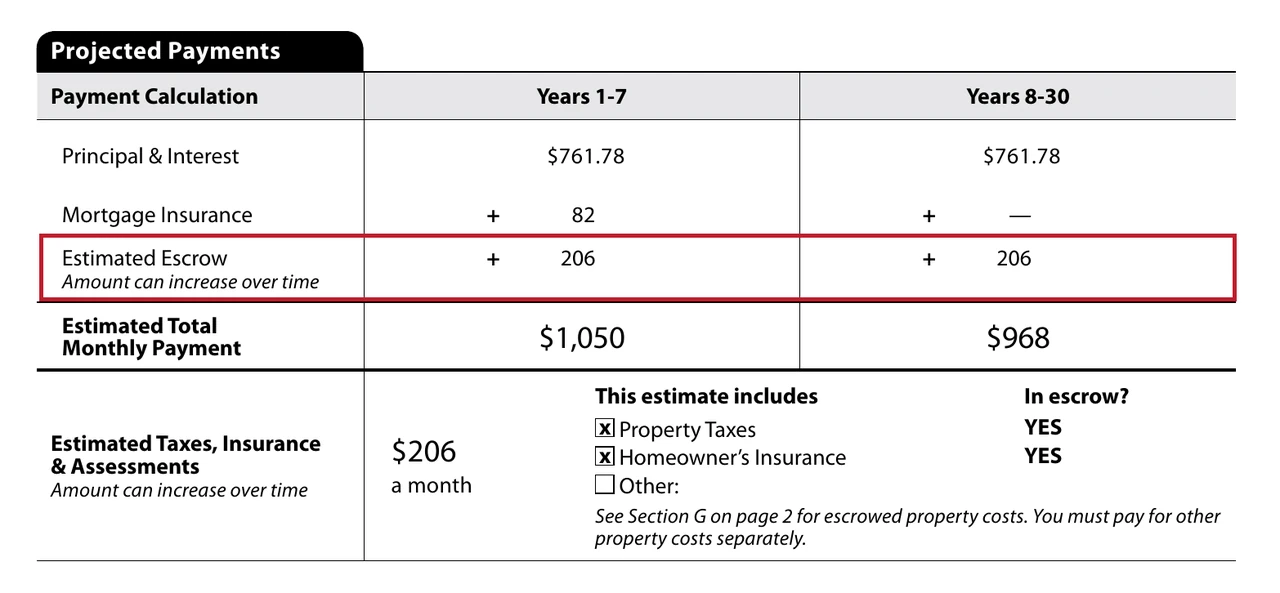
Estimated Escrow on page 1 of the CFPB sample Loan Estimate. Mortgage insurance has its own line. Source: Consumer Financial Protection Bureau.
Monthly mortgage insurance has its own rules. See our guide to what PMI costs and when it ends.
How is the monthly escrow payment calculated?
The servicer adds up the bills it expects to pay over the next year and divides by twelve. Federal rules also allow a cushion.
The cushion can be no more than one-sixth of the yearly total. That equals two months of escrow payments.
Source: 12 CFR 1024.17(c), Regulation X.
Here is an example for a Fairfax County home at the county’s average 2026 assessment.
| Item | Per year | Per month |
|---|---|---|
| Property tax, $829,895 at $1.1535 per $100 | $9,573 | $798 |
| Homeowners insurance, national average for mortgaged homes | $2,508 | $209 |
| Escrow payment | $12,081 | $1,007 |
| Largest cushion allowed, two months (a one-time balance, not a monthly charge) | $2,013 | |
| Principal and interest, $663,916 loan at 7.28% | $4,543 | |
| Total monthly payment | $5,549 |
Assessment: Fairfax County, mean 2026 assessed value of all improved residential property, February 17, 2026. Tax rate: 2026 base rate of $1.12 plus the countywide stormwater and pest levies. Insurance: ICE Mortgage Monitor national average, September 2026; your premium will differ. Rate: Freddie Mac 30-year average for October 1, 2026, used for illustration. Assumes 20 percent down. Figures are rounded to the dollar, so totals can differ by $1.
In this example, escrow is about 18 percent of the total payment.
How much is the initial escrow payment at closing?
It is the amount needed to start the account so it never runs short before the first bills, plus any cushion. The figure depends on your closing date and your local tax due dates.
On the Loan Estimate and the Closing Disclosure it appears on page 2 in section G, Initial Escrow Payment at Closing. Section F, Prepaids, sits just above it.
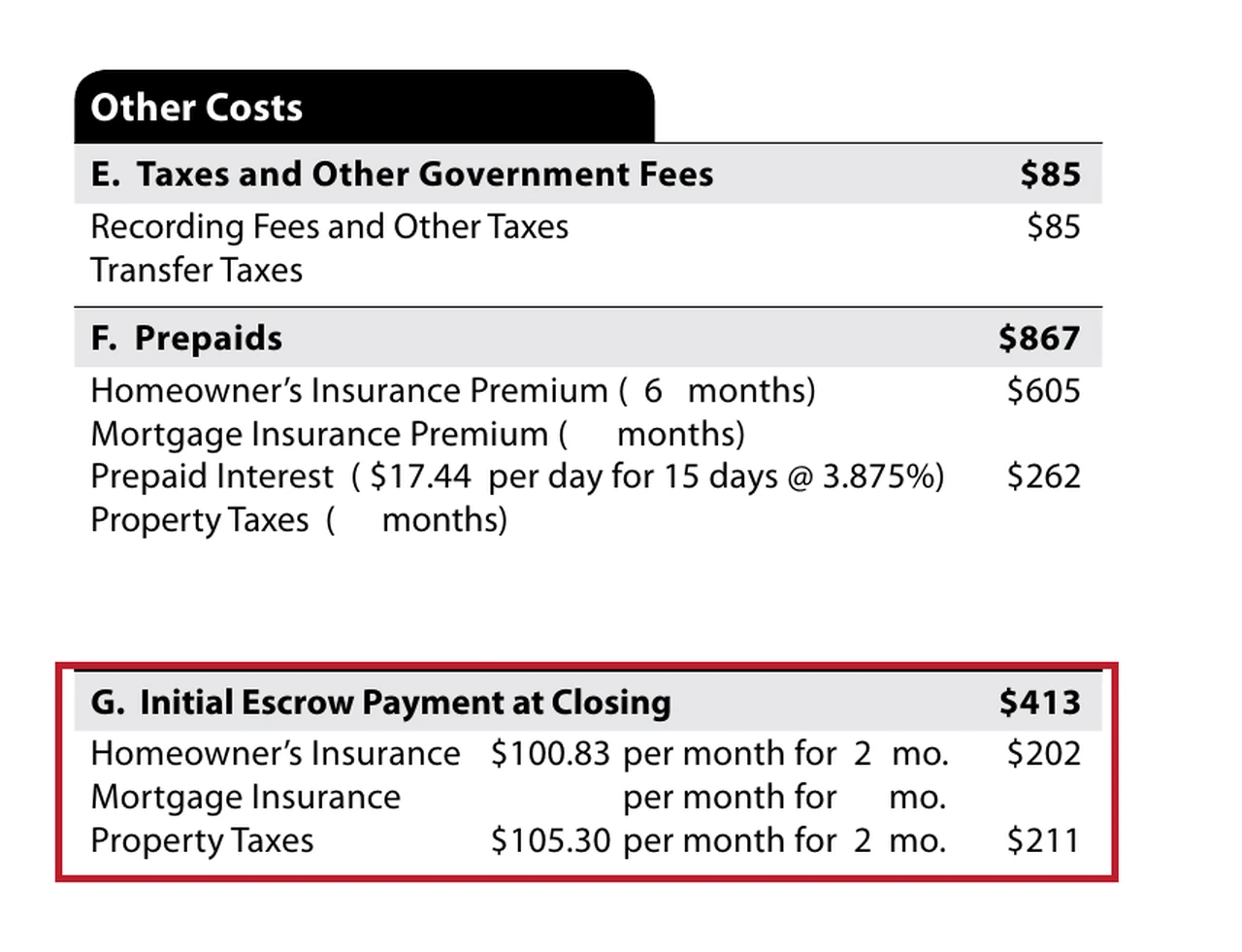
Sections F and G on the CFPB sample Loan Estimate. Source: Consumer Financial Protection Bureau.
| Section | What it is | Example on the CFPB sample forms |
|---|---|---|
| F. Prepaids | Bills paid in advance at closing, such as the first year of homeowners insurance and daily interest | $605 for six months of insurance and $262 of prepaid interest |
| G. Initial Escrow Payment at Closing | The starting balance of your escrow account | $413: two months of insurance and two months of taxes |
| Aggregate adjustment | A credit on the Closing Disclosure that keeps the total within the federal limit | Minus $0.01 on the sample Closing Disclosure |
Source: CFPB sample Loan Estimate and sample Closing Disclosure; 12 CFR 1026.37(g) and 1026.38(g).
Using the Fairfax example above, assume a September closing and a first payment on November 1. The December 5 tax bill is due after only two escrow payments.
| Step | Amount |
|---|---|
| Deposit needed so the account does not go negative in December | $2,773 |
| Two-month cushion, the most allowed | $2,013 |
| Initial escrow deposit | $4,786 |
Illustration using the aggregate method in 12 CFR 1024.17(d). It assumes the servicer pays tax bills in December and July, insurance renews each September, and the full two-month cushion is collected. A different closing date, payment schedule or cushion changes the result. Your Closing Disclosure shows the actual figure.
This deposit is your own money held for future bills. It is not a lender fee.
The early estimate appears on page 2 of your Loan Estimate. See how to read your Loan Estimate.
Is an escrow account required?
It depends on the loan. FHA and USDA loans require escrow. VA does not require it, so the lender decides. Conventional loans usually have it, with exceptions.
| Loan type | Escrow required? | Rule |
|---|---|---|
| FHA | Yes | The mortgage must provide for monthly payments toward taxes and insurance |
| USDA guaranteed | Yes | Lenders that can hold escrow must set up an account on every guaranteed loan |
| VA | Not by VA | VA does not require it. The lender must still make sure the bills are paid on time |
| Conventional (Fannie Mae) | Generally yes | A lender may waive it under a written policy. Monthly mortgage insurance must be escrowed |
| Higher-priced mortgage loan | Yes, for at least five years | Applies to a first mortgage on your main home with a rate well above the market average. Some loan types are exempt |
Source: 24 CFR 203.23; 7 CFR 3555.252(b)(1); VA Lenders Handbook, chapter 9; Fannie Mae Selling Guide B2-1.5-04; 12 CFR 1026.35(b).
A first mortgage on your main home is higher-priced when its annual percentage rate is at least 1.5 percentage points above the average prime offer rate. For jumbo loans above the Freddie Mac loan limit, the threshold is 2.5 percentage points.
Program rules are on our FHA loans page.
Veterans can compare options on our VA loans page.
Can you waive or remove escrow from your mortgage?
Sometimes, most often on a conventional loan. It is the lender’s decision at closing and the servicer’s decision later.
An ALCOVA Mortgage article says a conventional borrower with 20 percent or more down might be allowed to handle taxes and insurance directly. Ask for current requirements.
Fannie Mae does not let lenders base a waiver on the loan-to-value ratio alone. The lender must also consider whether you can handle the lump-sum bills.
After closing, a servicer of a Fannie Mae loan must deny a request to remove escrow in these cases:
| Reason for denial | Detail |
|---|---|
| Loan balance too high | The balance is 80 percent or more of the original appraised value |
| Recent late payment | Any delinquency in the past 12 months |
| Serious late payment | A delinquency of 60 days or more in the past 24 months |
| Prior modification | The loan was modified, or an earlier waiver was not kept current |
Source: Fannie Mae Servicing Guide B-1-01, published September 11, 2024; Selling Guide B2-1.5-04.
FHA and USDA rules call for escrow, and we found no waiver option in either. A higher-priced loan cannot drop it for at least five years, and only when the balance is under 80 percent of the original value.
A lender can charge a fee for waiving escrow. The Closing Disclosure has a line for an escrow waiver fee. Fannie Mae’s price adjustment chart of September 30, 2026 has no escrow waiver charge.
What is an escrow analysis?
It is the yearly review of your escrow account. The servicer compares what it collected with what it paid and sets your payment for the next twelve months.
| Document | When you get it | What it shows |
|---|---|---|
| Initial escrow statement | At closing or within 45 days | Your payment, the bills expected, their dates and the cushion |
| Annual escrow statement | Within 30 days after each escrow year ends | What was paid in and out, the balance, and any surplus or shortage |
| Short-year statement | When the servicer ends the escrow year early, such as after a mid-year review or a servicing transfer | The activity for the shortened year and any new payment |
Source: 12 CFR 1024.17(g) and (i); CFPB mortgage servicing FAQs.
What happens with an escrow shortage or surplus?
A surplus of $50 or more is refunded within 30 days. A shortage of one month’s escrow payment or more can only be collected over at least twelve months.
| Result of the analysis | What the servicer may do |
|---|---|
| Surplus of $50 or more | Must refund it within 30 days, if you are current |
| Surplus under $50 | Refund it or credit it to next year’s payments |
| Shortage under one month’s escrow payment | Leave it, ask for it within 30 days, or spread it over 12 months or more |
| Shortage of one month or more | Leave it, or spread it over 12 months or more |
| Deficiency under one month’s escrow payment | Leave it, ask for it within 30 days, or collect it in two or more equal monthly payments |
| Deficiency of one month or more | Leave it, or collect it in two or more equal monthly payments |
Source: 12 CFR 1024.17(f). These options apply when you are current on the loan. A deficiency is a negative balance.
For a larger shortage, the servicer cannot require one lump sum. You may choose to pay it at once to keep the monthly increase smaller.
Either way the base payment still rises to cover the higher bills going forward.
Why did my escrow payment go up?
Because your property tax or insurance bill went up. The principal and interest on a fixed-rate loan do not change, but the escrow part can change every year.
| Cause | Example |
|---|---|
| Higher assessment | Fairfax County single-family assessments rose 4.28 percent on average for 2026 |
| Higher tax rate | Arlington County raised its 2026 rate by 2 cents to $1.053 per $100 |
| Higher insurance premium | Nationally, the average property insurance payment on a mortgaged single-family home rose 8.7 percent in a year, to $209 a month |
| Maryland reassessment | Homes are reassessed every three years, with increases phased in |
| New construction | An early bill may cover only part of the year or only the land |
Source: Fairfax County, February 17, 2026; Arlington County, April 23, 2026; ICE Mortgage Monitor, September 2026 (national); Montgomery County Department of Finance (new construction); Maryland Department of Assessments and Taxation.
In the Fairfax example, suppose the tax bill rose 4.28 percent and the insurance premium rose 8.7 percent. The escrow payment would rise by about $52 a month, before any shortage is collected.
You can check the cause yourself. Compare the tax and insurance amounts on this year’s statement with last year’s.
A fixed rate protects only part of the payment. See fixed-rate vs adjustable-rate mortgages.
When are property taxes due in Virginia, Maryland, DC and West Virginia?
Most local governments bill twice a year. Your servicer pays each installment from escrow.
| Jurisdiction | Due dates | 2026 rate per $100 | Late penalty |
|---|---|---|---|
| Fairfax County, VA | July 28 and December 5 | $1.12 base | 10%, plus interest |
| Loudoun County, VA | June 5 and December 5 | $0.805 | 10%, plus interest |
| Prince William County, VA | July 15 and December 5 | $0.937 with countywide levies | 10%, plus interest |
| Arlington County, VA | June 15 and October 5 | $1.053 | 5%, then another 5% after 30 days, plus interest |
| City of Alexandria, VA | June 15 and November 15 | $1.135 | 5%, then 10% after 15 days, plus interest |
| Maryland, owner-occupied homes | September 30 and December 31 | Set by county | Montgomery County: 1 2/3% a month |
| Washington DC | March 31 and September 15 | $0.85, Class 1A | 10%, plus 1.5% a month |
| Berkeley County, WV | September 1 and March 1 | $1.2094 for owner-occupied homes outside towns, on 60% of value | 9% a year interest once delinquent. 2.5% discount if paid on time |
Source: county and city tax offices, the DC Office of Tax and Revenue, W. Va. Code 11A-1-3 and the Berkeley County Assessor, read October 7, 2026. Special district levies are not included. The Fairfax example above adds the stormwater and pest levies.
Maryland buyers can see how taxes fit into closing in our guide to closing costs in Maryland.
In Fairfax, Loudoun and Arlington you generally will not get a tax bill in the mail when your mortgage company pays it.
What happens to escrow when you refinance, sell or pay off the loan?
The servicer must return the remaining balance within 20 business days of payoff.
If your new loan is with the same lender or servicer, the balance can be credited to the new escrow account. You have to agree to that.
Source: 12 CFR 1024.34(b).
A refinance usually opens a new escrow account, with a new deposit at closing. Plan for the gap before the old balance comes back.
To weigh the costs, read should you refinance in 2026.
Does an escrow account earn interest?
No federal rule requires it. Some states do.
Maryland law requires banks, savings banks and savings and loan associations to pay interest on escrow balances, with some exceptions. The minimum rate is tied to the one-year Treasury yield.
That changed for some lenders in 2026. A federal banking regulator ruled that state laws like Maryland’s do not bind national banks or federal savings associations. The rule took effect June 18, 2026.
Maryland and nine other states sued in August 2026. Whether you earn interest depends on who services your loan.
Source: Md. Code, Commercial Law 12-109; Office of the Comptroller of the Currency, 91 FR 29350; Maryland Matters, August 12, 2026.
Virginia, Washington DC and West Virginia are not among the places named in that ruling.
Is it better to have escrow or pay taxes and insurance yourself?
Escrow is simpler and safer for most owners. Paying yourself gives you control of the cash, and all of the risk of a missed bill.
| With escrow | Paying yourself | |
|---|---|---|
| Budgeting | Twelve equal payments | One or two large bills a year |
| Missed due date | The servicer must pay on time while you are no more than 30 days late | You owe the penalty. In Fairfax County that is 10% of the installment |
| Cash on hand | The servicer holds up to a two-month cushion | You keep the money until the bill is due |
| Payment changes | The payment can change every year | No change to the mortgage payment |
| Insurance lapse | The servicer pays the premium | The lender can buy force-placed coverage, which the CFPB says typically costs more |
Source: 12 CFR 1024.17(k); Va. Code 6.2-414; Fairfax County Department of Tax Administration; CFPB.
In Virginia, a servicer that pays late while holding enough escrow funds is liable for the penalty.
Buying your first home? Start with our first-time homebuyer guide.
For the other costs due at settlement, see closing costs in Virginia.

Get a Mortgage Estimate for Free
See your payment with taxes and insurance included, before you make an offer.
✓Free, no obligation✓Licensed in VA, MD, DC and WV✓Loan officer Ken Byrne, NMLS #187129
Frequently asked questions
Is escrow included in closing costs?
The initial escrow deposit is listed on the Closing Disclosure under Other Costs, in section G. It is your money held for future bills, not a fee.
How much is the escrow cushion?
No more than one-sixth of the yearly escrow bills, which equals two months of escrow payments. A servicer may hold less.
Do you get escrow money back?
Yes, in two cases. A surplus of $50 or more is refunded within 30 days of the analysis if you are current. Any balance is returned within 20 business days after payoff.
What is the difference between an escrow shortage and a deficiency?
A shortage means the balance is below the target. A deficiency means the balance is negative because the servicer advanced money to pay a bill.
Can my servicer demand an escrow shortage in one payment?
Only when the shortage is less than one month’s escrow payment. A shortage of one month or more can only be collected over at least 12 months, unless you choose to pay it at once.
Is PMI part of my escrow payment?
It is collected with your monthly payment, and the servicer pays the premium for you. The Closing Disclosure lists mortgage insurance on its own line, next to estimated escrow.
Does my HOA fee go into escrow?
Usually not. The CFPB says homeowners association and condo fees are usually paid separately from the mortgage payment.
How often can my escrow payment change?
The servicer reviews it at least once a year and may change the payment then. It may also review the account at other times during the year.
What if my servicer pays my property taxes late?
The servicer must pay on time while you are no more than 30 days behind. In Virginia, it owes the late penalty if it held enough funds.
This article is general information, not financial or legal advice and not a commitment to lend or an offer of credit. Loan limits, program rules, premium schedules and rates change, and individual eligibility depends on a full review of your credit, income, assets and the property. Every figure here is an illustration, not a quote, built from published sources and a weekly survey average rather than underwriting decisions. Insurance and mortgage insurance amounts are planning estimates. Confirm anything you plan to act on with a licensed mortgage professional. Tax rates, due dates and rules were read on October 7, 2026 and can change. Examples are illustrations, not quotes. This is not tax or legal advice.
Categories
Recent Posts








GET MORE INFORMATION

Broker Associate