
Why Your Fairfax Home Isn't Selling (and How to Re-List Successfully in 2026)
Why Your Fairfax Home Isn't Selling (and How to Re-List Successfully in 2026)
By Ken Byrne, NMLS #187129 · ALCOVA Mortgage LLC, NMLS #40508 · Updated May 2026
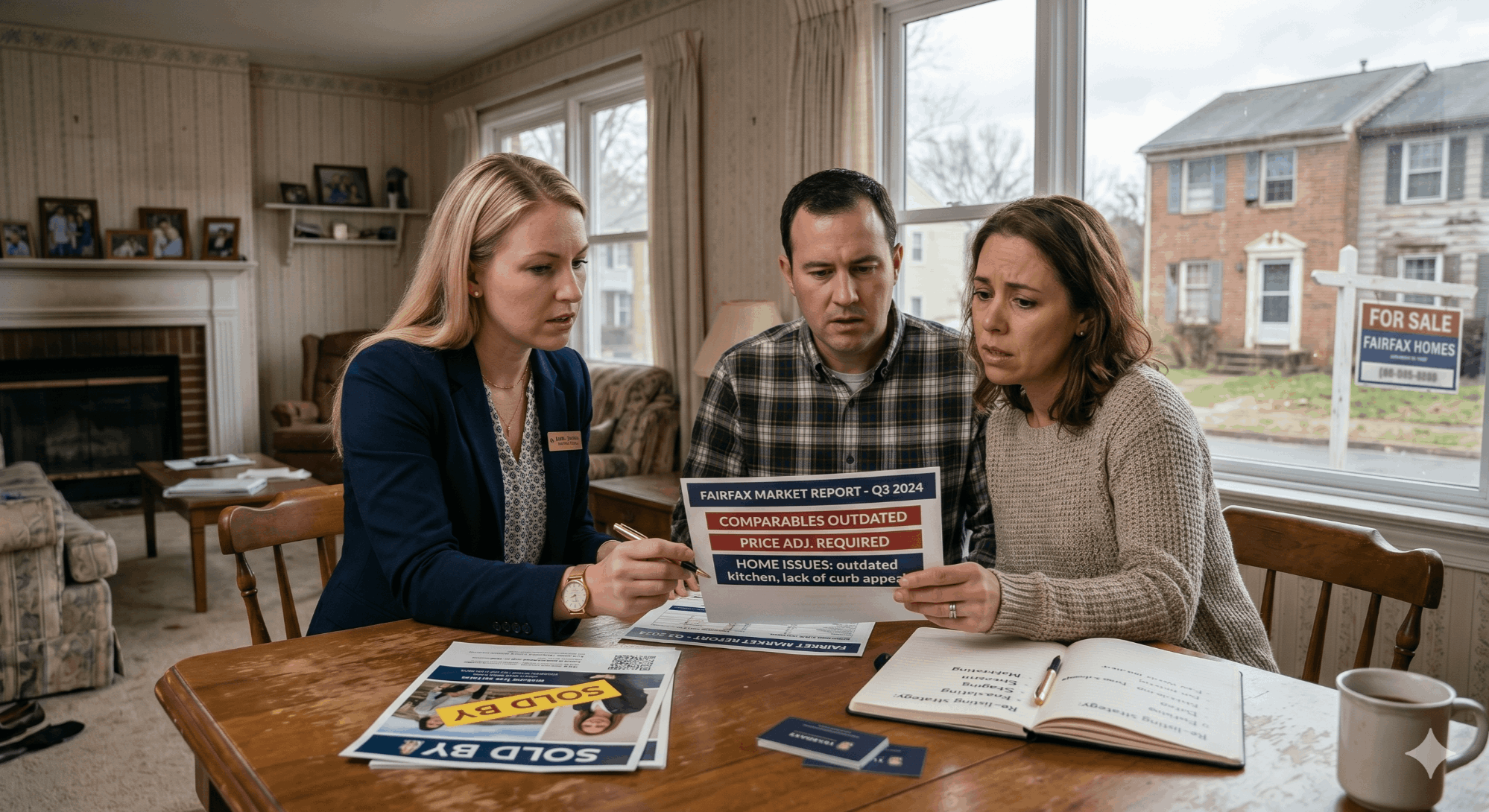
Quick Answer: Most Fairfax homes that don't sell suffer from one of three correctable problems — overpricing relative to recent comps, weak photography and marketing, or condition issues that scare off financed buyers. The fastest path to a successful re-list is to take the home off the market for at least 30–60 days, reset pricing based on current 2026 comps, professionally re-photograph the property, address obvious condition issues, and re-launch with a fresh MLS presentation and a strategic agent.
Key Takeaways
- Price is the #1 reason homes don't sell — In the Fairfax County market, homes priced 5–8% above comparable sales typically sit until reduced.
- "Days on market" hurts you — Buyers and their agents view listings over 60 days as either overpriced or flawed, triggering lowball offers.
- Financing-incompatible condition issues shrink your buyer pool — Peeling paint, missing handrails, and roof issues can disqualify FHA and VA buyers entirely.
- A 30–60 day market pause before re-listing resets the MLS "days on market" counter and signals a fresh opportunity.
- Re-list strategy > original strategy — New photos, new description, new price, and often a new agent are required to break the stigma of a failed listing.
- Saving on commission matters more when you re-list — A 1.5% listing fee can preserve thousands in seller proceeds after a price reduction.
Table of Contents
- The Fairfax County Market in 2026: What's Really Happening
- The Top 10 Reasons Fairfax Homes Don't Sell
- How to Diagnose Why Your Home Didn't Sell
- The Pricing Problem (and How to Fix It)
- Mortgage-Related Reasons Buyers Walk Away
- The 8-Step Re-Listing Strategy
- Withdraw, Cancel, or Let It Expire?
- Resetting Your Marketing for the Re-List
- Choosing the Right Agent for Your Re-List
- Planning Your Next Move (Buy and Sell Coordination)
- Frequently Asked Questions
- Glossary
The Fairfax County Market in 2026: What's Really Happening
If your Fairfax County home didn't sell, you're not alone — and you're not necessarily in a bad market. Fairfax County remains one of the most desirable housing markets in the country, with strong school districts, federal job stability, and consistent inbound migration from the broader DMV region. But the buyer behavior in 2026 is fundamentally different from the frenzied 2021–2022 market, and many sellers (and agents) are still pricing and marketing as though it's 2022.
Today's Fairfax buyer is patient, well-informed, and rate-conscious. With mortgage rates settled into a higher-than-pandemic-era range, buyers can no longer absorb overpricing the way they did when rates were sub-3%. Every $50,000 you overprice translates into a meaningfully larger monthly payment for the buyer — and pre-approved buyers are doing that math before they even tour your home.
The result: well-priced, well-presented Fairfax homes still sell quickly. Overpriced or poorly presented homes sit. That's the diagnostic line you need to honestly evaluate.
The Top 10 Reasons Fairfax Homes Don't Sell
In nearly every "didn't sell" case I see across Fairfax County, the root cause falls into one of these 10 categories. Most stalled listings have two or three of these working against them simultaneously.
| Reason | How Common | Fix Difficulty |
|---|---|---|
| 1. Overpriced vs. comparable sales | ~60% of cases | Easy (price reduction) |
| 2. Poor listing photos | ~50% | Easy (re-shoot) |
| 3. Visible condition issues | ~40% | Moderate |
| 4. Outdated kitchens/baths in renovated neighborhoods | ~30% | Hard (renovation) or Easy (price) |
| 5. Weak MLS description / no story | ~35% | Easy (rewrite) |
| 6. Restricted showing access | ~25% | Easy |
| 7. Poor curb appeal / clutter | ~30% | Easy to Moderate |
| 8. Listed at wrong time of year | ~20% | Easy (re-time) |
| 9. Financing-incompatible defects (FHA/VA) | ~20% | Moderate |
| 10. Wrong agent/marketing strategy | ~25% | Easy (switch) |
Notice that the most common problems are also the easiest to fix. Most homes that didn't sell on the first attempt sell quickly on a thoughtful re-list — they just needed honest diagnosis and a strategic reset.
Save Thousands When You Re-List
List Your Fairfax Home for Just 1.5%
After a failed listing, every dollar of seller proceeds matters. Our full-service 1.5% listing program saves Fairfax sellers thousands compared to the traditional 3% listing commission — without cutting service or marketing.
How to Diagnose Why Your Home Didn't Sell
Before you re-list, you need an honest, objective assessment of what went wrong. The temptation is to blame "the market" — but the same Fairfax County market is producing successful sales every week. Here's how to run a proper post-mortem.
Step 1: Pull Your Showing Data
Ask your agent for the showing log. The pattern of activity tells you exactly what went wrong:
- Lots of showings, no offers → It's a condition, layout, or in-person presentation problem. Buyers came, then left disappointed.
- Few showings, no offers → It's a pricing or online-presentation problem. Buyers aren't even interested enough to schedule a tour.
- Showings dropped off after week 2 → You launched at the wrong price; the home went stale once initial interest cleared.
- Lowball offers, no acceptable bids → Buyers see the home as overpriced; they're testing for a motivated seller.
Step 2: Compare Your Listing to Recent Sold Comps
Pull every comparable home in your Fairfax neighborhood that did sell in the past 90 days. Compare:
- Price per square foot — were you 5–10% above the average sold price/sqft?
- Photo quality — do the sold homes have visibly better photography?
- Condition and updates — were the sold homes more updated than yours?
- Time on market — did the sold homes get offers in the first 14 days, suggesting they were priced right?
Step 3: Get a Second Opinion CMA
Don't rely on the same agent who failed to sell your home for the new price analysis. Have at least two other local Fairfax County agents prepare a fresh Comparative Market Analysis. If their numbers converge well below your original list price, you've found the problem.
The Pricing Problem (and How to Fix It)
Roughly six out of ten failed Fairfax listings are fundamentally a pricing problem. The math is brutal but simple: in a market where pre-approved buyers are working from strict monthly-payment budgets, a home priced 5% above comps gets ignored. A home priced 10% above comps doesn't even appear in most buyers' MLS searches because they've capped their price filter at a realistic ceiling.
Here's how price reductions typically play out for stalled Fairfax listings — and why a clean re-list usually beats a chain of reductions.
Price Reduction Patterns: Stale Listing vs. Clean Re-List
Stale Listing — Price Drop Sequence
Clean Re-List — Right-Priced From Day 1
Illustrative example. The stale listing left $54K on the table and took 4× longer to close.
The math is counterintuitive but consistent: chasing the market down with serial price reductions almost always nets less than starting at the right price. Each reduction signals desperation to buyers, who then make offers below your reduced price. Meanwhile, the days-on-market counter keeps climbing, further damaging your negotiating position.
Run the Numbers
What Will Buyers Actually Pay Per Month?
Buyers are pricing your home in monthly payments, not list price. See what your asking price translates to for a pre-approved buyer in today's rate environment.
Mortgage-Related Reasons Buyers Walk Away
This is the part most sellers — and even many agents — overlook. A surprising number of Fairfax homes don't sell because of financing issues, not price or marketing. As a mortgage lender, here are the most common patterns I see disqualify otherwise interested buyers.
1. Appraisal Risk Above Comps
When you price a home above recent comparable sales, you create appraisal risk. Even a buyer who agrees with your asking price can't get the loan if their lender's appraisal comes in lower. The deal collapses, or the buyer has to bring extra cash to close the gap — which most buyers won't or can't do. Sophisticated buyers and their agents avoid these situations entirely. They see your overpriced listing and don't even submit an offer.
2. FHA and VA Condition Standards
A meaningful portion of the Northern Virginia buyer pool uses FHA or VA financing — first-time buyers, military buyers near Fort Belvoir and Quantico, and households without a 5%+ down payment. Both loan programs have property condition requirements (FHA minimum property standards and VA Minimum Property Requirements) that disqualify homes with:
- Peeling or chipping paint (especially on homes built before 1978 due to lead-based paint rules)
- Missing handrails on stairs with 3+ risers
- Exposed wiring or unsafe electrical conditions
- Active roof leaks or significantly damaged roofing
- Broken or missing window glass
- Inoperable HVAC, plumbing, or major appliances (in the case of FHA)
- Wood-destroying organism activity (termites, wood rot)
If your home has any of these issues, you've quietly eliminated a significant portion of your buyer pool — and you may not even know it until you fix the issue and re-list.
3. HOA Documentation Problems
Many Fairfax County neighborhoods are governed by HOAs (Burke Centre, Reston, Franklin Farm, South Riding, and others). If the HOA has pending litigation, inadequate reserves, or special assessments, condo and HOA buyers using conventional financing may be unable to close. This is especially common for condominiums where Fannie Mae and Freddie Mac perform project reviews. Check with your association before re-listing.
4. Unpermitted Additions or Conversions
Finished basements, sunrooms, and bonus rooms added without permits create appraisal and insurability issues. The square footage may not count toward the appraised value, and lenders may flag the property as non-conforming.
The 8-Step Re-Listing Strategy
Here's the proven sequence for taking a stalled Fairfax listing and re-launching it successfully. Don't skip steps — each builds on the previous one.
Pull the home off the market for at least 30 days
In Bright MLS, this is a "Temporarily Off Market" (TOM) or "Withdrawn" status change. Thirty days is the minimum to refresh the listing properly. Sixty to ninety days is better if you have the flexibility — it gives the days-on-market counter a clean reset when you re-launch.
Get a fresh, independent CMA
Have two new agents prepare comparative market analyses. Don't accept generic "auto-valuations" — you want a hands-on analysis of the last 90 days of sold Fairfax comps in your immediate neighborhood, adjusted for your home's specific features.
Address all visible condition issues
Touch-up paint, replace burnt-out bulbs, deep-clean carpets, repair handrails, fix obvious cosmetic flaws. Get a pre-listing inspection if there's any doubt about major systems. Eliminating buyer objections before they see the home is the single highest-ROI step you can take.
Stage strategically
If the home is occupied, declutter ruthlessly. If vacant, consider virtual or partial physical staging for key rooms (living room, primary bedroom, kitchen). Staged homes in Fairfax County consistently photograph better and sell faster.
Hire a professional photographer (different from your first one)
A new set of photos signals "new listing" rather than "rejected listing." Insist on professional photography, drone photography for properties with notable yards or community amenities, and a 3D virtual tour. The cost is typically a few hundred dollars and produces meaningful return.
Rewrite the MLS description
Don't copy and paste the old description. Lead with what's most compelling about the home — the school pyramid, the commute, the renovated kitchen, the lot. Be specific. "Updated home in great location" tells buyers nothing.
Re-list at a strategically right price
Price slightly under fair market value if you want to generate competitive bids. Price at fair market value if you want a clean sale within 14–21 days. Do not "test" the market with an aspirational price — that's exactly what failed the first time.
Launch with a coordinated marketing push
Re-launch on a Thursday or Friday with social media, paid digital ads, broker open house, and weekend public open house. A re-list should not look like a quiet republication of the old listing — it should look like the freshest listing on the market.
Withdraw, Cancel, or Let It Expire?
There are three different ways to end a listing in Bright MLS, and they have different implications for your re-list strategy.
| Status | What It Means | When to Use It |
|---|---|---|
| Withdrawn | Listing pulled from active marketing but contract with agent remains in effect. | When you plan to make changes (price, photos, condition) and re-list with the same agent. |
| Canceled | Both the MLS listing and the listing agreement are terminated. | When you want to switch agents or take an extended break before relisting. |
| Expired | The listing contract reached its end date without a sale. | When the listing agreement simply runs out and you're evaluating next steps. |
If you want to switch agents — which is often a good idea after a failed listing — you'll typically need a "Cancellation of Listing" signed by both you and your current agent. Most listing agreements include language about cancellation; review your contract or have a real estate attorney review it before making the change. Note that some listing agreements include a "protection period" that entitles the agent to a commission if the home sells to a buyer they previously introduced, even after termination — clarify this carefully.
Resetting Your Marketing for the Re-List
The single biggest mistake on a re-list is republishing the old listing with a lower price. Buyers and their agents notice. Sophisticated buyer agents in Fairfax County run "Bright MLS history" reports on every property — they see your previous listing history, all your price reductions, and your withdrawal date. To meaningfully reset perception, you need to materially change the listing.
The Five-Point Marketing Reset
- New primary photo — A different angle, different time of day, different season if possible.
- Rewritten description — Don't recycle the old copy. Different hook, different opening line, different selling point emphasized first.
- New video and 3D tour — If you didn't have these before, add them. If you did, reshoot.
- Updated room descriptions and feature lists — Highlight any improvements or staging changes.
- Strategic open house timing — A well-promoted broker open house plus a weekend public open house signals a new launch.
Best Time to Re-List in Fairfax County
Spring (March through May) remains the strongest seller's window in Northern Virginia, driven by federal job moves, military PCS season, and families wanting to be settled before the school year. The second-best window is post-Labor Day through mid-October. The weakest periods are mid-November through January, when serious buyers are scarce and inventory looks stale by comparison. If you can time your re-list to a peak window, you'll see more activity and stronger offers.
Free · No Commitment
Get Pre-Approved for Your Next Home
If you're selling to buy, pre-approval is the foundation. Know exactly what you qualify for in the DMV before your home re-lists — and submit competitive offers without delay.
Ken Byrne NMLS #187129 · ALCOVA Mortgage LLC NMLS #40508
Choosing the Right Agent for Your Re-List
If your home didn't sell, the original agent and listing strategy did not work. That doesn't necessarily mean your agent was bad — but it does mean the same person who priced and marketed the home the first time may not be the right choice the second time. Here's what to evaluate honestly when deciding whether to switch.
Questions to Ask Before Choosing a Re-List Agent
- How many homes have you successfully re-listed and sold in Fairfax County in the past 12 months?
- Can you show me your pricing analysis based on the past 90 days of sold comps in my neighborhood?
- What specific marketing changes would you make for the re-list?
- Will you use professional photography, video, and 3D tours? Are these included in your fee?
- What is your listing commission, and what's included for that price?
- What is your average days-on-market for listings in my price range?
- Will you handle pricing strategy or just publish the price I want?
The 1.5% Listing Option
Traditional listing commissions in Northern Virginia are typically 2.5–3% of the sale price. After a failed listing — where you've likely also reduced the price, paid for staging or repairs, and absorbed carrying costs — that commission becomes especially painful. A full-service 1.5% listing program from a qualified local team can preserve thousands in seller proceeds without sacrificing the marketing, staging consultation, professional photography, MLS exposure, and contract negotiation that a successful sale requires.
Full-Service · Local · 1.5% Listing Fee
Re-List Your Fairfax Home for 1.5%
Professional photos, full MLS marketing, staging consultation, pricing strategy, and full contract negotiation — at half the cost of a traditional listing. Learn how Fairfax sellers are keeping more of their equity.
Planning Your Next Move (Buy and Sell Coordination)
Most Fairfax sellers are also buyers — they're selling because they want to move up, downsize, relocate within the DMV, or move closer to family. A failed listing throws off this timeline and creates additional stress. Here are the financing options worth understanding as you plan the re-list and the next purchase.
Option 1: Sell First, Then Buy
The simplest and lowest-risk path. You sell your current home with a temporary rental contingency or extended closing, then buy your next home with the proceeds. Pros: maximum certainty on your purchasing power, no need for bridge financing. Cons: you may have an interim housing period (a few weeks of rental or family stay).
Option 2: Buy First Using Home Equity
If you have substantial equity, you can use a HELOC or cash-out refinance on your current home to fund the down payment on your next home. You then sell your current home after moving. Pros: no temporary housing, you can move once. Cons: you carry two payments temporarily, and you need to qualify for both mortgages simultaneously.
Option 3: Contingent Purchase Offer
You make an offer on your next home contingent on the sale of your current one. In most Fairfax County conditions, this is a weak offer position — sellers typically prefer non-contingent buyers. This option works best in slower micro-markets or with motivated sellers.
Option 4: Bridge Loan
A short-term loan that uses your current home's equity to fund the new purchase. You repay the bridge loan when your current home sells. Bridge loans are less common than HELOCs but useful for specific situations.
Whichever path you choose, your first step is pre-approval. Knowing exactly what you qualify for — and how much down payment your equity can produce — gives you the leverage to time the re-list and the next purchase strategically.
Ready to Search Your Next Home?
Browse Homes for Sale in Northern Virginia
Once your pre-approval is in hand, explore available homes across Fairfax, Loudoun, Prince William, Arlington, and Alexandria.
Frequently Asked Questions
Why isn't my Fairfax home selling?
In roughly 60% of cases, the home is overpriced relative to recent sold comparables in your specific Fairfax County neighborhood. Other common reasons include weak listing photography, visible condition issues that scare off financed buyers, an uncompelling MLS description, restricted showing access, or financing-incompatible defects that disqualify FHA and VA buyers.
How long should I wait before relisting my Fairfax home?
At minimum, take the home off the market for 30 days. Sixty to ninety days is better — it gives the Bright MLS "days on market" counter a more meaningful reset and lets you use the pause to address condition, staging, and photography issues. Some MLS systems reset the cumulative days-on-market counter after a longer gap; ask your agent how the local Bright MLS rules currently work.
Can I switch agents if my home didn't sell?
Yes, but you need to formally terminate your listing agreement first. Most listing contracts include cancellation language; you'll typically sign a "Cancellation of Listing" with your current agent before signing with a new one. Watch for any "protection period" clauses that entitle the original agent to a commission if you later sell to a buyer they previously introduced. Have a real estate attorney review the listing agreement if you're unsure.
Does the "days on market" counter ever reset?
In Bright MLS, the "Days on Market" (DOM) counter typically resets when a listing has been off-market for a sufficient period — historically 90 days — though the cumulative "Cumulative Days on Market" (CDOM) often follows the home longer. Buyer agents can usually see the full listing history regardless. The honest answer is that the reset helps perception more than it hides history. Your re-list needs to look meaningfully different — new photos, new price, new description — to truly start fresh.
How much should I reduce my price when relisting?
Don't think in terms of "how much to reduce" — think in terms of correct market price. Use a fresh CMA from two qualified agents to determine fair market value based on the last 90 days of sold comps. Price the re-list at or slightly under that value to generate competitive interest. Pricing 2–3% under fair market value is often the strategy that produces multiple offers and ends up at or above the original list price.
Should I do repairs before re-listing or sell "as-is"?
For visible cosmetic issues — paint, lighting, landscaping, deep cleaning — almost always fix them. The ROI is strong. For larger items like roofs, HVAC, or major systems, do the math. If the repair would expand your buyer pool (especially to FHA and VA buyers), it's often worth it. If you choose "as-is," you'll need to price for it explicitly — buyers won't reward as-is pricing that looks like market pricing.
What is the typical listing commission in Fairfax County?
Traditional listing commissions in Northern Virginia typically range from 2.5% to 3% of the sale price, paid to the listing brokerage. A buyer's agent is separately compensated, typically by the buyer in today's post-NAR-settlement environment, though sellers may still choose to offer concessions or compensation. Reduced-fee programs, such as 1.5% listing services, can save sellers thousands while delivering full marketing and negotiation support.
Is it a good time to sell a home in Fairfax County in 2026?
Fairfax County remains a fundamentally strong seller's market for well-priced, well-presented homes. Inventory remains constrained, buyer demand is steady (driven by federal employment, military households, and inbound DMV migration), and the spring and early-fall windows produce particularly strong activity. Overpriced or poorly presented homes still sit — buyers are disciplined, not desperate.
How do FHA and VA loan property standards affect my Fairfax home's saleability?
FHA Minimum Property Standards and VA Minimum Property Requirements disqualify homes with peeling paint (especially pre-1978 homes), missing handrails, active roof leaks, broken windows, unsafe electrical, or wood-destroying organism activity. Since FHA and VA buyers make up a meaningful portion of the Northern Virginia market — particularly first-time buyers and military households near Fort Belvoir, Quantico, and the Pentagon — these issues can quietly disqualify a large share of your buyer pool.
Should I get a pre-listing inspection before re-listing?
For a home that didn't sell the first time, yes — strongly recommended. A pre-listing inspection identifies the exact issues that may have scared off previous buyers, gives you the chance to fix or disclose them upfront, and removes negotiation leverage from the next buyer's inspection. The inspection typically costs $400–$700 and is one of the highest-ROI moves you can make for a re-list.
How do I find a good mortgage lender if I'm selling and buying in Fairfax County?
Look for a licensed local lender who has substantial Fairfax County and DMV experience, transparent fee disclosures, responsive communication, and the ability to structure financing creatively (HELOC, cash-out refi, bridge loans) if you're selling and buying simultaneously. Ken Byrne, NMLS #187129, of ALCOVA Mortgage LLC (NMLS #40508) is licensed in Virginia, Maryland, DC, and West Virginia and specializes in financing solutions for DMV homebuyers, including buy-and-sell coordination.
Can I use my current home's equity to buy my next home before mine sells?
Yes. The two most common paths are a HELOC (home equity line of credit) drawn against your current home or a cash-out refinance, either of which can produce the down payment for your next purchase. You'll need to qualify for both mortgages simultaneously, which means your debt-to-income ratio must support carrying both payments temporarily. A licensed mortgage professional can model the scenario for your specific income, equity, and price targets.
Glossary
- Comparative Market Analysis (CMA)
- A pricing report prepared by a real estate agent comparing your home to recently sold, currently active, and recently expired listings in your immediate market to estimate fair market value.
- Days on Market (DOM)
- The number of days a listing has been actively marketed on the MLS. Cumulative Days on Market (CDOM) follows the property across multiple listings.
- FHA Minimum Property Standards
- Federal Housing Administration property condition requirements that a home must meet to qualify for FHA financing. Includes rules on paint condition, handrails, roofing, electrical safety, and major systems.
- VA Minimum Property Requirements (MPR)
- Department of Veterans Affairs property condition standards for VA-financed home purchases. Similar to FHA standards with additional emphasis on safety, sanitation, and structural integrity.
- Bright MLS
- The multiple listing service covering most of the Mid-Atlantic, including Virginia, Maryland, DC, Delaware, and Pennsylvania.
- Withdrawn vs. Canceled vs. Expired
- Three different MLS statuses for ending a listing. Withdrawn pulls the listing but keeps the agent agreement; canceled terminates both; expired means the listing agreement reached its end date.
- HELOC
- Home Equity Line of Credit. A revolving credit line secured by your current home's equity, often used to fund down payments or short-term needs while a home sells.
- Bridge Loan
- A short-term loan that uses your existing home's equity to fund the purchase of your next home, repaid when the existing home sells.
Disclaimer: This article is for informational purposes only and does not constitute financial, legal, or real estate advice. Mortgage programs, rates, and eligibility requirements are subject to change. Real estate market data, commission structures, and listing practices vary by market and brokerage. Contact a licensed mortgage professional and licensed real estate professional for guidance specific to your situation. Ken Byrne, NMLS #187129 · ALCOVA Mortgage LLC, NMLS #40508 · Licensed in VA, MD, DC, WV.
Categories
Recent Posts






GET MORE INFORMATION

Broker Associate