
What Are Seller Concessions? 2026 Limits by Loan Type and How They Work

A seller concession is negotiated in the contract and shows up as a credit at closing.
Short answer: seller concessions are closing costs the seller agrees to pay for the buyer, usually as a credit at closing. The limits depend on your loan: 3%, 6% or 9% of the price or appraised value on a conventional loan (2% for an investment property), 6% on FHA and USDA loans, and 4% of reasonable value on a VA loan, where normal closing costs paid by the seller do not count toward the 4%. Concessions cannot pay your down payment and cannot be more than your actual closing costs.
By Ken Byrne, NMLS #187129 · ALCOVA Mortgage LLC, NMLS #40508 · Updated October 2026
In a market where buyers are stretching to cover cash to close, a seller credit can be worth as much as a lower price, and sometimes more. This guide explains what seller concessions are, how much each loan type allows in 2026, what they can and cannot pay for, and how a credit compares with a price reduction.
If you are writing an offer and want to know how much credit your loan can actually use, Ken Byrne at JB Financing can run the numbers before you sign.
What are seller concessions?
Seller concessions, also called seller credits or seller-paid closing costs, are costs the seller agrees to cover for the buyer as part of the purchase contract. The most common form is a dollar credit toward your closing costs. Concessions can also pay for prepaid items such as homeowners insurance and property tax escrows, discount points, or a temporary rate buydown.
On your Closing Disclosure, the amount shows on page 3 as a "Seller Credit," and specific items the seller pays can appear in the "Seller-Paid" column on page 2. The Consumer Financial Protection Bureau suggests checking that the credit matches what you agreed to in the contract.
How much can a seller pay in closing costs?
Each loan program caps how much a seller, builder or other interested party can contribute. Here is what the limits look like on a $500,000 home:
| Loan type | Seller concession limit | On a $500,000 home |
|---|---|---|
| Conventional, less than 10% down | 3% | $15,000 |
| Conventional, 10% to less than 25% down | 6% | $30,000 |
| Conventional, 25% or more down | 9% | $45,000 |
| Conventional, investment property | 2% | $10,000 |
| FHA | 6% | $30,000 |
| VA | 4% of reasonable value, plus normal closing costs | $20,000 plus closing costs, if it appraises at $500,000 |
| USDA | 6% of the sales price | $30,000 |
Sources: Fannie Mae Selling Guide B3-4.1-02 (Freddie Mac uses the same tiers); FDIC summary of FHA rules; VA.gov; 7 CFR 3555.102(h). Conventional limits are based on the lower of the price or appraised value; FHA and USDA use the sales price. Jumbo limits are set by each lender.
Conventional loans
Fannie Mae bases the limit on your loan-to-value ratio, including any second mortgage, and Freddie Mac uses the same percentage tiers. For a primary home or second home, it is 3% when you borrow more than 90% of the value, 6% between 75.01% and 90%, and 9% at 75% or less. Investment properties are capped at 2%. The percentage applies to the lower of the sales price or the appraised value, not the loan amount. Learn how conventional loans work.
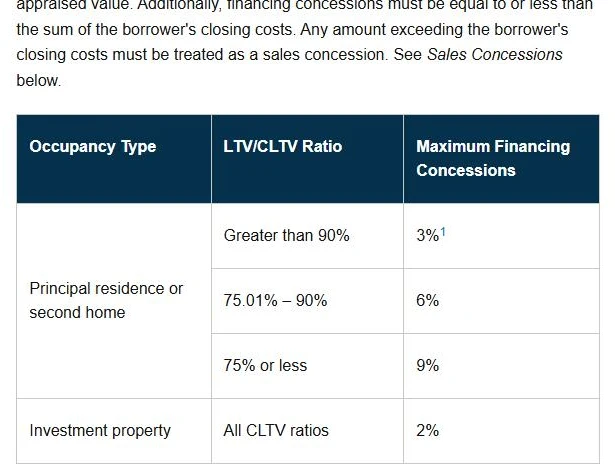
Fannie Mae's official limits table in Selling Guide B3-4.1-02.
FHA loans
FHA allows interested parties to contribute up to 6% of the sales price under HUD Handbook 4000.1. Contributions can go toward origination fees, other closing costs, prepaid items and discount points. Any permanent or temporary rate buydown counts inside the 6%, according to an FDIC summary of FHA rules, and anything above the limit is treated as an inducement to purchase that lowers the value used for your loan.
For the full program, including mortgage insurance and credit rules, visit our FHA loans page.
VA loans
VA caps seller concessions at 4% of the home's reasonable value, the figure on the VA Notice of Value. The key difference: VA does not limit seller credits for normal closing costs. The 4% applies to extras such as paying your VA funding fee, paying off your debts, or prepaying hazard insurance, according to VA.gov.
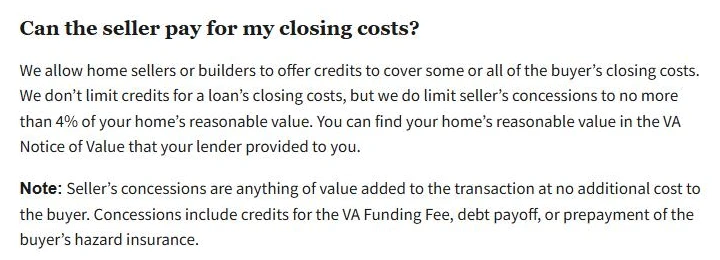
VA.gov explains the 4% limit and what counts toward it.
Because the funding fee is a common use of VA concessions, read our guide to the 2026 VA funding fee before you set your offer.
USDA loans
USDA will not guarantee a loan if the seller or another interested party contributes more than 6% of the sales price toward financing costs, closing costs, escrows or other giveaways, under 7 CFR 3555.102(h). USDA has excluded real estate commissions from that cap since a 2024 policy exemption.
See whether a home qualifies on our USDA loans page.
What can seller concessions pay for?
| Usually allowed | Not allowed under Fannie Mae rules |
|---|---|
| Lender and title fees, appraisal and recording costs | Your down payment |
| Prepaid interest, homeowners insurance and tax escrows | Cash reserves the lender requires |
| Discount points and temporary rate buydowns | HOA dues beyond 12 months |
| VA funding fee (counts toward VA's 4%) | Credits above your actual closing costs |
| Up to 12 months of HOA dues on a conventional loan | Amounts over your loan's limit |
Sources: Fannie Mae Selling Guide B3-4.1-02; VA.gov; FDIC summary of FHA rules.
What happens if seller concessions are more than your closing costs?
You cannot pocket the difference. On a conventional loan, any credit above your actual closing costs, or above the percentage limit, is treated as a sales concession. The lender subtracts it from the sales price before figuring your loan-to-value ratio, which can raise your down payment or mortgage insurance.
The fix is to ask for a credit that fits your real costs. Our guides to Virginia closing costs show typical totals by county.
Buying in Maryland? Use our breakdown of Maryland closing costs, which include higher transfer and recordation taxes.
In the District, see our guide to Washington DC closing costs for recordation tax and first-time buyer reductions.
Seller concession vs price reduction: which is better?
Both cost the seller about the same, but they help you in different ways. A credit lowers the cash you need at closing. A price cut lowers your loan amount and monthly payment.
| On a $500,000 home, 5% down | $10,000 seller credit | $10,000 price reduction |
|---|---|---|
| Price | $500,000 | $490,000 |
| Down payment | $25,000 | $24,500 |
| Cash saved at closing | $10,000 | $500 |
| Loan amount | $475,000 | $465,500 |
| Principal and interest at 7.40% | $3,289/mo | $3,223/mo |
| Monthly difference | About $66 less |
Our estimates at 7.40%, the Freddie Mac 30-year average for October 8, 2026. Taxes, insurance and mortgage insurance not included.
If cash to close is your tight spot, the credit usually helps more. If you have the cash and plan to stay long term, the price cut saves about $23,679 in principal and interest over 30 years in this example (about $66 a month). A third option is to use the credit to buy down your rate; our guide to mortgage points and rate buydowns compares those choices.
How do seller concessions affect the appraisal?
The appraiser reviews the contract and reports the total dollar amount of any seller concessions. Concessions do not raise the value. If a buyer raises the price to cover a bigger credit and the appraisal comes in at the original price, the conventional limit is figured on the lower appraised value, and any credit above the limit is treated as a sales concession that lowers the value used for your loan. Ask your lender to check the math before you agree to an inflated price.
How do you ask for seller concessions in Virginia, Maryland or DC?
- Get your Loan Estimate early so you know your real closing costs; our guide to reading a Loan Estimate shows where to look
- Confirm your loan's limit with your lender before you write the offer
- Have your agent write the credit into the contract as a dollar amount or a percentage of the price
- Expect the seller to weigh the credit against your price, financing and timeline
- Check page 3 of your Closing Disclosure to confirm the credit matches the contract
Concessions are more common when homes sit longer or need repairs. In a multiple-offer situation, a large credit can make an offer less competitive, so a smaller credit may be the better ask.
What are the pros and cons of seller concessions?
| Pros | Cons |
|---|---|
| Lowers the cash you need at closing | Can make your offer less attractive to the seller |
| Can pay for points or a rate buydown | Capped by your loan type and down payment |
| Keeps more savings for reserves and repairs | Cannot pay your down payment |
| VA buyers can have normal closing costs paid in full | Unused credit above your costs is lost |
| Works with conventional, FHA, VA and USDA loans | Does not lower your loan amount like a price cut |

Get a Mortgage Estimate for Free
See how much seller credit your loan can use, and whether a credit or a lower price saves you more.
✓Free, no obligation✓Licensed in VA, MD, DC and WV✓Loan officer Ken Byrne, NMLS #187129
Frequently asked questions
What are seller concessions in real estate?
Costs the seller agrees to pay on the buyer's behalf, usually as a credit toward closing costs. They are written into the purchase contract and show as a seller credit on the Closing Disclosure.
What is the maximum seller concession on a conventional loan?
3% with less than 10% down, 6% with 10% to 25% down and 9% with more than 25% down, based on the lower of the price or appraised value. Investment properties are capped at 2%.
What is the maximum seller concession on a VA loan?
4% of the home's reasonable value. Normal closing costs the seller pays do not count toward the 4%, so the total credit can be higher.
How much can a seller pay on an FHA loan?
Up to 6% of the sales price. The amount can cover origination fees, closing costs, prepaids, discount points and rate buydowns.
Can seller concessions be used for the down payment?
No. Conventional rules do not allow concessions to pay your down payment, and FHA does not allow them to cover your minimum required investment. Ask your lender about VA and USDA.
What happens if the seller credit is more than my closing costs?
The extra cannot be paid to you. On a conventional loan it is treated as a sales concession and subtracted from the price, which can change your loan-to-value ratio.
Do seller concessions affect the appraisal?
The appraiser reports the concession amount. On a conventional loan, if the home appraises below the contract price, the limit is figured on the lower appraised value.
Is a seller concession better than a price reduction?
A credit saves more cash at closing, while a price cut lowers your loan and payment. The better choice depends on whether cash or monthly payment is your tighter limit.
Can a seller pay for a rate buydown?
Yes. On conventional and FHA loans, a seller-paid buydown or discount points count toward the concession limit, and with a temporary buydown on a conventional loan you still qualify at the full note rate.
Do seller-paid real estate commissions count as concessions?
FHA does not count seller-paid buyer agent commissions that are customary and reasonable, and USDA excludes real estate commissions from its 6% cap. Ask your lender how they treat them on your loan.
This article is general information, not financial, tax or legal advice and not a commitment to lend or an offer of credit. Concession limits are set by Fannie Mae, Freddie Mac, FHA, VA and USDA and can change; individual lenders may set tighter limits. Examples are illustrations built on stated assumptions. Rules and rates were checked against official sources on October 15, 2026.
Categories
Recent Posts







GET MORE INFORMATION

Broker Associate