
Mortgage Points and Rate Buydowns: How Discount Points and 2-1 Buydowns Work (2026)

Buying down your rate trades cash at closing for a lower payment.
Short answer: you can buy down your mortgage rate two ways. Discount points are prepaid interest: each point costs 1% of the loan amount and lowers your rate for the life of the loan. A temporary buydown, such as a 2-1, lowers your payment for the first one to three years and is often paid by the seller or builder. Points pay off only if you keep the loan past the break-even point, which in our example is about five years. With a temporary buydown on a Fannie Mae, Freddie Mac fixed-rate or VA loan, you still qualify at the full note rate.
By Ken Byrne, NMLS #187129 · ALCOVA Mortgage LLC, NMLS #40508 · Updated October 2026
With 30-year rates averaging 7.40% in Freddie Mac's October 8, 2026 survey, more buyers are asking whether to spend money lowering their rate. This guide explains points and buydowns, shows the break-even math with real numbers, compares the rules for conventional, FHA and VA loans, and covers taxes.
To see a quote with and without points side by side, reach out to JB Financing, the Ken Byrne Team at ALCOVA Mortgage.
What does buying down your interest rate mean?
Buying down your rate means paying extra money at closing in exchange for a lower interest rate. A permanent buydown uses discount points and keeps the lower rate for the life of the loan. A temporary buydown puts money into an account that subsidizes your payment for the first years, after which the payment rises to the full note rate.
What are mortgage points?
Mortgage points, or discount points, are fees you pay the lender at closing to get a lower rate. According to the Consumer Financial Protection Bureau, one point equals 1% of the loan amount, so one point on a $400,000 loan costs $4,000. How much each point lowers your rate depends on the lender, the loan type and the market.
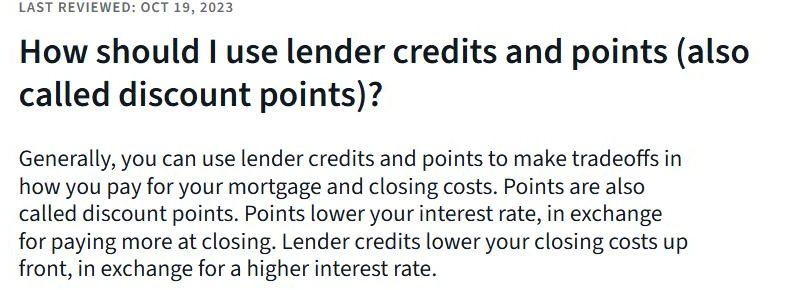
The CFPB's explanation of discount points and lender credits.
Points appear on page 2 of your Loan Estimate in Section A. Lender credits, the opposite of points, show as a negative number in Section J. Our guide to reading your Loan Estimate shows where to look when you compare offers.
How much does it cost to buy down a mortgage rate?
There is no fixed exchange rate between points and interest. To show the math, the table below assumes each point lowers the rate by 0.25% on a $400,000, 30-year loan starting at 7.40%. Your lender's pricing will differ.
| Points | Cost | Rate | Principal and interest | Monthly savings | Break-even |
|---|---|---|---|---|---|
| 0 | $0 | 7.40% | $2,770 | None | None |
| 1 | $4,000 | 7.15% | $2,702 | $68 | 59 months |
| 2 | $8,000 | 6.90% | $2,634 | $135 | 59 months |
| 3 | $12,000 | 6.65% | $2,568 | $202 | 60 months |
Our estimates. 7.40% is the Freddie Mac 30-year average for October 8, 2026. The 0.25% per point is hypothetical; actual reductions vary by lender and day.
Points are paid at closing on top of your other costs. Our guide to Virginia closing costs shows what else to budget for.
For context, the Mortgage Bankers Association's survey for the week ending October 9, 2026 showed an average of 0.83 points on 30-year conforming loans and 1.21 points on FHA loans, including origination fees. Source: MBA Weekly Applications Survey.
Is it worth buying points on a mortgage?
It depends on how long you keep the loan. Divide the cost of the points by the monthly savings to find your break-even point. In the example above, one point costs $4,000 and saves about $68 a month, so it takes about 59 months, close to five years, to come out ahead.
Points tend to make sense when you plan to stay in the home and keep the loan well past break-even, have cash left after your down payment and reserves, and do not expect to refinance soon. They make less sense if rates may fall and you could refinance, if you may sell within a few years, or if the cash would be better spent on a bigger down payment. Our guide on when refinancing makes sense explains why expected refinancing changes the math.
Local pricing matters too. Our look at mortgage rates in Fairfax County explains what moves the rate you are quoted.
Points have become common. In the first nine months of 2023, 58.7% of home purchase borrowers paid discount points, up from 30.5% in 2021, according to a CFPB data spotlight.
What is a 2-1 buydown?
A 2-1 buydown is a temporary buydown that lowers your rate by 2% in the first year and 1% in the second year. From year three on, you pay the full note rate. The cost is the total payment difference over the two years, and it is usually paid up front by the seller, a builder or another party, and sometimes by the buyer.
| $400,000 loan at a 7.40% note rate | Rate you pay | Principal and interest | Monthly savings |
|---|---|---|---|
| Year 1 | 5.40% | $2,246 | $523 |
| Year 2 | 6.40% | $2,502 | $267 |
| Years 3 to 30 | 7.40% | $2,770 | None |
Our estimates. Total cost of this 2-1 buydown: about $9,491. A 1-0 buydown (1% off for one year) would cost about $3,210.
What are 1-0 and 3-2-1 buydowns?
A 1-0 buydown lowers the rate by 1% for the first year only. A 3-2-1 buydown lowers it by 3%, 2% and 1% over the first three years. Fannie Mae and Freddie Mac cap temporary buydowns at 3% below the note rate and three years.
What are the rules for temporary buydowns?
The biggest rule: on Fannie Mae, Freddie Mac fixed-rate and VA loans you must qualify at the full note rate, not the bought-down rate. A buydown helps your budget in the early years, but it does not raise the amount you can borrow. Learn how lenders figure your debt-to-income ratio.
| Rule | Fannie Mae | Freddie Mac | VA | FHA |
|---|---|---|---|---|
| Qualify at the note rate | Yes | Yes (fixed rate) | Yes, on the full payment | Ask your lender |
| Maximum length | 3 years | 3 years | 1 to 3 years | Ask your lender |
| Maximum rate reduction | 3%, rising at most 1% a year | 3% | Not stated; rises at most 1% a year | Ask your lender |
| Who can pay | Seller, builder, lender, others | Confirm with your lender | Seller, lender, builder or Veteran | Interested parties, inside the 6% limit |
| Where it applies | Primary and second homes; no cash-out | Primary and second homes; no cash-out | All fixed-rate VA loans | Not allowed on adjustable-rate loans |
Sources: Fannie Mae Selling Guide B2-1.4-04; Freddie Mac temporary subsidy buydown product page; VA temporary buydown guidance (updated January 14, 2026); FDIC summary of FHA rules.
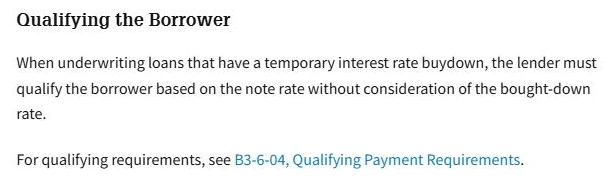
Fannie Mae Selling Guide B2-1.4-04 requires qualifying at the note rate.
What happens to unused buydown funds if you refinance or sell?
Under Fannie Mae's rules, buydown money sits in a custodial account. If you pay off the loan early by selling or refinancing, the unused balance is credited toward the payoff or returned to you or the lender, depending on the buydown agreement. On a VA loan, any money left in the buydown escrow account goes toward the loan balance if the loan is paid off; it is not returned to whoever funded it. Read your agreement before you plan an early refinance.
Temporary buydown, permanent points or a closing cost credit?
Say a seller agrees to about $9,491 in concessions on a $400,000 loan at 7.40%. Here is how the same money could be used:
| Option | What it buys | Best for |
|---|---|---|
| 2-1 buydown | Saves $523/mo in year 1 and $267/mo in year 2 | Buyers who expect income to rise or rates to fall |
| About 2.4 discount points | Rate near 6.81% saves about $160/mo for the life of the loan | Buyers keeping the loan long term |
| Closing cost credit | Lowers cash to close by about $9,491 | Buyers short on cash at closing |
Our estimates using the hypothetical 0.25% per point from the table above. Seller credits are capped by your loan type and down payment.
A seller-paid buydown or seller-paid points count toward your loan's concession limit. Our guide to seller concessions lists the 2026 limits by loan type.
Are mortgage points tax deductible?
Often, if you itemize. Points are treated as prepaid interest. On a loan to buy your main home, you can generally deduct them in the year you pay them when you meet all of the IRS tests, which include the points being shown on your settlement statement and computed as a percentage of the loan. Points on a refinance or a second home are usually deducted over the life of the loan. Seller-paid points are treated as paid by you, and you lower your home's tax basis by that amount. See IRS Topic 504 and ask a tax professional.
How do you compare quotes with points?
- Ask each lender for quotes on the same day, since rates change daily
- Request the same loan amount and lock period from every lender
- Compare the rate and Section A points together, not the rate alone
- Ask for one quote with no points and one with your target rate
- Figure the break-even on each option before you lock
Weighing a shorter term instead? A 15-year mortgage usually carries a lower rate (6.73% vs 7.40% in Freddie Mac's October 8 survey), though the monthly payment is higher.
If you are deciding between loan types, our comparison of fixed-rate and adjustable-rate mortgages covers how each handles rate risk.
VA rules allow a temporary buydown on any fixed-rate VA loan. See our VA home loans page for the program overview.

Get a Mortgage Estimate for Free
Ask for a quote with and without points and figure your break-even before you lock.
✓Free, no obligation✓Licensed in VA, MD, DC and WV✓Loan officer Ken Byrne, NMLS #187129
Frequently asked questions
How much does one mortgage point cost?
One point costs 1% of your loan amount. On a $400,000 loan, one point is $4,000.
How much does one point lower your rate?
There is no fixed rule. The reduction depends on the lender, loan type and market that day, so compare quotes with and without points.
How do I calculate the break-even on mortgage points?
Divide the cost of the points by your monthly payment savings. The result is the number of months before the points pay for themselves.
What is a 2-1 buydown?
A temporary buydown that lowers your rate by 2% in year one and 1% in year two. From year three on, you pay the full note rate.
Who pays for a 2-1 buydown?
Usually the seller or a builder, sometimes the lender or the buyer. Seller and builder payments count toward your loan's concession limit.
Do you qualify at the bought-down rate?
No. On Fannie Mae, Freddie Mac fixed-rate and VA loans you qualify at the full note rate, so a temporary buydown does not increase how much you can borrow.
Can I refinance during a temporary buydown?
Generally yes. On a Fannie Mae loan, unused funds are credited to the payoff or returned as the agreement says; on a VA loan they go toward the loan balance.
Are discount points tax deductible?
Often, if you itemize. Points on a loan to buy your main home can generally be deducted in the year paid if you meet the IRS tests. Refinance points are usually deducted over the loan term.
Is a temporary or permanent buydown better?
A temporary buydown helps most in the first years. Points help for the life of the loan but only pay off if you keep it past break-even.
Can I use a buydown with an FHA or VA loan?
Yes on fixed-rate loans. VA allows temporary buydowns on all fixed-rate VA loans, and FHA counts buydown costs toward its 6% contribution limit.
This article is general information, not financial, tax or legal advice and not a commitment to lend or an offer of credit. How much a point lowers your rate varies by lender, loan type and market; the per-point reduction in our examples is hypothetical. Talk to a tax professional about deducting points. Rules and rates were checked against official sources on October 15, 2026.
Categories
Recent Posts







GET MORE INFORMATION

Broker Associate