
Getting a Mortgage After Bankruptcy: Waiting Periods for Chapter 7 and Chapter 13

A bankruptcy delays a home purchase, but it does not rule one out.
Short answer: yes, you can get a mortgage after bankruptcy once you finish the waiting period for your loan type and rebuild your credit. After a Chapter 7 discharge, the usual minimums are 2 years for FHA, 2 years for VA (sometimes 1 year with re-established credit and a documented cause beyond your control), 3 years for USDA and 4 years for a conventional loan. In Chapter 13, FHA, VA and USDA can consider you after 12 months of on-time plan payments with written approval from the bankruptcy court (FHA) or the trustee or judge (VA and USDA), while conventional loans require 2 years from discharge.
By Ken Byrne, NMLS #187129 · ALCOVA Mortgage LLC, NMLS #40508 · Updated October 2026
Bankruptcy is a hard reset, not a permanent ban on owning a home. Each loan program sets its own waiting period, and the clock usually starts at your discharge or dismissal date, not the date you filed. This guide lays out every waiting period side by side, explains how Chapter 7 and Chapter 13 differ, and covers what lenders look for once the wait is over.
If you want to know where you stand today, JB Financing can review your discharge date and credit and tell you which loan you may qualify for first.
How long after bankruptcy can you buy a house?
| Loan type | After Chapter 7 | During or after Chapter 13 | With extenuating circumstances |
|---|---|---|---|
| FHA | 2 years from discharge | After 12 months of on-time plan payments, with court approval | 12 months after Chapter 7 discharge |
| VA | 2 years from discharge is generally acceptable | After 12 months of satisfactory payments, with trustee or court approval | 1 to 2 years with re-established credit |
| USDA | 3 years (36 months) from discharge | After 12 months of on-time payments, with trustee or court approval | Lender may consider |
| Conventional (Fannie Mae) | 4 years from discharge or dismissal | 2 years from discharge; 4 years from dismissal | 2 years |
Sources: Fannie Mae Selling Guide B3-5.3-07; OCC summary of FHA 203(b) rules; 38 CFR 36.4340(g); 7 CFR 3555.151(i). Lenders can add stricter requirements.
FHA and, for eligible veterans, VA usually have the shortest waits after a Chapter 7. Compare the programs on our FHA loans page.
Can you get a mortgage after Chapter 7 bankruptcy?
Yes. Chapter 7 wipes out most unsecured debt, and the waiting period starts at the discharge date. FHA allows a loan 2 years after discharge if you have re-established good credit or chosen not to take on new debt. Between 12 months and 2 years may be acceptable if the bankruptcy was caused by circumstances beyond your control and you have managed your finances well since.
For manually underwritten USDA loans, a bankruptcy discharged within 36 months before your application counts as unacceptable credit, although lenders may consider extenuating circumstances. Conventional loans backed by Fannie Mae require 4 years from discharge, or 2 years with documented extenuating circumstances. See the USDA rule in 7 CFR 3555.151.
USDA loans need no down payment in eligible areas; see whether a home qualifies on our USDA loans page.
Can you get a mortgage while in Chapter 13 bankruptcy?
Often, yes, with an FHA, VA or USDA loan. Because Chapter 13 is a repayment plan, these programs can consider you while the plan is still active once you have made at least 12 months of payments on time. FHA requires written permission from the bankruptcy court; VA and USDA require approval from the trustee or bankruptcy judge. Expect extra documentation and, in many cases, a manually underwritten loan.
Conventional loans are stricter: Fannie Mae requires 2 years from a Chapter 13 discharge, or 4 years if the case was dismissed instead of completed. Read how conventional loans compare.
Can you get a VA loan after bankruptcy?
Yes. VA's regulation sets no fixed waiting period, and a bankruptcy "would not in itself disqualify the loan." If the discharge was 1 to 2 years ago, you generally need re-established credit and a bankruptcy caused by something beyond your control, such as unemployment or medical bills not covered by insurance. VA notes that divorce is not generally viewed as beyond the borrower's control, and a discharge within the last 12 months is generally not acceptable. Source: 38 CFR 36.4340(g).
VA's own credit standards add that a bankruptcy discharged more than 2 years ago may be disregarded. For eligibility and benefits, see our VA home loans page.
What are the rules for a conventional loan after bankruptcy?
Fannie Mae's waiting periods are the longest, but they are clearly defined:
- Chapter 7 or Chapter 11: 4 years from discharge or dismissal, or 2 years with extenuating circumstances
- Chapter 13: 2 years from discharge, or 4 years from dismissal (2 years with extenuating circumstances)
- More than one bankruptcy in the past 7 years: 5 years from the most recent discharge or dismissal, or 3 years with extenuating circumstances
- You must also re-establish credit: a traditional credit history and a credit score that meets the loan minimum
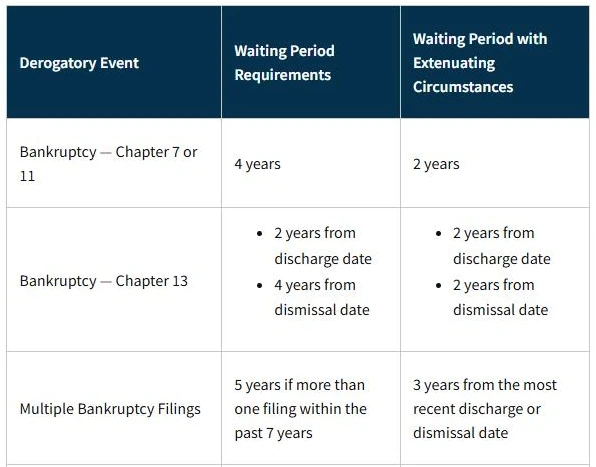
Fannie Mae's official waiting period summary in Selling Guide B3-5.3-07.
Fannie Mae's automated underwriting system returns an Ineligible recommendation for a recent bankruptcy or foreclosure unless the lender documents extenuating circumstances. Full details are in Fannie Mae Selling Guide B3-5.3-07.
What counts as extenuating circumstances?
Fannie Mae defines them as nonrecurring events beyond your control that caused a sudden, significant and prolonged drop in income or a catastrophic increase in expenses. You will need documents, such as medical bills, a layoff notice or severance papers, plus a written explanation showing you had no reasonable alternative. VA and FHA use similar ideas, and VA specifically says divorce generally does not qualify.
What if you also had a foreclosure?
A foreclosure has its own waiting period. Fannie Mae requires 7 years from the foreclosure, or 3 years with extenuating circumstances plus extra limits. FHA generally requires 3 years, and USDA treats a foreclosure completed within 36 months as unacceptable credit. For VA loans, a foreclosure does not disqualify you on its own, but if VA paid a claim, that entitlement is not restored until the loss is repaid. When a mortgage was included in the bankruptcy and later foreclosed, Fannie Mae may apply the bankruptcy waiting period if the lender documents that the mortgage debt was discharged in the bankruptcy.
How long does a bankruptcy stay on your credit report?
Federal law lets a bankruptcy stay on your credit report for up to 10 years. In practice, the credit bureaus often remove a completed Chapter 13 after 7 years from the filing date. The waiting periods above are measured from your discharge or dismissal date, not from when the bankruptcy drops off your report, so you can qualify long before it disappears. The FTC explains how long negative information stays.
How do you rebuild credit after bankruptcy?
Lenders want to see a steady record since the bankruptcy. The CFPB recommends paying every bill on time, keeping card balances low, limiting new applications, considering a secured credit card, and checking your credit reports for errors. After a bankruptcy, make sure discharged debts show a zero balance.
For a step-by-step plan, use our 90-day plan to improve your credit score.
Credit minimums vary by loan type; our guide to the credit score needed to buy a house compares them.
How do you apply for a mortgage after bankruptcy?
- Find your discharge or dismissal date in your bankruptcy papers and count forward to see when each loan type opens up
- Pull your credit reports and fix errors on accounts included in the bankruptcy
- Gather your bankruptcy petition, schedules and discharge order
- Write a short letter explaining what caused the bankruptcy and what has changed
- If you are still in Chapter 13, ask your trustee about the approval process for new debt
- Get preapproved before you shop so you know which loan and price range fit
Lenders will also look closely at your budget. Learn how they weigh your debt-to-income ratio.
When you are ready, follow our step-by-step mortgage preapproval guide.
For the full FHA requirements, see what an FHA loan is and who qualifies.

Get a Mortgage Estimate for Free
Tell us your discharge date and we will show you which loan could work and when.
✓Free, no obligation✓Licensed in VA, MD, DC and WV✓Loan officer Ken Byrne, NMLS #187129
Frequently asked questions
How long after Chapter 7 can I get a mortgage?
About 2 years for FHA and VA, 3 years for USDA and 4 years for a conventional loan, counted from the discharge date. Extenuating circumstances can shorten some of these.
Can I buy a house while in Chapter 13?
Possibly. FHA, VA and USDA can consider you after 12 months of on-time plan payments, with court permission for FHA or trustee or judge approval for VA and USDA.
Does the waiting period start when I file or when I am discharged?
For FHA, VA and USDA, from the discharge date. For a conventional loan, from the discharge or dismissal date. It is not counted from the filing date.
What is the easiest mortgage to get after bankruptcy?
Often an FHA loan, which allows 2 years after a Chapter 7 discharge. Eligible veterans may qualify for a VA loan on a similar timeline.
Can I get a conventional loan after bankruptcy?
Yes, after 4 years from a Chapter 7 discharge or 2 years from a Chapter 13 discharge under Fannie Mae rules. Extenuating circumstances can shorten some periods.
Does divorce count as an extenuating circumstance?
For VA loans, divorce is generally not viewed as beyond the borrower's control. Other programs judge each case on documentation.
What if I had more than one bankruptcy?
Fannie Mae requires 5 years from the most recent discharge or dismissal if you had more than one bankruptcy in the past 7 years, or 3 years with extenuating circumstances.
Will my mortgage rate be higher after bankruptcy?
Your rate depends on your credit score, down payment and loan type. Rebuilding your score before you apply usually helps you get better pricing.
Do I need a bankruptcy attorney to buy a house?
Not to apply for a mortgage, but if you are in an active Chapter 13 you will need court or trustee approval, and your attorney can help with that.
How long does bankruptcy stay on my credit report?
Up to 10 years under federal law. The bureaus often remove a Chapter 13 after 7 years, but you can qualify for a mortgage well before then.
This article is general information, not legal, tax or financial advice and not a commitment to lend or an offer of credit. Talk to a bankruptcy attorney about your case. Waiting periods come from Fannie Mae, FHA, VA and USDA rules, which can change, and individual lenders may set stricter requirements. Rules were checked against official sources in October 2026 and can change.
Categories
Recent Posts








GET MORE INFORMATION

Broker Associate