
Mortgage Rate Lock: When to Lock, How Long It Lasts and What It Costs

A rate lock protects you from market rate increases during the lock period, as long as your application does not change.
Short answer: a mortgage rate lock holds your interest rate for a set period, typically 30, 45 or 60 days, as long as nothing in your application changes and you close before it expires. Many buyers lock once they have a signed purchase contract and a closing date. If you cannot afford a higher payment, locking removes that risk; if rates fall after you lock, you may miss the drop unless your lock includes a float-down. Freddie Mac's 30-year average was 7.40% on October 15, 2026.
By Ken Byrne, NMLS #187129 · ALCOVA Mortgage LLC, NMLS #40508 · Updated October 2026
Mortgage rates change daily and sometimes hourly, so the day you lock can matter as much as the lender you choose. This guide explains how rate locks work, how to decide whether to lock today, how long locks last, what extensions and float-downs are, and where to find your lock on the Loan Estimate.
If you are under contract and weighing whether to lock, ask our JB Financing mortgage team to walk through your timeline and how locking would work for your loan.
What is a mortgage rate lock?
A rate lock means your interest rate will not change between the offer and closing, as long as you close within the lock period and your application stays the same, according to the Consumer Financial Protection Bureau. Locks are typically available for 30, 45 or 60 days, and sometimes longer. Some lenders lock your rate when they issue the Loan Estimate and some do not, so ask.
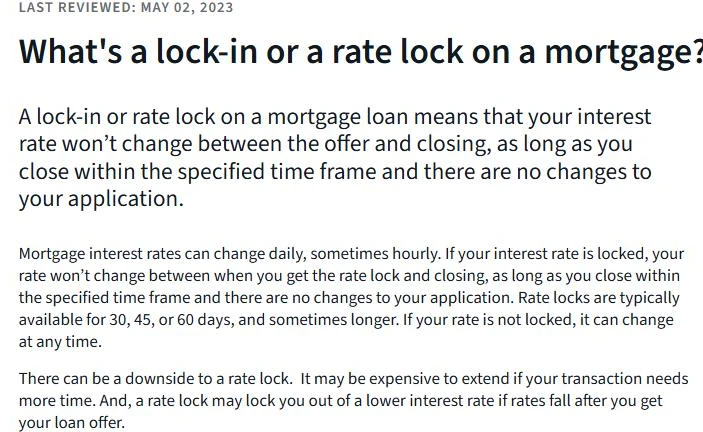
The CFPB's explanation of rate locks.
Should I lock my mortgage rate today?
No one can predict where rates will go next, so the question is how much risk you can afford. Here is what a rate move would mean on a $400,000, 30-year loan:
| If the rate is | Principal and interest | Change from 7.40% |
|---|---|---|
| 7.15% | $2,702/mo | $68 less |
| 7.40% | $2,770/mo | None |
| 7.65% | $2,838/mo | $69 more |
| 7.90% | $2,907/mo | $138 more |
Our estimates. 7.40% is the Freddie Mac 30-year average for October 15, 2026, unchanged from the week before.
Locking usually makes sense when you have a signed contract and a closing date, when a higher payment would push you past your budget or your debt-to-income limit, or when you simply want certainty. Floating can make sense if your closing is still weeks away, you can absorb a higher rate, and you are comfortable with the risk. Rates rose in early October: Freddie Mac's 30-year average climbed from 7.28% on October 1 to 7.40% on October 8, then held at 7.40% on October 15. The Mortgage Bankers Association's 30-year conforming rate reached 7.5%, its highest since November 2023, in the survey for the week ending October 9.
Market events can move rates quickly. The Federal Reserve's next meeting is October 27 and 28, 2026, and rates can move around Fed announcements. For local context, see our look at mortgage rates in Fairfax County.
When do you lock in a mortgage rate?
For a purchase, many borrowers lock after they have a ratified contract, since that sets the property, price and closing date the lock has to cover. For a refinance, you can lock once your application is in and you like the rate. Until you lock, your rate is floating: if it is locked later, the rate is set at that later time. Our guide to what happens after preapproval shows where locking fits in the process.
How long can you lock a mortgage rate?
Common lock periods are 30, 45 and 60 days, and some lenders offer longer locks, which is useful for new construction. Longer locks often cost more: older Federal Reserve guidance notes that "usually, the longer the period, the greater the fee," and the fee may be a flat amount, a percentage of the loan or a higher rate. Source: Federal Reserve consumer guide to lock-ins.
Choose a lock long enough to cover your closing date with some cushion. Our week-by-week closing timeline helps you estimate how many days you need.
What can change a locked mortgage rate?
A lock protects you from market moves, not from changes in your own file. The CFPB says a locked rate can still change if:
- You change your loan type or down payment
- The appraisal comes in higher or lower than expected
- Your credit score changes, for example after a new loan or a missed payment
- The lender cannot document income you listed, such as overtime or bonus pay
Separately, if your lock expires before you close, your rate is no longer protected. Avoid new credit and large unexplained deposits while your loan is in process, and send documents quickly. Our mortgage documents checklist lists what lenders usually ask for.
What happens if your rate lock expires?
If closing is delayed past your lock, you may need to extend it, and the CFPB warns that extending "may be expensive." Your Loan Estimate does not show the cost of an extension, so ask about it up front. If you do not extend, you may have to take the current market rate, which could be higher or lower. Keep your closing on track with our guide to how long mortgage approval takes.
What is a mortgage rate lock float-down?
A float-down is a lock feature that lets you move to a lower rate if market rates drop after you lock. Not every lender offers one, and those that do set their own rules on when it applies and what it costs. The CFPB suggests asking every lender, "If I lock my rate, and interest rates go down, what happens?"
Where is the rate lock on your Loan Estimate?
Page 1 of your Loan Estimate has a "Rate Lock" line. It shows whether your rate is locked and, if so, the date and time (with time zone) when the lock ends. It also shows when the estimated closing costs expire. If you lock after receiving the original estimate, the lender must send a revised Loan Estimate within three business days of the lock, under 12 CFR 1026.19(e)(3)(iv)(D).
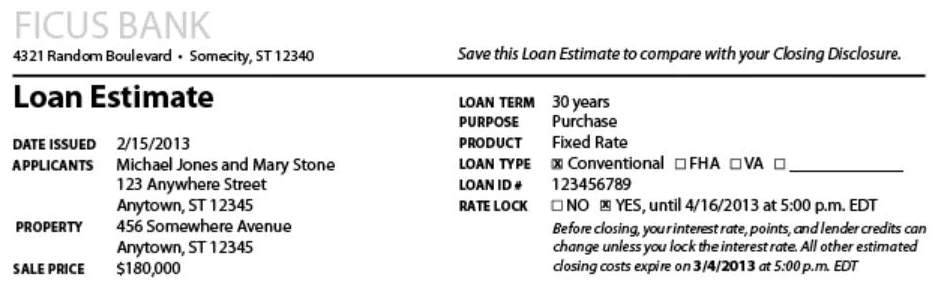
The CFPB's sample Loan Estimate shows the Rate Lock line on page 1.
For a full walkthrough of the form, see our guide to reading your Loan Estimate.
What does Virginia require in a rate lock agreement?
Virginia rules for state-licensed mortgage lenders and brokers require a lock-in agreement to be in writing, signed by the lender or broker, and to state the locked rate and points, any lock-in fee and the length of the lock. Banks and credit unions are generally exempt from these rules. If the loan does not close because the lock period was not reasonable for market conditions, the lock-in fee must be refunded, under 10VAC5-160-30. Ask for your lock confirmation in writing wherever you buy.
Lock or float: what are the trade-offs?
| Lock now | Float for now | |
|---|---|---|
| Payment certainty | Rate is set if nothing changes | Rate can rise or fall |
| If rates fall | You keep the higher rate unless you have a float-down | You can lock lower |
| If rates rise | You are protected | Your payment goes up |
| Timing risk | Delays may require a paid extension | No lock to expire |
| Best for | Buyers with a contract and a tight budget | Buyers far from closing who can absorb a rise |
What should you ask before you lock?
- What does locking today mean, and is the lock in writing?
- How long is the lock, and does it cover my closing date?
- What would a shorter or longer lock cost?
- What happens if closing is delayed and the lock expires?
- What could still change my locked rate?
- If rates go down after I lock, what happens?
Paying points is another way to manage your rate. Our guide to mortgage points and rate buydowns shows the break-even math.
Thinking about a refinance instead? Our guide on when refinancing makes sense covers when a lower rate is worth the cost.
Comparing loan types? Our look at fixed-rate and adjustable-rate mortgages explains how each handles rate risk.

Get a Mortgage Estimate for Free
Get a free quote and ask how a rate lock would work with your closing date.
✓Free, no obligation✓Licensed in VA, MD, DC and WV✓Loan officer Ken Byrne, NMLS #187129
Frequently asked questions
What is a mortgage rate lock?
An agreement that holds your interest rate for a set period, so it will not change before closing as long as your application stays the same and you close on time.
How long can you lock a mortgage rate?
Locks are typically 30, 45 or 60 days, and some lenders offer longer locks. Longer locks often cost more.
When should I lock my mortgage rate?
Many buyers lock once they have a signed purchase contract and a closing date. Lock sooner if a higher rate would break your budget.
Does it cost money to lock a mortgage rate?
It depends on the lender and the lock length. Some locks are included in pricing, while longer locks or extensions can carry a fee.
What is a rate lock extension fee?
A charge to extend your lock if closing is delayed past the expiration date. The cost varies by lender and is not shown on the Loan Estimate, so ask in advance.
Can my rate change after I lock?
Yes, if your application changes, such as your loan amount, down payment, credit score, verified income or appraised value, or if the lock expires.
What is a float-down option?
A lock feature that lets you take a lower rate if market rates fall after you lock. Not all lenders offer it, and terms vary.
Can I switch lenders after locking my rate?
You can, but you would start over with a new application and a new lock, and you may lose any lock fee you paid.
Where do I see my rate lock on the Loan Estimate?
On page 1, in the Rate Lock line, which shows whether the rate is locked and the date and time the lock expires.
Does a rate lock mean my loan is approved?
No. A lock sets your rate, but your loan still has to be underwritten and approved before closing.
This article is general information, not financial or legal advice and not a commitment to lend, an offer of credit or a rate quote. Nobody can predict where mortgage rates will go. Lock periods, fees, extension costs and float-down options vary by lender. Rules and rates were checked against official sources on October 16, 2026.
Categories
Recent Posts







GET MORE INFORMATION

Broker Associate