
Self-Employed Mortgage Requirements 2026: How Lenders Calculate Your Income

Self employed income qualifies for a mortgage. The question is how much of it the lender can count.
Short answer: you can get a conventional, FHA or VA mortgage while self employed. Lenders generally want a two year history, confirmed with your personal and business tax returns, and they qualify you on your net income after write-offs, not your revenue. Fannie Mae calls anyone who owns 25 percent or more of a business self employed, and requires a cash flow analysis such as its Form 1084 that starts from net profit and adds back non-cash expenses like depreciation. Every $10,000 of cash expenses you deduct lowers the loan you can qualify for by roughly $46,000 at today’s rates. When the returns understate your cash flow, a bank statement loan is the main alternative.
By Ken Byrne, NMLS #187129 · ALCOVA Mortgage LLC, NMLS #40508 · Updated September 2026
Being self employed does not make you a weaker borrower. It makes you a borrower whose income takes more work to document, and whose tax strategy and mortgage strategy can pull in opposite directions. This guide sets out what Fannie Mae, FHA and VA actually require in 2026, how an underwriter turns your tax returns into qualifying income, and what to do in the year before you apply so that the number the lender uses is the number you expect. To have your own returns reviewed before you start shopping, talk to Ken Byrne at JB Financing.
Who counts as self employed to a mortgage lender
The line is ownership, not job title. Fannie Mae’s Selling Guide states that any individual with a 25 percent or greater ownership interest in a business is considered self employed, and FHA and Freddie Mac use the same 25 percent test. That catches more people than most people expect.
| How you are paid | Treated as | What the lender reads |
|---|---|---|
| 1099 contractor or sole proprietor | Self employed | Schedule C on your Form 1040 |
| Single member LLC taxed as a sole proprietor | Self employed | Schedule C |
| Partner owning 25% or more | Self employed | Schedule K-1 and the partnership return, Form 1065 |
| S corporation owner, 25% or more | Self employed, even with a W-2 from the company | Your W-2, the K-1 and the business return, Form 1120-S |
| C corporation owner, 25% or more | Self employed | Your W-2 and the corporate return, Form 1120 |
| Owner of less than 25% | Usually treated as an employee | W-2 or K-1 as reported |
Fannie Mae Selling Guide B3-3.5-01; HUD Handbook 4000.1; Freddie Mac Seller/Servicer Guide Section 5304.1.
The S corporation row surprises people most. Paying yourself a salary through your own company does not make you a W-2 employee in underwriting; the lender still reviews the business return to confirm the company can keep paying you.
Self employed mortgage requirements by loan type
The three main loan programs agree on the basics and differ on the edges: how short a history they accept and when they want a current profit and loss statement.
| Requirement | Conventional, Fannie Mae | FHA | VA |
|---|---|---|---|
| Standard history | Two years | Two years | Two years preferred |
| Shorter history | Less than two years if your latest returns show a full 12 months from the current business and prior work in the same field at the same or higher income | One to two years with at least two years of prior work in the same or a related line | One year possible with prior regular employment or education in the same line of work |
| Tax returns | Two years; one year allowed if the business has existed five years and you have owned 25% or more for five straight years | Two years | Two years |
| Year to date profit and loss | Optional; the lender may require it when you apply more than 120 days after the business’s tax year ends | Required with a balance sheet if more than a calendar quarter has passed since the tax year ended | Year to date profit and loss and a current balance sheet |
| Income analysis | Form 1084 or equivalent cash flow analysis | Average of the years documented, with add-backs such as depreciation | Tax return income; depreciation may be added back |
Fannie Mae Selling Guide B3-3.5-01 and B3-3.7-04; HUD Handbook 4000.1, self employment income; VA Lenders Handbook, M26-7, chapter 4.
Conventional loans are often a good fit when your returns show solid income and your credit is strong; the program basics are on our conventional loans page.
FHA helps when your credit score is lower or your down payment is small, and its one to two year exception suits people who left a salaried job to do the same work on their own. Details are on our FHA loans page.

Get a Mortgage Estimate for Free
See what your tax returns support as qualifying income and payment, before you shop.
✓Free, no obligation✓Licensed in VA, MD, DC and WV✓Loan officer Ken Byrne, NMLS #187129
How lenders calculate self employed income: Form 1084
For conventional, FHA and VA loans, underwriters do not use the deposits in your bank account or the revenue on your invoices. Fannie Mae requires lenders to complete its Cash Flow Analysis, Form 1084, or another form that applies the same principles. It starts from the net profit on your return and adjusts for items that reduced your taxable income without costing you cash, or that will not happen again.
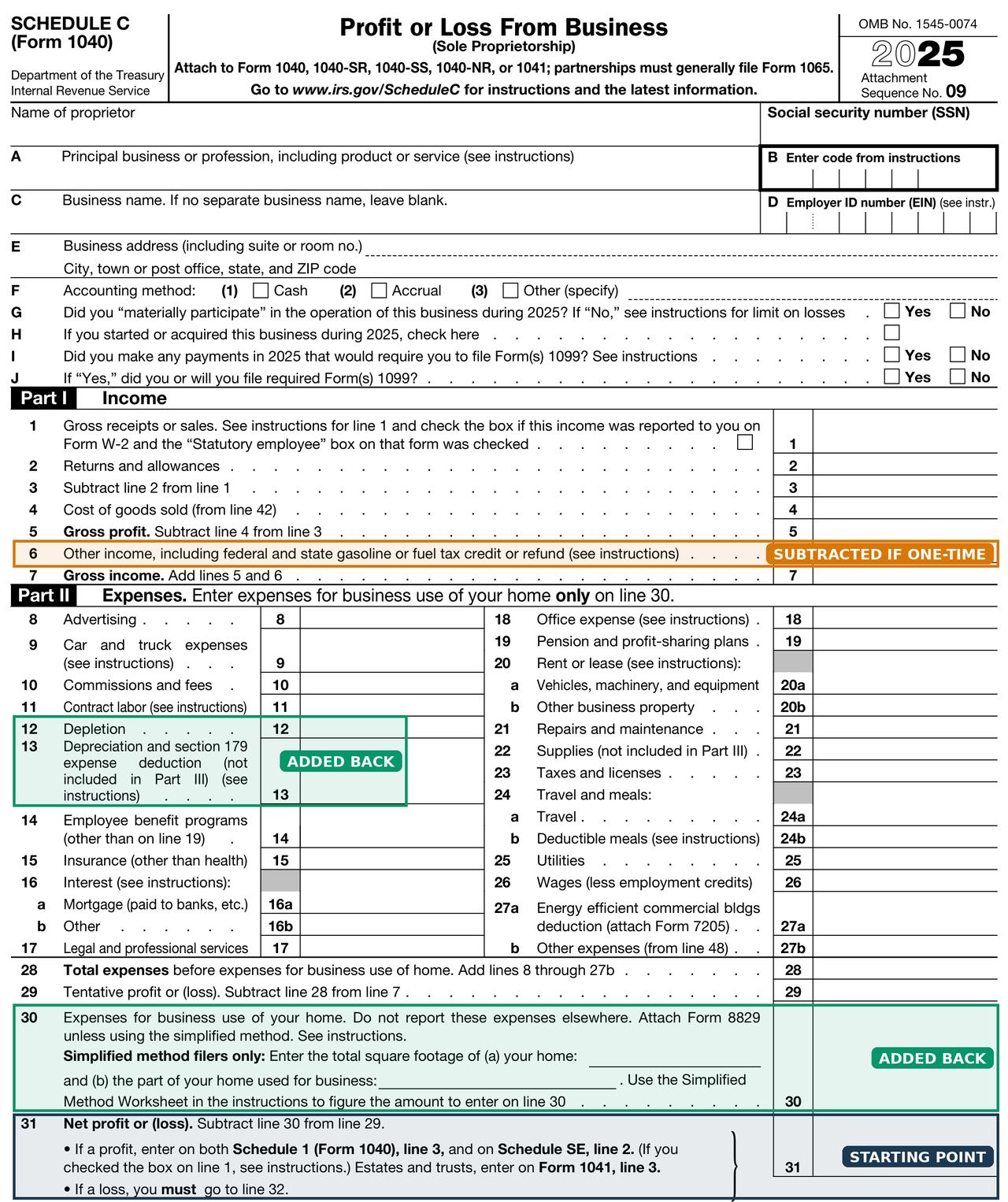
For a sole proprietor, the analysis starts at Schedule C line 31. Depletion, depreciation and business use of home are added back; one-time other income on line 6 comes out. Source: IRS Schedule C (Form 1040), 2025.
For a Schedule C filer, Fannie Mae lists depreciation, depletion, business use of home, amortization and casualty losses as items to add back, and requires nonrecurring income to be deducted. The part of your business meals that was not deductible is also subtracted, because you spent that cash. Then the two years are compared and, if they are stable or rising, averaged.
| Schedule C item | 2024 | 2025 |
|---|---|---|
| Net profit, line 31 | $118,000 | $132,000 |
| Add depreciation, line 13 | $9,000 | $11,000 |
| Add business use of home, line 30 | $3,600 | $3,600 |
| Subtract meals not deductible | −$1,400 | −$1,600 |
| Qualifying income | $129,200 | $145,000 |
| Two year average, per month | $11,425 |
Illustrative sole proprietor. Adjustments per Fannie Mae Selling Guide B3-3.6-03 and Form 1084. Calculated.
At a 45 percent debt to income ratio, below Fannie Mae’s 50 percent maximum for loans underwritten through its automated system, and with $600 a month of other debts, that income supports a housing payment of about $4,540. In Fairfax County with 10 percent down at 6.95 percent, that is roughly a $604,000 home.
Principal and interest $3,600, property tax at $1.121 per $100 $564, insurance $150 and mortgage insurance $227 assumed. Rate from the Freddie Mac survey for the week of September 17, 2026. Calculated.
Why write-offs cost you buying power
Every deduction for a cash expense lowers your qualifying income dollar for dollar; non-cash deductions such as depreciation are added back. A $10,000 deduction for a cash expense takes $833 a month off your income. At a 45 percent ratio that is $375 a month of payment you can no longer support, about $46,000 of loan or $52,000 of purchase price in Fairfax County with 10 percent down.
| Same business, different tax strategy | Qualifying income | Housing payment supported | Home price, Fairfax County, 10% down |
|---|---|---|---|
| Example above | $137,100 a year | $4,541 | About $604,000 |
| $25,000 more in deductions each year | $112,100 a year | $3,604 | About $475,000 |
45 percent debt to income ratio with $600 of other monthly debts. Calculated.
That is a $129,000 difference in price from choices made on the last two returns. The right trade off is a decision for you and your tax preparer, but make it knowing what it does to the mortgage. How lenders set the ratio limits is in our guide to debt to income ratio limits by loan type.
When income dropped or the business is new
Fannie Mae tells lenders to measure year to year trends in gross income, expenses and taxable income, and to judge whether the business can keep producing enough to pay the loan. A rising trend is averaged. A falling one is a problem: lenders generally will not average a decline, and will use the lower, more recent year only if the income appears to have stabilized.
| Two year history | Averaged | Lower year only |
|---|---|---|
| 2024: $140,000, 2025: $120,000 | $10,833 a month | $10,000 a month |
Illustrative. Calculated.
FHA is more specific: a decline of more than 20 percent in effective income over the period analyzed sends the loan to manual underwriting. Under all three programs, a short written explanation of why income fell, such as a large one-time equipment purchase, and a current profit and loss showing recovery, give the underwriter something to work with.
For a new business, the rules above decide it. A conventional loan can work with 12 months on your latest returns if you did the same work, at the same or higher pay, before. FHA wants two years in the same or a related line of work before you went out on your own.
Documents a self employed borrower should expect
Plan on more paper than a salaried buyer, and have it ready before the application so the underwriter is not waiting on you.
| Document | When it is needed |
|---|---|
| Personal federal tax returns, all schedules | One or two years, as above |
| Business returns: 1065, 1120-S or 1120 | When you own 25% or more of a partnership or corporation |
| Signed IRS Form 4506-C | At or before closing, so the lender can obtain your transcripts |
| Year to date profit and loss | FHA after a calendar quarter; conventional at the lender’s option |
| Business balance sheet | FHA, with the profit and loss |
| Two months of bank statements | For down payment, closing costs and reserves |
| Business license or CPA letter | Sometimes, to confirm the business exists and how long it has operated |
Fannie Mae Selling Guide B3-3.1-02, B3-3.5-01 and B3-3.7-04; HUD Handbook 4000.1.
Timing matters around tax season. Once the filing deadline passes, lenders expect your newest return or proof of an extension, so a spring or summer application may need the return you are about to file. The full list for every borrower type is in our mortgage loan documents checklist.
Get Pre-Approved Today
Get a pre-approval built on the same income analysis an underwriter will use.
✓Free, no obligation✓Licensed in VA, MD, DC and WV✓Loan officer Ken Byrne, NMLS #187129
When the tax returns do not tell the whole story
Federal rules require lenders making most home loans to make a reasonable, good faith determination that you can repay, using third-party records that provide reasonably reliable evidence of your income or assets. Those records can include financial institution records. That rule is what allows lenders to offer bank statement loans, which are generally non-qualified mortgages and qualify you on deposits over a set period instead of on your tax returns.
12 CFR 1026.43(c), the ability to repay rule under Regulation Z.
ALCOVA offers a bank statement loan that can use eligible personal or business statements, typically with a larger down payment than conventional programs; requirements vary by program. Pricing and terms differ from a conventional loan, so compare both on the same day. How these loans work, and who they suit, is in our guide to bank statement loans for self employed borrowers.
If you are buying a rental, a debt service coverage ratio loan qualifies on the property’s rent rather than your personal income; see our guide to DSCR loans for real estate investors.
Planning the year before you apply
The most useful step is the least obvious: talk to a lender before you file the return the lender will use. Once it is filed, the qualifying income is effectively fixed for that year.
Keep business and personal money in separate accounts, so deposits are easy to trace and large ones are easy to source. Hold off on new debt, including equipment financing, between application and closing, because the payment counts against your ratio. And keep reserves: a self employed file with savings left after closing is simply easier to approve.
The 2026 conforming loan limit is $832,750 for a single family home in most of the country and up to $1,249,125 in high cost areas, and self employed borrowers use the same limits as everyone else. Virginia programs and limits by county are on our Virginia mortgage page.
Federal Housing Finance Agency, 2026 conforming loan limit values.
Frequently asked questions
Can you get a mortgage if you are self employed?
Yes. Conventional, FHA and VA loans all accept self employed income, usually with a two year history documented by tax returns. Bank statement loans are an option when the returns understate your income.
How long do you have to be self employed to get a mortgage?
Two years is standard. Fannie Mae can accept less if your latest returns show 12 months from the current business and you did the same work before; FHA can accept one to two years with two years of prior work in the same line.
How do lenders calculate self employed income?
They start from net profit on your tax return, add back non-cash items such as depreciation, depletion and business use of home, subtract one-time income, and average two years if the trend is stable or rising.
What is Fannie Mae Form 1084?
It is Fannie Mae’s cash flow analysis worksheet for self employed borrowers. Lenders must complete it or an equivalent form that applies the same principles.
Can I get a mortgage with 1099 income?
Yes. A 1099 contractor is self employed to a lender, so the income is documented with your Schedule C and analyzed the same way as any sole proprietor’s.
Do I need a profit and loss statement?
For FHA, yes, with a balance sheet, once more than a calendar quarter has passed since your tax year ended. For a conventional loan it is at the lender’s option when you apply more than 120 days after year end.
Can I qualify with only one year of tax returns?
On a conventional loan, yes, if the business has existed for five years and you have owned 25 percent or more of it for five consecutive years, with a cash flow analysis completed.
What happens if my income went down last year?
Lenders generally will not average a decline and may use only the lower year, if the business appears stable. FHA sends a decline of more than 20 percent to manual underwriting.
Do tax write-offs hurt my mortgage approval?
Deductions for cash expenses lower your qualifying income dollar for dollar, while depreciation and similar non-cash items are added back. At 6.95 percent and a 45 percent ratio, each $10,000 of cash expense deductions reduces the loan you can qualify for by about $46,000.
Is a bank statement loan better than a conventional loan?
Only when your returns understate your income enough to matter. It usually needs a larger down payment, so compare the two side by side before choosing.
Next stepStart Your Pre-Approval
Start online with your last two returns, and Ken Byrne’s team will review them with you.
✓Free, no obligation✓Licensed in VA, MD, DC and WV✓Loan officer Ken Byrne, NMLS #187129
This article is general information, not financial or legal advice and not a commitment to lend or an offer of credit. Loan limits, program rules, premium schedules and rates change, and individual eligibility depends on a full review of your credit, income, assets and the property. Every figure here is an illustration, not a quote, built from published sources and a weekly survey average rather than underwriting decisions. Insurance and mortgage insurance amounts are planning estimates. Confirm anything you plan to act on with a licensed mortgage professional. Program rules summarize the Fannie Mae Selling Guide, HUD Handbook 4000.1 and VA credit standards as published in September 2026; lenders may apply additional requirements. Income figures are illustrations, not an underwriting decision, and nothing here is tax advice.
Categories
Recent Posts









GET MORE INFORMATION

Broker Associate