Home Loans for First Responders, Teachers and Nurses: Programs in VA, MD and DC
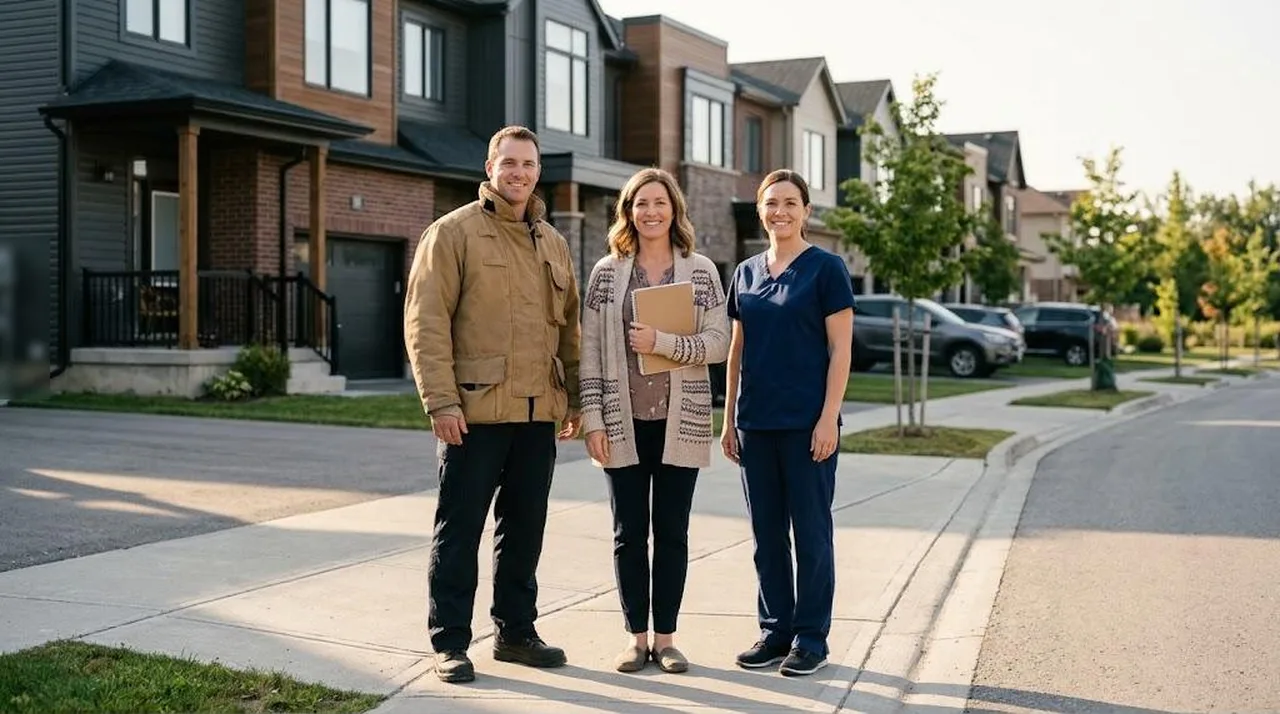
Programs for public servants usually work alongside a standard FHA, VA, USDA or conventional loan, not in place of one.
Short answer: there is no single federal "first responder mortgage." The real help comes from specific programs: HUD's Good Neighbor Next Door offers police officers, firefighters, EMTs and teachers 50% off the list price of certain HUD homes, and in our area Maryland, Virginia Housing, DC and several counties offer down payment help or rate discounts for first responders, teachers and, in some programs, nurses and other healthcare workers. Most of these are paired with a standard FHA, VA, USDA or conventional loan.
By Ken Byrne, NMLS #187129 · ALCOVA Mortgage LLC, NMLS #40508 · Updated October 2026
Police officers, firefighters, EMTs, teachers and nurses often see ads for "hero home loans." Some of those are marketing names for ordinary loans. This guide sticks to programs run by government agencies and housing finance agencies, explains who qualifies, and shows how lenders treat overtime and shift pay.
If you work in public service and want to know which programs fit your job and county, Ken Byrne at JB Financing can walk you through your options.
Are there special home loans for first responders?
Not as a separate federal loan type. A firefighter or teacher typically buys with the same FHA, VA, USDA or conventional loan anyone else uses. What changes is the help layered on top: a discount on the home, down payment assistance, or a lower rate from a state or local program.
| Program | Where | Who it is for | What it gives |
|---|---|---|---|
| Good Neighbor Next Door (HUD) | Nationwide, HUD homes in revitalization areas | Law enforcement officers, pre-K to 12 teachers, firefighters, EMTs | 50% off the list price; $100 down with FHA financing; 36-month occupancy |
| First Homes for First Responders and Teachers | Maryland | First responders and pre-K to 12 teachers or school counselors; first-time buyers | Rate 0.50% below the standard MMP 5% loan, plus a 0% deferred loan equal to 5% of the first mortgage |
| Community Heroes Grant (Virginia Housing) | Virginia | Educators, first responders, healthcare workers, childcare workers, military; first-time buyers | $10,000 grant toward down payment and closing costs, never repaid; requires a Virginia Housing bond loan |
| Employer Assisted Housing Program (EAHP) | Washington DC | DC government employees; extra help for police, firefighters, EMTs, corrections officers and teachers | Up to $20,000 deferred loan plus up to $5,000 match; first responders and educators can get up to $10,000 more with a 5-year service commitment |
| Critical Workforce Housing Assistance Program | Prince George’s County, MD | County public school teachers, nurses at hospitals and medical offices in the county, County public safety agency staff; first-time buyers up to 120% of area median income | Up to $50,000 or 25% of the price, whichever is less, forgiven over 10 years |
| Public Employee Homeownership Grant | Loudoun County, VA | Loudoun County government and Loudoun County Public Schools employees | $25,000, forgivable over 5 years |
Program pages from HUD, the Maryland Mortgage Program, Virginia Housing, DC DHCD, Prince George’s County and Loudoun County, checked October 22, 2026. Funding is limited for most programs.
How does HUD's Good Neighbor Next Door program work?
Good Neighbor Next Door, or GNND, sells HUD-owned homes in designated revitalization areas to eligible buyers at a 50% discount from the list price. In return, you must live in the home as your primary residence for 36 months. The details are on HUD's Good Neighbor Next Door page.
- Who qualifies: full-time law enforcement officers, full-time pre-K to 12 teachers at state-accredited public or private schools, and full-time firefighters and emergency medical technicians, each serving the area where the home is.
- How you buy: eligible homes are listed for seven days, and you submit through a HUD-registered real estate broker. If more than one eligible buyer bids, a random lottery picks the winner.
- The silent second: you sign a second mortgage for the discount. It carries no interest or payments and shrinks by 1/36th each month you live there.
- Ownership rule: you do not have to be a first-time buyer, but neither you nor your spouse can have owned residential property in the 12 months before your offer.
- Financing: you can use FHA, VA or conventional financing or pay cash. With FHA, the down payment is $100.
The catch is supply. HUD says the number of GNND homes is limited and the list changes weekly, and homes appear only in revitalization areas, so there may be none near you at a given time. Search by state on the HUD Home Store and check often. The program rules are in 24 CFR part 291, subpart F.
What programs help first responders and teachers in Maryland?
Maryland announced First Homes for First Responders and Teachers in September 2026, a $50 million Maryland Mortgage Program initiative. It offers a first mortgage rate 0.50% lower than the standard MMP 1st Time Advantage 5% loan, plus a 0% interest, 30-year deferred loan equal to 5% of the first mortgage for down payment and closing costs. See the program page for eligible jobs and limits.
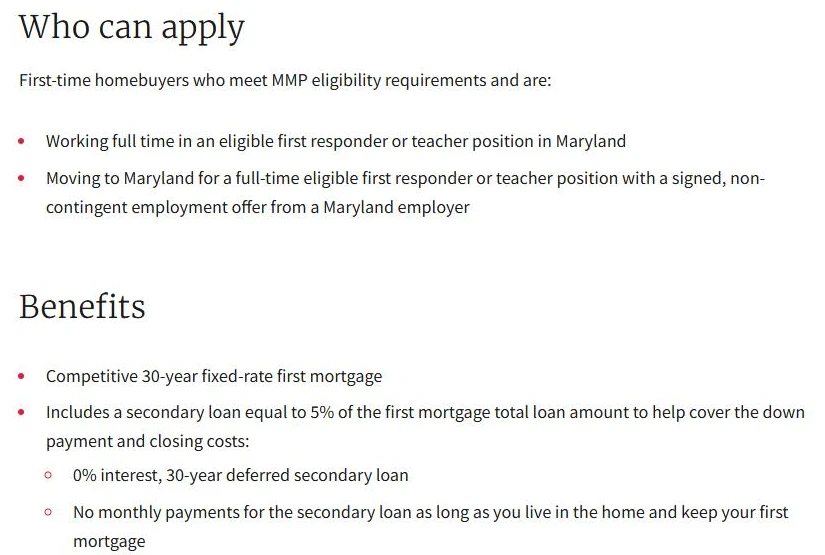
Maryland's new program for first responders and teachers pairs a first mortgage with a 5% deferred loan.
Eligible jobs include full-time firefighters, EMTs and paramedics, police officers, rescue squad members and 9-1-1 specialists, and full-time state-certified pre-K to 12 teachers and school counselors; volunteer firefighters with 12 months of documented service also qualify. At least one borrower must work in Maryland in an eligible role, or be relocating with a signed, non-contingent job offer from an eligible Maryland employer, you must be a first-time buyer, and MMP income limits apply. Our guide to the Maryland Mortgage Program covers the general rules.
In Prince George’s County, the Critical Workforce Housing Assistance Program offers up to $50,000 or 25% of the price, whichever is less, as a 0% deferred loan forgiven 10% a year over 10 years. It covers county public school teachers, nurses working full-time in a hospital or medical office located in Prince George’s County, and public safety staff employed by a County public safety agency. Details are on the county's program page; check whether funds are currently available.
What programs help first responders and teachers in Virginia?
Virginia Housing's Community Heroes Grant gives eligible first-time buyers $10,000 toward down payment and closing costs, and it never has to be repaid. Eligible professions include educators and school personnel, law enforcement officers, firefighters and first responders, healthcare workers, childcare workers, and military members and veterans. You must use a Virginia Housing bond loan and complete the Community Heroes certification before closing. Our guide to Virginia Housing programs explains the bond loan rules and limits.
Some localities run their own employee programs. Loudoun County's Public Employee Homeownership Grant offers $25,000, forgivable over five years, to Loudoun County government, courts and constitutional officers, and Loudoun County Public Schools employees working at least 20 hours a week who buy in the county, with an income range of $49,850 to $116,300. Funding is first come, first served, and the County expects to move applications to new software in early November 2026; see Loudoun County's PEG page.
The City of Alexandria's Employee Homeownership Incentive Program offers $7,500 to $15,000 as an interest-free deferred loan to city and Alexandria City Public Schools employees buying in the city. For other statewide options, see our roundup of Virginia down payment assistance programs.
What programs help DC government employees buy a home?
DC's Employer Assisted Housing Program, or EAHP, is open to full-time DC government employees in good standing with at least one year of service who have not owned a principal residence in DC in the past three years. It offers a deferred, 0% loan of up to $20,000 plus a matching grant of up to $5,000, with no income cap. Police officers, firefighters, EMTs, paramedics, corrections officers and public and charter school teachers skip the one-year service requirement. First responders, and educators according to DHCD's program page, can receive up to $10,000 more and may qualify for a matching grant of up to $15,000 in exchange for a five-year service commitment. Assistance depends on funding; see DC DHCD's EAHP page.
EAHP participants may also qualify for DC's Home Purchase Assistance Program. Our HPAP guide explains how much help it can add.
Are there home loans for nurses?
Nurses are not one of HUD's Good Neighbor Next Door categories, but several programs in our area do include them. Virginia Housing's Community Heroes Grant lists healthcare workers, Prince George’s County's program includes nurses working full-time in a hospital or medical office in the county, and DC's Negotiated Employee Assistance Home Purchase Program covers DC government employees under the DC Nurses Association agreement. NEAHP assistance ranges from $3,000 to $26,500 depending on years of service in the eligible union, and buyers must be first-time DC homebuyers. See DC DHCD's NEAHP page for the rules.
Which standard loans work best for first responders, teachers and nurses?
| Loan | Minimum down payment | Worth a look if |
|---|---|---|
| FHA | 3.5% | Your credit is in the 600s or your debts are on the higher side |
| Conventional (HomeReady or Home Possible) | 3% | Your income is at or below 80% of the area median; mortgage insurance can be canceled later |
| VA | None | You are a veteran or service member; no monthly mortgage insurance |
| USDA | None | You buy in an eligible rural area with income up to 115% of the area median |
HUD, Fannie Mae, Freddie Mac, VA and USDA program descriptions, checked October 22, 2026.
If you are also a veteran, a VA loan needs no down payment and no monthly mortgage insurance, and veterans receiving VA disability compensation are exempt from the funding fee. See VA's purchase loan page for details.
Check your eligibility and entitlement in our guide to VA loan eligibility.
For buyers comparing the two most common choices, our guide to FHA vs conventional loans shows the trade-offs. In outer counties and parts of West Virginia, USDA loans can also be an option.
Our guide to USDA loans in Virginia and West Virginia explains which areas qualify.
How do lenders count overtime and shift pay?
Overtime, bonuses and variable hourly pay are common for police, firefighters and nurses, and lenders look at them carefully. Fannie Mae's Selling Guide recommends a two-year history of overtime or bonus income, though a history as short as 12 months can be acceptable with positive factors. Lenders average it over at least 12 months and must confirm that declining income has stabilized.
Under Fannie Mae's guide, hourly pay with fluctuating hours is variable income and requires at least a 12-month history. FHA guidance, as published in HUD Mortgagee Letter 2022-09, calls for a two-year history of overtime or bonus income, with at least one year allowed when the lender documents it was consistently earned. FHA updates its handbook from time to time, so confirm the current treatment with your lender.
In general practice, lenders review shift differentials under these same variable-income rules, so ask how yours will be counted. Because every dollar of qualifying income affects your debt-to-income ratio, our guide to debt-to-income ratio and mortgage approval is worth a read before you apply.
Just starting a new job, such as a new nurse or a teacher moving into the area? Fannie Mae allows lenders to qualify some borrowers on a signed, non-contingent job offer, within set limits on start dates and reserves. Ask your loan officer whether that applies to you.
How do you apply for these programs?
- Confirm your job category and employer qualify, and get a letter or pay stub showing it
- Check the program's income limits, price limits and first-time buyer rules
- Complete any required homebuyer education class early
- Work with a lender approved for the specific program, since most state and local programs require one
- Get preapproved before you shop, and ask whether funds are currently available
Federal employees in the region have their own considerations; our guide to federal employee home loans covers them.

Get a Mortgage Estimate for Free
Find out which public programs and loan types fit your job, income and county.
✓Free, no obligation✓Licensed in VA, MD, DC and WV✓Loan officer Ken Byrne, NMLS #187129
Frequently asked questions
Are there special mortgages for first responders?
Not as a separate federal loan type. First responders use standard FHA, VA, USDA or conventional loans, often combined with a public assistance program.
What is the Good Neighbor Next Door program?
A HUD program that sells certain HUD homes in revitalization areas to eligible officers, teachers, firefighters and EMTs at 50% off the list price, with a 36-month occupancy requirement.
Can nurses use Good Neighbor Next Door?
No, nurses are not an eligible category unless they work full-time as an EMT. Nurses can qualify for some state and local programs instead.
Is there a teacher home loan program in Maryland?
Yes. First Homes for First Responders and Teachers offers a lower rate and a 5% deferred down payment loan to eligible first-time buyers who teach pre-K to 12.
What is the Virginia Community Heroes Grant?
A $10,000 Virginia Housing grant for eligible first-time buyers in hero professions, used with a Virginia Housing bond loan. It never has to be repaid.
Do I have to be a first-time buyer?
For most state and local programs, yes. Good Neighbor Next Door does not require it, but you cannot have owned a home in the prior 12 months.
Can I combine programs?
Sometimes. Each program sets its own rules on combining help; for example, Maryland's first responder program cannot be combined with DPA Partner Match.
Does overtime count as income for a mortgage?
Usually, if it is likely to continue. Two years of history is typical, and some loans accept 12 months with offsetting factors.
This article is general information, not financial advice and not a commitment to lend or an offer of credit. The programs described are run by government agencies and housing finance agencies, not by JB Financing or ALCOVA Mortgage, and each sets its own eligibility rules, income limits and lender requirements. Program funding can run out or change without notice. Program details were checked against official sources on October 22, 2026; confirm current terms with the program before you rely on them.
Categories
Recent Posts






GET MORE INFORMATION

Broker Associate