What Is a Non-QM Loan? Requirements, Types and Who Qualifies

Non-QM loans let lenders qualify borrowers in ways standard programs do not, such as with bank statement deposits or rental income.
Short answer: a non-QM loan is a mortgage that does not meet the federal definition of a qualified mortgage. Lenders use non-QM loans for borrowers the standard rules do not fit well, such as self-employed people who qualify with bank statements, investors who qualify with rental income, and borrowers with large assets but little regular income. The lender must still confirm you can repay. Expect a larger down payment, more cash reserves and a higher rate than on a standard loan.
By Ken Byrne, NMLS #187129 · ALCOVA Mortgage LLC, NMLS #40508 · Updated October 2026
Standard mortgages, including loans sold to Fannie Mae and Freddie Mac and FHA, VA and USDA loans, are designed to be qualified mortgages. If your income is real but hard to document the standard way, a non-QM loan may be the path to a home or an investment property.
This guide explains what separates a qualified mortgage from a non-QM loan, the main types of non-QM loans, what they cost and who they fit. If you are not sure which side of the line your file falls on, the Ken Byrne Team at JB Financing can review it with you.
What is a non-QM loan?
"Non-QM" stands for non-qualified mortgage. A qualified mortgage, or QM, is a home loan that meets a set of federal standards the Consumer Financial Protection Bureau describes as a loan with less risky features. A non-QM loan is any home loan that does not meet those standards, for example because it has interest-only payments, a term longer than 30 years, or income documented under lender guidelines that Fannie Mae, Freddie Mac and government programs do not accept.
Non-QM does not mean no rules. Under the ability-to-repay rule in Regulation Z, a lender making most closed-end home loans to a consumer must make a reasonable, good-faith determination that you can repay it. Lenders also check documents; a non-QM loan is not the same as the "no-doc" loans of the mid-2000s.
What makes a loan a qualified mortgage?
The CFPB lists the features a qualified mortgage generally cannot have: interest-only periods, negative amortization, balloon payments and terms longer than 30 years. QMs also have caps on upfront points and fees and, for most loans, a limit on how high the APR can be compared with market rates. See the CFPB's explanation of qualified mortgages.
| QM rule | What it means | 2026 figure |
|---|---|---|
| No risky features | No interest-only payments, negative amortization or balloon payment | Applies to all general QMs |
| Loan term | Term cannot exceed 30 years | 30 years maximum |
| Points and fees cap | Upfront points and certain fees are limited | 3% of the loan amount on loans of $137,958 or more |
| Price limit | APR cannot exceed the average prime offer rate by too much | Less than 2.25 percentage points above it on first-lien loans of $137,958 or more |
| Income and debts | Lender must verify income or assets and debts and consider your debt-to-income ratio or residual income | Applies to all general QMs |
Sources: 12 CFR 1026.43(e); CFPB annual threshold adjustments effective January 1, 2026. Smaller loans have different dollar caps and price limits.
The dollar figures adjust each year for inflation. The 2026 amounts come from the CFPB's annual threshold adjustment in the Federal Register.
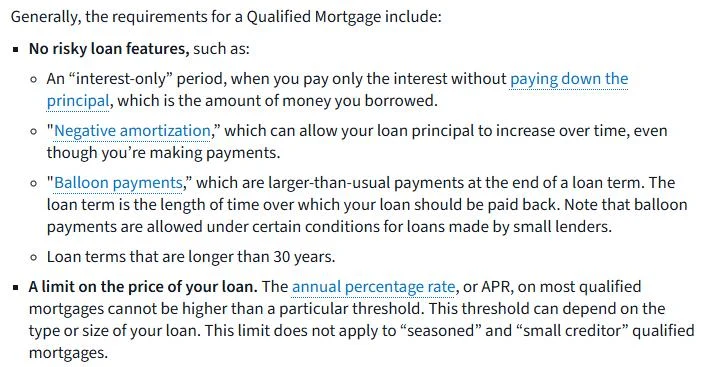
The CFPB's list of features a qualified mortgage generally cannot have.
What are the types of non-QM loans?
Non-QM is a category, not a single program. Lenders build each product around a borrower type. Here are the common ones in the market today; availability and terms vary by lender.
| Non-QM loan type | Who it is built for | How the lender qualifies you |
|---|---|---|
| Bank statement loan | Self-employed borrowers, business owners, freelancers and 1099 contractors | Deposits on personal or business bank statements instead of tax returns |
| DSCR loan | Real estate investors buying rental property | The property's rental income compared with its payment, rather than your personal income |
| Asset depletion or asset-based loan | Borrowers with large savings or investments but little regular income, such as retirees | Eligible assets converted into a monthly income figure |
| Interest-only loan | Borrowers who want lower payments for an initial period | Payments cover interest only for a set period, so the loan is not a QM |
| Recent credit event loan | Borrowers recovering from a bankruptcy, foreclosure or short sale | Some lenders allow shorter waiting periods than standard programs |
| Foreign national or ITIN loan | Buyers without a U.S. credit history or Social Security number | Alternative credit and identity documentation set by the lender |
General market descriptions. ALCOVA Mortgage lists a Bank Statement Loan and a DSCR loan among its loan options; ask about others before you apply.
Bank statement loans
A bank statement loan uses the deposits in your bank statements to show income, rather than the net income on your tax returns. That matters for business owners whose write-offs lower their taxable income. ALCOVA notes that not all deposits may be counted, rates may be higher than conventional financing, and a larger down payment and extra reserves may be required. Our guide to bank statement loans for self-employed buyers covers the details.
DSCR loans for investors
A debt service coverage ratio loan qualifies an investment property on its rent. The lender compares the expected rent with the monthly payment, including taxes and insurance, instead of using your W-2 or tax returns. ALCOVA's DSCR page describes it as an investment-property loan that typically needs 20% to 25% or more down. Read our guide to DSCR loans for real estate investors.
Asset depletion loans
An asset depletion loan, sometimes called an asset-based or asset qualifier loan, turns savings into qualifying income. In general, the lender takes your eligible liquid assets, such as bank, brokerage and retirement balances, applies any discount its guidelines require, and divides the result over a set number of months. The formula, the accounts that count and the minimum balance differ by lender, so compare offers carefully.
Is a DSCR loan a non-QM loan?
In practice, DSCR loans are grouped with non-QM loans because they qualify on rent under guidelines outside the standard agency programs. But there is a legal difference. Regulation Z, including the ability-to-repay and QM rules, applies to consumer credit. It does not cover credit extended primarily for a business purpose or credit to a company rather than a person, under 12 CFR 1026.3(a). Many investment-property loans fall in that business-purpose category, and a loan made to an LLC is credit to a company rather than a person.
That is also why DSCR loans often carry prepayment penalties while non-QM loans on your own home generally cannot, as explained below.
Are non-QM loans safe?
A non-QM loan is not automatically risky, but it gives you fewer built-in protections than a QM. The lender must still weigh eight factors under the ability-to-repay rule: your income or assets, employment, the new payment, any simultaneous loan, taxes and insurance, other debts, your debt-to-income ratio or residual income, and your credit history.
There is one strong protection that applies to consumer non-QM loans, such as on a home you live in or a second home. Federal rules allow a prepayment penalty only on a fixed-rate qualified mortgage that is not a higher-priced loan, so a consumer non-QM loan generally cannot charge one. Even where a penalty is allowed, it is limited to the first three years and capped at 2% of the amount prepaid in the first two years and 1% in the third.
The bigger risks are cost and features. An interest-only period means your balance does not drop until regular payments start, and the payment then rises. An adjustable rate can rise after the fixed period ends. Read the loan terms with your loan officer before you lock.
What are the requirements for a non-QM loan?
There is no single set of non-QM requirements; each lender sets its own. In general, expect lenders to look for:
- A larger down payment than a standard conventional or FHA loan
- Cash reserves left over after closing, often measured in months of payments
- A minimum credit score set by the program
- Documentation that fits the program: bank statements, rent schedules and leases, asset statements, or a CPA letter
- A full appraisal of the property
- A clear explanation of any large deposits or recent credit events
Your other debts still matter on most non-QM loans that use your personal income. Our guide to debt-to-income ratio and mortgage approval explains how lenders count them.
Our mortgage documents checklist covers what to gather before you apply.
Why are non-QM loan rates higher?
Non-QM loans generally cannot be sold to Fannie Mae or Freddie Mac, so lenders keep them or sell them to private investors who price in more risk. Alternative income documentation, investment properties and recent credit events all add risk. As a result, non-QM rates are usually higher than rates on comparable conventional loans, and pricing varies widely from lender to lender.
There is no official published average for non-QM rates. To compare offers, put the Loan Estimates side by side and look at the APR, the points and fees in section A, and any prepayment penalty. If you qualify for a standard loan, compare that too; our guide to conventional loans explains the standard route.
Non-QM vs qualified mortgage: how do they compare?
| Qualified mortgage | Non-QM loan | |
|---|---|---|
| Income documentation | Tax returns, W-2s, pay stubs and other standard records | Can use bank statements, rental income or assets |
| Loan features | No interest-only, negative amortization, balloon or term over 30 years | Can include interest-only periods or longer terms |
| Points and fees | Capped (3% on loans of $137,958 or more in 2026) | Not limited by the QM cap |
| Prepayment penalty | Allowed only on fixed-rate QMs that are not higher-priced, and only for three years | Generally not allowed on a consumer non-QM loan; common on business-purpose investor loans |
| Typical cost | Lower rates; can be sold to Fannie Mae or Freddie Mac or insured or guaranteed by FHA, VA or USDA | Higher rates and larger down payments |
| Ability to repay | Lender is presumed to have met the rule | Lender must still document ability to repay |
Sources: 12 CFR 1026.43; CFPB. Typical cost is a general market description.
Who should consider a non-QM loan?
A non-QM loan can make sense when a standard loan truly does not fit: two years of tax returns understate a growing business, an investor wants to qualify on rental income, or a retiree has assets but little income. It is usually not the best first choice for a buyer with W-2 income and good credit, because a QM will typically cost less.
Check the standard options first. Self-employed borrowers can often qualify conventionally with two years of returns; our self-employed mortgage guide compares both routes.
If a past bankruptcy is the issue, see our guide to buying a house after bankruptcy for the standard waiting periods.
Credit is the other common hurdle. Our guide to the credit score needed to buy a house lists the minimums by loan type.
How do you apply for a non-QM loan?
- Ask your loan officer whether you qualify for a standard loan first, and why not if you do not
- Gather the documents your program uses, such as 12 or 24 months of bank statements, leases or asset statements
- Ask which non-QM programs the lender offers and how each one calculates your income
- Compare Loan Estimates for rate, APR, points, reserves and any prepayment penalty
- Plan an exit: if your income becomes easier to document, a later refinance into a standard loan may lower your rate
Loan amounts above the conforming limit are a separate question; a jumbo loan can be a qualified mortgage. Our guide to jumbo loan requirements explains how those work.

Get a Mortgage Estimate for Free
Find out whether a standard loan or a non-QM loan fits your income and what it would cost.
✓Free, no obligation✓Licensed in VA, MD, DC and WV✓Loan officer Ken Byrne, NMLS #187129
Frequently asked questions
What is a non-QM loan?
A mortgage that does not meet the federal qualified mortgage standards, often because it uses bank statements, rental income or assets to qualify, or has features like interest-only payments.
Is a non-QM loan a bad idea?
Not necessarily. It can be the right tool when your income is hard to document, but it usually costs more, so compare it with standard options first.
What credit score do you need for a non-QM loan?
There is no single minimum. Each lender sets its own by program, and lower scores usually mean a larger down payment and a higher rate.
Do non-QM loans require tax returns?
Many do not. Bank statement loans use deposits, DSCR loans use rental income and asset depletion loans use savings, though some programs ask for other documents.
Are non-QM rates higher?
Usually, yes. Non-QM loans generally cannot be sold to Fannie Mae or Freddie Mac, and pricing varies widely by lender and borrower.
Can a non-QM loan have a prepayment penalty?
Generally not on a consumer loan for a home you live in or a second home, because federal rules limit penalties to certain fixed-rate qualified mortgages. Business-purpose investor loans often have them.
Is a DSCR loan a conventional loan?
No. A DSCR loan qualifies on rental income rather than Fannie Mae or Freddie Mac rules, and it is usually treated as a non-QM or business-purpose loan.
Can you refinance a non-QM loan into a conventional loan?
Often, yes, once you can qualify under standard rules, for example with two years of tax returns. Check for any prepayment penalty first.
This article is general information, not financial or legal advice and not a commitment to lend or an offer of credit. Non-QM programs, requirements and pricing vary by lender and change often; the loan types described here are general market descriptions, not a list of products offered by JB Financing or ALCOVA Mortgage. Federal rules were checked against Regulation Z (12 CFR 1026) and CFPB sources on October 26, 2026, using the 2026 dollar thresholds the CFPB published in December 2025.
Categories
Recent Posts







GET MORE INFORMATION

Broker Associate