
Home Appraisal Requirements: What Lenders Check and What to Do if It Comes in Low
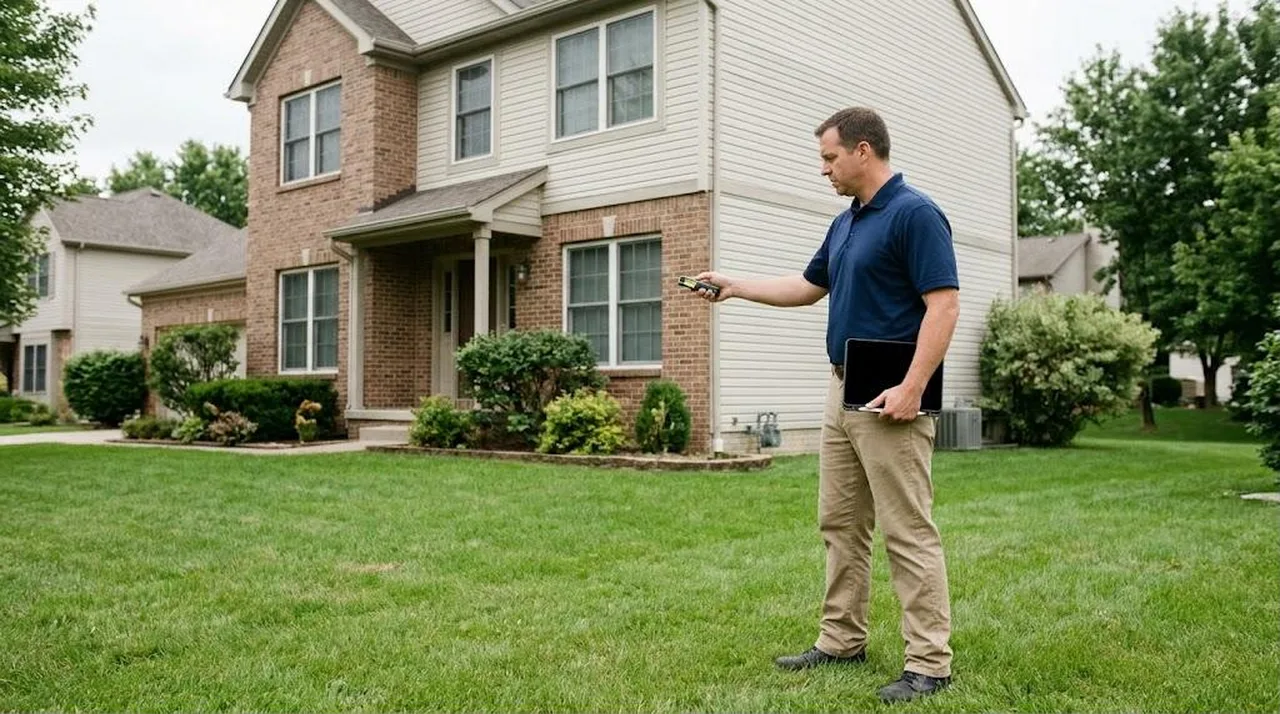
The appraiser gives your lender an independent opinion of the home's market value.
Short answer: a home appraisal is an independent opinion of value that your lender uses to decide how much it will lend. Your lender orders it, you usually pay for it at closing, and you have the right to a free copy at least three business days before closing unless you waive that timing. If it comes in below your contract price, you can renegotiate, pay the difference in cash, ask for a reconsideration of value, or cancel if your contract has an appraisal contingency. Some conventional loans qualify to skip the appraisal through Fannie Mae's value acceptance or Freddie Mac's ACE.
By Ken Byrne, NMLS #187129 · ALCOVA Mortgage LLC, NMLS #40508 · Updated October 2026
The appraisal is one of the few steps in a purchase that neither you nor the seller controls, and a low number can change your down payment or even end the deal. This guide covers what appraisers check, how conventional, FHA and VA requirements differ, when the appraisal can be waived, and what to do if the value comes in low.
If you are under contract and want to understand how the appraisal fits your loan, JB Financing can walk you through it.
What is a home appraisal and why does the lender require one?
The Consumer Financial Protection Bureau defines an appraisal as "a written document that shows an opinion of how much a property is worth." Because the home secures the loan, the lender needs an independent estimate of its market value before it lends against it.
The lender, not the buyer, orders the appraisal; on VA loans, VA itself assigns the appraiser. Fannie Mae requires a state-licensed or state-certified appraiser and does not let lenders use appraisals ordered by the borrower or anyone else with an interest in the sale, and federal rules bar lenders, agents and others involved in the loan from pressuring the appraiser toward a number. You usually pay for it, either upfront when it is ordered or at closing, depending on the lender; Freddie Mac puts the median cost at $450 to $700, though it varies by region. Our guide to reading your Loan Estimate shows where the fee appears.
Is an appraisal the same as a home inspection?
No. The CFPB puts it plainly: "A home inspection is different than an appraisal, but you generally need both." The appraiser works for the lender's decision on value; a home inspector works for you and looks for problems with the home. See the CFPB's home inspection guide.
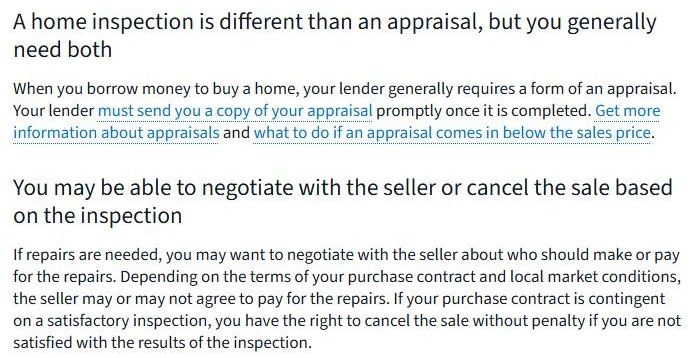
The CFPB explains why you generally need both an appraisal and an inspection.
| Appraisal | Home inspection | |
|---|---|---|
| Who it serves | The lender | You, the buyer |
| Purpose | Opinion of market value and basic property condition | Detailed check of systems, structure and safety |
| Who orders it | The lender | You |
| Required? | Generally required by the lender, unless waived | Usually your choice, but strongly recommended |
| Typical result | Value, condition rating and any required repairs | Report of defects to negotiate or plan for |
FHA makes the same point on its buyer notice: "Appraisals are NOT Home Inspections!" and "FHA does not perform home inspections." VA says an inspection is not required but is highly recommended. See HUD's For Your Protection: Get a Home Inspection form.
Do conventional loans require an inspection?
As a general matter, Fannie Mae and Freddie Mac do not require a separate home inspection for a conventional loan, and Freddie Mac's homebuyer site presents the inspection as optional but recommended. Your lender can still require repairs or a specific inspection, such as a roof or structural check, if the appraisal flags a problem. Skipping your own inspection to save money is one of the common first-time buyer mistakes.
What are conventional loan appraisal requirements?
For loans sold to Fannie Mae, the appraisal must be completed within the 12 months before your loan closes. If it is more than four months old at closing, the appraiser must update it, and a new appraisal is required if the value has dropped. The appraiser rates the home's condition from C1 to C6:
| Rating | What it means | Eligible as is? |
|---|---|---|
| C1 | New, never occupied | Yes |
| C2 | Near new or fully renovated | Yes |
| C3 | Well maintained, limited wear | Yes |
| C4 | Adequately maintained, minor deferred maintenance | Yes |
| C5 | Obvious deferred maintenance, significant repairs needed but livable | Yes |
| C6 | Problems with safety, soundness or structural integrity | No; must be repaired first |
Fannie Mae Selling Guide B4-1.3-06, checked October 23, 2026. Ratings are summarized.
Appraisers report physical problems that could affect safety, soundness or structure, but they are not responsible for hidden conditions, which is another reason to get an inspection. Minor items like worn floors or a cracked window are usually noted rather than required repairs. Starting November 2, 2026, new appraisals on loans sold to Fannie Mae and Freddie Mac move to a redesigned report format that replaces the familiar Form 1004.
Homes that need serious work may be better suited to a renovation loan; see our guide to home renovation loans.
How are FHA and VA appraisals different?
FHA appraisals also check that the home meets HUD's Minimum Property Requirements, which call for homes to be "safe, sound, and secure." The appraiser notes any repairs needed to meet them along with an estimated cost to cure, and the lender can require those repairs to be made before closing. Under HUD's 2022 guidance, an FHA appraisal is initially valid for 180 days; HUD refined its rules on reusing and updating appraisals in an August 2026 handbook update, so confirm the current timing with your lender. Our guide to FHA vs conventional loans covers the other differences.
VA appraisals check VA's minimum property requirements, which focus on homes being safe, sound and sanitary, and end with a notice of value. If the price is higher than the VA value, VA contracts must let you walk away with your earnest money, or you can bring cash for the difference. See the VA Buyer's Guide for details.
Our guide to VA loan requirements explains how VA financing works more broadly.
Can you skip the appraisal with an appraisal waiver?
Sometimes, on conventional loans. Fannie Mae's automated underwriting system can offer value acceptance, its current name for the appraisal waiver, and Freddie Mac offers a similar option called ACE. If the offer appears, the lender may be able to close without a full appraisal.
| Option | Purchase limit | Key limits |
|---|---|---|
| Fannie Mae value acceptance | Up to 90% LTV for principal residences and second homes | One-unit homes; not for $1,000,000+ prices, 2 to 4 units, co-ops, manufactured homes, leaseholds or gifts of equity |
| Fannie Mae value acceptance + property data | Up to 97% LTV for principal residences and second homes | A trained data collector visits and records the interior and exterior instead of an appraisal; resale-restricted homes are not eligible |
| Freddie Mac ACE | Up to 90% LTV for purchases, per Freddie Mac's announcement effective March 24, 2025 | Offered case by case through Freddie Mac's underwriting system |
Fannie Mae Selling Guide B4-1.4-10 and B4-1.4-11 and value acceptance page; Freddie Mac ACE announcement. Checked October 23, 2026.
Waivers are offered case by case and are never guaranteed. The lender must still order an appraisal when it believes one is warranted, and many buyers want one anyway as a check on the price. Fannie Mae estimates the average savings at about $550, and Freddie Mac at about $600.
What happens if the appraisal comes in low?
It is not rare. The Federal Housing Finance Agency found that from 2013 to 2020, 7% to 9% of appraisals came in below the contract price each year, rising to 15% in 2021 and 12% in 2022 when prices climbed fast. See FHFA's analysis.
When the value is lower than the price, the lender bases the loan on that lower value, so the gap has to be covered somewhere. Here is an illustration with 10% down:
| Appraisal at price | Appraisal $20,000 low | |
|---|---|---|
| Contract price | $500,000 | $500,000 |
| Appraised value | $500,000 | $480,000 |
| Loan at 90% of value | $450,000 | $432,000 |
| Cash needed for the price | $50,000 | $68,000 |
Our illustration only; closing costs not included.
- Renegotiate: share the appraisal with the seller and ask for a lower price.
- Pay the difference: bring more cash so the loan stays within the lender's limits.
- Split it: combine a price cut with some extra cash.
- Challenge it: ask your lender for a reconsideration of value if the report has errors or missed comparable sales.
- Cancel: walk away if your contract has an appraisal contingency and you meet its deadlines.
Paying the gap in cash can also affect mortgage insurance, since your loan-to-value ratio rises if you do not. Our guide to PMI costs explains how LTV drives it.
What is an appraisal gap?
"Appraisal gap" is common real estate shorthand for the difference between the contract price and the appraised value. In competitive markets, some buyers add appraisal gap coverage to an offer, a written promise to pay some or all of that difference in cash.
Gap coverage can make an offer stronger, but only promise what you can actually pay on top of your down payment and closing costs. Our guide to how much down payment you need helps you size that cushion.
What is an appraisal contingency?
An appraisal contingency is a contract clause that lets you renegotiate or cancel if the home appraises below the price. Freddie Mac says your contract "should include an appraisal contingency clause, which allows you to cancel the contract." Like other contingencies, it has deadlines, and waiving it means you could owe the gap or risk your deposit; our guide to earnest money deposits explains what is at stake.
VA loans are different: the VA escape clause is a required contract term that protects you if the price exceeds the VA value.
How do you challenge a low appraisal?
Start by reading the report. Under the ECOA Valuations Rule, your lender must give you a free copy of the appraisal promptly once it is completed, and no later than three business days before closing unless you waive that timing. See 12 CFR 1002.14.
If you find factual errors or better comparable sales, ask your lender for a reconsideration of value, or ROV. Fannie Mae requires lenders to have a borrower ROV process, disclosed when you receive the appraisal; it allows one borrower-initiated ROV per appraisal, up to five additional comparable sales, and no requests after closing. Federal regulators issued joint guidance on reconsiderations of value in 2024.
An ROV is a request for the appraiser to take another look, not a guarantee of a higher value. For complaints about appraisal independence or appraisal standards, the Appraisal Subcommittee's national appraisal complaint hotline refers complaints to the right regulator and points discrimination complaints to HUD or the CFPB.
Home appraisal checklist: how to prepare
Appraisers look at size, age, number of rooms, lot, condition, upgrades, location, market conditions and recent comparable sales. These general tips help the visit go smoothly:
- Make every room, the attic, crawlspace and mechanical systems easy to reach
- Keep utilities on so systems can be observed
- Prepare a list of upgrades with dates, and permits if you have them
- Fix small safety items such as missing smoke or carbon monoxide detectors, loose handrails and, in older homes for FHA or VA, peeling paint
- Have HOA or condo details handy
- Share relevant sales data with your agent or lender, not by pressuring the appraiser
Your lender orders the appraisal once your offer is final, before final loan approval; our closing timeline shows where it fits.

Get a Mortgage Estimate for Free
Talk through your appraisal, down payment and options before your contract deadlines.
✓Free, no obligation✓Licensed in VA, MD, DC and WV✓Loan officer Ken Byrne, NMLS #187129
Frequently asked questions
Who pays for the home appraisal?
The lender orders it, but the buyer usually pays, either upfront or at closing. Freddie Mac puts the median cost at $450 to $700.
Do conventional loans require a home inspection?
As a general matter, no; Fannie Mae and Freddie Mac don't require a separate home inspection. Lenders can require repairs or specific inspections if the appraisal flags problems.
What is an appraisal waiver?
An offer from Fannie Mae (value acceptance) or Freddie Mac (ACE) that lets some conventional loans close without a full appraisal.
What happens if the appraisal is lower than the offer?
The lender bases the loan on the lower value. You can renegotiate, pay the difference, request a reconsideration of value, or cancel under an appraisal contingency.
What is appraisal gap coverage?
A promise in your offer to pay some or all of the difference between the price and a lower appraised value in cash.
Can I get a copy of my appraisal?
Yes. Your lender must give you a free copy promptly, and at least three business days before closing unless you waive that timing.
How long is an appraisal good for?
For Fannie Mae loans, an update is needed after four months and a new appraisal after 12, or sooner if the value has dropped. Under HUD's 2022 guidance, FHA appraisals are initially valid for 180 days.
Can I challenge a low appraisal?
Yes. Ask your lender for a reconsideration of value and provide specific errors or comparable sales the appraiser may have missed.
This article is general information, not legal or financial advice and not a commitment to lend or an offer of credit. Appraisal requirements, waiver eligibility and fees vary by loan program, lender and property, and an appraisal waiver offer is never guaranteed. Contract contingencies and appraisal gap terms are set by your purchase contract; ask your real estate agent or attorney about yours. Rules were checked against Fannie Mae, Freddie Mac, HUD, VA and CFPB sources on October 23, 2026 and can change.
Categories
Recent Posts








GET MORE INFORMATION

Broker Associate