VA Loan vs Conventional Loan: Which Is Better for You in 2026?

For most eligible buyers putting little or nothing down, a VA loan needs less cash at closing and has no monthly mortgage insurance.
Short answer: if you are eligible and putting less than 20% down, a VA loan usually beats a conventional loan. It needs no down payment, has no monthly mortgage insurance, and VA sets no minimum credit score, though lenders set their own. A conventional loan can win when you put 20% or more down, are buying a second home or rental, want to keep your VA entitlement for later, or would pay the higher 3.3% funding fee on a repeat VA loan with little down. If you receive VA disability compensation, the funding fee is waived and the VA loan is hard to beat.
By Ken Byrne, NMLS #187129 · ALCOVA Mortgage LLC, NMLS #40508 · Updated October 2026
Veterans and service members in Virginia, Maryland, DC and West Virginia can usually choose between a VA loan and a conventional loan. Both can buy the same house. The difference is in what you pay upfront, what you pay every month and what the loan lets you do later.
This guide compares the two side by side, shows the cost on a $650,000 home, and explains when each one wins. If you want your own numbers run both ways, JB Financing can price a VA and a conventional option on the same home.
What is the difference between a VA loan and a conventional loan?
A VA loan is a mortgage made by a private lender and partly guaranteed by the Department of Veterans Affairs. That guarantee is why VA allows no down payment and no mortgage insurance. Only eligible veterans, service members and some surviving spouses can use it, and the home must be your primary residence.
A conventional loan has no government guarantee. Most follow Fannie Mae or Freddie Mac rules, which allow as little as 3% down for eligible buyers but require private mortgage insurance (PMI) when you put less than 20% down. Anyone who qualifies can use one, for a primary home, a second home or an investment property. Our guide to VA loan requirements and eligibility covers who qualifies for the VA side.
VA loan vs conventional loan at a glance
| VA loan | Conventional loan | |
|---|---|---|
| Minimum down payment | $0 with full entitlement, if the price is not above the appraised value | As little as 3% (97% loan-to-value options) |
| Monthly mortgage insurance | None | PMI if you put less than 20% down |
| Upfront fee | VA funding fee: 2.15% with less than 5% down on first use, lower with more down, waived for veterans receiving VA disability compensation | None comparable; normal closing costs |
| Minimum credit score | None set by VA; lenders set their own | No Fannie Mae minimum when approved through its automated system; 620 for a manually underwritten fixed-rate loan; lenders may set their own |
| Debt-to-income guideline | 41%, plus a residual income test | Up to 50% through Fannie Mae's automated system |
| Property use | Primary residence only, up to 4 units | Primary home, second home or investment property |
| Seller-paid concessions | Up to 4% of the reasonable value, plus normal closing costs | 3% to 9% depending on down payment; 2% on investment homes |
| Loan limit | None set by VA with full entitlement | One-unit limit of $832,750 in most areas; $1,249,125 in the DC metro (2026) |
| Assumable by a future buyer | Yes, with lender approval | Usually not |
Sources: Department of Veterans Affairs purchase loan, funding fee and loan limit pages; 38 CFR 36.4340; Fannie Mae Selling Guide B3-6-02 and B3-4.1-02; FHFA 2026 conforming loan limits. Checked October 29, 2026.
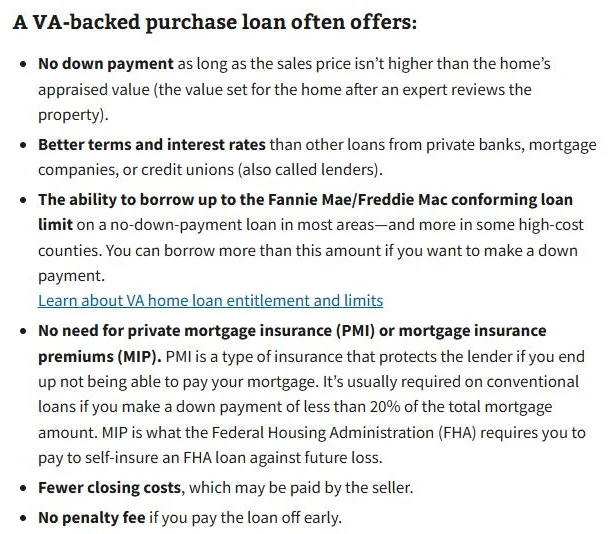
What VA says its purchase loans often offer, from VA.gov. Screenshot taken October 29, 2026.
Is a VA loan better than a conventional loan?
For most eligible buyers putting little or nothing down, yes. The VA loan removes the two biggest costs of a low down payment conventional loan: the cash for the down payment and the monthly PMI. VA says its loans often offer better terms and interest rates than other loans from private lenders, along with fewer closing costs.
The VA loan also tends to be more forgiving on credit. VA sets no minimum score, and its residual income test looks at the money you have left after your bills, not only at a ratio. Our VA loans in Northern Virginia guide walks through the full list of pros and cons, including assumability and using the benefit more than once.
When is a conventional loan the better choice?
A conventional loan is not always the weaker option. It tends to come out ahead in five situations.
- You are putting 20% or more down. There is no PMI at 20% down, and no funding fee on a conventional loan. A VA loan with 10% or more down still carries a 1.25% funding fee unless you are exempt.
- You are buying a second home or a rental. VA loans are for a home you will live in. Conventional loans allow second homes and investment properties.
- You want to save your VA entitlement. Using a conventional loan now keeps your full entitlement free for a future move, such as a later PCS.
- You would pay the repeat funding fee. After your first VA loan, the fee with less than 5% down rises to 3.3%. With strong credit, a conventional loan may cost less overall.
- The property may not pass a VA appraisal. VA appraisals check minimum property requirements, and condos must be in a VA-approved project. Conventional loans have their own property and condo project standards, but they differ from VA's.
Even with a conventional loan, PMI does not last forever. If you are current on payments, your servicer must drop it once your balance is scheduled to reach 78% of the original value, and you can ask in writing to cancel it at 80% if you meet the requirements, as the CFPB explains.
What does each loan cost on a $650,000 home?
Here is the same $650,000 purchase financed five ways. To keep the comparison fair, every loan uses the same 7.32% rate, the Freddie Mac weekly average for a 30-year fixed loan on October 22, 2026. Real VA and conventional rates differ, and PMI is not included because it depends on your credit and down payment.
| Option | Cash down | Funding fee | Loan amount | Principal and interest |
|---|---|---|---|---|
| VA, $0 down, first use | $0 | $13,975 (2.15%, financed) | $663,975 | $4,561 a month |
| VA, $0 down, exempt from the fee | $0 | $0 | $650,000 | $4,465 a month |
| VA, 10% down | $65,000 | $7,313 (1.25%, financed) | $592,313 | $4,069 a month |
| Conventional, 5% down | $32,500 | None | $617,500 | $4,242 a month plus PMI |
| Conventional, 20% down | $130,000 | None | $520,000 | $3,572 a month, no PMI |
Our calculations: 30-year fixed loan at 7.32% (Freddie Mac PMMS, October 22, 2026). Excludes taxes, insurance, HOA dues and PMI. Funding fee rates from VA, current as of October 29, 2026.
The $0 down VA loan has the highest principal and interest because the funding fee is added to the balance. But the conventional loan with 5% down needs $32,500 at closing and adds PMI every month until you reach those equity limits. Our guide to getting rid of PMI explains how long that usually takes.
What if you are exempt from the funding fee?
The funding fee is waived for several groups, including veterans who receive VA compensation for a service-connected disability, surviving spouses receiving Dependency and Indemnity Compensation, and active-duty Purple Heart recipients. For them, a $0 down VA loan has the lowest cash to close and no monthly mortgage insurance, which is hard for any conventional loan to match. Our VA funding fee guide lists every rate and exemption.
How do credit score and income rules compare?
VA does not set a minimum credit score; your lender will. VA looks at debt-to-income with a 41% guideline and adds a residual income test, so a strong cushion of leftover income can support approval above that ratio.
Fannie Mae does not require a minimum score for loans approved through its automated underwriting system, and allows debt-to-income up to 50% there. Manually underwritten Fannie Mae loans need at least a 620 score for a fixed rate, or 640 for an adjustable rate, and lenders may set higher minimums. Your score usually has a bigger effect on conventional pricing and PMI cost than on a VA loan. Our credit score guide shows the minimums lenders typically use for each program.
Can the seller pay more of your costs with a VA loan?
Often, yes. VA caps seller concessions at 4% of the home's reasonable value, and VA does not limit seller credits for the loan's closing costs. On a primary or second home, Fannie Mae caps contributions from the seller and other interested parties at 3% of the lower of the price or appraised value with less than 10% down, 6% with 10% to under 25% down, and 9% with 25% or more down.
That means a VA buyer can sometimes ask a seller to cover closing costs and still have room for other help. Our guide to seller concessions compares the limits for every loan type.
How do loan limits compare in the DMV?
If you have full VA entitlement, VA sets no loan limit; the amount you can borrow with no money down depends on your income, the appraisal and any cap your lender sets. With entitlement still tied up in another VA loan, the county conforming limit is used to work out how much you can borrow before a down payment is needed.
Conventional loans above the conforming limit become jumbo loans with stricter rules. For 2026 the limit is $832,750 in most areas and $1,249,125 in the DC metro. Our VA loan limits guide lists the figures for each county in Virginia, Maryland, DC and West Virginia.
Can you switch from a VA loan to a conventional loan?
Yes. You can refinance a VA loan into a conventional loan at any time, as long as you qualify. Some owners do this once they have 20% equity, so the new loan has no PMI and no funding fee.
Refinancing out of a VA loan is also a way to free up entitlement. You can apply to restore your entitlement after the VA loan is paid off and the home is sold. If you pay off the VA loan but keep the home, VA allows a one-time restoration.
How does a VA loan compare with FHA and USDA loans?
FHA loans need 3.5% down with a 580 score, charge a 1.75% upfront premium and add an annual premium that lasts for the life of the loan when you put less than 10% down. For most eligible buyers, a VA loan costs less than FHA because it needs no down payment and has no monthly insurance. Our FHA vs conventional comparison covers buyers who are not VA eligible.
USDA loans also allow no down payment, with a 1% upfront fee and a 0.35% annual fee, but they come with household income limits and only work in eligible rural areas. VA has neither restriction. Our USDA vs FHA guide explains where USDA loans work in Virginia and West Virginia.

Get a Mortgage Estimate for Free
Compare a VA and a conventional loan on the same home before you make an offer.
✓Free, no obligation✓Licensed in VA, MD, DC and WV✓Loan officer Ken Byrne, NMLS #187129
Frequently asked questions
Is a VA loan better than a conventional loan?
For most eligible buyers putting less than 20% down, yes. A VA loan needs no down payment and has no monthly mortgage insurance. A conventional loan can be better with 20% down, for a second home or rental, or when you want to save your VA entitlement.
What is the main difference between a VA and a conventional loan?
A VA loan is partly guaranteed by the Department of Veterans Affairs and is only for eligible veterans, service members and some surviving spouses. A conventional loan has no government guarantee and anyone who qualifies can use it.
Do VA loans have higher closing costs?
VA says its loans come with fewer closing costs, and the seller may pay them. The main extra cost is the VA funding fee, which can be added to the loan and is waived for veterans receiving VA disability compensation.
Can I get a conventional loan if I am eligible for a VA loan?
Yes. VA eligibility does not stop you from choosing a conventional loan. Many veterans compare both and pick the one with the lower total cost.
Does a VA loan require a higher credit score than a conventional loan?
No. VA sets no minimum credit score, though lenders set their own. Fannie Mae has no minimum when a loan is approved through its automated system, though lenders may set one, and a lower score raises the PMI and rate.
Can I use a VA loan for a second home or rental property?
No. VA loans are for a home you will live in. You can buy a home with up to four units and rent out the others, as long as you live in one of them.
Can I refinance from a VA loan to a conventional loan?
Yes, if you qualify for the new loan. Some owners do it once they reach 20% equity to avoid PMI. Once the VA loan is paid off, they may be able to restore entitlement; VA allows this once if they keep the home.
Is a VA loan or conventional loan better with 20% down?
With 20% down, a conventional loan has no PMI and no funding fee, so it often costs less. A VA loan with 10% or more down still has a 1.25% funding fee unless you are exempt.
This article is general information, not financial or legal advice and not a commitment to lend or an offer of credit. VA rules come from the Department of Veterans Affairs; conventional loan rules come from Fannie Mae and Freddie Mac guidelines; all were reviewed on October 29, 2026. Lenders may add their own requirements. Payment examples use the Freddie Mac weekly average rate for October 22, 2026 and are illustrations, not quotes; your rate, mortgage insurance and costs will differ.
Categories
Recent Posts






GET MORE INFORMATION

Broker Associate