
What Is a Closing Disclosure? The 3-Day Rule and How It Compares to Your Loan Estimate

Comparing your Closing Disclosure with your Loan Estimate is one of the most useful things you can do before closing.
Short answer: a Closing Disclosure is the five-page form that shows the final terms and costs of your mortgage. You must receive it at least three business days before closing, and for this rule a business day is every day except Sundays and federal holidays. Compare it line by line with your Loan Estimate. Only three changes restart the three-day clock: an APR that becomes inaccurate, a change in loan product, or a new prepayment penalty.
By Ken Byrne, NMLS #187129 · ALCOVA Mortgage LLC, NMLS #40508 · Updated October 2026
The Closing Disclosure is the last document you review before you sign. It replaces the estimates you have seen so far with the actual numbers: your rate, your monthly payment, every closing cost and the exact cash you need to bring.
This guide explains when you get it, what can and cannot change, how it compares with your Loan Estimate and what to check. If something on yours looks off, the Ken Byrne Team can walk through it with you before closing day.
What is a Closing Disclosure?
The CFPB describes the Closing Disclosure as a five-page form with the final details of the mortgage you selected, including the loan terms, projected monthly payments and the fees and other costs of getting the loan. It is required for most closed-end mortgages. See the CFPB's Closing Disclosure overview.
For most kinds of mortgages applied for after October 3, 2015, borrowers receive the Closing Disclosure instead of the older HUD-1 settlement statement, according to the CFPB's HUD-1 explainer.
It follows the same layout as the Loan Estimate you received after applying, so the two are easy to compare. Our guide to how to read your Loan Estimate walks through that earlier form.
When do you get your Closing Disclosure?
Federal rules require that you receive the Closing Disclosure no later than three business days before you close. For this rule, a business day is every calendar day except Sundays and federal legal holidays, so Saturdays count. If the disclosure is mailed or emailed instead of handed to you, you are generally treated as receiving it three business days after it is sent, unless the lender can show you received it sooner. The rules are in 12 CFR 1026.19(f).
| If you close on | You must receive the Closing Disclosure by |
|---|---|
| Friday | Tuesday of the same week |
| Monday | Thursday of the week before (Sunday does not count) |
| Thursday, November 12, 2026 | Saturday, November 7 (Veterans Day on November 11 does not count) |
Our examples of the three-business-day count under 12 CFR 1026.2(a)(6) and 1026.19(f), assuming the disclosure is received in person or electronically with confirmed receipt.
In practice, many lenders send the Closing Disclosure electronically and ask you to confirm receipt the same day. Answer that request quickly so your closing date does not slip. Our closing timeline guide shows where this step falls.
What changes restart the three-day waiting period?
Numbers often change in the last days before closing, and most changes do not restart the clock. The lender gives you a corrected Closing Disclosure at or before closing. A new three-business-day waiting period is required only for these three changes:
- The APR becomes inaccurate. On most loans that means it rises by more than 1/8 of a percentage point; on loans with irregular payments or advances, more than 1/4 of a point
- The loan product changes, for example from a fixed rate to an adjustable rate
- A prepayment penalty is added
A lower APR usually does not restart the clock. Under CFPB guidance, if the APR goes down and the earlier figure is still treated as accurate under Regulation Z, the lender can give you a corrected disclosure at or before closing without a new waiting period.
Your rate lock matters here. If your lock expires before closing and the rate is repriced, the APR can move enough to restart the waiting period. Our guide to mortgage rate locks explains how to time the lock around your closing date.
Loan Estimate vs Closing Disclosure: what is the difference?
| Loan Estimate | Closing Disclosure | |
|---|---|---|
| Purpose | Estimates your terms and costs so you can shop and compare | Shows the final terms and costs you will sign |
| When you get it | Within three business days after you apply | At least three business days before closing |
| Length | Three pages | Five pages |
| Who sends it | The lender or mortgage broker | The lender, or the settlement agent on the lender's behalf |
| What it adds | Estimated cash to close and comparison figures | Final cash to close, seller credits, escrow details and loan calculations |
Source: 12 CFR 1026.19(e) and (f); CFPB.
Sellers get their own Closing Disclosure for their side of the sale from the settlement agent, so do not expect to see the seller's full figures on yours.
Which costs can change between the Loan Estimate and the Closing Disclosure?
Federal good-faith rules, often called tolerances, limit how much your closing costs can increase from the Loan Estimate:
| Tolerance | Charges in this group | How much they can rise |
|---|---|---|
| Zero | Fees paid to the lender, mortgage broker or their affiliates; services you were not allowed to shop for; transfer taxes | Cannot increase |
| 10% in total | Recording fees and third-party services you chose from the lender's list of providers | The group total cannot rise more than 10% |
| No set limit | Prepaid interest, homeowners insurance, escrow deposits, property taxes, and services from providers you found on your own | Can change if the estimate was made in good faith |
Source: 12 CFR 1026.19(e)(3). A valid changed circumstance, such as a change you request or new information about the property, can allow a revised estimate.
If you were charged more than these limits allow, the lender must refund the excess and send a corrected Closing Disclosure no later than 60 days after closing. Escrow deposits and prepaid items can change without a set limit; see our guide to how a mortgage escrow account works.
What is on each page of the Closing Disclosure?
| Page | What it shows | What to check |
|---|---|---|
| 1 | Loan terms, projected payments, costs at closing | Name, loan amount, rate, monthly payment, any prepayment penalty or balloon payment |
| 2 | Closing cost details: loan costs and other costs | Origination charges, points, services you did and did not shop for |
| 3 | Calculating cash to close and summaries of the transaction | Cash to close, deposit and seller credits |
| 4 | Additional loan information | Late fees, partial payment policy, escrow account, assumption |
| 5 | Loan calculations, other disclosures and contact information | Total of payments, finance charge, APR, total interest percentage |
Based on the CFPB's Closing Disclosure explainer.
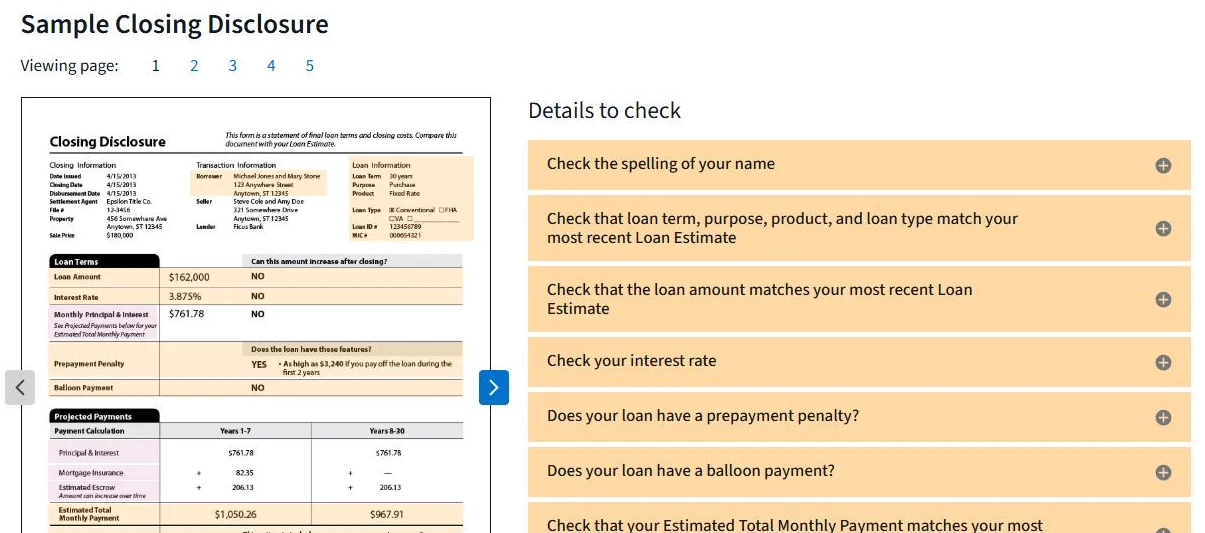
Page 1 of the CFPB's sample Closing Disclosure, from its interactive explainer.
The CFPB's interactive Closing Disclosure explainer lets you click any section of a sample form to see what it means.
What should you check on your Closing Disclosure?
- Your name, the property address and the loan amount are correct
- The interest rate, loan term and loan type match what you locked
- The monthly payment and the escrow amount for taxes and insurance look right
- Points and lender credits on page 2 match your Loan Estimate or locked pricing
- Seller credits on page 3 match your purchase contract
- Your earnest money deposit is credited on page 3
- Cash to close matches what you planned, and you know how you will pay it
- There is no prepayment penalty or balloon payment you did not expect
If you paid points or the seller is paying them, confirm the amount on page 2; our guide to whether mortgage points are worth it explains how they are priced.
Seller credits are easy to miss. Our guide to seller concessions explains how they appear and the limits by loan type.
Your deposit should reduce your cash to close. Our guide to earnest money in Virginia, Maryland and DC explains how it is credited.
Before you send any money, call your settlement agent at a phone number you already know to confirm wiring instructions. Never rely on wiring instructions that arrive by email alone, because closing-day wire fraud often starts with a fake email.
What if something on the Closing Disclosure is wrong?
Call your loan officer and settlement agent right away; most errors are fixed with a corrected disclosure before closing. A typo in a non-numeric item, such as a misspelled name, can be corrected within 60 days after closing. If something tied to the settlement changes an amount you paid within 30 days after closing, the lender must send a corrected Closing Disclosure within 30 days after learning of the change.
Closing costs and who pays them also differ by state. Our guide to closing costs in Virginia, DC and Maryland compares the taxes and fees in each.
Can you waive the three-day wait? Only for a bona fide personal financial emergency, only after you receive the Closing Disclosure, and only with a dated written statement describing the emergency, signed by every borrower who is primarily liable. Lenders cannot use a pre-printed form for it. The CFPB's example is an imminent foreclosure sale of your home, and such emergencies are rare.
For the full sequence from approval to keys, see our guide to what happens after you are pre-approved.

Get a Mortgage Estimate for Free
Get a Loan Estimate you can compare line by line with your final numbers.
✓Free, no obligation✓Licensed in VA, MD, DC and WV✓Loan officer Ken Byrne, NMLS #187129
Frequently asked questions
What is a Closing Disclosure?
A five-page form with the final terms and costs of your mortgage, including your rate, monthly payment, closing costs and cash to close.
How many days before closing do you get the Closing Disclosure?
At least three business days. For this rule, every day except Sundays and federal holidays counts, so Saturdays count.
What is the difference between a Loan Estimate and a Closing Disclosure?
The Loan Estimate is a three-page estimate you get within three business days of applying. The Closing Disclosure is the five-page final version you get before closing.
Does a corrected Closing Disclosure delay closing?
Only if the APR becomes inaccurate, the loan product changes or a prepayment penalty is added. Other corrections can be given at or before closing.
Can closing costs go up after the Loan Estimate?
Some can. Lender fees generally cannot increase, certain third-party fees can rise up to 10% in total, and items like insurance and escrow can change.
Who sends the Closing Disclosure?
The lender is responsible for it, though the settlement agent may deliver it. The seller receives a separate Closing Disclosure.
Can you waive the three-day waiting period?
Only for a bona fide personal financial emergency, with a dated written statement describing it, signed by every borrower who is primarily liable.
Do I sign the Closing Disclosure?
You may be asked to sign to confirm you received it. Signing does not commit you to the loan.
This article is general information, not legal or financial advice and not a commitment to lend or an offer of credit. Closing Disclosure timing and tolerance rules come from Regulation Z (12 CFR 1026) and were checked against the eCFR and CFPB guidance on October 26, 2026. Your lender and settlement agent can tell you exactly when your disclosure will be sent and how to confirm receipt.
Categories
Recent Posts








GET MORE INFORMATION

Broker Associate