
Earnest Money Deposits in VA, MD and DC: How Much, Who Holds It, Refunds

Earnest money is paid when your offer is accepted and is usually credited to you at closing.
Short answer: earnest money is a good faith deposit you make when the seller accepts your offer. A broker, title company or attorney holds it in escrow, and at closing it is credited toward your down payment and closing costs. If the deal ends for a reason your contract allows, such as a financing or inspection contingency, you generally get it back. If you back out for a reason the contract does not cover, you can lose it.
By Ken Byrne, NMLS #187129 · ALCOVA Mortgage LLC, NMLS #40508 · Updated October 2026
Earnest money is often the first real money you put into a home purchase, and it usually happens within days of the seller saying yes. This guide explains how much buyers typically put down, who holds the deposit in Virginia, Maryland, DC and West Virginia, when it is refundable, and how it shows up on your closing paperwork.
If you are getting ready to make an offer, the Ken Byrne Team at JB Financing can help you plan how much cash you need for the deposit, the down payment and closing.
What is earnest money?
The Consumer Financial Protection Bureau describes earnest money as a deposit a buyer pays "to show good faith on a signed contract agreement to buy a home." The money is held by the seller or a third party, such as a real estate agent or title company, until closing.
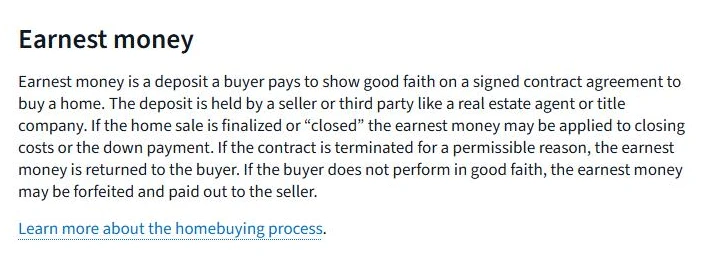
The CFPB's definition of earnest money.
Earnest money tells the seller you are serious. Along with the signed contract, it shows the seller you are committed while you get your loan, inspection and appraisal done. It is not an extra fee: in a normal closing, every dollar of it counts toward what you owe.
How much earnest money is typical?
There is no legal minimum or standard amount. Virginia Housing, the state's housing finance agency, notes that the amount varies with the market, the price range and local norms. Industry sources such as the National Association of Realtors describe deposits ranging from about 1 percent to 10 percent of the price, with larger deposits more common in competitive markets.
Here is what common percentages look like in dollars. Your agent can tell you what is usual for the neighborhood and price range you are shopping in.
| Purchase price | 1% deposit | 2% deposit | 3% deposit |
|---|---|---|---|
| $300,000 | $3,000 | $6,000 | $9,000 |
| $450,000 | $4,500 | $9,000 | $13,500 |
| $600,000 | $6,000 | $12,000 | $18,000 |
| $750,000 | $7,500 | $15,000 | $22,500 |
Simple percentages for illustration, not a recommendation for any market.
A bigger deposit can make an offer stronger, but it also puts more money at risk if you back out outside your contingencies. Keep the deposit separate in your budget from the down payment you plan to make, even though it is credited toward it later.
Who holds earnest money, and how fast must it be deposited?
In the DMV, a real estate brokerage, title company or settlement attorney usually holds the deposit in an escrow or trust account. Once a broker (or, in DC, anyone) holds your deposit, state law sets how fast it must go into that account; your contract sets when you have to pay it:
| Where you buy | Deposit deadline | Source |
|---|---|---|
| Virginia | By the end of the fifth business banking day after the contract is ratified, unless the parties agree otherwise in writing | Va. Code § 54.1-2108.2 |
| Maryland | Promptly, and no more than 7 business days after both parties accept the contract, unless the broker receives written directions otherwise | Md. Code, Bus. Occ. & Prof. § 17-502 |
| Washington DC | Within 7 days, in an account at a financial institution in the District, unless all parties sign written instructions otherwise | D.C. Code § 42-1704 |
| West Virginia | Immediately or by the next business day after the broker receives it, unless the purchase agreement directs otherwise | W. Va. Code R. 174-1-15.3 |
Checked October 21, 2026. Your contract will name who holds the deposit and when it is due.
Read the deposit section of your contract closely: it names the escrow holder, the amount and the due date. In Virginia, the full rule is in Virginia Code § 54.1-2108.2.
Is earnest money refundable?
Often, yes, but only on the terms in your contract. The CFPB recommends making your offer "contingent on obtaining financing and contingent on a satisfactory inspection," so that if you cannot get a loan or the inspection turns up serious problems, you are not required to buy. Its home shopping guide explains why those contingencies matter.
Common contingencies that can protect your deposit include:
- Financing: you can cancel if your loan is not approved by the contract deadline.
- Home inspection: you can negotiate repairs or cancel if the inspection finds problems.
- Appraisal: you can renegotiate or cancel if the home appraises below the price.
- Sale of your current home: you can cancel if your home does not sell by a set date.
Each contingency has a deadline, and missing it can cost you the protection. You can lose the deposit if you back out for a reason the contract does not cover, or after a contingency period has ended. Waiving contingencies to win a bidding war raises that risk; our list of first-time buyer mistakes covers this and other costly missteps.
What happens to earnest money at closing?
At closing, the deposit is credited to you. The CFPB says earnest money "may be applied to closing costs or the down payment," so your cash to close is lower by the amount you already paid. Federal disclosure rules require it to appear as a "Deposit" on both your Loan Estimate and your Closing Disclosure.
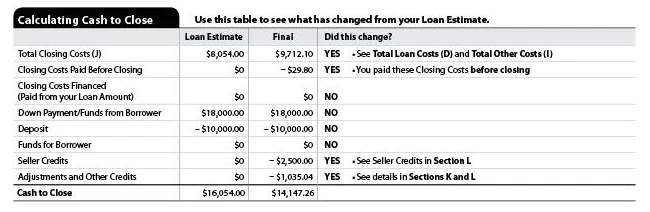
Page 3 of the CFPB's sample Closing Disclosure: the $10,000 deposit is subtracted from cash to close.
On the Closing Disclosure, look for the Deposit line in the Calculating Cash to Close table on page 3 and in the summary of what has already been paid on your behalf. The CFPB's Closing Disclosure explainer walks through each page.
Compare it with the Deposit line on your Loan Estimate; our guide to reading your Loan Estimate shows where it sits in the cash to close estimate.
Earnest money vs down payment: what is the difference?
| Earnest money | Down payment | |
|---|---|---|
| When you pay it | Within days of the contract being accepted | At closing |
| Who holds it | Escrow holder named in the contract | Paid through the settlement agent at closing |
| Purpose | Shows good faith and secures the contract | Your ownership stake; reduces the loan amount |
| Typical size | Varies by market and contract | Set by the loan program, from 0% (VA, USDA) or 3% to 3.5% (conventional, FHA) and up |
| At closing | Credited toward down payment and closing costs | Part of your cash to close |
Because the deposit is credited at closing, it is part of your total cash to close, not an extra cost on top of it. Our guide to closing costs in Virginia, DC and Maryland shows the rest of what you bring to the table.
What if the buyer and seller disagree about the deposit?
The holder must follow state rules before releasing disputed money. In Virginia, a broker holds disputed funds until the parties agree in writing, a court orders a release, the money is interpleaded into court, or the broker releases it to the party entitled to it under the clear terms of the contract. A broker may send notice that funds will be released unless a written protest arrives within 15 calendar days.
In Maryland, a broker who plans to release a deposit after a failed deal must notify both parties, and either can block the release by protesting within 30 days. The Maryland Real Estate Commission says it does not have the authority to order a broker to release the money.
In DC, the escrow holder releases funds on proper written instructions. West Virginia's rules do not set out a separate dispute procedure, but they do say that when a sale falls through because the seller fails or is unable to close, through no fault of the buyer, the broker has no claim to any part of the buyer's earnest money except by agreement of the parties or a court order. Disputes that cannot be settled usually end up in mediation, if the contract requires it, or in court.
How do lenders handle your earnest money?
Your lender will want proof the deposit came from your own acceptable funds. Fannie Mae's Selling Guide says receipt of the deposit must be verified with a copy of your canceled check or a written statement from the holder of the deposit, and if the deposit counts toward your required contribution, your bank statements must show a two-month average balance large enough to cover it. FHA lenders may also need to document where a larger deposit came from.
Pay the deposit from your own account by check or wire and keep the receipt. Cash or money from an undocumented source can create problems in underwriting. Our mortgage documents checklist shows the statements you will need.
If a relative is helping with the deposit, the gift needs to be documented the same way as any other gift toward your purchase. Ask your loan officer before the money moves.
How do you protect your earnest money from wire fraud?
Scammers target home buyers with fake emails that look like they come from an agent or title company, with new wiring instructions. The CFPB advises buyers to confirm instructions using a phone number they already know, never follow wiring instructions sent only by email, and be wary of any last-minute change. Its guide to mortgage closing scams lists the warning signs.
- Get wiring instructions in person or by a phone call to a number you already have
- Call the escrow holder to confirm the money arrived
- Never send account details by email
- If you think you were scammed, call your bank right away to ask for a wire recall and file a report with the FBI's Internet Crime Complaint Center
The FBI accepts reports at ic3.gov. Acting fast gives your bank the best chance of stopping a fraudulent transfer.
Earnest money in the full buying timeline
The deposit comes early: right after your offer is accepted and before the inspection, appraisal and final loan approval. Our step-by-step home buying process shows where it fits.
From there, most purchases take several weeks to close; our closing timeline breaks down each step so you can track your contingency deadlines.
Negotiating help from the seller is a separate question from the deposit. Our guide to seller concessions explains how sellers can help pay your closing costs.
If you are a first-time buyer in Virginia, assistance programs can lower what you bring at closing. See our guide to Virginia down payment assistance.

Get a Mortgage Estimate for Free
Plan your deposit, down payment and cash to close before you make an offer.
✓Free, no obligation✓Licensed in VA, MD, DC and WV✓Loan officer Ken Byrne, NMLS #187129
Frequently asked questions
What is an earnest money deposit?
A good faith deposit you make when your offer is accepted. It is held in escrow and credited toward your down payment and closing costs at closing.
How much earnest money should I put down?
It varies by market and price range. Industry sources cite about 1% to 10% of the price; your agent can tell you what is customary where you are buying.
Is earnest money refundable?
Usually, if the deal ends for a reason your contract allows, such as a financing, inspection or appraisal contingency. You can lose it if you back out for other reasons.
What happens to earnest money at closing?
It is credited to you and lowers your cash to close. It appears as the Deposit line on your Loan Estimate and Closing Disclosure.
Who holds the earnest money?
Usually a real estate brokerage, title company or settlement attorney named in your contract, in an escrow or trust account.
Is earnest money part of the down payment?
It can be. At closing it is applied toward your down payment, your closing costs, or both.
How fast does earnest money have to be deposited in Virginia?
Brokers must deposit it by the end of the fifth business banking day after ratification, unless the parties agree otherwise in writing.
Can a seller keep earnest money?
Only under the contract terms. If the parties disagree, the holder keeps it until they agree in writing, a court decides, or it is released under state notice rules.
Can I use gift money for earnest money?
Often, yes, but the gift must be documented under your loan program's rules. Talk to your loan officer before the money moves.
Do I get earnest money back if my loan is denied?
If your contract has a financing contingency and you follow its notice deadlines, the deposit is generally returned.
This article is general information, not legal or financial advice and not a commitment to lend or an offer of credit. Earnest money terms are set by your purchase contract, and contract forms and practices vary by market and by brokerage. Laws and rules cited here were checked against official sources on October 21, 2026 and can change. For questions about your contract, talk with your real estate agent or a real estate attorney.
Categories
Recent Posts







GET MORE INFORMATION

Broker Associate