
What Is a Gift of Equity? How It Works When You Buy a Home From Family

A gift of equity lets a family member sell you a home and count part of its value as your down payment.
Short answer: a gift of equity is when a family member sells you a home and gives you part of its value instead of cash. The seller credits that equity to you at closing, and lenders can count it toward your down payment and, on Fannie Mae loans, your closing costs too. USDA instead applies it as a reduction to the purchase price. Fannie Mae and Freddie Mac allow it on a primary home or second home from a relative, FHA allows it only between family members, and it cannot be used for an investment property or for cash reserves. For tax purposes, a gift of equity is a gift, so the seller may need to file a gift tax return.
By Ken Byrne, NMLS #187129 · ALCOVA Mortgage LLC, NMLS #40508 · Updated October 2026
Buying a home from your parents, grandparents or another relative is one of the few ways to get into a home without saving a large down payment. A gift of equity is how lenders let that family help show up on paper.
This guide explains how a gift of equity works, who can give one, how each loan program treats it, the gift letter and the tax side. If you are planning a family sale, Ken Byrne at JB Financing can map out how the numbers would look on your loan.
What is a gift of equity?
Equity is the part of a home the owner owns outright: its value minus any mortgage. Fannie Mae defines a gift of equity simply as a gift provided by the seller of a property to the buyer. In practice, the seller agrees to a price, then gives the buyer a credit for part of it. That credit replaces cash the buyer would otherwise bring as a down payment.
The gift has to be documented and shown on the settlement statement, and the donor signs a gift letter saying no repayment is expected. It is not a hidden discount; it is a recorded part of the sale.
How does a gift of equity work? An example
Say your parents own a home that appraises for $500,000, and they want to help you buy it. They sell it to you at $500,000 and give you $100,000 of their equity as a gift.
| Amount | |
|---|---|
| Appraised value and purchase price | $500,000 |
| Gift of equity from the parents | $100,000 (20%) |
| Your new mortgage | $400,000 |
| Loan-to-value ratio | 80% |
| Cash your parents receive at closing | $500,000 minus the $100,000 gift, minus their own costs and any payoff of their mortgage |
Our illustration. Your closing costs, prepaid items and the lender's requirements will change the final figures.
At 80% loan-to-value, a conventional loan would not need private mortgage insurance. A smaller gift still helps; it just leaves a higher loan-to-value ratio. Our guide to PMI costs explains how mortgage insurance is priced.
Who can give a gift of equity?
Each loan program sets its own list of acceptable donors. In every case the gift comes from the seller, so the seller must also be someone the program allows to give you a gift.
| Loan program | Who can give it | Property types |
|---|---|---|
| Conventional, Fannie Mae | A relative by blood, marriage, adoption or legal guardianship, a domestic partner, a fiancé or fiancée, a former relative, or someone with a long-standing family-like or mentorship relationship | Primary home or second home |
| Conventional, Freddie Mac | A related person, or a business, trust or estate of a related person | Primary home or second home |
| FHA | Family members only, selling to other family members | Primary home (FHA loans are for owner-occupants) |
| USDA | Not spelled out in USDA's guide; the gift must be applied as a reduction to the purchase price | Primary home in an eligible area |
| VA | Confirm with your lender; we could not verify VA-specific gift of equity rules | Primary home |
Sources: Fannie Mae Selling Guide B3-4.3-04 and B3-4.3-05; Freddie Mac Guide Section 5501.4; HUD Handbook 4000.1; USDA HB-1-3555 Attachment 9-A. Checked October 27, 2026.
HUD's definition of a family member for FHA covers children, parents, grandparents, spouses and domestic partners, siblings and step-siblings, aunts and uncles, and in-laws. Cousins, nieces and nephews are not on that list, so a sale between cousins would not qualify for an FHA gift of equity.
What can a gift of equity be used for?
Under Fannie Mae's guide, a gift of equity can cover all or part of the down payment and closing costs, including prepaid items. Neither Fannie Mae nor Freddie Mac lets it count toward the cash reserves a lender may require, and Freddie Mac does not allow it to produce cash back to the buyer.
USDA handles it differently: the gift must be applied as a reduction to the purchase price, the appraiser must be told about it, and you cannot receive cash back from it. Our guide to how much down payment you need compares the minimums by loan type.
Do you still need your own money?
Sometimes. Fannie Mae applies the same minimum-contribution rules to gifts of equity as to cash gifts. On a one-unit primary home, no minimum contribution from your own funds is required. On a two- to four-unit primary home or a second home with more than 80% loan-to-value, you must put in at least 5% from your own funds. Freddie Mac has a similar 5% rule for second homes above 80%.
Does a gift of equity count as a seller concession?
Not on a Fannie Mae loan. When the gift comes from an acceptable donor, Fannie Mae's guide says the donor is not considered an interested party, so the gift of equity is not treated like seller-paid closing costs. Seller credits on top of the gift are a separate matter; our guide to seller concessions lists the limits by loan type.
How do FHA loans treat a gift of equity?
FHA allows a gift of equity only when family members sell to other family members. The donor and the borrower must both sign and date the gift letter.
FHA also limits family sales in another way. A sale between family members is an identity-of-interest transaction, and FHA normally caps those loans at 85% loan-to-value. That cap does not apply when you buy another family member's primary home as your own primary home, or buy a family member's property you have rented for at least six months before the sales contract. Ask your lender exactly how the gift will be applied to your loan, including toward FHA's 3.5% minimum investment. Our FHA loan guide covers the other requirements.
What goes in a gift of equity letter?
Lenders need a signed gift letter. Fannie Mae requires it to state the dollar amount of the gift, that no repayment is expected, and the donor's name, address, phone number and relationship to the buyer. FHA requires the same details and asks for the letter to be signed and dated by both the donor and the borrower.
- The donor's name, address and phone number
- The donor's relationship to you
- The dollar amount of the gift of equity
- A statement that no repayment is expected or required
- Signatures and dates (both donor and borrower for FHA)
Your lender will usually supply its own gift letter form. Our mortgage documents checklist shows what else to gather.
Do you still need an appraisal?
Yes. The lender still orders an appraisal to confirm the home's value, and the loan-to-value ratio is based on that value and the price. Your loan cannot be larger than the program allows for that value, even if the family agrees on a bigger gift. Our home appraisal guide explains what appraisers check.
What are the tax rules for a gift of equity?
The IRS says that if you sell something at less than its full value, you may be making a gift. A gift of equity is treated that way: the seller is making a gift to the buyer equal to the amount of the equity given. See the IRS gift tax overview.
| IRS figure | 2026 amount |
|---|---|
| Annual gift tax exclusion, per recipient | $19,000 |
| Married couple giving jointly, per recipient | $38,000 |
| Lifetime basic exclusion amount | $15,000,000 |
Source: IRS, What's new, estate and gift tax, and Rev. Proc. 2025-32.
In most family sales, no gift tax is actually paid. The donor generally files Form 709 when gifts to one person in a year exceed the annual exclusion, and the amount over the exclusion counts against the lifetime exemption. Gift tax is owed only once lifetime taxable gifts exceed that exemption. The 2026 amounts appear on the IRS's estate and gift tax update page.
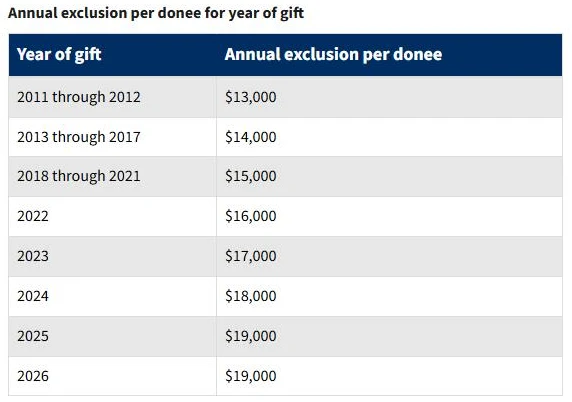
The IRS annual exclusion table: $19,000 per recipient for 2026.
Example: if two parents who own a home together equally give $100,000 of equity to one child, each parent is generally treated as giving $50,000. That is above the $19,000 annual exclusion, so each would generally file Form 709, but no tax is due unless their lifetime gifts exceed the exemption. Gifts also affect the buyer's tax basis in the home, so both sides should talk to a tax professional before closing.
Does a gift of equity lower transfer taxes in Virginia?
Usually not. In a gift of equity, the price normally stays at full value, so the deed taxes are figured on that price. Virginia's state recordation tax is based on the greater of the price or the property's most recent assessed value, under Va. Code 58.1-801. Ask your settlement agent how state and local taxes apply to your sale.
Our guide to closing costs in Virginia breaks down what buyers pay.
How do you set up a gift of equity?
- Agree as a family on the price, usually the expected appraised value, and the amount of the gift
- Talk to a lender before signing the contract so the loan program fits the gift
- Write the price and the gift of equity into the purchase contract
- Have the seller sign the lender's gift letter (and you, for FHA)
- Let the lender order the appraisal and confirm the loan-to-value ratio
- Check that the gift appears as a credit on your Closing Disclosure
- Have both sides talk to a tax professional about Form 709 and tax basis
The credit shows up on page 3 of your Closing Disclosure. Our guide to what a Closing Disclosure is explains what to check before you sign.
What are the pros and cons of a gift of equity?
| Pros | Cons |
|---|---|
| Can replace some or all of your down payment | Only allowed between relatives or similar relationships, and FHA is limited to family members |
| Can help you avoid PMI on a conventional loan if it reaches 20% | The seller receives less cash from the sale |
| On Fannie Mae loans, not counted as a seller concession | The seller may need to file a gift tax return |
| Keeps a home in the family | Not allowed for investment properties or cash reserves |
If a family sale is not an option, other help may be. Our first-time homebuyer guide for Virginia, DC and Maryland covers down payment assistance and other programs.

Get a Mortgage Estimate for Free
See how a family gift of equity would change your down payment, loan amount and payment.
✓Free, no obligation✓Licensed in VA, MD, DC and WV✓Loan officer Ken Byrne, NMLS #187129
Frequently asked questions
What is a gift of equity?
A gift a seller gives a buyer from the home's equity, usually between family members. The lender can count it toward the buyer's down payment and, on Fannie Mae loans, closing costs.
Who can give a gift of equity?
Usually a relative or someone with a close family-like relationship. FHA allows it only between family members, and the donor must be the seller.
Can a gift of equity be used for closing costs?
On Fannie Mae loans, yes, including prepaid items. It cannot be used for cash reserves, and USDA requires it to reduce the price instead.
Can a gift of equity cover the whole down payment?
On a one-unit primary home with a Fannie Mae loan, no minimum contribution from your own funds is required. Second homes and two- to four-unit homes above 80% loan-to-value need 5% of your own.
Can I use a gift of equity on an FHA loan?
Yes, if the seller is a family member under HUD's definition. Ask your lender how it applies to your loan, including the 3.5% minimum investment.
Does the seller pay taxes on a gift of equity?
The IRS treats it as a gift. The seller may need to file Form 709 if it exceeds $19,000 per recipient in 2026, but gift tax is due only above the $15 million lifetime exemption.
Does a gift of equity count as a seller concession?
Not on a Fannie Mae loan when it comes from an acceptable donor. Other seller credits still follow the normal concession limits.
Can I get a gift of equity on an investment property?
No. Fannie Mae and Freddie Mac allow it only on a primary home or second home.
This article is general information, not tax, legal or financial advice and not a commitment to lend or an offer of credit. Gift of equity rules come from Fannie Mae, Freddie Mac, HUD and USDA guidelines and were reviewed on October 27, 2026; lenders may add their own requirements, and VA guidance on gifts of equity should be confirmed with your lender. Gift tax figures are the IRS amounts for 2026. Talk to a tax professional before you sell or buy a home below market value.
Categories
Recent Posts








GET MORE INFORMATION

Broker Associate