
What Is Manual Underwriting? When It Happens and How to Get Approved

In manual underwriting, a person reviews your whole file instead of relying on an automated approval.
Short answer: manual underwriting is when a human underwriter reviews and approves your mortgage instead of relying on an automated underwriting system's approval. It happens when the system returns a "Refer" or "Caution" result, when you have no credit score, or when something in your file, such as a recent bankruptcy, requires it. Expect tighter limits: FHA starts at 31% for housing and 43% total debt, Fannie Mae at 36% total, and you will need more documents. Manual underwriting is not a denial, and many buyers are approved this way.
By Ken Byrne, NMLS #187129 · ALCOVA Mortgage LLC, NMLS #40508 · Updated October 2026
Most mortgage applications today get a first answer from software. When that software cannot approve a file on its own, the loan does not stop there; it goes to an underwriter who reviews it by hand. That is manual underwriting.
This guide explains when it happens, the limits each loan program uses, how to qualify without a credit score and how to improve your chances. If your loan officer has mentioned a manual review, JB Financing, the Ken Byrne Team at ALCOVA Mortgage can walk you through what it means for your file.
What is manual underwriting?
Lenders run most applications through an automated underwriting system: Desktop Underwriter for Fannie Mae, Loan Product Advisor for Freddie Mac, the Guaranteed Underwriting System for USDA, and FHA's TOTAL Mortgage Scorecard, which is accessed through an automated system such as Desktop Underwriter or Loan Product Advisor. The software weighs your credit, income, assets and debts and returns a recommendation.
When the result is an approval, the underwriter mainly confirms your documents match what was entered. When it is not, or when the file cannot be scored, the underwriter has to evaluate the loan against the program's manual guidelines. That review is stricter on ratios and documentation, and it takes more of the underwriter's time.
When does a loan get manually underwritten?
- The system does not approve it. FHA requires manual underwriting for a TOTAL "Refer." Fannie Mae's Desktop Underwriter returns "Refer with Caution," and Freddie Mac's Loan Product Advisor returns "Caution"; those loans must be manually underwritten to be eligible, where the loan product allows manual underwriting. USDA's GUS "Refer" also requires a manual review
- You have no credit score. FHA requires manual underwriting for borrowers without a score, and Fannie Mae can accept nontraditional credit, sometimes through Desktop Underwriter and otherwise manually
- FHA requires a downgrade. Even with a TOTAL "Accept," FHA lenders must manually underwrite the loan in certain cases, listed below
- Something in the file cannot be evaluated by the software, or new information affects the loan after the automated decision
FHA situations that require a downgrade to manual underwriting
Under HUD Handbook 4000.1, an FHA lender must downgrade an "Accept" and manually underwrite the loan if, among other reasons:
- You have $1,000 or more in total disputed derogatory credit accounts
- Your bankruptcy discharge was within two years of the case number assignment
- You had a foreclosure, deed-in-lieu or pre-foreclosure (short) sale within three years
- Your mortgage payment history shows certain recent late payments
- You have undisclosed mortgage debt
- Your business income declined by more than 20% over the analysis period
Recent credit events are the most common trigger. Our guide to getting a mortgage after bankruptcy explains the waiting periods by loan type.
What are the manual underwriting requirements by loan type?
| Loan program | Debt-to-income limits when manually underwritten | Other key rules |
|---|---|---|
| FHA | 31% housing and 43% total, up to 40% and 50% with two compensating factors | Scores of 500 to 579, or no score, are capped at 31/43 |
| Conventional, Fannie Mae | 36% total, up to 45% with the credit score and reserves in its eligibility matrix | Minimum credit score of 620 for fixed-rate and 640 for adjustable-rate loans |
| Conventional, Freddie Mac | 36% guideline; loans above 45% are not eligible | Loans with a "Caution" result must be manually underwritten |
| VA | 41% guideline; higher ratios need justification or strong residual income | Residual income tables apply to every VA loan |
| USDA | 29% housing and 41% total | Waivers up to 32% and 44% need compensating factors and scores of 680 or higher |
Sources: HUD Handbook 4000.1 II.A.5; Fannie Mae Selling Guide B3-6-02 and B3-5.1-01; Freddie Mac Guide 5401.2; 38 CFR 36.4340; 7 CFR 3555.151 and USDA HB-1-3555 Chapter 11. Checked October 27, 2026.
These limits compare your monthly payments with your gross monthly income. Our guide to debt-to-income ratio and mortgage approval explains which debts count.
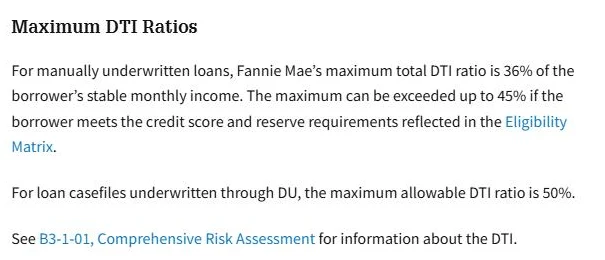
Fannie Mae's Selling Guide sets a 36% DTI for manually underwritten loans, up to 45% with stronger credit and reserves.
How does FHA manual underwriting work?
FHA uses a matrix that ties your maximum ratios to your credit score and compensating factors. The first number is your total housing payment as a share of income; the second is all monthly debts.
| Credit score | Maximum ratios | What you need |
|---|---|---|
| 500 to 579, or no credit score | 31/43 | No higher ratios allowed |
| 580 or higher | 31/43 | No compensating factors needed |
| 580 or higher | 37/47 | One compensating factor |
| 580 or higher | 40/40 | No discretionary debt |
| 580 or higher | 40/50 | Two compensating factors |
Source: HUD Handbook 4000.1 II.A.5.d.viii, unchanged in Update 18. Energy-efficient homes may use stretch ratios of 33/45.
What counts as a compensating factor for FHA?
- Reserves: at least three months of total mortgage payments for a one- or two-unit home, or six months for three or four units
- Minimal increase in housing payment: the new payment is no more than $100 or 5% above your current one, whichever is less, with a 12-month history showing no more than one 30-day late payment
- Significant additional income: overtime, bonus, part-time or seasonal income verified for at least one year that is not counted in qualifying income; it can be used only together with another factor above 37/47
- Residual income: the money left each month after major expenses meets VA's residual income table for your family size and region
- No discretionary debt: your housing payment is the only open account with a balance you do not pay in full each month, with credit lines open at least six months
Compensating factors cannot offset derogatory credit. Our FHA loan guide covers FHA's other requirements.
Can you get a mortgage with no credit score?
Yes, with manual underwriting. FHA lets a lender use a nontraditional mortgage credit report or build your credit history by hand. It needs at least three credit references, including at least one of rent, phone service or a utility, each with 12 months of payment history. If three are not available, the lender can use other recurring payments, such as insurance premiums not taken from your paycheck.
Fannie Mae also allows loans when no borrower has a credit score, sometimes through Desktop Underwriter. When those loans are manually underwritten, the home must be a one-unit primary residence, the loan must be a purchase or limited cash-out refinance at or below the baseline loan limit, and the total debt-to-income ratio cannot exceed 36%. If no borrower can document a housing payment history, 12 months of reserves are required.
FHA is changing how it reads scores, too. Under HUD Mortgagee Letter 2026-11, FHA will accept VantageScore 4.0 and FICO Score 10T alongside Classic FICO for case numbers assigned on or after January 1, 2027, with the same minimum score thresholds.
Our guide to the credit score needed to buy a house compares minimums across loan types.
How do VA and USDA handle manual underwriting?
VA's underwriting standards in 38 CFR 36.4340 set a 41% debt-to-income guideline. A loan above 41% can be approved with a written justification signed by the underwriter's supervisor, and that extra review is not needed when residual income exceeds VA's guideline by at least 20%.
Our guide to VA loan requirements explains residual income and the other VA standards.
For USDA loans, the regulation in 7 CFR 3555.151 sets limits of 29% for housing and 41% for total debt. When a USDA loan is manually underwritten above 29/41, USDA's handbook requires a debt ratio waiver: ratios no higher than 32/44, a 680 or higher credit score for every applicant, and at least one compensating factor, such as three months of payments in savings after closing or two years with your current employer.
USDA loans offer 100% financing in eligible areas; see our guide to USDA loans in Virginia and West Virginia.
Does manual underwriting take longer?
Usually, yes. The underwriter has to verify each item by hand and often asks for more documents, such as 12 months of rent payments, letters of explanation for late payments or large deposits, and additional bank statements. How much longer depends on the lender and how quickly you respond. Our guide to how long mortgage approval takes shows the normal timeline.
Expect requests like these:
- 12 months of canceled rent checks or a rental verification from your landlord
- Letters explaining any late payments, collections or gaps in employment
- Two months or more of bank statements, with any large deposits sourced
- Proof of reserves after closing
- Nontraditional credit references if you have no score
Our mortgage documents checklist lists the standard paperwork to gather first.
Is manual underwriting the same as a non-QM loan?
No. Manual underwriting is a review method within standard programs like FHA, VA, USDA and conventional loans, and a manually underwritten loan still has to meet that program's rules. A non-QM loan uses different guidelines altogether, such as bank statements instead of tax returns. Our guide to what a non-QM loan is explains when that route fits.
How can you improve your chances with manual underwriting?
- Pay down revolving balances to lower your debt-to-income ratio
- Keep at least three months of mortgage payments in savings after closing
- Choose a payment close to your current rent if you can
- Gather 12 months of rent records and any explanation letters early
- Avoid new credit, large undocumented deposits and job changes until closing
- Ask your loan officer which compensating factors you already have

Get a Mortgage Estimate for Free
Find out whether your file would go through automated or manual underwriting and what you can afford.
✓Free, no obligation✓Licensed in VA, MD, DC and WV✓Loan officer Ken Byrne, NMLS #187129
Frequently asked questions
What is manual underwriting?
A loan review done by a human underwriter under the program's manual guidelines, used when an automated underwriting system does not approve the file or cannot score it.
Is manual underwriting a bad sign?
No. It means your file needs a closer look. Many borrowers are approved this way, though the limits are tighter and more documents are needed.
What is the maximum DTI for manual underwriting?
FHA allows 31/43, up to 40/50 with two compensating factors. Fannie Mae allows 36%, up to 45% with strong credit and reserves. VA uses a 41% guideline.
Can you manually underwrite a conventional loan?
Yes. Fannie Mae allows lenders to manually underwrite a Refer with Caution loan, and Freddie Mac requires manual underwriting for Caution loans to be eligible.
Can you get an FHA loan with no credit score?
Yes, with manual underwriting and nontraditional credit, such as 12 months of rent, phone or utility payments. Ratios are capped at 31/43.
What are compensating factors?
Strengths that offset higher ratios, such as three months of reserves, a small payment increase, extra verified income or strong residual income.
How long does manual underwriting take?
Usually longer than an automated approval because more documents are verified by hand. Responding quickly to requests helps.
Do all lenders do manual underwriting?
No. Some lenders only approve loans with an automated approval, so ask before you apply.
This article is general information, not financial advice and not a commitment to lend or an offer of credit. Manual underwriting rules come from HUD, Fannie Mae, Freddie Mac, VA and USDA and were reviewed on October 27, 2026, including HUD Handbook 4000.1 Update 18 and Mortgagee Letter 2026-11. Lenders may set stricter requirements than the programs, and not every lender manually underwrites every loan type.
Categories
Recent Posts









GET MORE INFORMATION

Broker Associate